Philadelphia has become known as the “poorest big city” in the nation, a leader in gun violence, a city contending simultaneously with food apartheid [1]Gripper, A. B., Nethery, R., Cowger, T. L., White, M., Kawachi, I., & Adamkiewicz, G. (2022). Community solutions to food apartheid: a spatial analysis of community food-growing spaces and … Continue reading and widespread housing insecurity, at the same time as real estate development is in a pitched battle against the city’s long history of urban agriculture [2]Stanko, H., & Naylor, L. (2018). Facilitating (?) urban agriculture in Philadelphia: sustainability narratives in the inequitable city. Local Environment, 23(4), 468-484 as a means of community self-determination [3]Gripper, A. B. (2023). Practices of Care and Relationship-Building: A Qualitative Analysis of Urban Agriculture’s Impacts on Black People’s Agency and Wellbeing in Philadelphia. International … Continue reading. Above all, Philadelphia is a city straddling massive divides of income inequality and disparate qualities of life, across lines of race, class, and citizenship.
As the climate crisis continues to make the city hotter and wetter [4]Malter, S., Rockwell, J., & Maimone, M. (2017). Climate change and precipitation: Applying global climate model projections to local precipitation time series data in Philadelphia. In World … Continue reading[5]Weber, S., Sadoff, N., Zell, E., & de Sherbinin, A. (2015). Policy-relevant indicators for mapping the vulnerability of urban populations to extreme heat events: A case study of Philadelphia. … Continue reading, straining both its aging infrastructure [6]Kessler, R. (2011). Stormwater strategies: cities prepare aging infrastructure for climate change. Environmental Health Perspectives and residents’ bottom line due to increased rent, utility, and maintenance costs [7]Kenner, A., Skula, A., Mankikar, D., Zimmermann, I., Nobles, E., Menzo, J., … & Zerbo, R. (2020). The Climate-Ready Home: Teaching Climate Change in the Context of Asthma Management. … Continue reading, persisting struggles will only be exacerbated. To say Philadelphia is in crisis understates the point, because the very word crisis implies a moment, a turning or tipping point, rather than the long continuity of disinvestment, racist policy and practices that undergird the city’s seemingly intractable woes [8]Hoffman, J. S., Shandas, V., & Pendleton, N. (2020). The effects of historical housing policies on resident exposure to intra-urban heat: a study of 108 US urban areas. Climate, 8(1), 12.; [9]Schinasi, L. H., Kanungo, C., Christman, Z., Barber, S., Tabb, L., & Headen, I. (2022). Associations between historical redlining and present-day heat vulnerability housing and land cover … Continue reading; [10]Jackson, K. L. (2022). Urban Agriculture and Critical Environmental Justice: A Case Study of Gardens and Growers in Philadelphia and Camden (Doctoral dissertation, Rutgers, The State University of … Continue reading. Yet it is also an overstatement, because it is not “Philadelphia” as a whole that suffers — indeed, some quarters are doing quite well — but rather the same neighborhoods time and again which bear the brunt of social, economic, and ecological degradation. There is a clear correlation and continuity between historic disinvestment via redlining and a wide variety of disparities in health and quality of life [11]Wilson, B. (2020). Urban heat management and the legacy of redlining. Journal of the American Planning Association, 86(4), 443-457., from the condition and availability of housing in Eastwick, and the higher risk of flooding [12]Cahn, A. L. (2014). On retiring blight as policy and making Eastwick whole. Harv. CR-CLL Rev., 49, 449., to higher rates of asthma or heat stroke hospitalization in North Philadelphia, to the extremes of the heat island effect (Figure 1), with temperature differentials between neighborhoods as high as 22 degrees [13]Shokry, G. (2021). Competing riskscapes of climate change, gentrification and adaptation in Philadelphia’s Hunting Park neighborhood. In The Green City and Social Injustice (pp. 225-238). … Continue reading.
All of that is the bad news. The good news is that there are many strategies coursing through the ideosphere which offer Philadelphia a real chance to get its head above water — literally and figuratively speaking. Any serious strategy would have to take a holistic approach, addressing both the immediate social and material needs of overburdened communities, as well as provide a pathway to long term economic and ecological sustainability: building the collective capacity to thrive into the indeterminate future. One such strategy is the Resilience Hub, a singular facility situated at the nexus of climate mitigation, adaptation, and equity to enhance and improve community sustainability [14]Baja, K. (2018). Resilience hubs: Shifting power to communities and increasing community capacity. Urban Sustainability Directors Network, which has the capacity to channel “existing community action and resources towards building resolve and strength in the face of climate injustice” [15]Muir, M., George, A., Oesterle, M., & Pew, J. (2022). Detroit Resilience Hub Framework: Best Practices for the Implementation of Resilience Hubs in Detroit, Michigan.

Resilience Hubs as Philadelphia-Specific Strategy
Resilience Hubs are trusted and well-used infrastructure, such as community centers, churches, recreation centers, parks, which build and enhance their capacities to meet community needs on a daily basis, and in preparation for significant disruptions and recovery from long-term crises [16]Baja, K., McKinstry-Wu, S., Oxnam, G., & Fitzgerald, G. (2019). Guide to Developing Resilience Hubs. Urban Sustainability Directors Network.. The specific offerings of resilience hubs are contextual, geographically specific, and when done well, designed at the direction of the community itself. Yet there are certain features which are broadly consistent across diverse implementations of the model throughout the country:
- Programs and Services — providing culture, community, and connection for residents; these are usually in place before the site’s evolution into a hub, and what makes them a trusted resource; optimal hub planning enhances and expands these features.
- Energy — the ability to provide heating, cooling, electricity year-round, often utilizing a “Hybrid Resilience System (HyRS)”, or solar plus a storage system that can provide energy for at least a few days during grid failures.
- Water — On site water collection, sourcing, and storage, from the municipal system, local catchment, and/or advance purchase.
- Food — Local production, preparation, distribution, and storage, in the form of community gardens, dry storage, community kitchens, and/or food box pickup and delivery
- Communications — Free Wi-Fi, telephone service, ham radio, and/or walkie talkies, as a means of receiving and distributing valuable information to and between members of the community, directing them toward resources or sharing safety measures and protocols.
Philadelphia’s enduring problems — stressors impacting people’s everyday ability to thrive — only stand to get worse in the face of looming shocks, “major disruptions…that can disrupt a variety of critical systems.”[17]Baja, K. (2018). Resilience hubs: Shifting power to communities and increasing community capacity. Urban Sustainability Directors Network. The COVID-19 pandemic offered Philadelphia a preview of how shocks and stressors can be mutually reinforcing, casting racial and economic disparities in sharp relief, and exposing historical and structural continuities, driven by the primacy of capital accumulation, and the doctrine of “economic growth”. The lackluster and inconsistent government response to the pandemic also revealed a critical inflection point, the approach of a “choose your own adventure” scenario as the burgeoning climate crisis presents a mandate for building resilience.
When Philadelphia’s public schools closed to reduce COVID-19 transmission rates, unquestionably saving many lives in the process, it also had a devastating cascading effect, for the fact that schools operate at the nexus of multiple community needs. For Black, Brown, and low-income families, who make up the vast majority of the public school population, school closings meant a loss of free “childcare”, and reasonably safe places for young people to be while parents were working, a loss of access to social services, and potentially the loss of two daily meals, with most schools offering students both breakfast and lunch.
Families struggling with unemployment, underemployment, or loss of employment due to the pandemic, for whom the free meals were a necessity, suddenly had to scramble to fill the gaps created by school closures [18]Kinsey, E. W., Hecht, A. A., Dunn, C. G., Levi, R., Read, M. A., Smith, C., … & Hager, E. R. (2020). School closures during COVID-19: opportunities for innovation in meal service. American … Continue reading. Parents who were able to continue working, whether because their jobs were deemed “essential”, or because they were able to transition to working from home, also endured unanticipated financial hardships, both around childcare and daily sustenance. As the city and various nonprofit partners worked to set up meal sites to provide young people with the meals they were no longer able to receive at school, the communications and logistics were haphazard at best, and left many families in the lurch for about two weeks. The social and emotional impacts of these cascading impacts are easy to surmise, and remain the subject of ongoing research [19]Bhamani, S., Makhdoom, A. Z., Bharuchi, V., Ali, N., Kaleem, S., & Ahmed, D. (2020). Home learning in times of COVID: Experiences of parents. Journal of education and educational development, … Continue reading[20]Uzun, H., Karaca, N. H., & Metin, Ş. (2021). Assessment of parent-child relationship in Covid-19 pandemic. Children and Youth Services Review, 120, 105748..
While the pandemic itself did not discriminate, existing structural inequalities concentrated its impacts in the neighborhoods and communities already overburdened by intersecting and overlapping social, ecological, and health struggles [21]Anaele, B. I., Doran, C., & McIntire, R. (2021). Visualizing COVID-19 mortality rates and African-American populations in the USA and Pennsylvania. Journal of racial and ethnic health … Continue reading[22]Poteat, T., Millett, G. A., Nelson, L. E., & Beyrer, C. (2020). Understanding COVID-19 Risks and Vulnerabilities Among Black Communities in America: The Lethal Force of Syndemics. Annals of … Continue reading. These are communities which need not just relief, but a clear pathway to a thriving future now, in the face of surging violence, displacement, high morbidity for chronic illness, piling trash and epidemic dumping, drug addiction, food and housing insecurity. These are the same communities, by every metric and in every projection, that will be most devastated and resource-starved by the climate crisis. While resilience hubs cannot solve all of these problems in one fell swoop, the model embodies the required logic for building holistic community resilience, rather than relying on isolated one-off solutions.
Lessons from Detroit
Case studies in Detroit offer particular insight into the value of resilience hubs for Philadelphia, due to the marked commonalities between the three cities in terms of demographics, topographies, histories of divestment, racist policies, and the projected impacts of climate change. Detroit, like Philadelphia, has already seen more frequent flooding, “major precipitation changes, unseasonal temperature variation, extreme heat, and extreme cold”. It has also seen more days with temperatures above 90 degrees, which intensifies the heat island effect, and can “contribute to heat-related illness and death, exacerbate asthma, and increase the total number of people with asthma and other respiratory illnesses stemming from air quality.”[23]Muir, M., George, A., Oesterle, M., & Pew, J. (2022). Detroit Resilience Hub Framework: Best Practices for the Implementation of Resilience Hubs in Detroit, Michigan
In yet another similarity, Detroit uses a combined sewer system, which during flood events causes sewage and industrial waste to empty into the river, the same river from which much of the city sources its drinking water, occurrences known as combined sewer overflows (CSO). The recent chemical spill into the Delaware caused widespread alarm [24]Sharber, C., & Lamb, A. (2023, March 26). Officials warn of possible advisory Tuesday, encourage residents to begin storing tap water. WHYY., and yet the regular occurrence of waste water entering the river — made more frequent by climate change — barely registers in the public consciousness. This is due in part to the fact that the CSO is a known quantity, with the city confident in its ability to clean the water before it is distributed to homes and businesses, and for that not making a point of sending out emergency alerts and holding press conferences.
Then there’s the Jefferson Chalmers neighborhood of Detroit, which “experienced severe flooding in 2014, 2016, and 2021 and 96% of properties in the neighborhood are at an extreme risk of flooding in the future”, which evokes the troubles of the Eastwick neighborhood in Southwest Philadelphia, in which over 70% of homes and business are at major risk of flooding. For the people of Detroit, who also have a high level of distrust in their government, and are therefore uninterested in utilizing existing community shelters in the event of an emergency, resilience hubs have enabled them an alternative resource, one “deliberately designed to overcome this mistrust, [by] placing control in the hands of community leaders.”[25]Muir, M., George, A., Oesterle, M., & Pew, J. (2022). Detroit Resilience Hub Framework: Best Practices for the Implementation of Resilience Hubs in Detroit, Michigan
In one example, a church was set up stormwater catchment to support a tree nursery and vegetable garden, as well as solar + battery storage to provide clean energy everyday and boost resilience during power outages. In addition to local resilience, such hubs reduce the strain on city emergency response services, as hubs are ideally designed for “self-governance, agency, and autonomy”[26]Muir, M., George, A., Oesterle, M., & Pew, J. (2022). Detroit Resilience Hub Framework: Best Practices for the Implementation of Resilience Hubs in Detroit, Michigan.
A Hypothetical Happy Hollow Hub
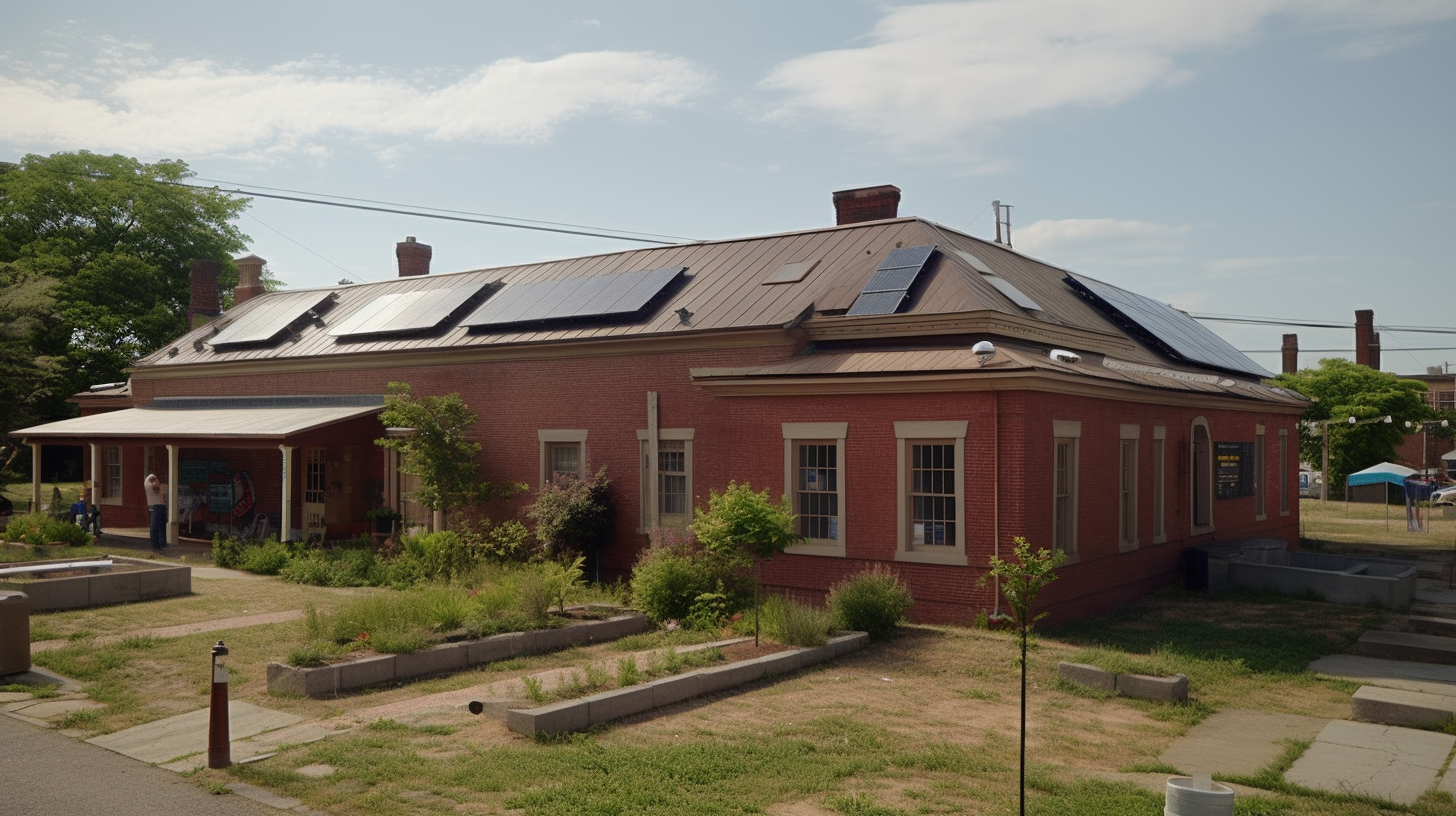
Happy Hollow Recreation Center in the Germantown section of Philadelphia, is the city’s oldest recreation center, first opened in 1911. It has a playground, two basketball courts, two tennis courts in disrepair, and 2 acres of open land. As a community fixture, Happy Hollow offers a wide variety of community services, including sports, gardening, cooking, and computer classes. It has also gained some repute over the years for producing a series of NBA-caliber basketball players through its coaching programs.[27]Dent, M. (2017, July 7). From Happy Hollow to the NBA: Philly’s oldest rec center is a basketball hotbed. Billy Penn at WHYY. In spite of this history, it has experienced turns of repair and neglect. Most recently it has been slated for renovations as a Parks and Recreation capital project, and was allotted funding through the city’s Rebuild program to finalize those updates. The city website is vague on the details of the renovation, and the project is in the “Pending” phase — a designation which is equally unclear.

As a beloved community center, Happy Hollow is a prime candidate for transformation into a resilience hub. For improving residents’ everyday quality of life, the rooftop real estate is enough to host some solar + storage infrastructure, the installation of which offers both employment and educational opportunities for the community. The surrounding land could be allocated to any number of fundamental community needs, such as an urban farm and/or food forest, complete with beehives and chickens — to provide fresh, local food, and to further enhance existing gardening classes. Programs could be expanded to include training to help residents build resilience, such as counseling on how to access state and federal funding such as the Inflation Reduction Act (IRA) or Whole Home Repairs Act (WHRA) to renovate and retrofit their homes. Taking cues from nearby Mt. Airy Learning Tree, community members could participate in regular skillshares, in those faculties which enhance quality of life today and help people prepare for future stressors and shocks.
Stormwater management infrastructure — permeable pavers, rain gardens, etc — in addition to a rain catchment, purification, and storage system, could encourage residents to implement similar solutions in their own homes through the city’s woefully under-utilized Rain Check program. As residents come to understand the value of local air monitoring, additional sensors might proliferate throughout the city, and encourage officials to be more granular in their approach to air quality — addressing disparities in vulnerable neighborhoods.

These improvements to residents’ everyday quality of life, building upon the benefits Happy Hollow already offers, would have a wide impact. Increasing young people’s access to recreation is often cited as an antidote to violence, which has become a critical issue in the city. By implementing a resilience hub model, expanding the site’s green space, improving community nutrition, and simply creating more opportunities for neighbors to build relationships with each other, would have a compound effect on reducing violence.
In times of disruption, people might come to Happy Hollow for first aid, temporary shelter, or emergency food and water provisioning. Although Germantown is not one of the more vulnerable neighborhoods with respect to the heat island effect, Wayne Avenue, on which the center is located, is a commercial thoroughfare with very little tree canopy, and on a particularly hot day, Happy Hollow might offer cooling stations — of particular value for elders and young children. On poor air quality days, the center could provide some reprieve for residents with asthma or other respiratory challenges. The recent scare around the chemical spill in the Delaware also presents a perfect use-case, as a Happy Hollow resilience hub could’ve provided clean drinking water sourced from rain catchment or purified through relatively low-cost on-site infrastructure such as Lifestraw technology, and forestalled the run on local stores for bottled water.

Finally, a Happy Hollow hub, where it regularly provides programs, services, and resources that improve quality of life and help residents build resilience, would also be well-positioned during recovery from a devastating or enduring shock. An on-site tool library could help residents repair damaged homes, with help from a Citizen Repair Corps, trained in carpentry or electrical at Happy Hollow through the community skillshare. And because Happy Hollow is a trusted community location, it would be well-suited to coordinate disaster response with other agencies, and to provide a gathering space during recovery planning.
Funding
Happy Hollow has been named as a site to receive renovations through the city’s Rebuild program. Instead of merely restoring the existing facilities, additional funding from Rebuild, coupled with additional resources from the federal government, such as the IRA, could go a long way toward reimagining the recreation center as a resilience hub. More funding still might be secured from the William Penn Foundation, which has placed sustainability initiatives at the top of its list of targeted projects [28]William Penn Foundation (2023). What We Fund., or from long overdue PILOTs — payments in lieu of taxes [29]Leland, P. (2005). Payments-in-lieu-of-taxes: A revenue-generating strategy for central cities. Revitalizing the city, 201-225. — extracted from universities and corporations.
Community Engagement
Philadelphia has a poor reputation for community engagement, for while the city ostensibly asks for resident feedback in many fora — testimony at City Council, public comment at various commission meetings, and various community design processes — less transparent, or even evident, is how this feedback gets incorporated into the implementation of the city’s plans [30]Hargrave, L. (2022, August 29). The process of Washington Avenue’s redesign falls short of democracy and fairness. Grid Magazine.. One of the seven stages of development in the Rebuild program is “Public Engagement and Design”, aligning with the process of creating a resilience hub, which must be driven by community input in order for it to be effective.[31]Baja, K. (2018). Resilience hubs: Shifting power to communities and increasing community capacity. Urban Sustainability Directors Network. People don’t use services they don’t need or want, and so it would be crucial to “rebuild” Happy Hollow at the community’s direction.
There is even precedent in the city for a participatory budgeting process [32]Murphy, D. (2020, December 3). How would you spend $1M in city cash? Philly wants residents to shape next budget. WHYY., which allowed residents to weigh in on how to allocate funding for community facilities and public infrastructure. Missing from this process, however, were regular cycles of feedback and reflection and a clear articulation of how community input translated into how money was ultimately spent.
A truly participatory process would recognize that valuable knowledge can be actively produced by the community. This recognition would need to be made explicit at every stage of the process, from the collection of data, to the analysis and application. A more authentic and robust engagement process could increase the existing social capital of Happy Hollow, and strengthen its stature within the community as a trusted resource.
Conclusion and Additional Policy Implications
The creation of resilience hubs in Philadelphia would not only do a great deal in meeting the city’s sustainability targets, it would foster short and long-term quality of life enhancements for local residents, and prepare us for inevitable stressors and shocks during the long march through the climate crisis.
A hub at Happy Hollow could act as a pilot for implementing the model citywide, which, aside from its many clear benefits to community and environmental health and well-being, could also kickstart broader policy conversations. For example, where a hub makes the advantages of solar energy more widely understood, it may cultivate enough political will at the local and state level to push for the legalization of community solar in Pennsylvania [33]Glabicki, Q. (2022, September 20). PA needs new solar energy laws. Here are where the bills stand. PublicSource., itself a strategy for building resilience through lower energy costs [34]Corby, E., & O, K. (2023, April 19). Community solar can propel Pa. Toward an equitable clean energy future. Pennsylvania Capital-Star.[35]Chan, G., Evans, I., Grimley, M., Ihde, B., & Mazumder, P. (2017). Design choices and equity implications of community shared solar. The Electricity Journal, 30(9), 37-41. and creating infrastructure redundancies in case of grid failure.[36]Deng, S., Hansen, A. V., Hiltbrand, G., Maddex, S., & Sinclair Lecaros, S. (2019). Evaluating Viability of Community Solar Microgrids for Resilience in Puerto Rico.[37]French, C., Van Kirk, J., & Messick, A. (2022). Solar Microgrid Implementation in Prince George’s County, Maryland. Partnership for Action Learning in Sustainability (PALS)
Finally, through the resilience hub co-development process, the city could set a new standard for community engagement, and where the process translates into direct, material, quality of life enhancements for residents, it could do much to reverse long histories of justified distrust toward city officials [38]Atherton, T. L. (2017). Mitigating distrust: Trauma and redevelopment in Eastwick, Philadelphia. University of Delaware..