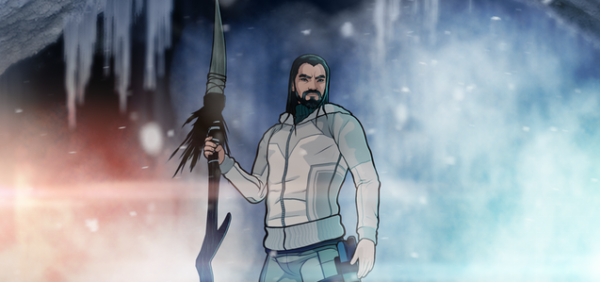
Fear Effect is coming back. Have you heard? After the heartbreak of Inferno’s cancellation, and a 15 year wait with no new game in sight, French indie studio Sushee Games is creating Fear Effect: Sedna. To say that I “literally screamed”, might actually be literal. I mean, look. There has been a 15 year vacuum that no other game has been able to fill. For fans of Fear Effect, this is huge news, so I can only hope that Sushee is successful, and that they are able to be true to the spirit of the franchise.
Check out the video below, and support their Kickstarter campaign here.
As I followed the campaign, being who I am, I couldn’t help but notice some things. 15 years ago, when Retro Helix was released, I had no awareness of cultural appropriation, and probably even a knee-jerk resistance to any discussion of the matter. Now, with the game industry’s slow realization that representation matters, reflecting an even longer-time-in-coming realization by mass media in general, creators are being held accountable for how they “borrow” — let’s go ahead and say appropriate — cultures not their own.
What I noticed with Fear Effect: Sedna, was their proposed use of Inuit culture and a native character. Alarm bells went off in my head, first about my impression that the character, Iluak, pretty much looks like a white man as currently designed.

So I tweeted to Sushee Games about it.
Iluak has very European features. In jeans/t-shirt he’d be white. Please tell me he’s not the “more relatable” “half-Native”. @FearEffect
— Kermit O (@KermitO) April 16, 2016
I was delighted that Sushee bothered to respond, as this is something they could’ve easily shrugged off, with me being a nobody on Twitter, and representing a small and easily recoverable amount towards their Kickstarter goal.
@KermitO He has changed yet from the concept till the artwork, especially for this reason. We keep an eye on this, and for others too!
— Fear Effect (@FearEffect) April 16, 2016
As I continued thinking about cultural appropriation, I decided to contact Sushee Games again, with more in-depth concerns about how they would handle the use of Inuit aesthetic, cultural stories and history. I sent them a message through Kickstarter, which I’m publishing here as an open letter, so that as the game’s production moves forward, it can be known that at least one person brought this issue to their attention.
This is part of the reason I love Kickstarter, as a platform, and as a new standard for interactions between creators and consumers. Will my message make a difference? Maybe. Which is more than I could say for my impact on the production of a mainstream title produced by a major company. I will continue to update the post if and as Sushee Games responds to my letter.
Hello,
I recently tweeted my concern about Iluak’s “European” look and was pleased that your team responded. I just wanted to follow up a little and share some thoughts on the troubled waters Sushee is wandering into. I hope you’ll take the time to consider it.
The big issue at stake here, featuring the likenesses, history, and or lore of Inuit people is cultural appropriation. By the way, you do know that “Inuit” is a broad term encompassing several culturally distinct groups? The appropriation issue is especially contentious when dealing with culture of indigenous or other historically oppressed people.
This is not a matter of “political correctness” but has very serious implications (possibly legal) and consequences for indigenous people. When cultures are in danger of disappearing, appropriated representations can accelerate that erasure by displacing native sources. Outsiders should never be the primary source for any culture.
I think it is really worth your team’s time to read these articles (and the works cited in them) as you proceed:
Appropriate Cultural Appropriation
http://irosf.com/q/zine/article/10087
Primer on Cultural Appropriation
http://jezebel.com/5959698/a-much-needed-primer-on-cultural-appropriation
With respect to Nisi Shawl’s article, you should look at the game “Never Alone” (Kisima Inŋitchuŋa) as an example of how creators can be “Guests”. They work with an indigenous population that I believe fit under the Inuit umbrella.
Be aware that this issue rightfully keeps emerging as creators recklessly use others’ culture, a recent backlash involving JK Rowling and Native Americans. Read about that here, and please Google “JK Rowling Cultural Appropriation” for more:
“Magic in North America”: The Harry Potter franchise veers too close to home
http://nativeappropriations.com/2016/03/magic-in-north-america-the-harry-potter-franchise-veers-too-close-to-home.html
Also please be aware that different cultures have different rules about when and where and by whom their culture can be used. It is vital that you consult with an authority of the culture you’re borrowing.
This has come up for me personally in writing an Indigenous Australian character for my novel, and in doing my research I came across these resources. Although they deal with Indigenous Australians, I think similar considerations apply to borrowing culture in general:
More than Words: Writing, Indigenous Culture & Copyright in Australia
http://www.terrijanke.com.au/#!more-than-words/j3yth
Pathways and Protocols: A Filmmaker’s Guide
http://www.terrijanke.com.au/#!pathyways-protocols/ig3b6
FE: Sedna is not a film, but again, it’s a place to start.
I write all this to you not to tell you how to make your game, but because I love the Fear Effect franchise and at the same time care deeply about this issue. I don’t want to see the campaign mired in controversy, and I also really want to see indigenous culture and people represented in a way that honors them and preserves their dignity and culture.
One more note, and I’ll leave you alone. It also occurs to me that Iluak is a secondary (non-playable) character. Fear Effect as a franchise already over-represents white/European people, as all of the main characters are white (yes, I know Hana is “half-Asian, but aesthetically, culturally, and even given her voice actor, she might as well be white).
It’s been 15 years since the last Fear Effect game, and a lot has changed in the gaming and media climate in general. It seems to me a lost opportunity not to upgrade the franchise in a way that reflect’s the game industry’s (and consumer base’s) dawning recognition that the vast majority of the world’s people are not white.
Is there any reason why Iluak can’t be a playable character? And also, France has a multitude of different ethnicities (in spite of the government’s ridiculous official policy that race doesn’t exist), so is there anything about Axel that necessitates that he be a white Frenchman?
These are the thoughts of one measly backer, but I feel like Kickstarter as a platform allows for a new level of communication and collaboration between creators and their audience. So I hope you’ll consider my words here as you move forward.
Thank you,
Kermit O
We actually saw your open letter before this message ^^
It’s quite a long (and interesting) question/post, so we’ll take some time to answer it the best as we can. One thing you should know before we start: we are at a very early stage of the development, and the script isn’t finished at all. It’s actually time to think about these questions.
First of all, we are well aware of cultural appropriation. It is a complicated matter, and our first intention was to bring some spotlight to a less known culture that we discovered late ourselves, and which is incredibly rich; and not to use it for dramatic purpose. What is done today with egyptian mythology in some Hollywood movies for example, where all the protagonists have been westernized and the myths just used for the sake of exotic mystery, doesn’t please us at all – we really want to avoid that kind of cheap usage of the Inuit myths and legends. But we don’t want to avoid speaking about a particular country in the world just because no one in the team originates from it (or everything would have happened in Brittany – which is a very nice place, but not really the kind you come across in a dark cyberpunk horror story).
Iluak, in our story (without saying too much) is part of Glas’ past. He originates from Nuuk, but lived in the USA for more than 20 years. As we said earlier on Twitter, his design evolved from the early concepts to the current 3D model. We are happy with his design for now: his aura, his noble and proud stature serve the story perfectly, and he does look like some of the Greenland inhabitants we came across during our research. In a cel-shaded way, of course.
Also, we never said he would not be playable. In fact, he is really central to the story, and not at all a secondary character.
One last thing about Inuits: for now we are doing a lot of research on their story, to begin with; their lifestyle, their art, their music, their ceremonies and celebrations, and the way they live their spirituality. This is all very good, but we all know that academic knowledge alone won’t do justice to their culture. So we are now searching for consultants and advisors who could guide us on the right way.
Obviously, we’re now focused on the Kickstarter campaign, so we didn’t dig too much here, but yes for sure, this is our plan.
As for Axel, he is exactly the cute-looking over-confident young white man we wanted him to be – and that will serve the story as well!
There are no good nor villains in Fear Effect (I mean, look at Deke!). So in case you were afraid of that: Iluak won’t be a bad guy. He will do bad things for good reasons, as well as good things for bad reasons, because this is all what Fear Effect is about. To quote John Zuur Platten (writer of Fear Effect 1): “morally ambiguous people ending up doing heroic things”.
We hope this will answer your concerns, and we will keep working hard to create the best experience and story we can provide.
Please don’t hesitate to share you thoughts & ask any question you want, we will be happy to discuss with you!
Friendly yours,
Sushee.
Thank you for responding, and promptly at that.
I am glad that you are familiar with the cultural appropriation and have already considered steps to handle the matter carefully. That does a lot to ease my mind.
Still, as there is always more we can learn about any issue, I encourage you still check out the resources I mentioned in my earlier message. You may find they address the issue in ways that you haven’t considered.
Also, please note that I was very intentional about not using the words “myths” or “legends”. The reason for that is that some cultures, especially indigenous cultures, can be reduced simply to their “myths and legends”, when in fact these cultures regard these particular elements of their culture as neither. See the issue of Rowling and her use of “skin walkers” as an example.
Native cultures are often mysticized, treated as something ancient or obscure, in some space “other” than the reality the rest of us inhabit, rather than living and breathing and existing in a continuity with the present. This, too, is a kind of erasure. So another question I would ask would be whether or not the game deals with the realities, including the struggles, of *Inuit people (again, recognizing that term as too broad) TODAY, in the time and place in which it is set? Or do ancient “myths and legends” extend from some dark and mystical past to impact the present? This would be the sort of “dramatic purpose” you mentioned in your response as one to avoid.
As I am not in any way culturally connected to Inuit people, nor have I been nominated by anyone to speak on their behalf, I don’t feel I am the one to continue this discussion. I am glad your team has given it some thought, and I hope you’ll share your thinking and how it factors into your production process publicly and transparently as you move forward (like in your project updates). I think this could encourage those who are impacted by your use of their culture to share their own concerns and help shape the final product.
Thank you again for your response, and I look forward to hearing more as development continues.
Kermit
First of all, let’s be clear : Fear Effect being what it is, mythical creatures and old traditional magic is part of what makes the game unique, along with the fact that it often collides with a futuristic/technologic reality. So we will of course be inspired by Inuit myths to build our world.
From what we read about J.K Rowling’s debate over Skin Crawlers (we hadn’t heard about it before), the fact that she didn’t link the myths to actual people is the problematic part. Also, it seems that she pictured them the wrong way. This will not happen in our game.
When you write a story, you have to fictionalize a lot of things (otherwise you would be creating a documentary). This is where we will have to be careful – but depicting legends in a dramatic way is part of the process, especially with a game like Fear Effect. Building a whole legendary/mystical realm coming out of nowhere is not our intention though. Even if we are not from Greenland ourselves, the myths we talk about will be brought and told by local inhabitants. The mix between a realistic (though futuristic) setting and the legends is one of Fear Effect’s core ingredients.
There are examples of games that made very clever choices while choosing to talk about foreign cultures. In The Secret World, for example, the depiction of Transylvania could have been what we all imagine in the first place: huge pine forests and gothic castles with bats under the moonlight. But they remembered that Transylvania is actually part of Romania, and they chose to show the rural part of that country, in a way that makes you feel they have actually been there to see how they lived and how they would tell their own stories. Same goes for Egypt and the native americans, in the same game.
Of course it’s not perfect, you can still come across the eternal “old fortune teller in her colorful caravan” cliché, but at least it shows a lot of respect for the people. This is what we’re aiming at (minus the cliché, that is).
I know it’s all but words, but we too think these matters are important.
Thanks again for your interest in the game we’re making!
Thibaut & the Sushee team
