One of the reasons I post on this blog ao infreqently is that my standards for my own writing are so restrictive as to be paralyzing. So many would-be posts bubble up, only to fail to fully materialize, or the window of their relevance closes before they can. If I could give myself permission to just write without worrying about how tightly composed it is, this might actually become a blog rather than an archive of occasional articles.
So I’m trying something new starting today. A new kind of post (for me) where I’ll basically just vomit up whatever’s really pressing against my consciousness: crazy observations, responses to political garbage, philosophical meanderings, down whatever trail the Hunter leads…
Liz Cheney, Trump, and Liberal Alarmism
This is one of those things I’m talking about after the moment has passed, especially post-election, but I gotta get it out. Democrats and liberal media were up in arms over Trump’s supposedly violent statements toward Liz Cheney, in which he said her usual warhawk orientation would be different if the guns (presumably those of enemy soldiers) were pointed at her.
She is a radical war hawk. Let’s put her with a rifle standing there with nine barrels shooting at her, OK? Let’s see how she feels about it. You know, when the guns are trained on her face.
The context was Cheney’s penchant for supporting U.S. wars abroad, like her father before her. And context aside, these words in themselves do not constitute a threat. The guns in question are not held by Trump himself or any of his proxies. There is no plan here, no order, nothing. It is hypothetical because of course Liz Cheney would never see a battlefield, hyperbolic, and in total disregard for the establishment’s rules of decorum, as is Trump’s well-worn style.
Listen. I’m old enough to remember — it was only 16 years ago! — when George W. Bush and his ilk were public enemies for the liberal establishment. That he’s somehow managed to launder that image and retire as some more reasonable elder statesman who paints mediocre pictures in his spare time does not change the fact he — and main man Dick — are responsible for hundreds of thousands of deaths from a war waged under false pretenses. Or their responsibility for the economic crash of 2008 and the annihilation of generations of Black wealth. It was popular back then to cast Bush as a moron, and so the thinking was that it was Cheney and Powell and Rumsfeld and Wolfowitz and Rove and whoever else pulling his strings.
As far as Liz goes, the apple doesn’t fall far, and somehow, we’re supposed to forget her family’s war profiteering legacy because she stands guard at the Right Gate to defend the establishment, which apparently has grown so big (coalition is the word they use) that Bernie Sanders guards the Left Gate? And pundits are still confused as to why an antiestablishment firestarter like Trump resonated with so many?
About Those Slavery Texts
When I first read the story about these racist mass texts telling Black people all over the country to report to the nearest plantation…can I be real with y’all for a minute?
I cracked up laughing. I’m laughing now.
There were a few reasons for this. First was that this was so obviously a trolling of epic proportions that no serious person could actually think… Well, more on that in a minute.
Second, I’m sure whatever clever little roach thought this up is sitting somewhere all smug and self-satisfied at the outrage. He or they won the minute this became a national story. And I’m not gonna give him the satisfaction.
Third, it was so asinine that it triggered some juvenile funny bone, and I just couldn’t help myself.
Also funny, but in the sobering sense that black and white people functionally live on separate planets, is this bit from a CNN article:
Attorneys general in Washington, DC, Virginia, New Jersey, Illinois and Maryland have condemned the messages and urged those who feel under threat to contact law enforcement.
Bruh. What? Do otherwise (presumably) intelligent people shit their brains out when it comes to the police? Absent a recent protest about another execution of a Black person by a cop, or forgetting the mass mobilizations of 4 years ago, or forgetting or perhaps somehow never knowing what even the National Law Enforcement Museum admits on their website, that the origin of the modern US police is in the practice of slave catching? In what bizarro world would a Black person in the United States of America, fearing being forced into slavery, turn to the very institution which enforced it and has since presided over a regime of Black oppression and murder for generations? What the fuck are these people even saying?
But here’s the thing that all the coverage of this story seems to miss, which is far more ominous and far more important. This person or people, with presumably far fewer resources than the Trump campaign (if we take them at their word they they weren’t involved), were able to send targeted communications to a large number of people, knowing their names and racial identities.
The real story here is about data. Who has access to it and what they can do with it. I suspect this was an exploitation of the same infrastructure that brought us all the election campaign texts. At some point I gave the wrong person or entity my name and phone number, and that, paired with my recent history of holding my nose while voting for Democrats, opened me up to the most aggressive, relentless, spammy text assault I’ve ever experienced. Just how many people have my information? And whose job is to identify and protect my data from bad actors?
I can imagine a scenario in which some unsuspecting Black voters, participating in some phone survey or exit poll, had their name, race, and contact info logged in some database somewhere, for political spam purposes, and then that database — likely with less security than the many large companies experiencing data breaches of late — was somehow compromised and the Clever Roach found their opportunity to troll a bunch of Black people, the FBI, the media, the NAACP, and everyone else up in arms about this dumb shit. The timing is likely not a coincidence.
And the Kids Are Not Alright
That all said, the most damage done — as much by those continuing to give the story air as the original troll — seems to have been to young people, who through a combination of social media virality (and the related capitalization on outrage and fear) their own lack of digital literacy, and what seems to be a deep sense of fatalism and powerlessness, came to believe that the reinstitution of slavery — without a country-collapsing war — is even a possibility.
What it also signifies is a failure of public education, our mass media, and popular culture, at least insofar as it applies to adequate representations of history. From To Kill a Mockingbird, to 12 Years a Slave, many of us, and perhaps young people especially, have internalized this false narrative in which millions of Black people were brutally enslaved and mostly accepted their plight without resistance. Disarmed with this version of history, one might reasonably assume that were it not for the infinite good will and impeccable morality of the white people in the northern states, that we would’ve been enslaved for another fifty years. That we, today, by a shift in our good fortunes, a depletion of that good white will, or the rise of a fascist president, might be enslaved again. Without resistance.
In this version of history there were a few outliers — hell, maybe only one by the name of Harriet Tubman — but the rest of us by and large accepted our fate. They probably haven’t heard the names of Nat Turner or Denmark Vesey, or understand that resistance was actually not the exclusive province of a handful of radicals, but a deeply embedded praxis that took any number of forms. Forms that echo into the present: the resistance inherent to carving out dignified lives under siege in the imperial core from forces social, political, and economic. Finding joy, creating art, shaping culture, making worlds. It reminds me that in their bid to render young people as fungible sites of social reproduction, schools have foreclosed on their horizons of possibility: where a return to slavery is more feasible than a thriving life.
So for all that — all that — I say to the Clever Roach: bring your white van to my block, homey, and…let’s see how you feel when the guns are trained on your face.
Now that’s a threat. It’s also a mother fucking promise.
Quantic Dream founder David Cage got in some trouble recently, with accusations of racism, misogyny, and homophobia being lofted at him by employees who accuse him of creating a toxic workplace. Cage, of course, denied these charges, and where there is documented proof of racist or sexist incidents involving his staff, he claims not to know about it. This is a bit difficult to believe, given that Cage actually has a pretty well-established history of racism, particularly anti-black racism, in his games.
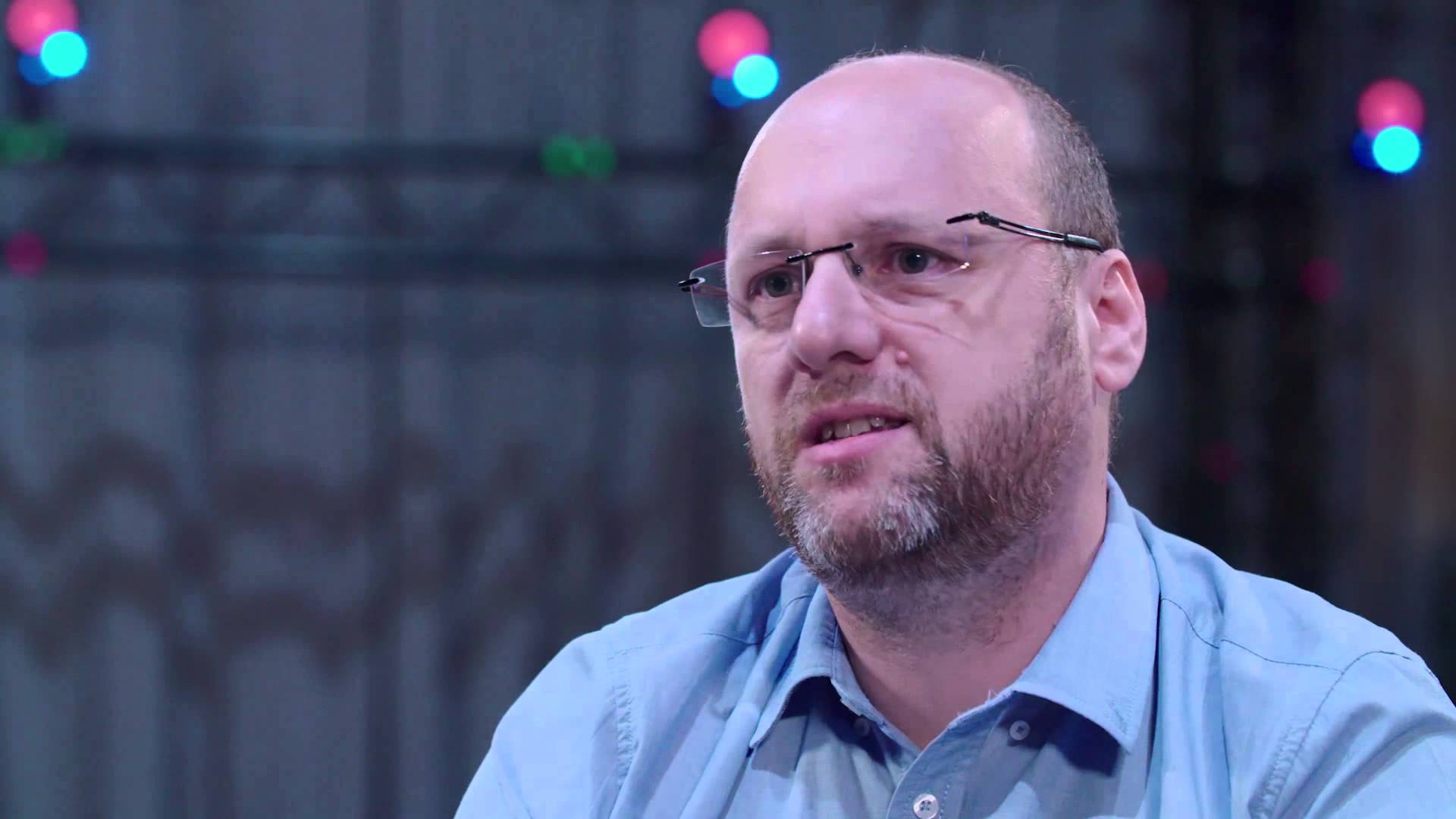
Quantic Dream Founder David Cage
Terrence Wiggins over at Paste Magazine, already called Cage out on on some of these issues, and others I forgot or blocked out, well over a year ago. That this recent controversy has emerged as a “new” problem suggests that neither Cage, nor the gaming media at large, has been paying attention.
Fahrenheit
With Fahrenheit (also known as Indigo Prophecy), released in 2005, Cage started off light, though about as subtle as a brick through a window. All of the controllable (read: important) characters in the game were white, except for Sergeant Tyler Miles, a black police officer who the player controls for a brief period. While all of the other characters have reasonable character development, Tyler is more or less a black caricature, and an accessory to main character Carla Valenti. In scenes where you are not controlling him, it seems to be the player’s objective to prove Tyler’s incompetence, like when Lucas hides from him, under a table in plain sight. Or when Carla beats his ass at the gym. From Tyler’s dialogue to the way he walks, everything hints at the possibility that Cage had never actually met a black American, and had only ever seen them in racist Hollywood movies or blaxploitation films.
Unique to Tyler, too, is the fact that on two distinct occasions when the player gets to control Tyler, he is in the midst of, or just finished having sex with his girlfriend. At first glance, you might wonder how this constitutes racism, but it has to be considered within the long historical context of how black people are represented in film: in this case, black men as insatiable nymphomaniacs. There is a reason “BBC” is a common search term on pornography websites; it taps into a deeply ingrained stereotype — and well-documented white hysteria — about black men as sexual predators.
Heavy Rain
Quantic Dream’s next release, in 2010, was Heavy Rain, another quick-time-event police procedural game with a decidedly somber atmosphere. Cage seems to be a fan of melodrama. This time around there are no playable black characters, or really any black characters of note at all. This in itself is not racist, or uncommon, as there is no shortage of posts about the absence or misrepresentation of black characters in video games. On this very site, no less. What’s interesting about Heavy Rain is that its setting was inspired by Philadelphia — my beloved hometown — a city which demographically is about 50% Black.
Heavy Rain’s faithful portrayal of Philadelphia’s iconic row homes and murals
And yet, there is scarcely a brown face to be found anywhere in the city Cage created for Heavy Rain. He copied much of Philly aesthetic with fidelity, but at some point must’ve decided to reimagine the demographics such that black people barely exist, replaced with a majority white population with vaguely French accents.
Heavy Rain’s portrayal of a shopping area in Philly. Where are all the black people?
If you think this was merely some oversight, or just a limitation of graphics engine, or some other weak excuse, consider the lens through which Cage even visited Philadelphia in the first place.
So we took a plane to Philadelphia, hired this movie scout that worked on the movie Philadelphia. We asked him, “Could you take us to some poor houses and meet poor people?” The movie scout was surprised by the request.
What kind of weird, condescending, voyeuristic pretext is this? Who even says things like this in real life? I imagine Cage thinks that this request was “surprising” because who would “want” to see poor people, right? Zey are, how do you say in America? Gross? Oui!
And later, he describes his experience in detail. I have trimmed the excerpt for length, but it really is worthwhile to read the whole thing:
We saw despair. We saw violence. We saw fear. We saw poverty, in a way that no one in Europe could imagine takes place in the U.S. […] I remember one specific time where we went to this family, and the movie scout had arranged it a month before. But when we arrived, their ten-year-old daughter had died the day before in an accident. The family was there crying in the kitchen and we immediately said, “We’re going to go. Sorry.” And they said, “No. You came from France to take pictures of the house, please come in.” We didn’t want to say no, we couldn’t say no. And we were taking pictures of their house while they were crying about their daughter. This is something that stayed in my mind for all the years I spent writing, this moment of intense sadness, and depression, and death. I hope a little of this is in the final story.
There are several interesting things about Cage’s commentary here. He talks about “violence”, “fear”, and “poverty” as these novel things that he has barely heard of, and certainly never seen or experienced before. Indeed, “no one in Europe could imagine” the horrible state of things he witnessed in Philadelphia. I suppose Cage has never been to, read an article, or even seen a news report about the some of the banlieues in Paris (he’s from France), or economically depressed and socially marginalized communities anywhere else in the whole continent of Europe.
As is the case across the United States, Philadelphia’s low-income population is disproportionately black. There is no doubt in my mind that the people Cage met and photographed were also black. The “sadness, depression, and death” Cage claims to have seen — all the while missing the vibrancy, resilience, flourishing culture, art scene, and night life — certainly touches black Philadelphia in unequal proportions, too. The story of the family that lost a daughter “stayed in Cage’s mind” for years, and he hoped a little of it transferred into Heavy Rain. And yet, not even their likeness, or that of people like them, made the final cut.
Beyond: Two Souls
In 2013, Quantic Dream released Beyond: Two Souls, featuring the likeness of actors Willem Dafoe and Elliot Page. Worth mentioning is the fact that Cage used Page’s activist reputation to defend himself against accusations of homophobia, because surely Page wouldn’t agree to work with him if they were true? While Page did work on B:TS, he was also furious to discover that Cage and the development team had decided to leave a nude model of him within the assets of the game, in spite of the fact that his character doesn’t actually appear nude at any point. Even in his interactive shower scene. Why even was there an interactive shower scene?
Seriously, the player has to move the controller back and forth to make Jodie towel dry. It’s weird. I mention this here not to further damage Cage’s credibility, but because it relates to his overall deflection of his former employees’ accusations. I will come back to this point later.
In Beyond: Two Souls, main character Jodie Holmes (voiced by and designed in the likeness of Page) possesses a variety of psychic powers which enable her to perform any number of superhuman feats. Although she has her own personal conflict to deal with, she continuously finds herself inserted into other people’s and other nation’s affairs, mostly through her work as a US government agent. In a demonstration of the white savior complex rivaled by James Cameron’s Avatar or the KONY 2012 campaign, Jodie goes to Somalia to save the country from a ruthless warlord, only to be manipulated by her handlers into killing the country’s democratically elected president. This was actually a rare case in which a game pointed a finger US imperialism, and the CIA’s very real history of assassination and regime change. For that much, the developers deserve some credit. Still, it surely wouldn’t be a proper depiction of Africa without a child soldier for the white hero to rescue along the way.
Jodie comforts child soldier Salim in Beyond: Two Souls
In another segment, oddly titled “Navajo”, Jodie comes upon — you guessed it — a Navajo family living on a remote ranch. A common trope in entertainment media not written or overseen by indigenous people, is to relegate them to some frozen past, playing up the “mystical” aspects of their culture, while rarely taking on the long-term systemic issues that Native folks have had to deal with into the present. They are treated as human relics, only relevant to the present insofar as they can provide some peculiar insight or ancient wisdom.
The Navajo family members are the silliest sort of “noble savages” dressed up in a thin veneer of modernity. The Navajo culture is almost entirely ignored. At one point, Cage gives us a flashback of tepees burning, despite the fact that the Navajo never lived in tepees.
[…]
There’s even a moment where the boys take Jodie to a place “no white man’s ever been before” which, honestly, is just the worst sort of nonsense. As if the American government hasn’t been all over indigenous lands. No, in Cage’s bizarre vision of the American Indian, it’s all mysticism and horses and Jodie the white savior.
Jodie stays with a Navajo family in Beyond: Two Souls
Invited to stay for a few days and help out around the farm in exchange for room and board, it isn’t long before she dons the mantle of the white savior once more. The family has apparently been under siege by an evil entity known as Yé’iitsoh, a character lifted arbitrarily from Navajo creation mythology and then bastardized.
This entity has attacked the Navajo family every night, for generations. Five spirits protect the family from “Yé’iitsoh”, but none of the flesh and blood Navajo can figure out a way to stop it. Once again, all of indigenous America’s power and agency must be an artifact of another time, with B:TS consigning modern Native folk to incompetence, ignorance of their own history and culture, and ultimately, irrelevance. Because it is Jodie who figures out how to use some ancient talismans in some ancient ritual to save the family from Yé’iitsoh once and for all — though not without sacrificing the grandmother in the process. It is patently absurd, and indicative of the kind of “subtle racism” that runs throughout all of Cage’s games.
Detroit: Become Human
This brings us to the present, with Quantic Dream’s latest release, Detroit: Become Human. I need to disclaim from the start that I have not played — and likely will not — simply because I refuse to give any more money to this developer. If I borrow a copy from someone, perhaps I’ll have more to add here in an update.
Detroit: Become Human is, of course, set in Detroit. The reason Cage gives for choosing the setting is that given its history as a manufacturing city, its current decline might be reversed by the establishment of a new industry such as artificially intelligent androids. It’s a solid premise.
But can you guess the substance of my critique?
Detroit is — wait for it — over 80% black. Yet in the future the game imagines, black people are once again relegated to minor roles and are relatively absent with respect to the city’s actual demographics. What’s interesting, too, is that the proportion of black people in Detroit has only increased over the years.
Since 1910, the black population of Detroit has increased
Much like he did with Philadelphia in Heavy Rain, Cage seems to have made it a point to “unblacken” Detroit as much as possible. At least he has a more reasonable explanation in this case, because it is almost certain that any burgeoning industry in future-Detroit would displace the mostly black population, those who have remained in spite of the city’s decline, either out of necessity, or love for their city. But even if this was the case, why not make that gentrification and displacement part of the narrative? Because Androids? That’s a lazy excuse, and suggests an inability to write with complexity or nuance.
In an interview with Gamespot at E3 2016, Cage says that Detroit is “great, for its cultural background”, and then goes on to mention music and Motown, a decidedly black institution. Later he rambles on about the people he met, apparently having honed his lens to notice some of the positive things about Detroit, though he doesn’t say much of any substance.
“We met the people, and we were very surprised by the energy there, and the fact that there are people there who want to build something new here.”
What did they expect, then? More fear, violence, and despair, like they found in Philadelphia? It’s a strange interview, made all the more difficult to watch due to the interviewers’ boot-licking and complete failure to ask any deep questions.
Watch the entire interview, if you are so inclined. The quoted segment takes place at about 4:40.
Earlier, I mentioned Elliot Page’s ordeal with Quantic Dream. If you recall, in Cage’s mind, the mere fact that Page agreed to work on Beyond: Two Souls somehow vindicates him of any wrongdoing with respect to creating a toxic workplace, or charges of misogyny or homophobia. He called the accusations — not the alleged behavior, mind you — “ridiculous, absurd, and grotesque”.
He also said:
“You want to talk about homophobia?” he said. “I work with [Elliot] Page, who fights for LGBT rights. You want to talk about racism? I work with Jesse Williams, who fights for civil rights in the USA… Judge me by my work.”
Well, that’s exactly the purpose of this essay, Mr. Cage. Your work speaks volumes, and not in your defense.
Like with Page, he seems to think that merely working with Jesse Williams — who, yes, isn’t just any black man, but one who uses his platform to speak out against racism — means that Cage, by association, cannot be racist.
This is, of course, utter nonsense, because one’s mere proximity to a member of a marginalized group does not magically clear their mind of prejudice toward that group. Especially that of the implicit variety, as I think is mostly at work in Cage’s games. Proximity certainly helps, and working relationships more so, and if Cage actually recruited more people of color for his development team, he would grow as a developer, and be a lot less likely to commit these kinds of offenses.
I’m not sure what kind of compartmentalization took place in the development process, that is, how much of the world design Williams was privy to, but I wonder what he thought, or would’ve thought, of a visibly not-black Detroit. According to an interview with Waypoint, Williams lent his voice to the project “very early on”, before he even emerged as an activist.
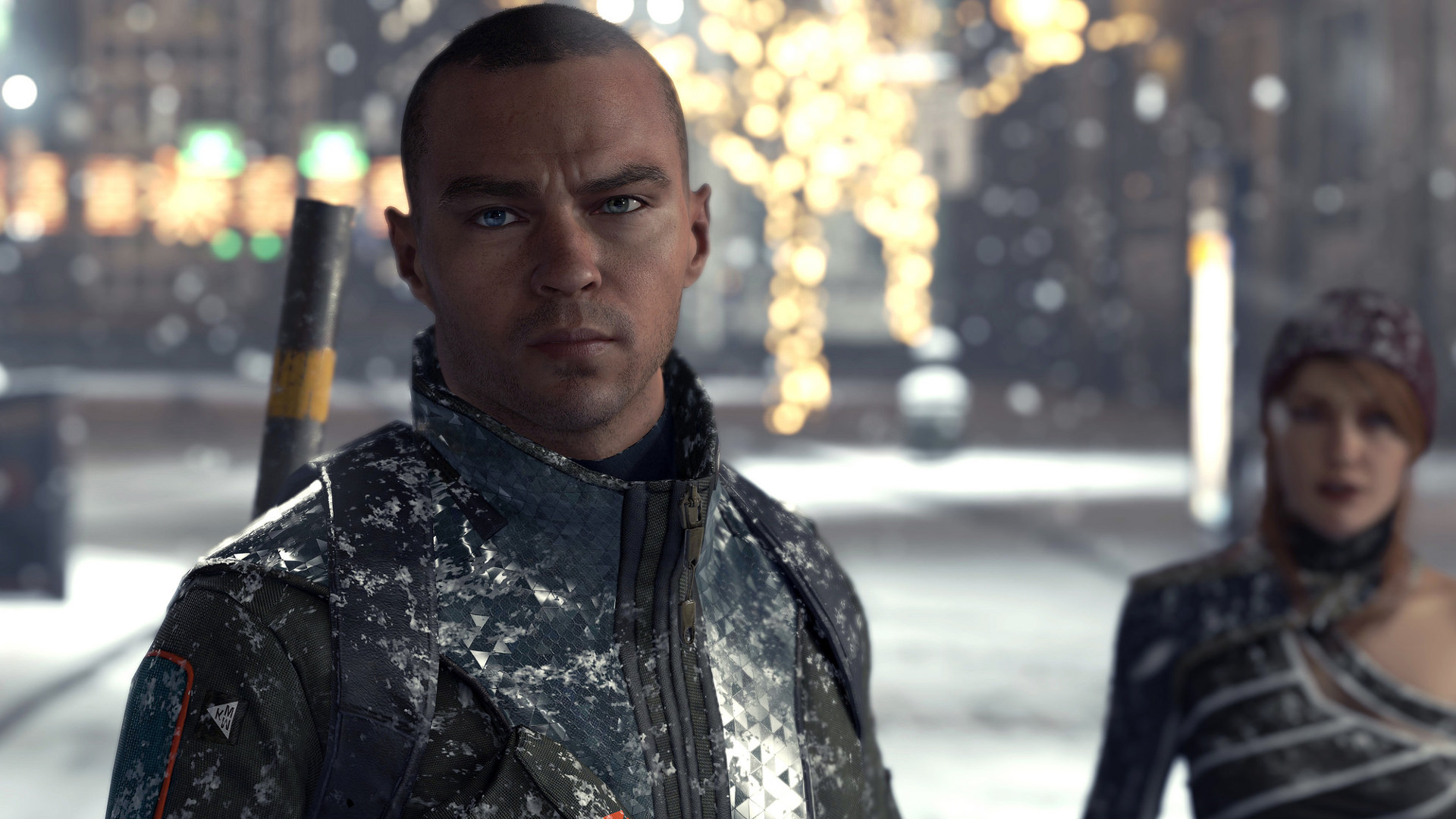
Jesse Williams lends his voice and likeness to Detroit: Become Human as Markus
It is also worth noting that of all the black people that could’ve — and should’ve — been featured in Detroit: Become Human, Cage chose Williams, who is very light-skinned with blue eyes. I want to tread carefully here, because I am in no way suggesting that Williams is any “less black” for these reasons, and he certainly solidifies how and with whom he identifies through his activism. But there is a clear trend in Hollywood, the gaming industry, advertising, and other media to give preference to lighter skinned, more ethnically ambiguous black people, where we’re included at all.
It was an interesting decision to center Williams’s character, who in the context of the game does not have the actual man’s background, identity, politics, or platform. To a player unfamiliar with Williams, as I imagine many will be, the character’s blackness can be plausibly denied. Either implicitly — giving his race conscious consideration, or explicitly in arguing against his blackness as so many gamers do when it comes to ethnically ambiguous characters.
The recent accusations against Cage do not exist in a vacuum, or without precedent. Cage wants to be judged by his work, and indeed if one looks critically at his games, a theme emerges. People of color are reduced to caricatures, invoke harmful stereotypes, and should remain at the margins, if they appear at all. Even if that means literally erasing them from settings where they predominate. This is not the cross-burning of the past or the anger-marching racism so en vogue these days, but the more deeply entrenched racism underlying all of our media institutions.
Cage might be forgiven for simply being ignorant, if only I were able to believe that no one, ever, has brought these issues to his attention. But as he seems to be the kind of man who reads every review and critique of his work, tied as it must be to his self-worth, I think he has simply chosen to ignore them. Worse yet, when the issues drag him out into the spotlight, forcing him to come to terms, he deflects all accountability and uses what amounts to the “black friend” defense, or the…”I’ve worked with an actual woman” defense. Is that even a thing?
What’s sad is that David Cage is a talented developer, and I have, in spite of everything, enjoyed Quantic Dream’s games. But for someone so ambitious as to attempt social commentary, examine the human condition, and speculate on humanity’s future in video games, his massive blind spot about race and racism — or his willful ignorance — is a persisting blight that keeps him well-short of accomplishing any of these objectives.