Introduction
The academy has often served as a pillar of state dominance, through the empirical validation of the imperial project. The state’s recognition of academic intellectual authority and the academy’s appeal to state political authority creates a mutually reinforcing matrix which gives structure to the formal, and dictates “which bodies can conduct research and posit theory and which bodies get to be researched and theorized”.[1]Guishard, M. (2009). The false paths, the endless labors, the turns now this way and now that: Participatory action research, mutual vulnerability, and the politics of inquiry. The Urban Review, 41, … Continue reading The imperial violence of the state, both internal and external, is mirrored by the often invasive character of academic research: an imposition of power that renders the subject as object. Some attempts to subvert this power relationship fall under the broad umbrella of “participatory methods” and include a wide range of epistemologies, which provide research subjects with some degree of agency, and redefine the terms of knowledge production, by resituating and redistributing intellectual authority.[2]Coombes, B., Johnson, J. T., & Howitt, R. (2014). Indigenous geographies III: Methodological innovation and the unsettling of participatory research. Progress in Human Geography, 38(6), 845-854.
In the sections that follow, I will discuss several participatory methods, their commonalities and differences, along the spectrum of “participation”, which ranges from the extraction of information from research subjects to actively contesting and reformulating dynamics of power. I am particularly interested in how participatory methods might be used as a strategy for cultivating more equitable social and political relations, and building community power and control over the means and modes of production, distribution, and consumption. To that end, I attempt to synthesize and distill various epistemologies into a framework for the co-production of both physical and social space.
What Means Participation and to What Ends?
What is meant by “participation” or “involvement” varies case by case, but generally refers to three positions: those who stand to be impacted by the decisions made about how space will be transformed and used, those who can offer knowledge to inform the changes, and those who ultimately have the power to decide what changes and how it changes. The term “participatory methods” actually refers to epistemologies or orientations[3]Guishard, M. (2009). The false paths, the endless labors, the turns now this way and now that: Participatory action research, mutual vulnerability, and the politics of inquiry. The Urban Review, 41, … Continue reading, wherein the researcher and the subjects collaborate horizontally, or with the subjects themselves being the researchers. The methods within this broader orientation are many, including but not limited to surveys, mapping, focus groups, story circles, and interviews. The use of these methods alone, however, does not make a process participatory, and in fact, they are often used in ways that reinforce existing power relations.
Sherry Arnstein conceptualized this dynamic as a “ladder of participation” (Figure 1), wherein the bottom rungs represented various degrees of “nonparticipation” — those impacted by development decisions manipulated by the process.[4]Arnstein, S. R. (1969). A ladder of citizen participation. Journal of the American Institute of planners, 35(4), 216-224. The middle rungs represent “tokenism”, the sourcing of information from those impacted, and telegraphing that feedback as an indication of power-sharing, when it is “really little more than consultation.[5]Coombes, B., Johnson, J. T., & Howitt, R. (2014). Indigenous geographies III: Methodological innovation and the unsettling of participatory research. Progress in Human Geography, 38(6), 845-854. FInally, the top rungs represent good faith attempts to transfer decision-making authority, or even to shift the locus of power.

Participatory methods can be difficult to deploy, due in part to a well-established pattern by state and academic actors of extracting data from participants for their own objectives, or to invoke a democratic process, even though the actual decisions are still being made from the top down. Even where data is collected toward empowering ends, the ideal of collaboration often stalls at analysis and representation[6]Coombes, B., Johnson, J. T., & Howitt, R. (2014). Indigenous geographies III: Methodological innovation and the unsettling of participatory research. Progress in Human Geography, 38(6), 845-854. — that is, the stage at which the interpretation of the data translates into meaningful transformation of lived conditions or power dynamics. Accordingly, would-be participants are less inclined to commit their time and energy to a process in which their input has no actual influence[7]Brown, G., & Kyttä, M. (2014). Key issues and research priorities for public participation GIS (PPGIS): A synthesis based on empirical research. Applied geography, 46, 122-136. or worse, where the mere fact of their participation is used to validate a predetermined decision or plan made by people in power.
Such processes are extractive and exploitative by intent and design, flattening people into “mere datasets, risk calculations, and variables in financial algorithms[8]Renzi, A. (2017) “Entangled Data: Modelling and Resistance in the Megacity,” Open! Platform for Arts, Culture and the Public Domain. T/A/S Issue.,” and tempering anticipated resistance by involving subalternated people on a superficial and ephemeral level [9]Cochrane, L., & Corbett, J. (2020). Participatory mapping. Handbook of communication for development and social change, 705-713.[10]Guishard, M. (2009). The false paths, the endless labors, the turns now this way and now that: Participatory action research, mutual vulnerability, and the politics of inquiry. The Urban Review, 41, … Continue reading. Research that may have once given voice to the subalternated now often silences them, by speaking on their behalf, rather than making space or creating a platform for their own self-expression.[11]Coombes, B., Johnson, J. T., & Howitt, R. (2014). Indigenous geographies III: Methodological innovation and the unsettling of participatory research. Progress in Human Geography, 38(6), 845-854. Those truly invested in using participatory methods as a means of empowering the marginalized, disenfranchised, or oppressed (hereafter “subalternated”) must be committed to working from the bottom up, involving the public in every aspect of research, planning, and/or decision-making.[12]Mukherjee, F. (2015). Public participatory GIS. Geography Compass, 9(7), 384-394.
Other barriers to implementation include fear of participation, institutional distrust, lack of experience in participatory methods amongst those in power, regulatory obstacles, and lack of support from various stakeholders.[13]Mukherjee, F. (2015). Public participatory GIS. Geography Compass, 9(7), 384-394. There is also the matter of accessibility, especially where research methods employ technologies or tools which require specialized training or are expensive (e.g. GIS), creating a drain on people’s time and financial resources). The technologies themselves can distract from the goal of meaningful engagement[14]Brown, G., & Kyttä, M. (2014). Key issues and research priorities for public participation GIS (PPGIS): A synthesis based on empirical research. Applied geography, 46, 122-136., which requires a commitment to the more social side of the process: the building of trusting relationships.[15]Renzi, A. (2020). Hacked Transmissions: Technology and Connective Activism in Italy. U of Minnesota Press.
The relationships between participants — especially where the initiative comes from outside the subject community — are essential in determining the power dynamics within the process. The false pretexts of objectivity and externality are discarded in favor of recognition of how all participants are situated with respect to each other and their collective work, “a multi-layered reflexivity: self, interpersonal and collective”[16]Coombes, B., Johnson, J. T., & Howitt, R. (2014). Indigenous geographies III: Methodological innovation and the unsettling of participatory research. Progress in Human Geography, 38(6), 845-854., which creates “a space in which the subjectivity of the co-researchers and the researched can express themselves.”[17]Sacchetto, D., Emanuela, A., & Steve, W. (2013). Coresearch and counter-research: Romano Alquati’s itinerary within and beyond Italian radical political thought. Viewpoint Magazine, (3), 1-8. Participants must also remain in a state of critical reflection, “critique and problematization”[18]Borio, G., Roggero, G., & Pozzi, F. (2007). Conricerca as political action. Utopian pedagogy: Radical experiments against neoliberal globalization, 163-85., enabling the construction of ever new and accumulative theory and praxis, in all possible directions[19]Colectivo Situaciones. (2003). On the researcher-militant. European Institute for Progressive Cultural Policies. and in a “spiral becoming”.[20]Borio, G., Roggero, G., & Pozzi, F. (2007). Conricerca as political action. Utopian pedagogy: Radical experiments against neoliberal globalization, 163-85.
In order for participatory processes to unsettle existing power relations, they must challenge dominant worldviews[21]Cochrane, L., & Corbett, J. (2020). Participatory mapping. Handbook of communication for development and social change, 705-713., oppose hegemonic narratives[22]Renzi, A. (2020). Hacked Transmissions: Technology and Connective Activism in Italy. U of Minnesota Press., and create alternative models which grant the subalternated the agency to advance their own vision.[23]Renzi, A. (2017) “Entangled Data: Modelling and Resistance in the Megacity,” Open! Platform for Arts, Culture and the Public Domain. T/A/S Issue. It requires the “deconstruction of the dominant forms of perception[24]Colectivo Situaciones. (2003). On the researcher-militant. European Institute for Progressive Cultural Policies.,” and the abandonment of a certain cynicism, wherein “expertise” is only situated at the “top” — the credentialed, the elected, the wealthy — and rejecting the idea that “knowledge emanating from marginalized standpoints is unworthy and deficient.”[25]Guishard, M. (2009). The false paths, the endless labors, the turns now this way and now that: Participatory action research, mutual vulnerability, and the politics of inquiry. The Urban Review, 41, … Continue reading
Instead, a truly participatory process recognizes that valuable knowledge can be actively produced by everyone[26]Brown, G., & Kyttä, M. (2014). Key issues and research priorities for public participation GIS (PPGIS): A synthesis based on empirical research. Applied geography, 46, 122-136., especially the subalternated. This challenge to both dominant power and knowledge systems must be made explicit at every stage of the participatory process, from the collection of data, including the creation of the tools and the formulation of the questions [27]Renzi, A. (2021). Data Acquisition, Data Analytics, and Data Articulations: DIY Accountability Tools and Resistance in Indonesia—An Interview with Irendra Radjawali of Drone Academy, Indonesia. In … Continue reading, to the analysis and application.
The use of participatory methods to actually shift power or control of resources “would represent a radical departure from current top-down land use planning methods used by most public agencies and municipal governments[28]Brown, G., & Kyttä, M. (2014). Key issues and research priorities for public participation GIS (PPGIS): A synthesis based on empirical research. Applied geography, 46, 122-136..” Ownership and control of the data itself, which usually lies with those who sponsor the process, such as government agencies, NGOs, or paid consultants[29]Cochrane, L., & Corbett, J. (2020). Participatory mapping. Handbook of communication for development and social change, 705-713., must instead be granted to the people and communities that produce it — call this “data sovereignty”[30]Renzi, A. (2021). Data Acquisition, Data Analytics, and Data Articulations: DIY Accountability Tools and Resistance in Indonesia—An Interview with Irendra Radjawali of Drone Academy, Indonesia. In … Continue reading — as a means of securing power.
Participatory Mapping
Participatory mapping — broadly defined as sourcing geographic information from people and communities within the area of interest — is itself a wide umbrella, including various epistemologies such as participatory geographic information systems (PGIS), public participatory geographic information systems (PPGIS), and volunteered geographic information (VGI). The differences between the three are subtle, but generally, they aim to both provide subalternated populations with access to geographic information technologies, and to incorporate their knowledge in research conclusions and any policy or development decisions that follow.
The different forms of mapping are the products of “social, institutional, and political context [31]Mukherjee, F. (2015). Public participatory GIS. Geography Compass, 9(7), 384-394.,” and therefore are not passive or benign activities. What’s mapped, such as “landscape values, development preferences, place qualities, and participant experiences or behaviors within space [32]Brown, G., & Kyttä, M. (2014). Key issues and research priorities for public participation GIS (PPGIS): A synthesis based on empirical research. Applied geography, 46, 122-136.,” what’s included or excluded, who does the mapping, why the mapping is being done, where and when it’s done all carry implications of power [33]Cochrane, L., & Corbett, J. (2020). Participatory mapping. Handbook of communication for development and social change, 705-713.[34]Brown, G., & Kyttä, M. (2014). Key issues and research priorities for public participation GIS (PPGIS): A synthesis based on empirical research. Applied geography, 46, 122-136.. As Harley says, “cartography…is never merely the drawing of maps: it is the making of worlds”.[35]Harley, J. B. (1990). Cartography, ethics and social theory. Cartographica: The International Journal for Geographic Information and Geovisualization, 27(2), 1-23.
In all cases participatory mapping invokes the individual and collective memory of people around their physical and social experiences within a space, their sense of how space is currently being used and their projections of how land use may change in the future [36]Brown, G., & Kyttä, M. (2014). Key issues and research priorities for public participation GIS (PPGIS): A synthesis based on empirical research. Applied geography, 46, 122-136.. Tracing Arnstein’s ladder of participation, participatory mapping also varies in the ends to which it is deployed, from data extraction and manipulation, to empowerment.
The tools and methods used within participatory mapping vary widely as well: including but not limited to collaborative sketching, 3D modeling (physical and digital), GPS and satellite photos, drones, remote sensing, and the geospatial web, and can either ameliorate or exacerbate the power differential inherent to mapping itself. According to Mukherjee, while the methods have evolved, the dynamics of “participation” have not kept pace.[37]Mukherjee, F. (2015). Public participatory GIS. Geography Compass, 9(7), 384-394.
Geographic information systems (GIS), which mediated the production and exchange of knowledge through specialized tools, equipment, and training, have been mostly inaccessible to subalternated populations [38]Mukherjee, F. (2015). Public participatory GIS. Geography Compass, 9(7), 384-394.. The emergence of computerized GIS also corresponded to the prioritization of quantitative data, and the devaluation of the qualitative. This was not just a matter of access to useful tools and data, but informed the power dynamics between those making decisions over the use of space, and those who lived and worked in it. GIS became indispensable in technical, academic, and policymaking circles, as a way to quantify various aspects of space, from the value of extractable assets and potential land uses to the lived conditions of people in those spaces, the former often coming at the expense of the latter.
PGIS and PPGIS emerged into and in response to this growing gap, with the word “participatory” referring to the direct involvement of subalternated populations in mapping physical and social space — that is, the material characteristics of both the natural and built environment, as well as the ways that people move within and use the space. The difference between PGIS and PPGIS is less methodological and more a matter of where each tended to be practiced, with the PGIS taken up mostly in the Global South, and PPGIS in the north. Both source voluntary geographic information (VGI) from resident populations, and how it is used differs more between practitioners and their agendas than between the two methods.
PGIS and PPGIS are both concerned with the management of natural resources, and changes in urban land use toward ends of “revitalization” and “development”, and “involving” people in decision-making. The degree to which mapping is participatory — that is, how power over decision-making is distributed — tends to correspond to what kind of organization is doing the mapping. This is not only a matter of power or equity, but also data quality, which is affected by the meaningful participation of those impacted by land use decisions.[39]Brown, G., & Kyttä, M. (2014). Key issues and research priorities for public participation GIS (PPGIS): A synthesis based on empirical research. Applied geography, 46, 122-136. The state, which holds ultimate power over land-use, is often under no legal or political obligation to involve residents in decision-making. The academy tends to hover around the middle, eager to collect data from subalternated populations, but not necessarily committed to using their research to support people’s needs or demands. Community-based organizations, especially those formed within and from the communities where the research and decision-making is taking place, tend toward true participation, mapping as a means of vesting citizens with the power to control their own land.
Renzi discusses practices of counter-mapping and counter-modelling in Indonesia, through the collection and analysis of various data, from “census information, personal and local histories, socio-economic networks maps and planning records” to maps of indigenous territory and informal settlements, and the location and condition of natural assets.[40]Renzi, A. (2017) “Entangled Data: Modelling and Resistance in the Megacity,” Open! Platform for Arts, Culture and the Public Domain. T/A/S Issue.[41]Renzi, A. (2020). Hacked Transmissions: Technology and Connective Activism in Italy. U of Minnesota Press. These data in turn inform movements for claiming or reclaiming space, opposing land corporate or state land grabs, settle territorial disputes between communities without involving the courts, improve local agriculture, make the informal visible as a means of (re)claiming space, create more viable flood models to build resilience in the face of climate change, and “generate connections among people” and foster the “transformative potential of collaborative knowledge production to sustain communities in struggle.”[42]Renzi, A. (2021). Data Acquisition, Data Analytics, and Data Articulations: DIY Accountability Tools and Resistance in Indonesia—An Interview with Irendra Radjawali of Drone Academy, Indonesia. In … Continue reading
Counter-modelling engages communities in the “prototyping of the infrastructure through a process of visioning and research facilitated by expert volunteers.”[43]Renzi, A. (2017) “Entangled Data: Modelling and Resistance in the Megacity,” Open! Platform for Arts, Culture and the Public Domain. T/A/S Issue. These alternative data deployments are constituted in opposition to the extractive uses of data by state and corporate actors, which attempt to impose order on the informal as a means of legibility, and through that, control and the accumulation of capital. [44]Renzi, A. (2017) “Entangled Data: Modelling and Resistance in the Megacity,” Open! Platform for Arts, Culture and the Public Domain. T/A/S Issue. The potential for data extraction is subverted through “data sovereignty”, which requires not only that communities secure and retain control of their own data, but that its acquisition, analysis, and articulation be collectivized, so that “new forms of knowledge and practices of resistance can emerge.[45]Renzi, A. (2021). Data Acquisition, Data Analytics, and Data Articulations: DIY Accountability Tools and Resistance in Indonesia—An Interview with Irendra Radjawali of Drone Academy, Indonesia. In … Continue reading
Participatory Action Research
Participatory Action Research (PAR) is another epistemology with contested origins, but generally associated with major thinkers such as Paulo Freire, Orlando Fals-Borda, and Walter Rodney — though the latter is better associated with the term “groundings”, which captures the same spirit of research as a means of counterpower. PAR is generally defined as research that recognizes people as the experts of their own experience, a concept otherwise known as “standpoint epistemology”, and that they are best suited to conduct inquiries into their own issues and concerns. PAR, as an epistemology, commonly uses multiple methods, such as focus groups, interviews, asset mapping, observation, and photovoice. What distinguishes PAR from traditional academic research is that these methods are conducted by the members of the subject community themselves, rather than by an outside researcher. The role of the “researcher”, if not a member of the community, should only be advisory, or to train participants in the methods. It is not for any outside researcher to dictate or impose their own objectives.
PAR is most commonly used amongst people in a subordinate position within a given power dynamic: the residents of a gentrifying community, the workers at an exploitative company, indigenous people fighting against ongoing displacement. As with any such practice, the potential for co-option is ever-present, and regardless of the essence of PAR, its implementation still varies with respect to levels of participation as conceptualized by Arnstein’s ladder. For example, the key pivot of PAR — the situating of the subject as researcher — could easily be exploited to extract labor from participants as well as data. How the data is used, and to what ends, how it is analyzed, and how has access to it, are all variables influencing how “participatory” the research truly is.
One might argue, however, that the most important part of PAR is not the “participation”, but the “action”. If there is no move to positively transform the conditions of the subject community, then the research may not qualify as PAR at all. A related term, community-based participatory research (CBPR), removes the critical “A” for action, and accordingly is a term more commonly used by the state and other institutional actors. In these cases, where “the action component is first to be jettisoned when confronting the practicalities of community research”[46]Coombes, B., Johnson, J. T., & Howitt, R. (2014). Indigenous geographies III: Methodological innovation and the unsettling of participatory research. Progress in Human Geography, 38(6), 845-854., participation is seen as enough in its own right, independent of whether or not the research has any significant impact on the lived realities of the subject community.
Another pitfall within the practice of PAR has been co-option through the politics of representation, or “elite capture”, meaning that institutions of power cloak themselves in the language of equity, or even justice, as a symbolic gesture, or “virtue signaling”, while not meaningfully engaging with the populations whose identities they invoke. There are tensions between so-called standpoint epistemology, and politics of representation (often mischaracterized as “identity politics”), for the fact that there is not a 1-to-1 correspondence between identity and lived experience.
Put another way, if the research is intended to effect action on behalf of an oppressed identity group, a member of that group who is not oppressed in that particular way, is not automatically an expert on experience they actually do not have. It is easy enough, and common practice, for institutions to elevate an individual member of an identity group as a token signaling their commitment to the broader community. Where standpoint epistemology is steeped in a shallow politics of representation, it is a failure in tactics, serving only to reinforce the “cultural and political hegemony of the Western bourgeoisie.”[47]Borio, G., Roggero, G., & Pozzi, F. (2007). Conricerca as political action. Utopian pedagogy: Radical experiments against neoliberal globalization, 163-85.
What’s also true is that even where one’s membership in an identity group confers useful expertise, said expertise can be enhanced by outside perspectives. Indigenous knowledge systems, such as Nishnaabewin[48]Simpson, L. B. (2017). As we have always done: Indigenous freedom through radical resistance. U of Minnesota Press. and Red Pedagogy[49]Grande, S. (2016). Red pedagogy: Indigenizing inquiry or, the un-methodology. In Ethical futures in qualitative research (pp. 133-143). Routledge. recognize the value of drawing upon diverse bodies of theory and praxis as vital for navigating the “larger systems, forces and relationships” in which they’re situated[50]Coombes, B., Johnson, J. T., & Howitt, R. (2014). Indigenous geographies III: Methodological innovation and the unsettling of participatory research. Progress in Human Geography, 38(6), 845-854., but only where this exchange of knowledge and practice is done in the “absence of coercion and hierarchy and in the presence of compassion.”[51]Simpson, L. B. (2017). As we have always done: Indigenous freedom through radical resistance. U of Minnesota Press.
What makes PAR effective in transforming power dynamics is not merely situating the subject as expert, but empowering community members to be project leaders, which in turn enables them to navigate the cultural norms and rules so as to create relatively safe spaces for community members to engage in the “co-production of pedagogical safe-places that enable intersubjective contemplation and growth in consciousness about social processes and options for resistance.”[52]Coombes, B., Johnson, J. T., & Howitt, R. (2014). Indigenous geographies III: Methodological innovation and the unsettling of participatory research. Progress in Human Geography, 38(6), 845-854.
One of the strengths of PAR is that it does not have to involve the academy at all. The practice of research deeply rooted in community, designed to investigate, challenge, and ultimately transform social and political relations is not unique to PAR itself, but is essential to doing it well and for the right reasons.
Conricerca and Militant Research
Conricerca, or “co-research” is a practice and orientation arising from workers movements in both Europe and Latin America, to contest the power relations inherent to labor. It therefore differs from other participatory methods in that it is unambiguously political and oriented toward resistance[53]Renzi, A. (2020). Hacked Transmissions: Technology and Connective Activism in Italy. U of Minnesota Press., seeking to “understand which forces are fighting for what kind of transformation with what kind of organization.”[54]Borio, G., Roggero, G., & Pozzi, F. (2007). Conricerca as political action. Utopian pedagogy: Radical experiments against neoliberal globalization, 163-85. The critical turn of co-research is to make explicit what PAR often only implies: the “subjectivation” of the participants[55]Colectivo Situaciones. (2003). On the researcher-militant. European Institute for Progressive Cultural Policies., that is, the situating of participants as subjects rather than objects of the research, who can play an “active part in envisioning and realizing social change.”[56]Sacchetto, D., Emanuela, A., & Steve, W. (2013). Coresearch and counter-research: Romano Alquati’s itinerary within and beyond Italian radical political thought. Viewpoint Magazine, (3), 1-8. In stronger terms, co-research is the “decolonization of subjectivity of the construction of counter-subjectivity.”[57]Borio, G., Roggero, G., & Pozzi, F. (2007). Conricerca as political action. Utopian pedagogy: Radical experiments against neoliberal globalization, 163-85.
These two processes — the cultivation of subjectivity and organizing for resistance against dominant power — are taken up simultaneously by co-researchers[58]Renzi, A. (2020). Hacked Transmissions: Technology and Connective Activism in Italy. U of Minnesota Press.[59]Borio, G., Roggero, G., & Pozzi, F. (2007). Conricerca as political action. Utopian pedagogy: Radical experiments against neoliberal globalization, 163-85.. Unlike most academic research, conricerca is not purely epistemological, but also ontological, its goals ultimately attending to the transformation of the subject and its conditions[60]Borio, G., Roggero, G., & Pozzi, F. (2007). Conricerca as political action. Utopian pedagogy: Radical experiments against neoliberal globalization, 163-85., which inevitably requires contesting relations of domination and exploitation. This focus on subjectivity, however, implies nothing about the rigors of co-research, which formulates hypotheses, “tests them, modifies and implements them, and then constructs more advanced levels of knowledge and strength”.[61]Borio, G., Roggero, G., & Pozzi, F. (2007). Conricerca as political action. Utopian pedagogy: Radical experiments against neoliberal globalization, 163-85.
Militant research, while embodying the same emphases on subjectivity and resistance, modifies co-research in one critical way: the voiding of any assumptions about what the subjects already know or should come to know, or what the goals of the process should be. The militant researcher takes on the role of Ranciere’s ignorant schoolmaster in “not knowing”, to avoid projecting anything — “meanings, values, interests, filiations, causes, influences, rationalities, intentions, and unconscious motives to their object”[62]Colectivo Situaciones. (2003). On the researcher-militant. European Institute for Progressive Cultural Policies. — whether as part of a political agenda or an academic objective.
Such projection is analogous to the observer effect in physics, changing the subject through the interaction, rather than experiencing it in its most authentic incarnation. In rejecting the imperial orientations of the academy, the state, the NGO, philanthropist, and even the expectations of “the party” for what “should be” based on a ideological canon[63]Sacchetto, D., Emanuela, A., & Steve, W. (2013). Coresearch and counter-research: Romano Alquati’s itinerary within and beyond Italian radical political thought. Viewpoint Magazine, (3), 1-8., militant research takes on a certain ambivalence, making space for a multitude of counterpower formations, including hidden knowledges[64]Colectivo Situaciones. (2003). On the researcher-militant. European Institute for Progressive Cultural Policies. and latent practices[65]Renzi, A. (2020). Hacked Transmissions: Technology and Connective Activism in Italy. U of Minnesota Press. which may not be immediately or at all recognizable as political.
Embracing the Plenitude
All participatory methods, even, or perhaps especially if they are deployed for political purposes, have the potential to depress or obscure a community’s own desires or motivations, under the pretext of empowerment. Where participant engagement ebbs and flows, or where “researchers assume a functional, singular ‘community’ that is waiting to participate,”[66]Coombes, B., Johnson, J. T., & Howitt, R. (2014). Indigenous geographies III: Methodological innovation and the unsettling of participatory research. Progress in Human Geography, 38(6), 845-854. the work might even start to resemble coercion.[67]Guishard, M. (2009). The false paths, the endless labors, the turns now this way and now that: Participatory action research, mutual vulnerability, and the politics of inquiry. The Urban Review, 41, … Continue reading Well-meaning researchers and/or activists, committed to taking up the “cause” of the subalternated, with a specific agenda or outcome in mind, may in turn fail to recognize, or otherwise disregard or diminish the “social needs, the traditions of struggle, as well as the practices of dissent that are already latent or present in hidden forms”.[68]Renzi, A. (2020). Hacked Transmissions: Technology and Connective Activism in Italy. U of Minnesota Press. Militant research embraces this plurality — what Colectivo Situaciones calls the “plenitude”, understanding that not all resistance involves explicit confrontation with the state.
Similarly, conricerca attempts to recognize that the mission to create new worlds requires “a great new collective narration, one that is not univocal but rather is made up of many irreducible singular narrations[69]Borio, G., Roggero, G., & Pozzi, F. (2007). Conricerca as political action. Utopian pedagogy: Radical experiments against neoliberal globalization, 163-85., and an “openness to ontological pluralism and multinatures[70]Coombes, B., Johnson, J. T., & Howitt, R. (2014). Indigenous geographies III: Methodological innovation and the unsettling of participatory research. Progress in Human Geography, 38(6), 845-854.,” It attempts to reveal and potentially scale up more subtle and emergent methods of resistance. These may include what Asef Bayat calls quiet encroachment: atomized, unstructured, non-ideological acts of everyday resistance, as a means of securing material needs — through illegal seizure and redistribution — rather than a concentrated political movement.[71]Bayat, A. (1997). Street politics: poor people’s movements in Iran. Columbia University Press. This absence of defined, concentrated, structured resistance may seem powerless or even apolitical — indeed, even participants themselves hesitate to classify or reject its classification as political[72]Kinder, K. (2016). DIY Detroit: Making do in a city without services. U of Minnesota Press. — due to a lack of policy change[73]Hayes-Conroy, A., Saenz Montoya, A., Croog, R., & Munoz, F. (2020). Not quite quiet, not quite encroachment: Interrogating the political nature of urban subaltern community engagement in … Continue reading.
Hayes-Conroy and her colleagues discuss how the activities of the people in Medellin, Colombia are also geared toward the improvement of living conditions, both material and affective. The primary difference is that the activities are not quiet, but loud and performative (e.g. dance, theater, fire blowing, music). The youth and community actors in Medellin reject the characterization of their activities as “resistance”, because they’re not actively challenging the state or the gangs and haven’t resulted in any structural change. Instead these activities are creating “affective, spatial, and convocational gains”, which have a real impact on the people’s quality of life that policy change may not.[74]Hayes-Conroy, A., Saenz Montoya, A., Croog, R., & Munoz, F. (2020). Not quite quiet, not quite encroachment: Interrogating the political nature of urban subaltern community engagement in … Continue reading
The affective dimension of these activities is significant for how they inspire people and expand the horizon of possibility, and also how they enable people to gain social and political capital on a local level, as well as a sense of belonging that may have otherwise come from membership in gangs. The spatial and convocational gains come through these groups’ ability to informally “mobilize” large groups of people — audiences not activists — in public spaces which would ordinarily be prohibited, but are ignored or allowed by authorities, who see the activities as “both helpful (to the community) and non-threatening (to prevailing interests)”.[75]Hayes-Conroy, A., Saenz Montoya, A., Croog, R., & Munoz, F. (2020). Not quite quiet, not quite encroachment: Interrogating the political nature of urban subaltern community engagement in … Continue reading
Although these “not quite quiet” activities do not directly contest or resist existing power dynamics in Medellin, they do serve as a means of “lay[ing] the foundations for a hypothetical mobilization of the urban subaltern,”[76]Hayes-Conroy, A., Saenz Montoya, A., Croog, R., & Munoz, F. (2020). Not quite quiet, not quite encroachment: Interrogating the political nature of urban subaltern community engagement in … Continue reading what Bayat refers to as “passive networks”[77]Bayat, A. (1997). Street politics: poor people’s movements in Iran. Columbia University Press., which under the right conditions can lead to a large and spontaneous resistance.
What these often overlooked or diminished forms of resistance tend to have in common is that they do not constitute “a conscious political strategy”, but instead emerge out of “the necessity to survive and live a dignified life[78]Bayat, A. (1997). Street politics: poor people’s movements in Iran. Columbia University Press.,” through improvement of both material and affective conditions.[79]Hayes-Conroy, A., Saenz Montoya, A., Croog, R., & Munoz, F. (2020). Not quite quiet, not quite encroachment: Interrogating the political nature of urban subaltern community engagement in … Continue reading These “self-provisioning” activities[80]Kinder, K. (2016). DIY Detroit: Making do in a city without services. U of Minnesota Press. attend to people’s immediate needs — redirecting and siphoning municipal water or energy supplies, building informal settlements or community gardens on private or government-owned land — and also “destabilize the affective control of authorities/elites”[81]Hayes-Conroy, A., Saenz Montoya, A., Croog, R., & Munoz, F. (2020). Not quite quiet, not quite encroachment: Interrogating the political nature of urban subaltern community engagement in … Continue reading, free people from “the discipline and controlling relations of the modern working institutions”, and “challenge modern principles of exchange value, bureaucracy, and the state.”[82]Bayat, A. (1997). Street politics: poor people’s movements in Iran. Columbia University Press.
Although these activities most often emerge in response to the failure, neglect, or contempt of the state or other institutions of power, and the absence of any “institutional mechanism through which they can collectively express their grievances and resolve their problems[83]Bayat, A. (1997). Street politics: poor people’s movements in Iran. Columbia University Press.,” they are done for their own sake, their own inherent value, without necessarily attempting to challenge political authority[84]Bayat, A. (1997). Street politics: poor people’s movements in Iran. Columbia University Press., or to undermine the capitalist status quo.[85]Kinder, K. (2016). DIY Detroit: Making do in a city without services. U of Minnesota Press. Yet in spite of lack of an overt strategy, and the declassification of such activities as resistance, the informal capture and redistribution of resources, the “illegal” use of public space, and other moves toward autonomy are not only political, but do represent a challenge to the authority of the state, in “reclaim[ing] significant political space,” and for the fact that “a fully autonomous life renders states irrelevant.”[86]Bayat, A. (1997). Street politics: poor people’s movements in Iran. Columbia University Press.
Conricerca and militant research both place a particular focus on this informal or “quiet, resistance, identifying it as “the zone of potenza (power), the space of what is possible”[87]Borio, G., Roggero, G., & Pozzi, F. (2007). Conricerca as political action. Utopian pedagogy: Radical experiments against neoliberal globalization, 163-85., approaching it with an intentional ambivalence and openness to unforeseen and unplanned possibilities. Indeed, these more subtle forms of resistance can result in the creation of “passive networks”, which under the right conditions can generate instant collective action.[88]Bayat, A. (1997). Street politics: poor people’s movements in Iran. Columbia University Press.
Critically, by subverting “hegemonic notions of order and control”[89]Hayes-Conroy, A., Saenz Montoya, A., Croog, R., & Munoz, F. (2020). Not quite quiet, not quite encroachment: Interrogating the political nature of urban subaltern community engagement in … Continue reading and by achieving gains (affective, material, and political), people are more willing to fight to protect them, especially where the benefit is direct and concrete. It is easier, for example, to fight to defend a beloved community garden than to build abstract political power, or to defend a long continuity of culture and livelihood as indigenous people do, than to fight to “smash the state”. This is not about incrementalism, but rather about what actually motivates people. As Kinder notes, self-provisioning in Detroit tends to take place in the same locations as more concentrated organizing efforts, creating the potential for “mutually reinforcing connections between resident activism at the household scale and collective mobilization at the neighborhood and district levels.”[90]Kinder, K. (2016). DIY Detroit: Making do in a city without services. U of Minnesota Press. While the tipping point — what causes an exponential spike in revolutionary activity — eludes analysis, the conditions for spontaneous mass mobilization lie right at the surface. Where the focus — of the researcher, activist, NGO — is on the problem rather than creating or enhancing existing assets, it fails to activate the affective potential needed to drive a more organized and sustained resistance.
Synthesis: Toward a Framework for Co-Production
The success or failure of each of the participatory epistemologies discussed above might be reasonably determined by shifts in power. Yet how these shifts are measured — via policy changes, material or affective gains, enfranchisement — are highly subjective, and therefore must be gauged by the participants themselves. Ultimately, if resistance, whether organized or atomized, does not transform meanings and values, only who occupies roles of dominant vs. subalternated, then relations of domination are maintained.[91]Colectivo Situaciones. (2003). On the researcher-militant. European Institute for Progressive Cultural Policies.
Such a framework would always be experimental, like conricerca “a production of knowledge that is ‘other than,’ an experiment in organizational practices, and a space of resubjectification”[92]Borio, G., Roggero, G., & Pozzi, F. (2007). Conricerca as political action. Utopian pedagogy: Radical experiments against neoliberal globalization, 163-85. — subject to constant reflection, revision, and rearticulation, in accordance with the unveiling, shifting, and evolving of participant values, motivations, and objectives. It would also necessarily engage all participants in a practice of mutual, renewable, and/or revocable consent, and one that “transforms the members of a collective within forms of cooperation and communication.”[93]Sacchetto, D., Emanuela, A., & Steve, W. (2013). Coresearch and counter-research: Romano Alquati’s itinerary within and beyond Italian radical political thought. Viewpoint Magazine, (3), 1-8. The framework would have to embrace, foreground, and uplift the “plenitude”, to start from a position of ambivalence, an openness to counterpower activities not explicitly conceived or understood as such: the “quiet encroachment” and informal practices not regarded — by participants or their antagonists — as political.
Where Arnstein’s ladder of participation is juxtaposed with the continuum between subjectivation and objectification, it reveals a parallel spectrum of power from exploitation to self-determination (Figure 2). Where so-called participatory methods only extract information, it serves as both a form of manipulation (bottom of Arnstein’s ladder), and exploitation of the research object (through a disregard of their subjectivity). Where research is done as part of an “impact agenda”, rather than emerging from the needs of participants, it reeks of paternalism, ostensibly providing information or a “service”, and further cementing a sense of dependency. When this drive to “help” communities is taken up by activists — what Colectivo Situaciones calls “solidarity humanism”, it “naturalize[s]…the victimizing objectuality that separates everyone from their subjectifying and productive possibilities.”[94]Colectivo Situaciones. (2003). On the researcher-militant. European Institute for Progressive Cultural Policies.
Climbing the ladder to the levels of consultation, placation, or even partnership, corresponds to attempts by the state or other institutional powers to confer “enfranchisement” — that is, to enable subalternated communities to participate on “equitable” terms within an existing structure, as opposed to challenging extractive or exploitative economies and societies themselves. Where such a move shifts the long weight of oppression, it may be seen as “justice”, but it could also be understood as merely redistributing existing values.[95]Colectivo Situaciones. (2003). On the researcher-militant. European Institute for Progressive Cultural Policies. On the other hand, the authentic — as opposed to symbolic or rhetorical — delegation of power, or better yet, the recognition of extant and heretofore repressed power, inherent to one’s subjectivity, confers agency, and enables the activation of one’s own values and toward their own ends.

Finally, where people are empowered to become the “creator of values, of experiences, of worlds,”[96]Colectivo Situaciones. (2003). On the researcher-militant. European Institute for Progressive Cultural Policies. to “[claim] the rights of self-definition, the right to tell their own histories, recover their own traditional knowledge,”[97]Coombes, B., Johnson, J. T., & Howitt, R. (2014). Indigenous geographies III: Methodological innovation and the unsettling of participatory research. Progress in Human Geography, 38(6), 845-854. it is akin to self-determination (citizen control on Arnstein’s ladder), the highest form of subjectivity, and one of the prerequisites, alongside autonomy, for liberation. To effect such a monumental shift in power is not a singular action or transaction; rather it is the wholesale transformation of relationships, “the decolonization of individual and collective subjectivity, the decommodification of connections and relations, the delabouring of human activity.[98]Borio, G., Roggero, G., & Pozzi, F. (2007). Conricerca as political action. Utopian pedagogy: Radical experiments against neoliberal globalization, 163-85.
The 5D Ecological Compass
Background & Positionality
In order to even propose a “framework for the co-production of space”, it feels important for me to build some background and establish my own positionality. I am a former K-12 science teacher turned school abolitionist, which perhaps sounds controversial until one considers how schooling, the relationship between teachers and learners, at least in the United States, is constructed much the same as the ladder of participation: a spectrum along which young people have varying degrees of subjectivity and power — practically never at the level of self-determination. My prior research analyzed schooling through the lens of enclosure, which I defined as a “physical or ideological partition that divides a larger whole, for purposes of commodification and/or control”, manifest across land, space, and time, and moving steadily “inward” to the community, the individual body, to the mind, to labor, learning, and the very experience of living. Abolition, in turn, is defined as “the dissolution of enclosures so as to liberate the movement of bodies, cultures, knowledges, resources, and/or energy, across space and time, along collectively self-determined pathways.” — which recognizes the “dual nature of abolition, as both a destructive and creative force, logic, and praxis.”[99]O, K. (Forthcoming). From the Schoolhouse to the Field: A Case for Abolition and Notes Toward an Education for Liberation. https://kermito.com/from-the-schoolhouse-to-the-field/
Toward the end of my tenure as a school teacher, I embarked on a participatory action research project with students, for the purpose of studying the local impacts of climate change, and their connections to the more immediate issues young people in my own classroom were facing. At the time, PAR was like a breath of fresh air, but because of the power dynamics of the school, codified in our respective positions as “teacher” and “students”, there was an inherent coercion to the whole process. Since that time I have continued to embrace and advocate for PAR in various professional contexts. At the same time, I’ve contemplated, written, and labored extensively to understand and to hold the contradictions within “participation”, while seeking to create “a framework for education and organizing — living, learning, resisting, dreaming, creating — to resist the physical and ideological enclosures”[100]O, K. (Forthcoming). From the Schoolhouse to the Field: A Case for Abolition and Notes Toward an Education for Liberation. https://kermito.com/from-the-schoolhouse-to-the-field/ The proposed framework is a continuation of that endeavor.
Overview
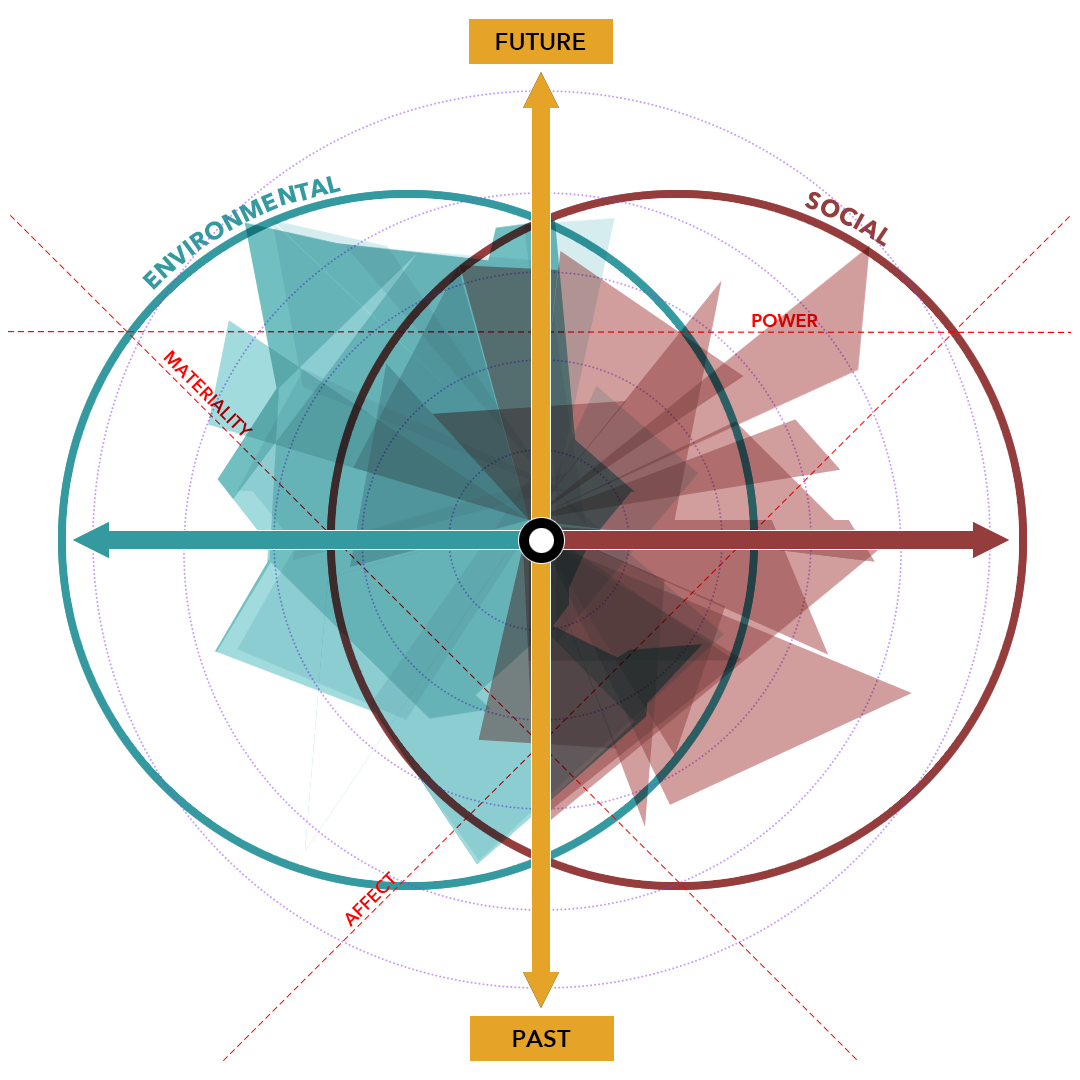
The Five Dimensional (5D) Ecological Compass emerges in response to what I call “spatiotemporal alienation”: the “collapsing of being — body, mind, and activity — into discrete units of space-time”[101]O, K. (Forthcoming). From the Schoolhouse to the Field: A Case for Abolition and Notes Toward an Education for Liberation. https://kermito.com/from-the-schoolhouse-to-the-field/, attempting to invite communities into a collective inquiry process, situating themselves or other matters of interest/concern at the center — i.e. in relationship to time, space, and community (Figure 3). The compass is as much a tool as a framework, one that aims to invert power relations by situating the locus of control squarely with the community as subject.
The dimensions in question are the three spatial dimensions, plus one dimension for time, and a fifth for the social. Fundamentally, the compass is meant to stimulate conversation about the relationships between people in space, and across time. The right side of the horizontal axis examines social space, such as the relationship between an individual subject and their community, while the left side would be concerned with the individual’s relationship to their physical space. The vertical axis prompts inquiry into the individual’s past, present, and/or future identities.

The ordinal directions represent inquiry along trajectories of both space (social or physical) and time. Inquiry into the future of the community, corresponds to collective dreaming, while a rigorous exploration of the community’s past might encourage intergenerational dialogue between young people and elders to build collective memory. The past condition or composition of the environment — the embedded history of the land itself — might provide important context for current development considerations, or expose repeating trends that demand intervention. Inquiry into the future of the land is part of a process of worldmaking — which itself may either follow or disrupt a trajectory started in the past. The potential questions are practically infinite, and besides encouraging a process of co-production, the process carries the potential to build community relationships, enhance existing relationships, and ground people with respect to how they connect or have been disconnected from their physical environment.
From participatory mapping, it borrows the practice of sourcing local stories of land, whether oral or written, collective community planning, and informal design. From PAR it borrows the practices of situating the researcher as an equal participant, collective knowledge production, and the assumption that the work it produces will lead to transformative action. From conricerca and militant research it borrows the practice of ambivalence and openness to the plenitude. The compass circumvents the need for any training in common methodologies such as interview, survey, focus group, because users generate and answer questions organically and collectively. The compass is meant to critique and intervene against those same methods, to the extent that its purpose is never to enfranchise marginalized populations, or to “include” them in existing state projects or political activism; nor to provide any “answers” to research questions. Rather it is intended to stimulate inquiry about the social and physical production of space toward the ends that participants themselves decide.
The interventions the compass proposes for all three epistemologies is an explicit grappling with the temporal, the affective, the material, and the dynamics of power. It rejects enfranchisement, is both ontological and technological, as well as epistemological, and can occupy a space outside of Arnstein’s ladder of participation, because it does not require the involvement of state or academic actors. In fact, it could even be used to project the will of the people onto/into and against those institutions.
While the subject at the center of the compass acts as the fulcrum of the inquiry, if the subject is a social, cultural, or environmental phenomenon, like gun violence or air quality, it could also serve as a mediating factor in the relationship between the vertices of the compass itself. One might consider, for example, how gun violence mediates or informs the ways the community engages with the physical space of the neighborhood, or how the community’s experience in air quality past to present alters their horizon of possibility for how the space could be transformed in the future. The relationship between ordinal points can be explored as well, such as the collective memory of the environment, or projections of how people may relate to the environment in the future.
Epistemology + Technology + Ontology
The framework is not just about asking questions / collecting data (epistemology), but about actively making changes to physical and social worlds (technology) and empowering people to contemplate, reflect upon, and dream/prefigure/change their lived realities (ontology). Using the compass, some epistemological questions might be: What do we know, what knowledge has been lost, what do we want to know / what knowledge do we want to restore? Technological questions might include: What are we doing / making / producing, what past productive capacities have we ceded to the state or capitalist enterprise, what do we want to build for the future? While the ontological might be concerned with: Who are we / What is this place? Who came before us? / What did this place used to be? Who do we want to become? What could this place become?
Complications, Mediations, and Scale
The transformative potential of participatory methods is stymied where they do not “accede to the affective and emotional conditions of their relationships.”[102]Coombes, B., Johnson, J. T., & Howitt, R. (2014). Indigenous geographies III: Methodological innovation and the unsettling of participatory research. Progress in Human Geography, 38(6), 845-854. Accordingly, the compass invites participants to consider three mediating factors: materiality, affect, and power (Figure 4), which further complicate the questions generated, and within a process of co-production mediate what is mapped, how, and by whom. The experiences of participants within both physical and social space are almost entirely affective, but can also depend on material interactions, or how power shapes their ability and to what degree to interact with a space and to have their intended experience. For example, the possibilities for young people and other community members of Medellin, Colombia, to secure affective gains from the dominance of authorities and elites, were determined by flexibilities in pre-existing rules about how certain public spaces could be used, these enforced through fear and violence [103]Hayes-Conroy, A., Saenz Montoya, A., Croog, R., & Munoz, F. (2020). Not quite quiet, not quite encroachment: Interrogating the political nature of urban subaltern community engagement in … Continue reading.
A “5D ecological” lens, further refined by considerations of the material, affective, and political, might illuminate and articulate the relationships between seemingly benign cultural activities and the logics of subversion embedded in their practice, especially where situated both spatially and temporally, with respect to the tumultuous political climate of Colombia over the past several decades.
Preferences for development are also highly affective, but considered through a political lens might reveal how power forecloses the possibility of implementation. The materiality of the space has a significant influence on what’s possible in either/any case. Landscape values, similarly, are affective, but also shaped by the material features of the space, while power informs the lens through which landscape values are formed, such as whether the relationship with the land is extractive, transactional, or regenerative.

None of the three mediating factors can be considered in isolation, as they are not only mutually constitutive, but additive. Power + Materiality invokes physical barriers or facilitators within the relationship between subject and a given space-time, while Power + Affect is psychological, with past or existing power dynamics influencing perceptions of what happened or what is possible. Materiality + Affect filters the emotional experience of the physical space. All three together represent a totality of experience and relationship dynamics.
For the residents of the Indonesian kampungs (informal settlements) discussed by Renzi[104]Renzi, A. (2017) “Entangled Data: Modelling and Resistance in the Megacity,” Open! Platform for Arts, Culture and the Public Domain. T/A/S Issue. … Continue reading, the individual subjective experience of the city model invokes at once the physical/material relationship between the settlements and the city which would displace them, the residents’ affective relationship to both the landscape and the experience of displacement, and the power dynamics which govern the entire process. The practice of counter-modelling might be enhanced through an inquiry which situates the subjectivity of the kampung in relation to the broader landscape, present, past, and future, and with explicit consideration for material, affective, and political dimensions.
Another layer of the inquiry comes with respect to scale: with “near” and “distant” referring to size of the spatial, temporal, or social context within which the inquiry is conducted (Figure 5). For example, when considering what a given space “used to be”, the “near” would be bound temporally by the living memory of the community — such as Colombians collective memory of political repression — and spatially within the local neighborhood, while the “distant” might look at change over seven generations, as recorded by centuries of oral tradition, or even over the course of geological time, and across a much wider area, such as a watershed or bioregion. The smallest scale is the self: a participant situating themselves as the subject on the compass can consider their relationship to their own body, past, present, what they want or imagine for the future, and how that’s mediated by power, affect, and materiality.

Taken together, considerations of the relationships between subjectivities, space, time, and community, as mediated by power, affect, and materiality, across different scales, creates the scaffolding for rich and ongoing community inquiry. All of these questions can be filtered by materiality, affect, and power, across multiple spatial and temporal scales (Figure 6), recognizing that the “political” has various interpretations through active and passive resistance; the small scale, hyperlocal, and individual material gains of quiet encroachment versus the affective and “convocational” gains of the youth in Medellin. In Indonesia, where drones are used to settle spatial conflicts, leading to material and affective gains, the exchanges between parties are still subject to the whims of the state. This differs from “state politics”, as such, which take place on a much larger scale, while simultaneously effecting little material change in people’s lives, and as a result failing to penetrate the affective layer, which in turn can manifest in political disillusionment, disengagement, or apathy.

Where researchers engage in a participatory process with presumptions about what participants know, and/or what purpose their knowledge will serve[105]Brown, G., & Kyttä, M. (2014). Key issues and research priorities for public participation GIS (PPGIS): A synthesis based on empirical research. Applied geography, 46, 122-136., it forms the basis for an extractive relationship and forecloses upon what Collectivo Situaciones refers to as the plenitude. The 5D ecological compass does not presume anything about the kinds of information it will produce, and does not have a fixed agenda, for the very fact that it is designed to generate participants’ own questions. People have near infinite capacity to engage with a process prompted by their own inquiry, rather than that of some outsider researcher or even activist. The compass, then, is a tool — one with an embedded logic for certain — but one that does not exclude any possibility for how it might be used. Ultimately the goal of the compass is to get at how space might be co-produced in such a way as to address the problems and enhance the assets revealed through the collective thought process.
Conclusion
Research has been implicated in, and constitutive of the imperial-colonial project, transforming people, environments, and living systems into objects — targets or recipients of the research action — rather than agents with their own subjectivity. Participatory methods, from participatory mapping and participatory action research to conricerca and militant research, have contested this relationship, even if they are not always successful in overturning it. With respect to planning, and with wider applications besides — such as academic research, schooling, and activism — Arnstein’s ladder of participation offers a framework for understanding the spectrum of research activities between manipulation and citizen control, and in parallel, it reveals a spectrum of community agency, from exploitation (no agency) to self-determination (maximum agency).
The objective of this essay has been to explicate various participatory epistemologies, and their merits and pitfalls with respect to activating the subjectivity of would-be research objects. Challenges abound, from the perspective and positionality of external actors, to technical and financial barriers to accessing methods and tools, to an underlying sense of cynicism toward people, their capabilities, and the value of actions they take on their own behalf. This cynicism forecloses upon the innumerable possibilities of the plenitude — the many ways people exercise their own agency and assert their own autonomy, from quiet encroachment to subversive expression to active organization. It is this cynicism, perhaps above all, that taints the possibilities of participatory research. Autonomy and self-determination are etymologically linked and share a common basis in radical subjectivity. Research that denies this subjectivity can only ever uphold embedded relations of domination, regardless of the best intentions of the researcher (or activist).
The role of the external researcher committed to a truly participatory process — to effect a shift in power relations — is one of providing access to methods, tools, technologies, resources, and availing themselves and their expertise to projects emerging from the interests, concerns, needs of a community. This is a matter of reconciling standpoint epistemology with the expertise of the external researcher, who for the inherent value of diverse perspectives always has something to contribute to the community project. It requires both an acknowledgment of the researcher’s positionality, and an ongoing process of self-reflection and transparency with respect to their own motivations and how they align — or don’t — with the desires of the community.
My intention in creating the 5D Ecological Compass, as both a framework and a tool, is to help make visible and legible the relationships between people and with their environment, as mediated by power, affect, and materiality, and at different spatial and temporal scales: individuals and communities, neighborhoods and cities, past, present, and in the future. It is these relationships which, in turn, inform the research or activist project. The external researcher can then leverage their expertise and access to tools and resources in ways the community deems meaningful and relevant. Where both the means and the ends are determined by the community itself, the project is resistant to external impositions.
Independent of my own political trajectory and momentum, toward the ideals of autonomy, self-determination — and through these, liberation — how, whether or not, and to what extent the compass is used by anyone is up to them. I offer it up in hopes that it can effect a transformation of power relations and enable a true co-production of physical and social space.