I’ve maintained a blog of some kind since the late 1990s. And yet I imagine that the number of people, or instances of people, reading my writing to be exceedingly few. For more than a decade, I’ve curated my web presence on my personal website, and through the years have been on and off social media. For privacy reasons, disdain for big tech algorithms, and because of the well-researched and deeply felt improvements in mental health that come from avoiding the doomscroll.
What attention my website has received has mostly come from me linking people to it directly through my personal connections, email, texts, even word of mouth. But…the point of writing, especially publishing on the internet, is to be read, and if moving to a platform like Substack will get more engagement with my words and thoughts, then it’s worth a shot.
Like most people in my political circles, I caught wind of the Substack controversy around “free speech” and the “platforming of Nazis”, and well…given the utter devolution of Twitter into a right-wing troll farm, and the fact that there are countless other places where hateful people can find a voice, it almost seems pointless to boycott this one. Besides, I think it’s probably better to try and drown them out with clear-eyed perspectives. And so, I’m heading over there to do my part…
The challenge of keeping up with regular posts to my blog has to do with a certain editorial paralysis, which itself stems from a few related things:
My self-identification as a writer, which makes it feel as though my every output is either a proof or a denial of that claim. This is, naturally, tied up with my self-worth.
My interpellation into the norms of the Academy, in spite of the fact that I’ve personally disavowed the legitimacy of the whole institution. As I’ve said elsewhere, I feel that I must anticipate and “write ahead” of any future critique, not because I fear critical engagement with my work, but to shore it up against bad faith attacks on form rather than substance
I am often writing “against the grain,” which means greater scrutiny, and requires greater rigor as it concerns supporting my claims with research or sources of any kind. I usually avoid this by writing speculatively or dwelling in abstraction, because I often don’t have the time, energy, or attention for that kind of rigor. Until I do, which results in my periodic long form essays.
But recent events — namely high profile murders and contentious debates about “free speech” — have me reconsidering all of this. I have never been a “free speech absolutist,” if indeed such a person exists at all, because “speech” does not exist in a vacuum. It very often has material consequences, and these consequences tend to fall with inversely proportionality to the degree of power people have in society, which is the basic argument I made in my essay on cancel culture some years back.
The about-face by the US political right on what speech should be protected is a direct attempt to reinforce existing power dynamics, manifest in white supremacy, patriarchy, and the rest, which the powerful — both in relative and absolute terms — perceived as under threat from the rise of social justice politics.
I’m years late to reading Freddie DeBoer’s scathing yet undeniably accurate analysis of the social justice movement, which as he astutely pointed out, did not actually win anything, least of all in material outcomes for the marginalized people for whom it claimed to advocate.
What it did accomplish, however, was to give cultural legitimacy and political ammunition to its critics, who have in turn captured state power and turned it ruthlessly — and materially — against those same marginalized groups. So it wasn’t only a lack of a win, but a loss so grave that we’ll be probably be feeling the aftershocks for a generation or more.
Coming back to this idea of free speech, the paralysis of my own expression, the anticipation of critique, only needs to be an issue where I actually care about what others think of my writing. Where I implicitly believe that my identity as a writer, or even my character, hinges upon opinions, validations, or rebukes from innumerable potential readers on the internet.
But this is a false premise. First of all, almost no one reads my work. And second, only I – and perhaps the relative handful of people with whom I am in close or even proximal relationship – know my mind, my heart, my integrity, the intentions behind whatever I post: right, wrong, supported by adequate evidence or not. There’s some irony in the fact my occasional readers and real life connections are entirely different groups of people, given that the latter also do not read anything I write here.
Third, the culture of the internet is averse to any earnest pursuit of truth or even arguments made in good faith. Charlie Kirk, who W. Kamau Bell, Will Shoki, and many others have rightly pointed out, was a grifter and a parasite who gorged himself on controversy and conflict, not from the conviction of his beliefs, but for profit and notoriety. Neither the actual facts nor the cultural and political impacts of his free speech mattered as much as the returns in followers, clicks, and income.
He was, for these reasons, and the actual content of his speech, an awful person. And yet, none of that justifies his murder, or the spectacle of his death, which itself will remain fodder for consumption until something else comes along to sate people’s appetites for violence.
But here I am, paralyzed, because my speech is a direct reflection, an extension, of who I am as a person, my values, my convictions, my integrity. And my commitment to justice, to liberation. I also feel a distinct tension between the strong desire for my writing to disseminate far and wide, and a commitment to remaining relatively obscure on the internet. It would seem that I am the diametric opposite to someone like Charlie Kirk.
So why should I feel so constrained, where he was entitled and emboldened to shower his millions of followers in venom and shit? If I speak from my values and toward my purpose, then shouldn’t it be okay for me to get it wrong sometimes — most of the time! — to engage in principled discussion and debate in a search for even better answers?
Of course there are other considerations, like the professional risk of taking unpopular or even controversial positions. Especially considering that the internet’s memory, reinforced by the archive, and a virtual army of digital forensic sleuths willing to unearth and mischaracterize any speech to serve personal or political agendas.
But I can’t – and haven’t – let myself be constrained by these potential threats either. I am already on record as not only supporting Palestinian liberation, a position which I think will age as well as the support for genocide must certainly curdle and rot – perhaps on that day when “everyone will have always been against it“. But I am also on record with my belief that the state of Israel should no longer exist – a seemingly extreme position, but one that with a good faith reading will be understood as a case for true liberation for both Palestinians and Jewish people. Such a reading is unlikely on the internet, with its algorithmic hunger for outrage, controversy, and conspiracy. I have likely already sealed my fate in that regard, and yet, I remain steadfast and unabashed in my position because it consistent with my values.
So I think I will lean more into this commitment to speak my mind — free speech! — and all the social and professional peril it brings, for what I might be able to contribute toward a greater purpose I share with so many comrades, of speaking truth to power.
A certain nameless billionaire was quoted as saying that empathy is the weakness of Western Civilization. The backlash was obvious, inevitable, but ultimately impotent, because a stark absence of empathy has driven the politics of the American Empire ever since its founding, and continues to this day.
What do we call the absence of empathy? Not apathy, which connotes a sort of neutrality as opposed to callous indifference, or worse a targeted animosity we might call antipathy. Maybe pathos exists on a spectrum, with compassion on one end, gradiating through sympathy, acknowledgement, consideration, obliviousness, apathy, disregard, neglect, antipathy?
I think empathy – call it the ability and willingness to understand other people’s needs, joy, suffering, being, and how we might contribute to those things through our actions or lack thereof — is the thread coursing through it all.
The absence of empathy is not nothing, but rather a void with its own mass, gravity, force. An inversion which manifests as a positive feeling — vindication, justification, satisfaction, even pleasure — derived from cruelty toward others, their suffering, their destruction.
But here’s the thing. The billionaire was right. At least I hope so. Because so-called Western Civilization, as he meant it, is just code for the doctrine and politics of white supremacy, and indeed this “civilization” could not have come about without a deep void of empathy for the indigenous peoples stolen from lands in Africa to be enslaved, and murdered en masse in the various places Europeans settled.
While it may seem reductive, I have come to believe that from the micro to the macro scale, a lack of empathy can be implicated in nearly every problem humanity is simultaneously creating and facing. Consider relatively trivial problems like neighbors having loud gatherings outside late at night when others are trying to sleep, to drivers being reckless on the road as if their urgency is more important than everyone else’s safety.
Scale up to the austerity politics of my city’s mayor, and her willingness to make billionaires richer while denying local workers what they need for a better quality of life, the same attitude behind every corporate union busting effort.
From there to the systematic cruelty enshrined in government policy, whether towards immigrants, trans people, indigenous peoples, longtime EJ communities or victims of environmental disasters, or the environment itself we continue destroying. None of these things are possible without suppressing empathy.
The strange intersection of millenial dispensationalism and so-called longtermism — what Naomi Klein and Astra Taylor call end times fascism — which would see the worthy be either raptured or digitized, also comes at the expense of everyone else. Unworthiness, here, might as well be defined as “those for whom there is no empathy”, usually coupled with some form of dehumanization.
At the extreme end of the pathos spectrum, opposite compassion, we would plot the genocide and displacement of the Palestinian people, in Gaza and the West Bank, perhaps the most egregious display of antipathy and brutality in my lifetime. The mass murder of a people, including tens of thousands of children, the annihilation of their lands, culture, and futures, livestreamed for daily global consumption for nearly two years, should have long since stopped the entire world on its axis. The only way such a thing is possible is if the Palestinian people are deemed “unworthy” of empathy.
The global churn of extraction, exploitation, ecocide, and downright evil that sustains the imperial project is at its core, an absence of empathy.
So if empathy is the weakness of such a franchise — that which might see Western Civilization fall — then I would see us cultivate so very much more of it. Indeed, as writer/activist Kelly Hayes regularly impresses upon her readers, empathy, and from it, solidarity and mutual care, may be our most important defense against the escalating violence of empire.
A few days ago I had the opportunity to participate in an environmental convening hosted by Philadelphia city councilperson Jamie Gauthier. For four hours I spent time talking to a bunch of smart, solutions-oriented people, along with Gauthier herself and her staff, about how we might move Philly from being a city drowning in trash, toward the ideal of a zero waste future.
It should be no secret to anyone who pays me even the slightest bit of attention that I am, let’s say, “cynical” toward the government at every level (municipal, state, federal), but I will say that Gauthier, for her part, convened this group, spoke earnestly with and listened to us, in a clearly good faith effort. What will come of our enormous collective brainstorm, given that she is just one person in a labyrinthine bureaucracy? Time will tell, I suppose, and I will do whatever part I am called to do.
Yet at the same time, I felt a striking cognitive dissonance between these good faith efforts on the part of one city councilperson, and this “notice of violation” that I received in the mail. The notice itself is vague, reading: “RECYC NOT SEP TYPE“, and ordering me to pay a fine. Nothing about this indicates what exactly I’ve done wrong, or why it should cost me $50.
As it happens, though, I do know the “violation” committed, because a month or so ago I found some guy rooting through the trash in front of my house. Naturally, I approached him to find out what he was doing, at which time he informed me that I am not supposed to put my recycling in a plastic bag, that it should go directly into the bin.
What? I have lived in my house for three years, and have diligently separated my recyclables from the garbage (side note: I compost, too), placing them in a neatly-cinched bag, so that the items don’t end up strewn about the neighborhood due to the meddling of curious cats or enterprising raccoons. Never once have I received a notice, nor have I ever heard anything by word of mouth, of any policy change.
Meanwhile, the corner of my block is a regular dumping site. I have to constantly clean up trash in front of my house from random passersby, or stray refuse spilled by sanitation workers focused more on speed and efficiency than keeping blocks clean.
Meanwhile, these same sanitation workers were just recently on strike for better wages and benefits, until being arm-twisted by mayor Cherelle Parker into accepting a woefully inadequate contract.
And meanwhile, the city sends a large portion of its trash to an incinerator in Chester, polluting the air of that mostly Black city, contributing to a longstanding environmental injustice.
I’m expected to pay a fine for putting my recyclables into a plastic bag, even though those same recyclables often end up mixed in with regular trash, and sent to the Chester incinerator or in a landfill?
How should I read this, except as an attempt by Parker’s administration to nickel and dime residents for additional revenue, while kowtowing to private development?
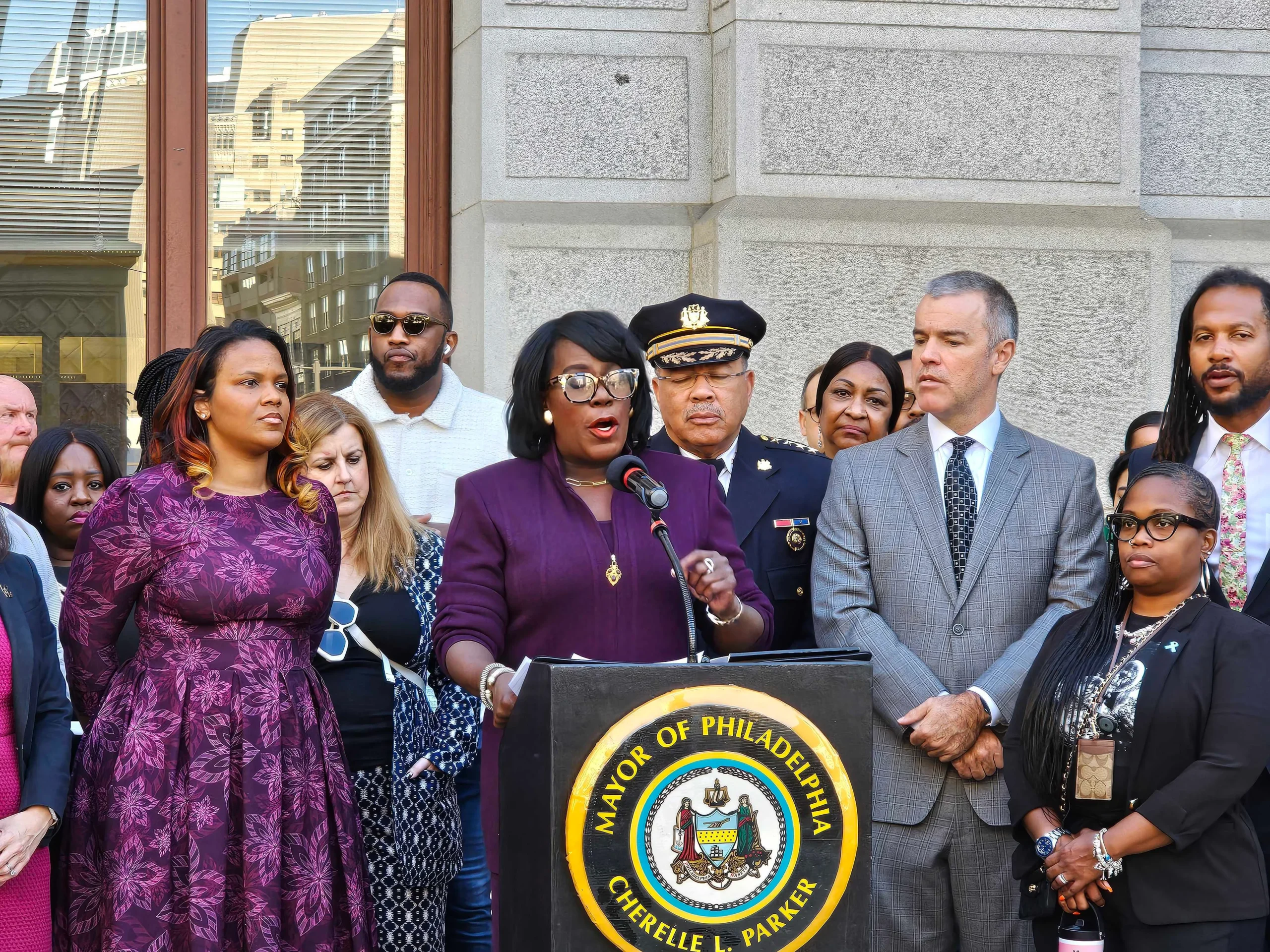
While Parker mostly avoids talking to local media, she is partial to one-way press conferences, flanked by an entourage of nameless toadies, where she spins half-truths and lies by omission, toggling between teary eyes and stern-faced proclamations delivered with the cadence of a black preacher parody.
This all from the person who ran on a platform of making Philly “the cleanest, greenest city”. It’s almost comical. Except there’s nothing funny about having to steer a stroller through an obstacle course of trash, just to take my kid to the playground.
There’s nothing funny about Philly continuing to choke out Chester, while Parker brow-beats the public and bullies her own employees.
How should I reconcile this contradiction between the earnest attempts to address Philly’s waste problems on one side from Gauthier and her team, and bloated rhetoric and hand-waving from Parker on the other?
I have one idea.
At some point during the sanitation worker strike, in holding the line for austerity, and denying her workers what they deserve, Parker was quoted as saying “If that means I’m a one-term mayor, then so be it.”
So let’s put that shit on a T-shirt. And ensure that at least one thing out of Parker’s mouth turns out to be true in 2027.
I don’t put much stock into the idea that we’re living in a simulation, first because I plainly don’t believe it, and second because it wouldn’t matter if we are. This is the only reality we know, and if “somewhere else” we’re actually just brains in jars hooked up analog to some supercomputer via some bio-electronic interface or just digitized consciousnesses interacting within a similar machine, it changes nothing for how I live my life.
Just like the actual composition of my body being quarks and whatever other weird subatomic shit I don’t understand is irrelevant to my conscious lived experience.
But what I want to start sketching out here are my thoughts about how what we experience as “reality” is increasingly manufactured — a simulacrum — even as compared to 10 years ago. These thoughts are mostly abstract and speculative, and maybe some day they’ll coalesce into an actual argument, but for now…
It has started to feel like our whole society is built on templates: housing, food businesses, entertainment, etc. Endlessly reproduced. Never so clearly as with the sudden emergence and widespread proliferation of the Hot Chicken Shop™. Or the countless new malls and food courts popping up in the repurposed ruins of post-industrial decay. Thousands of sleek modern storefronts with cute logos and band-random names, only barely concealing the near identical machinery and logistics behind the facades.
The people who make it work are fungible: workers, consumers, politicians, voters, renters, swapped in and out in regular cycles of varying durations, from seconds-long transactions to leases to elections. Until they can be completely replaced by machine algorithms in the name of “efficiency”. The new gentrification will see humans displaced by data centers.
This is all further exacerbated by social media, which consists of a wide range of generated/simulated realities, into which people are plugged in like widgets. All clamoring for validation and the subsequent dopamine hit it brings, and on the contrary either crumpling or raging at any criticism (fight or flight).
Zoom backgrounds and Instagram performativity: people playing at / simulating real life for other people’s consumption and their own validation. Labor, consumption, the messiness of actual life are external to this bid for attention in the absence of actual community.
“AI” (it’s not AI) is the logical endpoint: the ability to instantly and massively reproduce anything, to diversify the templates so they better simulate the plurality of real lived experience. Following Google’s idea (as expressed in their Selfish Ledger “thought experiment”) of “custom objects”, on a product search, I can imagine a consolidated marketplace (soon to be entirely Amazon) that generates custom websites — in real time — suited to the user’s aesthetic sensibilities.
Merely simulating a small business / boutique shop selling that product and those in its proximity (category/theme), including phony copy about the shop’s backstory and proprietors, complete with generated photos catering to cultural/political sensibilities as well. Where a “Black-owned” or “MBE” business is instantly simulated for one user, the same search generates some boutique owned by a folksy Midwestern grandma for another.
But there will be no actual inventory until a purchase is made, at which point the object is 3D printed or assembled by sweatshop labor from the global south and shipped within 2 days.
For certain large commodities, like houses, for those whose data profiles (prior purchases, current needs, income, and perceived suggestability) indicate a high likelihood of purchase, the websites can have even the images of these items AI generated, situated in an existing vacant lot within a shared developer inventory, and after negotiation and settlement custom built within days. This housing inventory — for the rapidly decreasing minority who can afford it — would be subject to a rapid cycle of construction and demolition in accordance with the market and the algorithm.
For poor, working class, black or brown people, immigrants, disabled, others, their marginalization is defined by their externalization from the “simulation”, exacerbated by a lack of control of the means of production or even subsistence.
The ledger and the archive work together to maintain and direct the inertia of the simulation. Black life in particular, where it can’t be (re)purposed through labor or consumption, remains an externality to be controlled, channeled, stored: in carceral systems rather than servers.
Where there are gaps in the simulation, due to capitalism’s internal contradictions, and ongoing processes of extraction and exploitation, additional “UI” layers — such as escapist entertainment, social media, VR — act as “patches” to keep us sufficiently engaged, instead of peering through the cracks as our material and political realities collapse.
Those of us who at least glimpse the contours of the simulation, and have both the wherewithal to resist and bolster ourselves against deprivation, are the “radicals” the system managers work to destroy or co-opt…
But the overlords in charge of the simulation may be overplaying their hand in the mad dash to technofascism, shattering even the pretense that everything will be okay as they openly steal the minority of resources they don’t already control.
And maybe, just maybe, people will be able to successfully organize across every manufactured division to break the simulation’s hold…
In August of 2022, I enrolled in the Temple Geography PhD program. By December of 2024, I was exiting the program early, with a Master’s Degree. I did not make this decision arbitrarily, nor did I leave because of any academic or personal difficulties. It was the result of members of the Geography Department (GENUS), including my own advisor, creating a hostile academic environment.
This is my attempt to hold certain individuals publicly accountable, even as I expect there to be no consequences for them. I am also writing this to provide information: to current and future Geography PhD students, as they pursue their own degrees and make decisions about who they want to work with, and to people and organizations outside the Academy, that they might weigh the pros and cons of any deeper engagement with the individuals named here. I should note, however, that my characterization of the GENUS “department” as hostile does not extend to any faculty not explicitly named here, most of whom I’ve never even met, any of the staff, or my fellow graduate students.
(As this is quite a long post, my advice for anyone taking the time to read it is that the main body of the post sufficient frames most of the supplementary content — screenshots of texts and emails — so skim or even skip it, unless you really want or need that deeper context.)
When People Tell You Who They Are…
I applied to the Temple Geography PhD program with full self-awareness of the inherent contradictions of being a self-professed school abolitionist and seeking 5 more years of schooling. I was also quite forthright about this tension in my statement of goals:
It may seem ironic that a school abolitionist would seek to enroll in a PhD program for at least another five years, but rather than more schooling, I am seeking to enter a community of practice, to engage with like-minded scholars in the co-construction of knowledge and more importantly, its application to radically improving the lived realities of the people of Philadelphia.
The committee that accepts students into the program presumably read my statement, and therefore had some idea of what to expect from me. My advisor, Christina Rosan, absolutely knew, as we were familiar with each other for a full year before the program began. They read my letter and said, “okay, come on in…and here’s some funding.” Perhaps 2022 was close enough to the short-lived post-George Floyd white liberal racial awakening that the committee felt obligated to swallow down any concerns or apprehensions in the name of “DEI”, and/or to keep up appearances as “good white people”, or even “allies”.
Regardless, that search for a community of practice, for application, is what never manifested for me at Temple, and what became the central tension in my time there. The rest, unfortunately, was a clash of fragile egos with a personality (mine) that gives no quarter to such fragility, least of all when it’s wielded against me in a hierarchical fashion.
Fall 2022: Fragile Egos and Hierarchies
It was bad from the beginning. In Fall 2022, the COVID-19 pandemic was still raging, new variants emerging, cases spiking, and the first whisperings of so-called Long COVID were getting louder. I was a new parent to a 7-month old, and son to a high-risk parent who also assisted me with childcare. Protecting the health and wellbeing of my family was paramount.
And so even though Temple’s policy was “mask-optional”, which generally meant “no masks”, I wrote to all my professors in advance to ask if we — professors and students both — could discuss a class policy. Two of three agreed, and the result was that everyone would mask. It wasn’t contentious at all. But the third professor, Jacob Shell, informed me that he wouldn’t even bother to ask the class because he himself would not be masking. Why? In his words:
running a seminar over 2.5 hours is enjoyable but physically-mentally demanding—at least the way I do it–and with a mask on the whole time it becomes much harder
At the time I couldn’t imagine what this meant. What could he possibly be doing that was so “physically and mentally demanding”? Aerobics? Or maybe he had some kind of disability? I decided to play it by ear.
As it turned out, what was so demanding is that Shell spent most of the two and a half hours talking. In fact, he out-talked the students 4-to-1. I know, because I timed it one day out of morbid curiosity. The first inklings of an argument were bubbling up.
The class was Geographic Inquiry, the purpose of which is to orient new students within the Temple Geography PhD program by offering a kind of survey of the sub-disciplines and the historical and thematic turns made over the years. That would’ve all been fine, except that Shell chose to take something relatively mundane and practical and change it into what I can only describe as intellectual masturbation — framing it all within Thomas Kuhn’s concept of “paradigms”.
If that wasn’t enough, he assigned us a reading from Italian fascist mystic Julius Evola, a racist misogynist who continues to inspire other racist misogynists in the present day. Why? I couldn’t say for sure, but what’s thematically resonant here is that Julius Evola, according to his Wikipedia entry, valued “authority, hierarchy, order, discipline, and obedience”.
About a month in, my concerns about COVID were still present and I saw no legitimate reason for Shell to to place what seemed to be nothing more than his personal comfort, above the health and wellbeing of my child. So I emailed him again. This time I copied the whole class, to circumvent Shell’s administrative bottleneck. I raised two issues: 1) my objection to his mask policy, specifically that he had made the decision unilaterally, and 2) my problem with his idea of a seminar being a 2 hour lecture, broken up only by the occasional question, which after 20-30 seconds of silence, he would usually answer himself. And then quite logically, I connected the two:
I swear I’m not trying to be facetious with this next part, but the connection between Issue #1 and Issue #2 is that maybe if you made more space for us to talk, it wouldn’t be so “physically-mentally demanding” for you to wear a mask. Please also understand that if there’s a tone you’re picking up on from this email, it is coming entirely from my ongoing concerns about the safety and well-being of my 7-month old child.
I made references to the health of my child four times in that email. And yet Shell never acknowledged it. He instead suggested I take the issue up with the department chair, Melissa Gilbert, knowing that she could not, because of university policy, demand he do anything different. It was a move that basically communicated he didn’t give a shit about my kid. But I was supposed to sit in front of this man while he gassed on about paradigms and mystical fascists, without complaint? Not likely.
In our back and forths about the merits of a lecture-dominated “seminar”, his feedback was that I “should worry less about how [he is] teaching the class, and more about getting reading and assigned documentary viewing done”. Also that his motivation was to get across to the class “a certain set of ”anchor’ ideas—ideas which are not always obvious to students”. And then, as if to reinforce his point, he compared his approach to the relationship between the inimitable Ruth Wilson Gilmore and her PhD advisor Neil Smith, as:
the product of a distinct tradition of taking the professor-student relationship, defined in a hierarchical way, as real and something to launch from.
This condescending elitist, who would place his own comfort above the health of his students and their families, nevermind their agency in making choices about their own health, also found it necessary to teach about a man who valued “authority, hierarchy, order, discipline, and obedience”, and to position himself as the Neil Smith to my Ruth Gilmore? Him? Mentoring me? The analogy was an insult to everyone involved. It’s almost comical now, but at the time, it had an early tarnishing effect on my experience.
In the end, I chose to attend the class virtually, but I also decided to make something clear to Shell:
Know, though, that our relationship will never be one of mentor and mentee, as you are not some superior scholar by whom I will be inspired, or directed. It’s that exact top down attitude that I find objectionable. But it matters not. Your class checks a box. And so it will be checked. That is all.
Shell is a man whose academic understanding of people and place is so out of touch with the actual people and places he talks about – and worse, lives and works in proximity to – that in December of 2024 he was “amazed” that the restoration of a statue of some 11th century Icelandic explorer, who never stepped foot into what would become Philadelphia, is the priority of precisely no one.
“Probably Antifa!” 😂 (Citation Needed)
A look through Shell’s Twitter feed suggests an unwavering devotion to Eurocentrism, to extolling the virtues of European (and mostly male) thinkers, and to criticizing any political efforts to challenge or undermine their importance. Shell’s Geographic Inquiry class was the same: in discussing all of the “turns” in Geography as a discipline, the only non-white person he had us read was Chinese Human Geographer Yi-Fu Tuan, while the only woman was Ellen Semple.
While I wouldn’t deny the outsized role of European / white scholars in Geography, being an imperialist discipline for most of its history, I found it strange that Shell deemed the scholarship from other people and places irrelevant to its development over the years. Yet a place was reserved for Julius Evola, who wasn’t a geographer at all. This, taken together with his inflation of Neil Smith’s role within Ruthie Gilmore’s scholarship, while neglecting her own significance in steering Geography through its more recent turns, his hierarchical mentality, general arrogance, and total disregard for the health and wellbeing of my family, created an atmosphere permeated by white supremacy, even as he never made it explicit.
If only that were all I had to deal with in my first semester. But it was only one example of the “professor-student relationship, defined in a hierarchical way”.
Sanjoy Chakvravorty is someone I would characterize as a third world apologist for capitalism[1]I’m aware of the inelegance and obsolescence of the term “third world”, but I use it with intentional derision, and to separate this man from the “Global South”, which I … Continue reading, one who rejects arguments for climate drawdowns in the Global South, because non-Western countries are due their opportunities for economic growth at the expense of the planet. Chakravorty is somewhat infamous at Temple, having been there for over twenty years, yet deaf to the whispers of disgust swirling around him from every direction — students and faculty both — presumably because his own internal dialogue is too loud.
At some point he made a statement, something to the effect of the average Indian only owning three acres of land. And that this was not enough to make a living. I was rather stunned, as someone from Philadelphia, where we have pitched battles over urban agriculture done in 2,000 square foot parcels, and as a permaculturist, who knows that with the right methods, very large yields can be generated from relatively small amounts of land. I tried to bring these points up to him, and he, without any counter-evidence, just kept insisting that I was wrong. After advancing several related arguments, and even saying I had at the citations to back it up, he attempted to shut me down, saying “Kermit, you need to know when to back off”.
Y’all. Listen…
Anyone who knows me, also knows that “I am not the one”. Which means that aside from generally rejecting hierarchy, particularly where it subordinates me to anyone else, people should understand that their positions within certain formal, professional contexts, are completely dissolved outside of those contexts, and even more immediately where they treat me with disrespect. That’s a roundabout way of saying: don’t say any shit to me in the classroom that you’re not willing to say to me on Berks street.
I approached Chakvavorty after class, to set clear boundaries for our would-be professor-student relationship. We had a contentious discussion, in which he explained that he “has been studying land issues for 10 years”, and accused me of “only having ideology”, and claiming — evidently with zero knowledge of the term — that permaculture “is technology too expensive for India”. He also saw fit to place the blame for Sri Lanka’s food crisis, resulting in part from the government’s sudden banning of pesticides, on environmental activist Vandana Shiva. This revealed a shallow understanding of both Shiva’s overall arguments for regenerative agriculture, and the broader sociopolitical dynamics in Sri Lanka.
Within a rather long five minutes, Chakravorty outed himself as both someone who, in spite of 10 years of study, had no idea what he was talking about in this particular context, and as someone who, perhaps for his credentials, automatically assumed his 10 years gave him more knowledge than me. Oblivious to the possibility that for all he knew about me — that being nothing — I could’ve myself been a smallholder farmer in India for the past 30 years. It was the same mentality as Shell, which presumes that students are automatically, for their position in the academic hierarchy, less knowledgeable.
Toward the end of our conversation, Chakravorty said to me that “your insistence on arguing this point makes me inclined to not take anything else you say seriously.” Not only unprofessional, but unscholarly, and undermining of his credibility. Or, to put it a different way: his insistence on refusing any evidence that contradicts his position makes me inclined to dismiss every bit of academic output he’s ever produced. Because what, for his ego, has he failed to consider or even notice? At the urging of my partner, who didn’t believe he would evaluate my work fairly, I ended up dropping the class.
A culture of internal debate is inherent to Academia, from the common practice of peer review, to the “defense” of dissertations, to fact that many articles are written from a defensive posture, with the authors’ anticipating critique and trying to write “ahead” of it. Academics should, at any time, expect their ideas to come under scrutiny, and be prepared to counter them with their own evidence and citations. Why should my challenge of these professors at Temple not be received in the same way?
Because the key word in “peer review” is peer. Where challenges come from other, similarly credentialed academics, they warrant due consideration, not for their merits, but for the status which underpins them. For both Shell and Chakravorty, because I was a student, independent of the merit of my arguments, or even my own credentials, I was not qualified to challenge their ideas or their authority because of the “professor-student relationship, defined in a hierarchical way”.
That these two SIMMS[2]Acronym for “Self-Important Mutual Masturbation Society”. SIMMS can refer to departments, whole universities, or the Academy as an institution. It is also appropriate to call an … Continue reading, one whose class I was in for maybe two weeks, and the other who gave me an A- for the semester, tried to make a case against my continuing in the program after the first year, only further demonstrates how much ego supplants reality. And, in case you’ve lost track, this was all still in my first semester.
Interlude: The Passion of Dr. Christina Rosan
I met Christina Rosan (Tina) in 2021, when we were both working group co-leads for Drexel’s Climate Resilience Research Agenda. During that time, I came to learn about Tina’s other projects, which aligned well with my own aspirations, and a budding interest in Geography. It was Tina who convinced me to apply to the Temple Geography PhD Program, which I did with the explicit intention of having her be my advisor. Throughout the three and a half years we’ve known each other, we worked on various things, both within the student-advisor relationship, and beyond.
The most significant of these was “PREACT”, an NSF grant proposal to create an environmental mapping tool, toward which I donated hours of free labor and insights. When PREACT’s progress stalled, and I was invited to participate in a related project with a different team, I was very intentional about trying to bring Tina onboard, or where those attempts were rebuffed, keeping her apprised of its progress. I was steadfast in my loyalty. Because I had come to regard Tina as a friend — something which would later prove to be an egregious error in judgment.
Throughout our relationship, I remained consistent. Authentic, candid, perhaps to a fault, prone to liberal use of hyperbole and profanity, if it serves the point I’m trying to make in any given moment. None of this seemed to phase Tina, but if it did, there were many ways, both passive and direct, and many opportunities for her to express a discomfort, displeasure, or even concern with how I communicate. She never did. Never showed even an inkling. More than that she regularly engaged with me, and on many occasions we commiserated over our experiences within GUS.
My sense that Tina was a friend, not just an advisor, wasn’t just because of what I was able to share with her, but what she shared with me, which suggested a certain level of trust. She told me about her struggles within the Geography department, including her distaste for various faculty within the department. Tina had a particular gripe with Kimberley Thomas, who she saw as leading the charge to drop “urban studies” from the department name, which Tina saw as diminishing of her own work, and weakening the already tenuous connection between her and the department, given she is not a geographer by training. She shared her dissatisfaction with the pace of her career advancement, specifically around publishing requirements, her feeling that the book she had co-written a few years earlier was not being counted as it should have been.
I saw parallels between my feelings of alienation in the Temple Geography PhD Program, and Tina’s own expressions of feeling like something of an outsider. I thought this, perhaps more than anything, made us the right fit for each other. It became a regular thing for me to consult her opinion on different faculty as I decided whether or not to take a class, or even to consider them as possible members of my committee. If she had thoughts on a person, she would make suggestions based on how compatible our respective personalities were. Other times she would let on that she just disliked certain people, which didn’t necessarily translate into advising against taking their class, just perhaps that I should be wary.
What would eventually become clear, however, was that what I perceived as cause for commiseration and solidarity between Tina and I, was actually more a sign of her own fragility and sense of professional precarity at Temple. In one way or another, Tina was always a victim: of Kim’s attempts to marginalize her within the department, of Abby Sullivan’s rudeness when Tina reached out Philadelphia’s Office of Sustainability to discuss PREACT. She was a victim again, when a former colleague — barely an acquaintance, really — pursued a similar project and was able to actually get the funding where she was not. She was, in her imagination at least, maligned by the entire planning department at Temple — particularly Lynn Mandarano — who she suspected of resenting her for being in the Geography department, on the wrong side of an old rivalry.
When I look back on it now, I realize that Tina never quite “got me”, or perhaps never really tried to do so. While our conversations outside of the program were fruitful, those within the student-advisor dynamic seemed to always return to what I needed to do to comply with the PhD requirements. I asked her on multiple occasions to try to understand the bigger picture of what I was trying to do, and why I was having such a hard time. I offered her additional context, and asked her to read my earlier work, that she might understand how I imagined my own trajectory. That she never took me up on any of it was something I attributed to her lack of time or capacity (as a researcher, professor, and parent), rather than any lack of interest or commitment as my advisor.
But the warning signs were always there, echoes of earlier experiences where people who hold some social or political power yet simultaneously harbor some dubious claim to victimhood, are in some position to hurt me personally or professionally. That these experiences have almost always involved white women, like Tina, is not a coincidence, but rather inherent to the entire race-class power dynamic between us. In spite of my experience, how this would all manifest, how it would come to a head, still managed to surprise me.
Spring 2023: On Strikes and (the lack of) Solidarity
It was in my second semester that TUGSA, the graduate student union, went on strike, and where it was revealed just how little respect the university administration has for graduate students. “You aren’t an essential function of the university” is what they said to TUGSA representatives during negotiations. What surprised me was the complicity and cowardice within the Geography department, most of all from Melissa Gilbert, who was department chair at the time. Rather than using her position to provide some cover, she complied with the administration’s demand to identify the students who were striking. Worse, she also had the audacity to scab for a student’s class. The text thread below is a conversation between me and Melissa, in which I refuse to admit whether or not I’m striking, and question her rationale.
At the same time me, I was also having conversations with Tina, whose concern, like always, was about my ability to complete the program, and how striking might affect it. But what’s more relevant to here is how Tina offered nothing by way of defense of her colleague, nor did she take issue with my colorful language — no indication that she felt disrespected by it, or threatened by it. This is important context for later.
I do need to add here that after the strike ended, Melissa helped to get my former teacher assistant assignment (which was no longer available) changed into an research assistantship with Tina so that I could be paid for the rest of the semester. That was much appreciated on a personal level, and while it doesn’t give me cause to withdraw my previous statements, I’d revise them slightly to say Melissa was guilty of “cowardice”, as a behavior in a particular moment, as opposed to characterizing her as a “coward” overall. This whole situation, however, left me distrustful of Melissa, insofar as my ultimate inability to form a committee, as I will discuss in more detail later.
Fall 2023: Public Policy and Fundamental Differences
As the primary caregiver for my young child, it was difficult, if not impossible, for me to teach in-person synchronous classes as the work requirement for my enrollment. I avoided this in my first two semesters by being assigned as a teacher assistant, grading undergraduate work, which I could do on my own time, and from home. Knowing that I couldn’t count on TA assignments always being available, I searched for other funding options every semester. For Fall 2023, I was able to secure a fellowship with Temple’s Public Policy Lab (PPL), mostly I think, by riding a wave of good will that Tina had established with the people who ran the program. I want to be clear that at this point, Tina did seem genuinely committed to my longevity and success.
The PPL fellowship was a challenge for two reasons. First was that the expectation was that I attend in-person meetings two days a week, which was impossible for me because of my childcare responsibilities. As far as I knew, there was an understanding between myself and the PPL directors, but Tina clearly insinuated that they were unhappy with the arrangement.
I find it very difficult to understand passive aggressive behavior, or a general unwillingness to be candid or forthright. It’s probably clear from my account so far that if I have an issue with someone, I approach them directly to discuss it. If there was a problem with my not attending PPL meetings on the second day, I should’ve heard something about it, whether in person or even by email. So, really, I can’t even be sure that the PPL directors had a problem, or if it was actually Tina, more to do with the social capital she spent to get me into the fellowship in the first place. Maybe she felt that my “halftime” commitment reflected badly on her? If so, this was yet another thing that could’ve been addressed with me directly.
The second reason that the PPL fellowship was challenging was its very structure: bringing together graduate students and faculty from different disciplines to discuss their active or forthcoming research and/or projects. At least one week in advance, each fellow would share their work with the group, and then we would all discuss it, critique it, offer feedback during in-person meetings.
This quality of interdisciplinarity wasn’t the problem in itself. Rather it was that there was no unifying pretext or theme, other than perhaps the vague category of “public policy,” which my work, and certain others, didn’t really address. The discussions we had during PPL meetings were interesting, and even productive in some cases, and I am sure at least some fellows walked away with some valuable feedback — some of which, I’d like to believe, I was able to provide. But because we were mostly from different disciplines, and writing from certain foundations which were not mutually understood, the sessions sometimes featured a lot of confusion, explanations, and clarifications.
When it was my turn to share my work, I got the sense rather quickly that most people either had not read it, or had given it only a cursory glance, perhaps at the last minute. I say this because most of the questions that were raised were addressed in the work itself, in that hallowed academic tradition of anticipatory defensiveness. More than that, the questions exposed a complete misunderstanding of what I was actually trying to do, resurfacing the core tension between theory and practice which was emblematic of my entire experience at Temple.
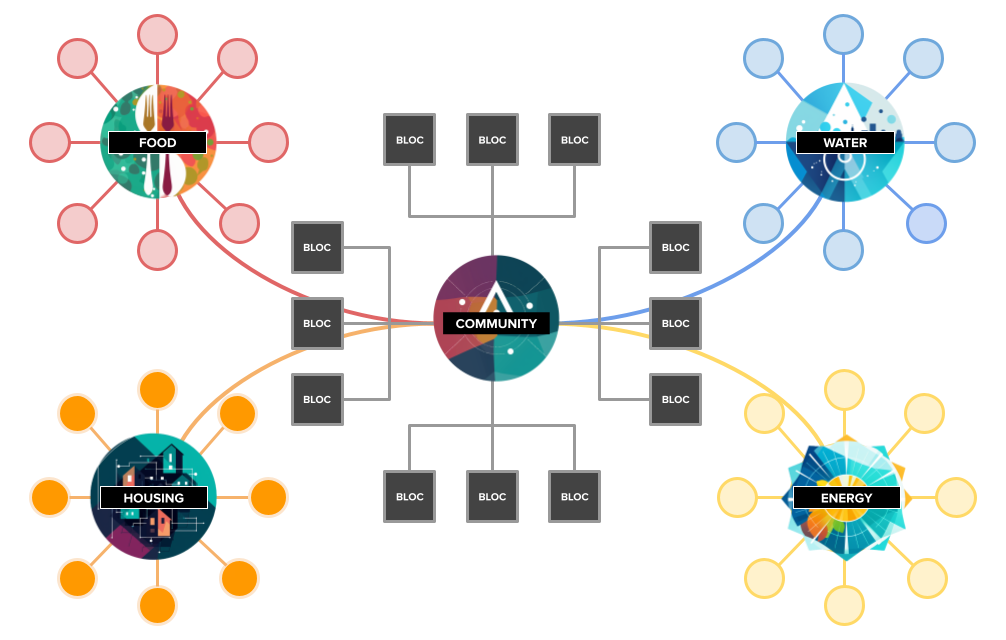
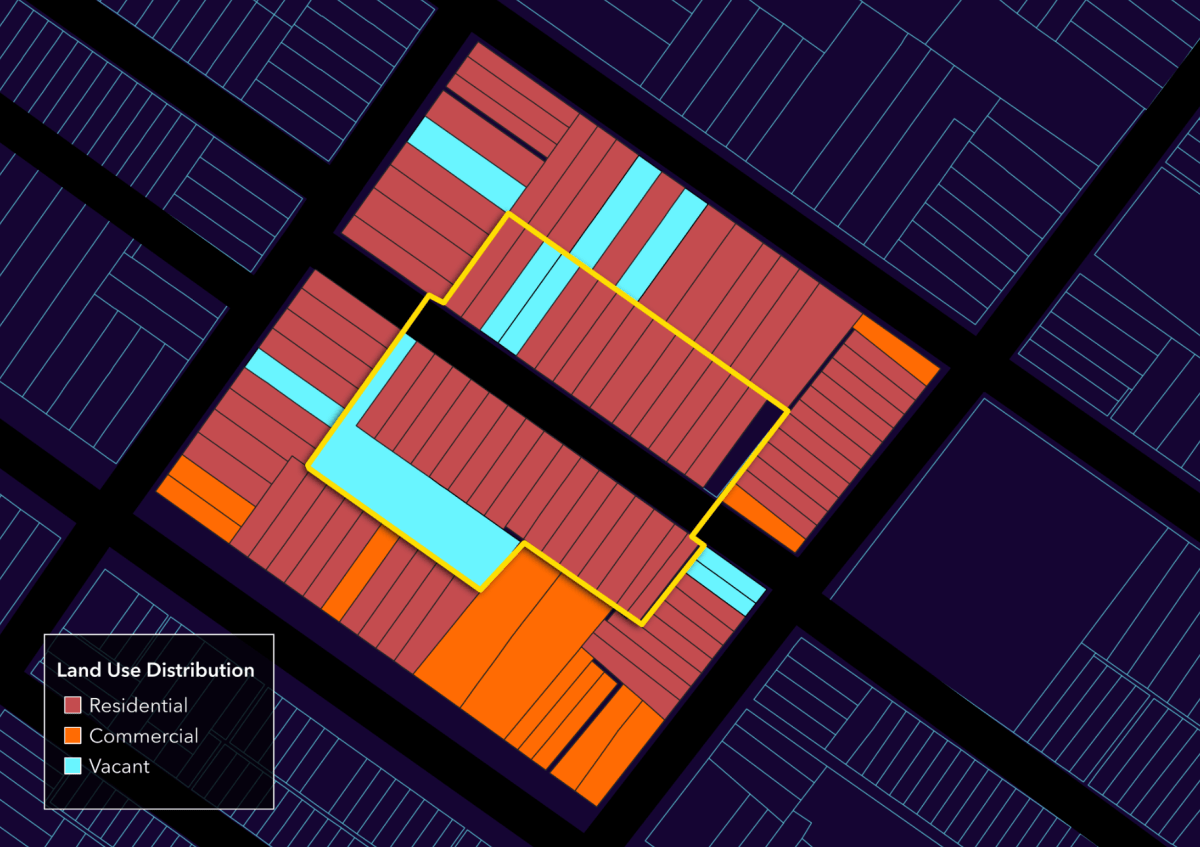
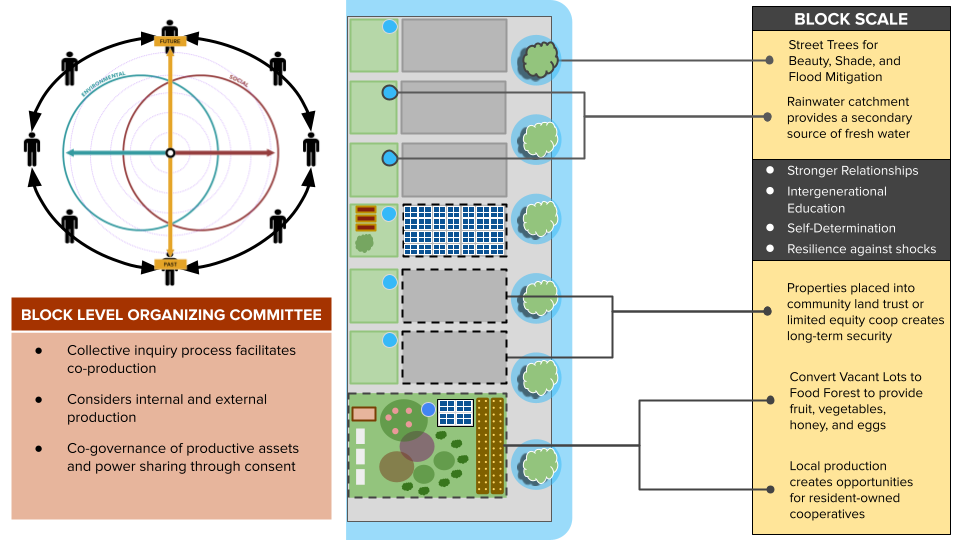
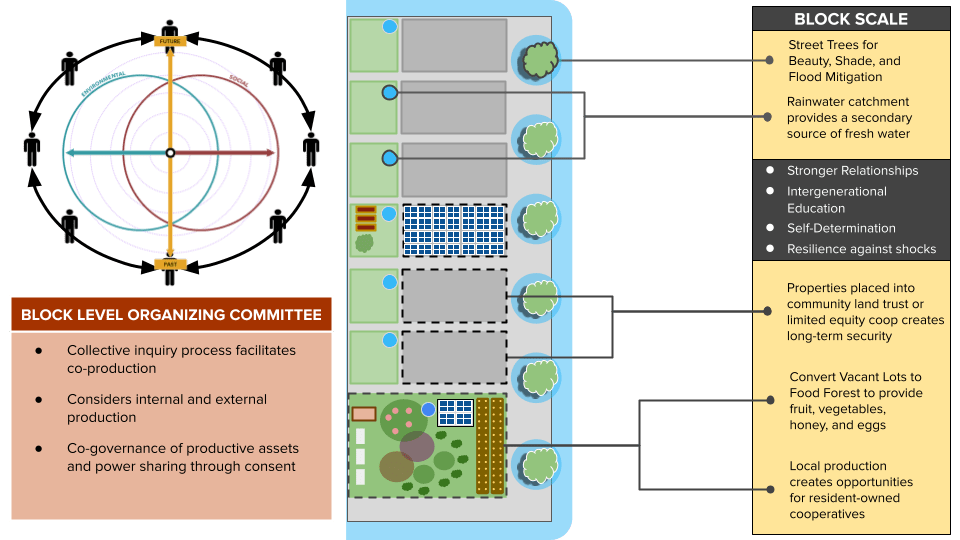
At one point, Colin Hammar, the Associate Director of the PPL asked me a question which made no sense to me in the moment, but for which I have since conjectured a satisfactory explanation. What I presented was an early version of my Building BLOCs research, which if you’re unfamiliar with my work, is about modeling resilience at the scale of the city block, as an actual practice, if for reasons that are currently only theoretical. Colin asked something to the effect of “What about equity?” — that if my block alone were to achieve some standard of resilience, as I defined it, what about all the other blocks which did not have the same experience?
Huh?
This was confusing to me for two reasons. First, the paper I submitted clearly explained that my work was about modeling, and that successes and failures would be shared in an attempt to “scale” the desirable outcomes. Second, by what definition of equity should one group of people be denied the benefits of their labor, simply because other people do not share in those benefits? Completely absent from the question, too, was any consideration of the context in which my research and work was situated: poor and working class, and mostly Black, and therefore any improvement of their quality of life, especially where achieved through their own self-determination, would mitigate deeply entrenched inequities. This context was laid out at the start of the paper.
I also will never forget how, at the end of my session, Judith Levine, the director of the Public Policy Lab, said “good luck” with a smirk and a roll of her eyes. It really is the subtle things. My time in the Academy was like a war of attrition, so many micro and passive aggressions that could be plausibly denied even as their grinding effect continued to take its toll.
Some time later, I came to my own explanation of Colin’s question. If the lens through which he was viewing my work was publicpolicy, such as could — theoretically — improve quality of life citywide, then I suppose focusing all of my attention in one small place could seem “unfair”? If, also, he was of a mind that the state is the only vehicle through which inequalities could be resolved, our two frameworks were almost entirely incompatible. Colin would hardly be the first person I’ve encountered who could not grasp the possibility of people improving their own lived conditions outside of and even against the whims of the government.
I only realized that Christina Rosan was another of these individuals when she said so directly. One day, as we were walking and talking through West Philly, she told me in so many words, that she “didn’t believe what I believe” — that people, of their own volition and power, and without state intervention, were capable of changing our current conditions. This, for me, was the first real “crack” in my self-assurance that she was the right person to advise me on my PhD journey. It was from this point on that every dogmatic return to the fundamentals — her constant harping on what I needed to do to get through the program, more about compliance than engaging with the actual content or merits of my work — felt more like an irreconcilable difference.
Spring 2024: Neurodivergence vs. Compliance
I came into the PhD program knowing more or less what I wanted to study, what I wanted to write about, and at least the kinds of things I wanted to accomplish through practice. This position emerged from a deep understanding of my own needs, as well as my neurodivergence. As anyone with ADHD will tell you, doing anything that is “not interesting”, even something as mundane as housework, can be practically Promethean in its difficulty. Graduate school classes are not housework. In the Temple Geography PhD program, they were far more grueling, much less practical, and in most cases, considerably less interesting.
Two classes which did not feel so grueling were both taught by Allison Hayes-Conroy. One class was directly relevant to my research, and in the other Allison allowed me to tailor the class requirements to the needs of my research at that juncture. It was through those two classes that I eventually developed the 5D Ecological Compass framework, which, far more than even the Master’s Degree, was the most (and perhaps only) valuable thing to come out of the program.
Allison would later tell me that she was disappointed with my progress, taking my narrow focus as my being “not interested or open to learning from the faculty in the program”. This surprised me, not that anyone would misunderstand me in this way, but specifically that she did, because I thought I had done some of my best work for her classes. It was true at least that the work I turned in to her was a steady evolution of the same ideas, and so while I understood how she could come to that conclusion, it didn’t feel great to be so mischaracterized. That all said, I greatly appreciated what autonomy she did allow me within the confines of the program, which as I mentioned, resulted in some of my best work.
By Spring of 2024, I was almost done with classes. Two more semesters and I could dive fully into my actual research, rather than trying to rework class requirements into something relevant. I took a Research Design class, which in addition to being a requirement for the PhD program, also functioned as the thesis course for the Master’s degree. The class was taught by Kimberley Thomas, who at that time was also the graduate chair. I liked Kim, at least in the beginning. My first interactions with her were not as her student, but through helping her set up part of the annual Nature and Society workshop — specifically, leveraging my personal connections to secure a local site visit for the participants. In the class, she was amicable, approachable, and really good at facilitating conversations amongst the students — completely the opposite of the top-down approach of Jacob Shell or Sanjoy Chakravorty.
My problems with the class, and eventually with Kim herself, were two-fold. First was that, in my mind, a “research design” course should have been primarily about methods, that is, how we should structure our actual research. Instead the class was mostly a writing seminar, the final product of which was a mock NSF proposal. Being able to write such a proposal would no doubt have been useful if I had any intentions of being a traditional academic, or someone who ever planned to apply for NSF funding, but neither was true for me.
My expectations for the course may have been misplaced, or based on my own misunderstanding, but it was disappointing nonetheless, especially since I was feeling no more like a “geographer” than I did before starting the program. This feeling had to do in large part with the utter failure of Jacob’s Geographic Inquiry class to orient me within the discipline, and the dynamics within the department as a whole, which as I described to Tina at some point as “a bunch of loosely affiliated faculty in a neoliberal university offering classes in their own areas of expertise, or based on their own interests or career advancement goals/requirements, with no semblance of continuity or thematic consistency, let alone any application in the real world.”
A characterization I stand by firmly today.
Aside from the scathing tone of that sentiment, what it really meant for me in practice was that nothing I was learning in the classes necessarily built on top of anything that came before. I never felt like I was gaining any traction, least of all in ways that felt important or relevant to the research I wanted to do. Today I have a Master’s degree in Geography, but I can tell you point-blank that I am not the master of shit as it pertains to this discipline. I am no more a geographer than I am a peanut. Less, actually, because I share at least some genetic commonalities with Arachis hypogaea.
The second problem with Kim’s Research Design class had to do with what I mentioned earlier, around my ADHD and struggles with attention on things I don’t find interesting. Before the class even began, however, I advocated for myself around my disability, by email:
Kim’s response was basically that I didn’t need to worry because the class was so essential and relevant to my future work in the program that everything would fall within the “cone”. Unfortunately, this was not the case, for the reasons I mentioned above, about the structure, purpose, and utility of the class (for me). More than that, it consisted exactly of the kinds of “small, relatively trivial assignments, that reflect compliance rather than comprehension or application”. The class was a week-by-week construction of the eventual mock proposal, and so it wasn’t long before I started falling behind, just as I had anticipated, and in spite of my every effort to push back against my own inertia.
Because all the assignments would eventually culminate in one final product, it seemed less important that I complete them on time, than to demonstrate the capacities they represented within my final proposal. I asked Kim if I could focus on what was current and work on the smaller missed assignments along the way. She confirmed that it was okay, and that I did not need to worry about my grade.. This would turn out to be untrue. Even though I received an A on my final proposal, indicating that I had “mastered” all I needed to learn, and indeed had worked in all of the smaller requirements, I received a C for the course. The reason Kim gave when I challenged her on it, was that I was docked for not completing all of the peer reviews for my classmates. I believe there were two, maybe three of these, out of maybe 10 to 12 assignments. But, as I said to Kim in an email:
The issue here is a technical/bureaucratic one, again to do with Canvas. Because I did not submit assignments on time, I simply did not receive peer work to review. Every assignment that I did review, I gave my full attention and thorough feedback. I was willing to do that at any time, outside of the Canvas system, but there was no opportunity to do that.
At no point when I expressed concern about my grade, did Kim mention the reviews being significant enough to almost completely undermine the rest of my work, in terms of my overall grade. What will become more clear later is that Kim has a tendency to be “flexible” with the truth.
In a later email, I framed my discontent with my grade in terms of disability accommodations, but along the way I also expressed my frustration with the program, with particular professors, and with what I felt were compliance measures rather than any assessment of my academic merits. Because I used accommodations as the basis for my argument, Kim went into defense mode, ignoring my more emotional appeal, and instead explaining how she had in fact complied with all her obligations according to university policy. It was ironic that of all the things I said in my email, Kim took it as some kind of attack on her non-compliance. I would attempt to make my actual intentions more clear in a follow-up email.
Kim did not respond.
At the end of the Spring 2024 semester, there was an “annual progress report”, a new initiative within the department. Before this, whatever process the faculty engaged in to determine whether or not a student should proceed in the program was completely opaque. About a month before the reports came out, Kim, in her role as graduate chair, sent out a survey to the graduate students, asking us to share our sense of our own progress, as well as what we’ve been working on outside of classes, such as volunteer work, fellowships, etc.
The “progress report”, which was issued about a month later, was odd for the fact that it was merely a recounting of those same self-reported activities, along with a recognition of my dissatisfaction with the program — which Kim no doubt derived from our email correspondence.
The response of the department was basically, “suck it up or bounce, bruh.” No questions or offers about how they might support me, or what might change to make my experience better. Nor any acknowledgment of the ways they (as a department) were complicit in, or directly responsible for that frustration and dissatisfaction. It was like the most passive-aggressive middle finger. Passive aggression, as you’ve surely recognized, was something of a recurring theme.
I couldn’t tell you whether Kim’s signature at the end of the letter meant that these were her own sentiments, or a consensus amongst the faculty that she represented as graduate chair, but it was her voice in my head as I was reading it. On the heels of our recent communications, what happened in Research Design, this more or less disqualified her for me — emotionally — from committee candidacy. I didn’t feel like I could trust her.
This distrust was even more warranted than I realized at the time.
Fall 2024: Petty Antagonisms and a Stunning Betrayal
One more semester of classes before I would get to formally delve into what I had already been informally doing the past two and a half years. My own research. All the struggles and deciding to persist were all to get to that point. Except, I wouldn’t make it.
The issues in my final semester began with class offerings that continued to feel extraneous, discontinuous, and from my perspective, arbitrary. My options were either to attempt another independent study — I had done two others prior to this — or to seek classes outside the department that met the requirements for the PhD. As it happened, I had a solid idea for an independent study, based on research done in Detroit that aligned with the overall arc of my thesis. It was the kind of work that I was desperately craving — practical, applied, with a potential material impact — and that just was otherwise not on offer at Temple. All I had to do was to get Tina’s approval, and to find a faculty member to serve as the instructor of record for administrative purposes.
Unfortunately for me, both my first and second choices for a faculty partner were on their way out for sabbatical in Fall 2024. At the same time, Tina was not-so-lightly pushing me not to pursue an independent study, as she seemed to think there was such a thing as “too many”, in spite of receiving direct confirmation from higher-ups that there was no such limitation. She “encouraged” me instead to look for classes in the planning department, or methods courses in other departments. At this point it should’ve been obvious to me that Tina was not very supportive of the actual work I wanted to do, so much as getting me to meet all of the program requirements. This breach, between my own desires, and university expectations, was a through line in my experience at Temple, and it was unfortunate that practically no one — at least not anyone with any power — was on “my side” of this struggle. I ended up enrolling in two planning courses as electives, and a GIS class, which fulfilled the final requirement for the program.
The next set of problems came by way of my teaching assignment: a class in the Intellectual Heritage (IH) department. It’s worth mentioning that this was an opportunity which only came about due to the university’s austerity politics, leading to the termination of nearly all of the faculty. Graduate students and adjuncts are cheaper than tenure lines, after all.
But I was excited about teaching this course, and felt well-qualified to do so, unlike Geography courses, given that even after two years I didn’t feel like I had found my footing within the discipline. The IH course was exciting because one of the required texts was Octavia Butler’s Parable of the Sower, a book which is not only one of my favorites, but deeply informs my own work. In addition to that, I was able to pick half of the selected readings for the course myself. In general, I was provided a level of autonomy and agency that I had otherwise been denied throughout my time at Temple.
Then came the “audit”. Some university functionary by the name of Keith Gummery reviewed my course Canvas page, and reported back to CLA administrators that I was using the Discord app for class communications and assignments. I received an email from the Senior Vice Dean of CLA — Annette Bakley — who spoke on behalf of the Dean, Richard Deeg, telling me that I had to stop using Discord immediately and transition the class back to Canvas. She cited privacy reasons with Discord, which as a digital privacy wonk myself, I had preemptively worked to mitigate. These attempts were not good enough, apparently. All of this was strange to me, but even more strange was that this order came down from the highest ranking person in the College of Liberal Arts. Why was I getting this much attention?
Because the course was asynchronous, the students and I did not meet, unless for office hours. Later in the semester, presumably after yet another “audit”, I was told by Kevin Henry, who had become the department chair after Melissa, that CLA was also requiring me to appear on camera for the videos I was posting for the class. This presented a challenge for me, because as a general rule, as part of my own digital threat modeling, I do not allow myself to be recorded, to have my likeness or my voice stored in any for-profit company’s cloud storage. The reasons for this are more than I want to explain here, but what matters is that I was given an ultimatum: comply or be denied this teaching assignment in the future.
At first I protested, both on privacy grounds, and as a practical matter, because why did students need to see my face? Was there some research that showed that student engagement or learning in asynchronous classes was greater if they did?
No, there wasn’t, and there isn’t.
That I pushed back at all seemed to be cause for someone in CLA to tell Kevin that I would not be allowed to teach the class, regardless of whether or not I complied with the camera mandate. This was a major problem, because asynchronous classes were practically the only teaching assignment that I could work into my childcare schedule. This was something that everyone in the chain of command understood full well, and no doubt factored into their ultimatum. The withdrawal even of the ultimatum struck me as petty and spiteful, a punishment for daring to even question their authority.
Kevin responds to email very quickly, almost as if he has some sort of direct brain-computer interface. This sort of responsiveness is a good thing, but it also made certain delays all the more striking. When I asked if he and I could also speak, in person, about the teaching assignment troubles, he responded immediately as usual, and said it would be fine. But when I indicated that the conversation I wanted to have was broader than just TA assignments, and in part about my feelings of “being treated as a ‘student’, a data point in some unfathomable algorithm, rather than a human being,” two whole days passed without a response.
Kevin’s silence, misinterpreted or not, felt like a response in itself. At best an apprehension toward dealing with personnel challenges within his own department, at worst a disregard for the sentiments I was expressing. I wrote back to say I no longer thought the conversation was necessary. Which really meant that I didn’t trust him with that conversation. This may have been an unfair evaluation of Kevin, but by this point I felt so beaten down from all directions, and wary of everyone.
What I didn’t realize until later, was that my request for a meeting with Kevin was sent roughly the same time — within the same hour — that I was having a particular text conversation with Christina Rosan. It was a conversation which as far as I knew at the time was unremarkable, but which would end up accelerating what had been a slow process of pushing me out. Was there a connection between this exchange and Kevin’s silence? One can only guess.
The conversation started when I shared an article by Steven Salaita — The Customs of Obedience in Academe — which is highly critical of the Academy, and provided me with such valuable perspective. It explained so much of what I was experiencing, from the hierarchical behavior of faculty, to the empty gestures toward collegiality. This prompted Tina to ask if I wanted to talk. I didn’t, really, but given the time and a platform to rant, I found it hard to refuse. I was very critical of the Geography program, CLA, and the university as a whole. As I was the entire 2.5 years I’d been there. I used a lot of choice language, as is my tendency, but the underlying sentiment was one of frustration. And it was clear that Tina was also frustrated — I thought perhaps at her inability to really help me. In spite of a fair amount of evidence that I should’ve done otherwise, I continued to give her the benefit of the doubt. Because, I thought, we were “friends”.
Meanwhile, in order to keep my funding, I had to find another class assignment. The professors in the Intellectual Heritage department, who were very supportive of me and my pedagogical innovations, and to whom I am grateful for advocating on my behalf, proved dependable yet again as we were able to schedule an in-person class that worked for me, after some negotiation with my partner around childcare.
On October 24, I received an email from Tina, in which she copied Kevin, Kim, and Julia Falcon, the director of graduate affairs in the College of Liberal Arts. Channeling her inner Karen, on some real “complain to the manager” type shit, she excerpted one small snippet of our private conversation, out of context, characterizing my words as “threatening and disrespectful”. This was also apparently part of a pattern “over the past few years”, which she had somehow never bothered to mention before. Even at an opportune juncture, like say, when I called her colleague a fucking coward? Curious.
And as of that email, suddenly, “contacting [her] via text message or phone [was] unacceptable”, and she wanted to “ encourage [me] to consider whether it makes sense to continue to PhD Candidacy or if it makes more sense for [me] to graduate from the program with a Master’s degree”. This latter bit was a direct reference to Kim’s (suddenly “Dr. Kimberley Thomas’s”) Annual Progress letter from the previous semester.
I was gobsmacked. Not even angry at first. Just so utterly confused that this person who I had built a relationship with, who I thought of as a friend outside of the student-advisor dynamic, would betray me in such a blatant way. Below you can read Tina’s original email, and my two responses: the first to everyone on the thread, and the second a more personal message just to Tina herself.
In the email, Tina wrote that “If we can develop a working relationship that is respectful, then I am willing to continue to serve as your advisor,” which served the double function of casting her as reasonable and generous, and characterizing our existing relationship as disrespectful. Neither of which was true. It was a classic move, subtly playing on built-in cultural assumptions of white female innocence and black guilt. She certainly also had to know that after such a bald-faced betrayal, there was no way I’d want her to continue on as my advisor. That choice, of course, would be my refusal of her generosity. Ungratefulness, even. Yet in the end, without a confirmation from me either way, she quietly went to Kevin and told him that she no longer wanted to be my advisor after all.
The timing of everything was also curious. If my text messages were so “threatening and disrespectful”, why was it a full three weeks before she sent her email? And was it just a coincidence that the email came a day after I managed, against the odds, to secure a teaching assignment? Hm.
Tina’s betrayal upended my already weak prospects for putting together a committee, within what I felt was a hostile department. I wrote an email to Kim to confirm my options – specifically what the process was, on the one hand, for graduating with a Masters degree, and on the other, who was eligible to be on my PhD committee. I had heard that only tenured or tenure-track faculty were eligible, and so to be certain, I identified the specific faculty by name.
Kim confirmed that of the total GUS faculty, only twelve were eligible. Four of these — Sanjoy, Jacob, Tina, and Kim herself — were immediately disqualified. I also didn’t trust Melissa, who because of her conduct as Chair during the TUGSA strike, gave me the impression she would place her own career ambitions or security above her integrity as a scholar, colleague, or advisor.
Of the seven remaining, only four did research even remotely related to my own. One of these four couldn’t commit to helping me, which I suspected had to do with rumors she was on her way out. And indeed she has since left the university. Another was about to go on maternity leave, and the other two declined on the basis of already having full plates. As it seemed I literally did not have the people I needed – not even two eligible, trustworthy, research-relevant faculty – able and willing to join my committee, I felt I had no choice but to leave early.
Kevin and Kim,
After Tina’s betrayal and abdication of responsibility, and after reaching out to other faculty to see who might be a new advisor and/or committee members, it seems I have been left in a position where I am unable to form a committee. At least one where I trust the faculty in question to have my best interests at heart, and to also be working in areas relevant to my research.
Therefore I feel I have no option other than to exit after this semester with the MA. I just want to make it clear that this “decision” feels much more like my hand is being forced. Lest someone try to launder this as some amicable departure, or some change of heart, or of all, my inability to complete the program.
There was not even a whiff of support from anyone that I remain in the program. Kevin’s response – less than 12 hours later – was tepid, matter of fact, and as impassive as his in-person affect.
Hello Kermit, Thank you for letting us know. CLA is working on the paperwork for you to graduate in December.
Worst of all, it turned out to be untrue that I had no other option. I have since learned that non-tenured faculty are eligible to join a dissertation committee: it only requires filling out a particular form. This means that Kim plainly lied to me in our email correspondence — a lie Kevin tacitly supported by not saying otherwise — which was not only deeply unethical, but has affirmed and further justified my distrust toward both of them.
Taken together, how else should I interpret these proceedings, except as a (perhaps loosely) coordinated effort to push me out of the university? Another question would be: Why? While I could almost understand Shell and Chakravorty pushing for my ouster — more likely for personal and ego-driven reasons than about my worthiness as a scholar — what great offense turned anyone else, especially Tina Rosan, so suddenly against me? What did I do that warranted Kim Thomas lying about the options available to me, ultimately tipping my decision toward leaving early?
The answer I have conjectured, the one that feels correct, reflects the sentiments of Steven Salaita’s article: I was not sufficiently obedient. Or, to quote Jacob Shell one more time, I did not submit to the “distinct tradition of…the professor-student relationship, defined in a hierarchical way”.
Aftermath
As of this writing, several months after my graduation from the Temple Geography PhD Program, I feel so much lighter, if perhaps less confident in my ability to conduct research on my own terms. At the American Association of Geographers (AAG) conference, which I attended recently to present a paper, it occurred to me that there is a particular “mode”, a switch that lights up certain parts of my brain, while dimming others, which is necessary to function within the Academy.
Sometime since my departure from Temple, that switch turned off. A colleague’s exam questions, which he shared for the very fact that they were so arcane, were literally illegible to me. I recognized all the words, but their order and arrangement may as well have been random. In a conference session, where a book author engaged with critics, one panelist read from an overlong pre-written review, while the other attendees listened quietly, a dynamic made all the more awkward for the fact that he was on Zoom, while everyone else was present in person.
As someone with the tendency to “ramble” — a function of ADHD — I am also sensitive to the time and space I occupy. So I found it particularly striking for this panelist to read page after page, seemingly without that same self-awareness, or perhaps as an indication of how the norms of the Academy — gasbagging, self-important posturing, clamoring for attention — are so out of sync with the norms of communication in the broader society. While the premise of his rambling was to shower the author with praise, it was framed in such a way as to also highlight the sophistication of his analysis. I mean, what is an academic book review, if not a way for one scholar to boost their own standing on the shoulders of another’s work, whether by amicable association, or some kind of takedown? Regardless, I found myself with little patience for it. I felt as though I was truly and fully on the outside of the whole vainglorious enterprise.
I pride myself on my ability to fluently navigate between different spaces and contexts, across race, class, gender, between the Academy, activist spaces, and everyday people I encounter on the street. This is, in part, because of my neurodivergence, but I think also because of my authenticity and candor. People are quick to trust me, to confide in me because I am so obviously not about the bullshit. I wear my agenda on my sleeve, and I am unflinching in my commitment to seeing it through.
I don’t say this to toot my own horn, but to emphasize the very quality that put me so strongly at odds with the Academy. Nothing about that institution is authentic or candid. Very little about it is real, which likely explains the prevalence of both impostor syndrome and actual impostors. Agendas are ephemeral, mercurial, changing as it suits narrow self-interest on the individual level, or the reproduction of institutional power dynamics. Recent events have only reinforced Steven Salaita’s argument that the Academy is a place where obedience is paramount, even if that means sacrificing one’s own to the cruel whims of fascism, and co-signing genocide.
Although the terms and conditions of my departure were not what I would’ve chosen, I am genuinely relieved to be on the outside. My abolitionist sensibilities, forged in the K-12 context, have since expanded to include the Academy, which in spite of any pretense of freedom, symbolic gestures toward liberatory theory or practice, and the brilliant scholarship which occasionally emerges, ultimately reinforces and reproduces the colonial-imperialist paradigm upon which it was built and by which it is sustained.
The very paradigm I am devoted to seeing abolished. And so, the work continues.
I’m aware of the inelegance and obsolescence of the term “third world”, but I use it with intentional derision, and to separate this man from the “Global South”, which I usually only speak about in terms of solidarity
Acronym for “Self-Important Mutual Masturbation Society”. SIMMS can refer to departments, whole universities, or the Academy as an institution. It is also appropriate to call an individual a SIMM, or plural “SIMMS”. 😏
I’ve previously discussed the value — the indispensability — of taking a participatory approach to research, the coproduction of space, and land use change. I’ve proposed the 5D ecological compass as a framework and tool for working toward a variety of social, environmental, and political outcomes: true environmental justice, reversing (or at least stalling) climate change, and effecting a shift toward the next economy. In this essay, I discuss permaculture, a design approach which broadly attempts to create and shape human space in ways that mimic natural ecologies. It is my belief that permaculture has the potential to break out of a relatively niche community of practice and the ad hoc development of personal homesteads, to evolve into a movement which can literally — physically, socially, politically — change the world.
I frame my discussion within three of the most essential parts of the permaculture design process: the Scale of Permanence, Zones of Use, and the Sector Analysis, as a lead-in to ideas about how it can be deployed toward participatory development, and eventually to propose a schematic for organizing and self-governance at multiple scales.
Scale of Permanence
The Scale of Permanence refers to a framework derived from the work of P.A. Yeomans, an Australian inventor who developed a method of landscape design based on topography, hydrology, and other factors. The scale ranks these different factors according to how “permanent” — that is, how difficult they are to change. Throughout the permaculture literature, you’re likely to see some version of the diagram below, which plots permanence (conceived as amount of energy required to change a thing) vs. time.
Missing from the Scale of Permanence framework is any consideration of power, perhaps because the presumption is that the person(s) on whose behalf a design is being done, have ownership or stewardship rights over the land in question. Where the design runs up against the boundaries of that power of ownership — most often the property boundary — it becomes a limitation on what’s possible, or even worth considering. A good designer, of course, will recognize these limitations also as opportunities, but there is greater opportunity still in thinking beyond the property boundary and the boundaries of the individual, toward a more collectivist approach.
The traditional plotting of the different elements on the scale of permanence sees a proportional increase in time with every increase in energy. When we consider power, capital, and labor, any given element may shift temporally or energetically. The relationship between energy and time also changes with respect to the scale from the individual to the collective. Put a different way, where energy and time demands are high for any land use change, at the scale of an individual, these demands might be mitigated where this individual has greater capital or political power, which in turn enables them to direct the labors and energies of other people, whether through authority or by way of the market. On the other hand, where people ply their labor to a collective project, energy and time demands also decrease, without coercion or the mediating influence of capital.
For example, if we’re thinking about landform, second-highest on the scale, it only becomes more permanent as we expand our analysis geographically and temporally. That is to say, it is much easier to alter the structure of the land in someone’s backyard, than it is to change the terrain of a large public park. At the same time, this expansion changes the power dynamics of any design, as it involves more “stakeholders”, which in the purview of the state, usually just means increasingly powerful authorities.
In participatory design, an increase in power might correspond to an increasing set of decentralized decision-making bodies, like moving from the household to the BLOC (Block Level Organizing Committee) to the neighborhood assembly. Organizing people, or attempting to bring them to agreement, or consent, becomes increasingly difficult — the existing conditions more “permanent” — where there exists a strong culture of individualism, or a dominance of the private property regime, both of which are true within my own context of the United States.
When we consider the scale of permanence as “top down”, from most topographically or hydrologically or geographically or temporally fixed (resistant to change), this relationship is most pronounced at the smallest people scale, with respect to power. In other words, the individual, or the BLOC, experiences the landform or the movement of water as permanent in ways that large land owners or state authorities do not. Large scale land use changes, like deforestation, or massive public works projects, like dams, scale down in permanence with increases in power. Put simply, permanence and power have an inverse relationship, as illustrated in the diagram below.
The “Scale of Power” modifies the permaculture scale of permanence to consider the role of power in land use change.
In the traditional conceptualization, everything on the scale of permanence refers to the physical environment. This limitation that has been taken up more recently by various practitioners thinking through how social elements fit within the ranking. There is a growing understanding of how permanence is not only a material condition, but a social one. Which elements are included in this analysis vary widely, and so my contribution to the conversation should be understood as only one set of considerations. Because “aesthetics and experience” are themselves social characteristics, I have removed them from my modification of the material scale of permanence — likewise the “scale of power” — and included them on the social scale.
Experience — how a person or community (wants to) relate to the land, encompassing both “aesthetics and experience” from the original scale of permanence
Labor — the work that a person is able to do, willing to do, and has the “right” to do within the context of a particular land use project
Property — the boundaries of individual land ownership, or stewardship rights, as determined and enforced by the state
Land UseAuthority — the “right” to transform land within any particular context; exceeds property ownership in cases of usufruct, adverse possession, or other informal actions
Economic Mobility — a person or community’s ability to either improve or transcend their economic class
Institutions — hospitals, universities, churches, and other non-state entities which exercise or mobilize power over people and their use of land
State — the government entities with ultimate land use authority and the mechanisms which enforce them (e.g. laws, courts, police)
Culture — the customs, beliefs, values, practices, etc. of any group of people, variable by context (race, class, geography), and which irrevocably shape the way people relate to each other and their environments
The Scale of Power modified to consider the social dimensions of permanence
Sector Analysis
The Sector Analysis refers to considerations of the “uncontrollable forces” that influence use of a particular space, such as sunlight, wind, fire, and water. There is an obvious overlap with the scale of permanence, but the sector analysis is very specific in mapping how these factors will impact the specific site being developed. The designer will consider the amount of sunlight that will be received throughout the site, both in summer and winter, areas that are likely to receive higher winds and thereby requiring windbreaks (e.g. trees, hedges, walls), how the location and layout may make it vulnerable to fires, and how the water flows through the site based on location within the watershed, the slope of the land, and other variables.
I am interested in the idea that these forces are “uncontrollable”, because in fact the very purpose of sector analysis is exactly to control, or at least anticipate and redirect them — but only within the boundaries of the land wherein the owner or steward has the authority to do so. The design encloses the land within the bounds of private property held by an individual (or associated group), with everything else “outside” of that purview.
The most significant “uncontrollable factor” within this framing isn’t sunlight, wind, fire, or water, but people, either on the outside, or who can be expected to move throughout the site for any reason. The tacit assumption is that the other property owners nearby, attending to their own interests, will be either indifferent, disagreeable, or even hostile to the needs of the site. What’s also true is that the harder work of building relationships with neighbors, let alone organizing across a larger area, such as a town or watershed, for the fact that it is the work of years, if not a lifetime, falls well outside the charge of the permaculture designer.
Yet this is exactly the kind of work that is essential to shifting permaculture from a cloistered design philosophy to part of a strategy for participatory land use and management. This means that permaculture must leave the confines of private hired practice — or charity work disproportionately done by global north practitioners to (or at best with) global south communities — and enter the commons, become common, with at least the basic principles and processes known to as many people as possible.
This does not necessarily require training a whole generation of new horticultural, engineering, and water management experts. It may be more conducive to organizing, particularly given the limited capacity of the most resource-starved communities, for these knowledges to be distributed and coordinated through relationships into the cooperative design of larger systems.
Zones of Use
In permaculture, “zones of use” is what it sounds like: designating different parts of a given site into zones, based on how much (how often) the owner/steward needs to access them, whether to harvest a resource, or to tend to the land. Typically zones are numbered 0 through 4, with zero corresponding to the household, or the place where the owner/steward spends the most time, and 4 being those areas they will seldom need to access, such as a forested area left to re-wild. In the example of the permaculture homestead, zone 1 may be the herb garden right outside the front door, zone 2 the beds of annual and perennial crops to be harvested once a season, and zone 3 the young orchard which won’t produce yields for a few years.
Visual representation of the permaculture zones of use. Image credit Felix Müller (CC BY-SA 4.0)
However, if we consider zones of use not only with respect to the individual owner/steward, but through the lens of organizing or a collective approach to larger systems design, one person’s Zone 2 or 3 could be coincident with another person’s Zone 4, depending upon their proximity and their relationship to each other. If we carry this further and think about zones as polycentric and overlapping, then moving from 0 to 4 could represent an expansion from individual to collective use, and potentially shared governance.
Visual representation of the permaculture zones of use, reframed as polycentric, and scaling from individual ownership toward collective stewardship
Within the urban context, Zone 0 could correspond to an individual’s house or apartment, while Zone 1 could be the block or residential complex, Zone 2 the neighborhood, Zone 3 the sheds (food, water, energy, etc), and Zone 4 the ecoregion. Zones 3 or 4 in this case might even be reconceptualized as the commons, unsettling the private property regime altogether.
Governance of the zones expands from the cohabitants of the household, to the BLOC, to the neighborhood assembly, to the organization(s) stewarding the water/food/energy shed, to the bioregion: recognized here as both an environmental and sociopolitical unit. As zones expand and intersect, permanence does not merely concern the energy required to effect land use change, but the political power.
Bringing in the 5D Ecological Compass
Where the Five Dimensional (5D) Ecological Compass, which I have proposed for use in participatory research, planning, and mapping. is brought into a permaculture design process, its considerations of “scale” — spatial, temporal, and social in the original conception — could be also mapped to permanence. As already discussed, there is a clear correlation between “permanence” and time and space, and further modified by power.
The ecocompass framework explicitly considers the social and environmental past, which can inform the design process based on such things asa how long a particular topography or hydrology has been present. The point here is that “permanence” cannot be so neatly mapped in a linear fashion, but must consider a range of different relations across both space (physical and social) and time, as mediated by power, affect, and materiality. The “political landscape” affects our ability to change the physical landscape, to even do site or systems design, a manifestation of how power cuts across multiple scales. For example, where power intersects with “water”, questions emerge not only about the hydrology of the watershed, but the entities and laws which govern its maintenance and anyone’s ability to change it. These considerations are sometimes folded into “access” on the scale of permanence, but tend not to exceed the boundaries of the individual homestead.
The negotiation of power across social and spatial scales isn’t expanding or “scaling up”, but rather scaling across, or sharing power horizontally. This is in opposition to the typical concentric domains of power (e.g. city, state, nation, etc.) For example, the decision-making power of the people at the top of the watershed (geographically) could understand themselves as having an obligation to share land use decisions with the people downstream, on whose lives and livelihoods those decisions have a huge impact.
This all becomes more feasible where people come to understand their power within the hyperlocal context (e.g. the block), and for which there is more immediate accountability and/or consequences. Where people come into their own power, having decision-making power within their households, or on their blocks, perhaps they start to appreciate the value of building consent at larger scales. This logic of consent and collaboration can’t be imposed from the top down — i.e. by government — because that would be inherently contradictory.
The 5D Ecological Compass, in addition to considering spatial and temporal scales, can also be used to consider geographic scales and political scales, specifically for the purpose of conceptualizing community self-governance
Even though the permaculture design process usually thinks through the scale of permanence from top to bottom (i.e. from Climate to Aesthetics), for purposes of participatory development, it may be more practical to start from the bottom. For both affective and political reasons, most people can’t or won’t be interested in starting at the top, with “climate”, especially where the sense of agency shares an inverse relationship with degree of permanence. Put more simply, most people do not feel they have any individual power to change the climate, the flow of water through the watershed, or the overall topography of a region. But they can probably speak at length about what they desire in terms of how they occupy, share, and utilize space.
It has been my direct experience working with young people in Philadelphia that engagement on the topic of climate change was higher where they could see the more immediate impacts on their lives and livelihoods. Where permaculture informs a process of organizing, rather than just site design or even systems design, it has to meet people where they are, engaging with them in the areas, and on the subject matters that interest or concern them most, that have a social or material impact on their actual lives.
Starting at the bottom does not mean staying at the bottom, however, and eventually the design and planning will take a broader/deeper more systems-oriented view, scaling with the expansion of a corollary organizing project. “Climate” is empirically well outside any individual or even large group’s ability to control, and it is well understood that any movement on the municipal, national, or global scale requires deep and sustained organizing, including but not limited to coordination between governments.
Challenges and Opportunities of Governance
In most places, government is the supreme land authority, superseding even private property through mechanisms like eminent domain. Where officials are mostly unaccountable, or highly resistant to public pressure, as is true in my hometown of Philadelphia, participatory land use planning calls for a reorganization and redistribution of power. That is to say, direct democratic control over land use and high coordination within and across different scales. Where the current practice of municipal zoning is made more participatory, it could be function more like permaculture zones of use, modified to be polycentric, in order to bring local resources (food, water, energy) under direct democratic control.
Because permanence and power share an inverse relationship, it goes without saying that the state has greater ability to effect land use change than an individual. It also stands to reason that where people build real collective power, toward more participatory models of land use governance, the degrees of permanence might become lesser still, as suggested by the diagram below.
Such a state of organized community self-determination is a possibility being explored in certain places, such as with the Zapatistas in Chiapas, Mexico, or Rojava in Northeast Syria, but which we have yet to even approach here in the United States. The rest of this essay is devoted to conceptualizing how governance might look on the other side of that threshold.
As a brief tangent, I like to think of the “vanishing point” where all the domains of permanence converge, as a sort of singularity where collective power is maximized, as is our ability to transform our world in a way that is supportive and regenerative for everyone, all life, and the planet as a whole.
Because different geospatial units, such as neighborhoods, can be hard to define, with people having different ideas about what constitutes their boundaries, their size and shape can remain relative, flexible, and negotiated through a process of consent. This would mean that there are multiple governance bodies governing overlapping spaces, with shared members between them that together make up a yet larger “neighborhood”. Thus the “neighborhood” does not have to be defined geographically at all, but by the governing bodies. In the same way that the BLOC, the organizing body, is not the same as the city block, the geographic unit.
In the case of watersheds, even though their boundaries are relatively fixed and empirically determined: topographically, hydrologically, geographically, they should also include the social and political dynamics which govern the interactions between water and people, across domains of distribution, use, and impact.
Where the impacts of hydrological changes are most pronounced downstream, and most changeable (less permanent) upstream, it usually falls to a larger geographic authority (e.g. moving up from municipality to county to state) to intervene and mitigate or eliminate downstream effects, though they most often fail to do so.
This is a problem not just of government, but governance, which might be resolved where the people downstream and upstream are in communication with each other, and negotiate / share power / build consent around how land is developed, and the impacts of that development. If smaller decentralized bodies physically situated at the top of the watershed were able to make decisions over land and water, as informed by their understanding of the impacts of those changes downstream, these groups would collectively form a watershed-scale governance body.
Unlike watersheds, other “sheds” do not occupy the same geographic boundaries, but rather correspond to shared governance over the production, distribution, and consumption of these resources across ever larger spaces, and amongst a negotiated, even fluid, body of people.
For example, the “foodshed” consists of the land and labor which produce the food that people within a certain geography consume. The people who “own” the land usually have the largest say over how the land is used, i.e. what food is produced on it, but “food” doesn’t actually exist as such, until it is consumed, meaning that consumers also have an indirect “say” over what is produced, and thereby in how the land is used. The individualization of market logic, however, disintegrates the collective power that entails.
What if instead we consider the foodshed as a space for collective governance? What if we considered the environmental and social impacts of food production on not only consumers, but the workers — who are usually not the owners — and who often occupy a precarious or vulnerable social position, as is the case for the many undocumented immigrants working in agriculture, processing plants, and logistics.
Workers’ labor calories — the literal energies they expend — are ultimately converted into consumers’ food calories, and so this relationship could be more carefully navigated. There are also “downstream” effects, on people and nonhumans and environments that are neither owners, nor consumers, nor workers — those who happen to be within the geographic boundaries of production’s impacts. Where these impacts are global, and unequally distributed across geopolitical lines (e.g. global north vs. global south), accountability is difficult if not impossible. This, in my view, is one of many factors which make the case for the localization of food production.
At the neighborhood scale, multiple community organizations could leverage their collective assets and capacities in the form of “circuits” corresponding to the key resources of food, water, energy, and housing. A neighborhood assembly, a sort of community circuit consisting of multiple BLOCs, could govern the production and distribution of critical assets. Beyond providing direct services and material support to the community, the assembly helps to build and strengthen relationships within and between circuits and the community, and to provide logistical support to coordinate and distribute information and resources.
At the neighborhood scale, multiple organizations coordinate through a local assembly, consisting of Block Level Organizing Committees (BLOCs), which facilitate distribution of resources and information between community members and resource nodes.
The food circuit might look like a collaboration between organizations at different locations within the foodshed: i.e. production (growing, foraging), distribution, preparation, service, and waste management. Similarly, the water circuit coordinates the collection, purification, storage, and distribution of water.
The energy circuit provides a secondary source of energy (i.e. detached from the municipal utility, as in solar microgrids), as well as sourcing materials and providing technical support to build and maintain this secondary infrastructure. The housing circuit may coordinate temporary housing for people in need, coordinate funding, labor, and/or training for home repairs, and assist in retrofitting existing housing for more efficiency and resilience.
Governance and coordination would be fluid and adaptive, with multiple organizations identifying their assets and capacities, accounting for any gaps therein to provision the community with the resources it needs to thrive. It also connects assets between nodes, such as sourcing food waste for fuel, water for food production, energy for heating and cooling.
Continuing development of the 5D Ecocompass framework has led to the addition of “flows”, which similar to the permaculture sector analysis, considers the movement of food, water, energy, other resources — and perhaps most of all, people — in and out of and between systems and scales.
The 5D Ecocompass Framework can be used to conceptualize the social and material flows (energy, water, food, even people) — their transformation, storage, and use — through a space
Mapping the scales of permanence to the 5D ecocompass, particularly with considerations of power and affect (above and beyond the default of materiality), can help create not only a sector analysis, but an organizing strategy. All of this may help create a more concrete definition of bioregions, as an overlay/superimposition of both the geographies and sociopolitical organizing structures that can meaningfully move land use changes. A watershed, for example, may help to define an ecoregion, but it only becomes a bioregion where there is some nested and decentralized set of organizing committees which collectively govern land use at various scales.
At the city scale, there is coordination between circuits to create asset-based networks — again in the areas of food, water, energy, and housing — sharing information and (re)distributing any surplus resources where needed. At the same time, where a neighborhood node is compromised, a network of neighborhood assemblies route the necessary resources from the larger asset networks to fill the gap. Where an assembly itself fails, the asset networks also serve as a fallback to direct their particular resource(s) to the community with logistical support from other assemblies.
Diagram of a resilient network at the municipal scale, with neighborhood networks threaded together multiple times by way of larger asset-based networks linking food, water, energy, and housing nodes, creating multiple layers of redundancy.
Altogether this socio-material infrastructure and collective governance comprise a kind of “dual power grid”. As its name suggests, this organizing formation could function in parallel to the state, a counter power formation capable of placing community needs under direct community control, and leveraging its assets, relationships, and shared political analysis to reorient state power toward the community’s own ends. This is not some dreamy prospect or a merely theoretical horizon, but a formation that, with variations across time and place, has existed for hundreds of years, if not the entirety of the history in which humans have self-organized into bands, tribes, settlements, and towns. [1]For more information on movements toward dual power in practice, see this archived reading list from ROAR magazine, which covers a wide variety of contexts from worker cooperatives to housing justice.
The various scales of collective governance need not correspond to the usual (arbitrary) administrative units, like municipal zones, zip codes, wards, city boundaries. Rather, within this formation, political boundaries may even dissolve, leaving existing bureaucracies to serve administrative and logistical purposes rather than exercising power.
Such an organizing formation can be built under current social and political conditions, making communities more resilient against stressors and shocks at multiple scales, especially — as we are witnessing at the time of this writing — where the state either fails to attend or becomes hostile to the interests of the people and our environment.
For more information on movements toward dual power in practice, see this archived reading list from ROAR magazine, which covers a wide variety of contexts from worker cooperatives to housing justice.
This report by Sludge analyses a recent memo distributed by the Third Way think tank, claiming to identify the steps Democrats need to take after their election losses.
So while some billionaires openly telegraph their alignment with (or rather, shaping and steering of) Trump’s agenda and gut the federal government, other billionaires try to capture the do-nothing Democrats in secret?
This memo is despicable and so thinly veiled in its bid to appeal to the white working class. Which is hypocritical given its stated emphasis on identity politics. Things like gun shows, churches, tailgates, patriotism and individualism, while not the exclusive domain of white people, are definitely more associated with them in the popular imagination.
While Third Way is correct about the Democrats shallow and purely symbolic gestures toward identity being a strategic error, what they get wrong is how those gestures were also a moral failure. While signaling allegiance to or concern for immigrants, LGBTQ, people of color, their policies did nothing to alleviate the everyday struggles we face. Sowing dissent through rhetorical gamesmanship and cultivating a white backlash against us instead of advancing policy that challenges the neoliberal capitalist status quo.
Policies, which of course, were promoted by the actual Left, who are all but absent from the Democratic Party. The idea of the Left having an outsized influence on this party of corporate do-nothings is absurd on its face.
The one surprising and interesting omission from the memo is any guidance on Palestine. But I suppose that’s because it’s the one thing Third Way thinks Democrats got right? And “keep on supporting genocide” isn’t something they’re willing to commit to paper.
For the past year, I have been working, in an advisory capacity, as part of a team developing a local EJ map for Philadelphia. From the beginning, it was important to me that we not just reproduce the plethora of existing maps which show disparities across neighborhoods in environmental quality (e.g. heat index or air pollution), which while highlighting injustices, tend not to lead to any serious action to mitigate, let alone remediate them. Instead I am interested in mapping for self-determination.
In a previous essay, I defined resilience as the ability and extent to which we can thrive under precarious conditions, to endure stressors and recover from shocks. I also claimed that resilience requires community control and decision-making power — over land use, labor, resources, across the means and modes of production and exchange.
The work up to this point has mostly consisted of conversations with various environmental justice (or EJ-adjacent) organizations and everyday city residents, particularly in the most environmentally burdened neighborhoods, to understand their sense of the conditions in their own communities, which indicators of social and environmental health we might prioritize in a mapping tool, how such a tool might advance their work across a variety of use-cases, and how the functionality of the tool can be more conducive to its actual use, given the tendency of GIS maps to be arcane and inaccessible to non-specialists.
One of the overarching questions I’ve asked in my own independent research is “How can participatory methods be deployed toward the co-production of space?” In this essay, I propose how a GIS mapping tool might empower community members within a participatory decision-making and co-productive process, by correlating different land uses (e.g. urban agriculture, housing, industrial sites) with environmental impacts and various social determinants of health.
As the actual building of the tool is not my charge, nor is it within my skillset or capacity, what I want to attempt here is a kind of “proof of concept” wherein different environmental measures, such as Heat Exposure Index, Litter Index, Neighborhood Food Access, and Tree Canopy might be combined using a basic algorithm to standardize and weight each metric, and create a composite “Thriving Score”.
Heat Vulnerability
Figure 1: Philadelphia Heat Vulnerability Index (HVI) — vulnerability to heat related illness and/or death by combining heat exposure index and certain determinants of health (OpenData Philly)
The first constituent metric of the Thriving Score is the heat vulnerability index (HVI), which considers variables such as surface temperature and reflectivity (as affected by impervious surfaces and asphalt roofs), building density and vegetation, against various social determinants of health such as race, age, and disability. The index ranges from -10 to +10, with negative values representing the least vulnerability, and higher numbers representing the most (Figure 1).
In order to bring these values into a relationship with the other metrics, I standardized the HVI using a simple formula to plot the values on 1 to 100 scale, and also reverses the values semantically, such that -10 (low heat vulnerability) equates to 100 (high heat resilience) and +10 to 1 (lowest heat resilience):
100 – (((“HVI” + 10) * 99) / 20)
For example, a block group with an HVI of -6.5 would yield a heat resilience score of 18.33. I then took the average heat resilience score for all block groups within each planning district in order to generate a comprehensive heat resilience score by district (Figure 2)
Figure 2: Heat Resilience Score — Indicates which districts have the least vulnerability to heat related illness
Neighborhood Food Access
There were many ways to measure “food access”, but for this metric I chose the percentage of stores with a high produce supply (HPSS) walkable within half a mile of each block group (Figure 3), creating a map informed by the city’s open data project.
Figure 3: Philadelphia Food Access — Indicates the percentage of all stores within a half mile of the block group with a high produce supply (OpenData Philly)
As with heat vulnerability, I needed to standardize HPSS on a 1-100 scale, and so I used the following formula:
100 – (((“HPSS” – 0) * 99) / 50)
Here I set 50% of nearby stores with high produce supply as a feasible ideal. As with HVI, I took the average score for every block group in each district to calculate a composite “food resilience score” (Figure 4).
Figure 4: Food Resilience Score — calculated by standardizing food access percentage and weighing it against an ideal of 50% high produce supply
Tree Canopy
Meaningfully calculating tree canopy proved difficult, due to the quality, age, and usability of the data from the city. There were multiple kinds of data, from the locations of street trees — which proved inadequate for the fact that it did not consider the many trees on private property, or whole forests as in Fairmount Park and Wissahickon. In the end I chose data which displayed the “outlines” of tree canopy throughout the city, mostly as a visual representation (Figure 5).
Figure 5: Philadelphia Tree Canopy — silhouettes of tree canopy throughout the city, providing a sense of how much coverage is present in each planning district (TreePhilly 2015)
I then roughly estimated the area (in square meters) of each canopy by considering the relationship between height and crown spread. Research indicates that the relationship varies by species and can range from 0.5 to 0.7 times, but for the sake of time, I ignored this variation and split the difference, using 0.6 as the height multiplier. I then calculated “canopy density” as a percentage of the total area of each district occupied by canopy. Because these values were very low, I used a formula to standardize a “canopy score” on a scale from 1 to 100, setting 5% coverage as the ideal.
100 – (((“canopy density” – 5) * 99) / 5)
To check my work I mapped these results against the actual distribution of trees in the original shape file to ensure that those districts visibly containing more canopy did in fact also have the higher canopy scores (Figure 6)
Figure 6: Canopy Score — A composite score determined by the percentage of district land area covered by tree canopy, measured against a projected ideal of 5%.
Litter Index
The city also maintains a “litter index”, started back in 2018 under the now defunct Zero Waste Cabinet, and maintained up through 2023. Countless volunteers were deployed to observe and photograph litter, block by block, and evaluate it on a scale from 1 (no litter or very light) to 4 (extreme or heavy litter of the sort that cannot be removed without special equipment). See Figure 7 for a visualization of the litter index for the entire city, displayed block by block by red lines of increasing opacity as the scale moves from 1 to 4, minus those blocks which were not observed, which are displayed in yellow.
It is noticeable how the most severe litter burden is concentrated in the northern and southwestern parts of the city, consistent with patterns of disinvestment going all the way back to the time of redlining. Center City on the other hand, which sees much more foot traffic, and commerce, which would in theory lead to more litter, is on the whole cleaner, likely because these commercial corridors benefit from city services, deployed in service of “economic growth”.
Figure 7: Litter Index — Shows the degree of litter contamination block by block, increasing from transparent to deep red along a scale from 1 to 4. Yellow blocks were not indexed.
As with the previous metrics, I needed to standardize the litter index, and so this time I took the median litter index value within each district (to account for the skew caused by significant variations across neighborhoods) and used the following formula to plot and invert these values on a 1-100 “cleanliness” scale.
100 – (((“litter_index” – 1) * 99) / 3)
The corresponding map shows the disparities by planning district (Figure 8).
Figure 8: Cleanliness Score — calculated using the average litter index of blocks within the planning district
Thriving Score
The “thriving score” is intended as a simplified way to understand the cumulative impacts of various environmental assets and burdens, each compounding and or subtracting from one another in various ways. The aforementioned four metrics — Heat Resilience Score, Food Resilience Score, Canopy Score, and Cleanliness Score — were each standardized and weighted differently in order to comprise a single comprehensive score, which was then mapped by district (Figure 9)
The limitations of this model are 1) that the constituent metrics were chosen more or less arbitrarily, and do not come close to representing the wide range of assets and burdens that affect quality of life in Philadelphia, and 2) the weights of each metric were also chosen somewhat arbitrarily, and any change in those values significantly changes the overall score.
For a true implementation, there would be a wider range of indicators, as identified through a participatory process. Likewise, the weighting would draw upon the lived experiences and priorities of residents, while also considering research into the compounding effects of different metrics, such as heat and tree canopy, themselves having impacts on other variables as well as an inversely proportional relationship on each other.
Results
In calculating the thriving scores of the 18 planning districts, clear patterns emerge of inequality and disparities in quality of life, reflecting the realities described at the start of the paper. Yet backing up those claims with data is redundant to people for whom these realities are self-evident. Mapping inequality has become a hackneyed exercise taken up by academic and state actors, with the stated intention of directing additional resources or implementing better policy toward alleviation of various environmental burdens, an outcome which has yet to be seen anywhere in the country, let alone Philadelphia.
I have described a “thriving score”, which may seem to be in contradiction to my earlier definition of resilience as implying some measure of community control. So my interest here is not to find yet another way to represent, visually or with data, that certain neighborhoods suffer undue social, economic, and environmental burdens, but rather to use mapping as a way for communities to strongly advocate for themselves. By this I do not mean appeals to the state, which often go unheeded, but to enable people to organize in their own defense, to participate in processes of co-production at multiple scales.
It is my hope that forthcoming environmental justice mapping tools will provide people with a granular way to look at data, understand the correlations between various burdens and their impacts on quality of life, and then to make decisions — about development, about siting, about relationships between people and land — that improve their quality of life. In my view, it is to what extent a community can materially transform their lived conditions that informs “resilience”.
So while the above sections indicate a correspondence between burdens and resilience, there is in fact a more important, and direct relationship between environmental burdens and people’s current inability to decide how their social and environmental worlds are developed. It is not merely the burdens that must be shifted and alleviated, but the power of people that must be elevated.
Discussion
Based on the relationship between different land uses and the thriving score, residents could make informed choices about which kinds of development they wish to support, not to mention how they might themselves engage in a process of participatory co-production. If we look at thriving scores against the distribution of different land uses across planning districts, we may very well be able to trace a pattern which could inform resident participation in future development. To do so I charted what percentage of the land area in each district was comprised by the eight city-categorized land uses, which also directly correspond to Philadelphia’s zoning regime.
Cultural / Recreation (%CULT) Parks / Open Space (%PARK) Water (%WTR) Vacant (%VAC)
District
Score
%RES
%COM
%IND
%INST
%CULT
%PARK
%WTR
%VAC
Lower Northwest
64
33.82
3.09
7.1
4.82
4.41
25.68
2.7
4.29
Central
59
24.13
10.94
3.08
5.14
5.09
4.30
10.99
2.22
Lower Far Northeast
57
29.98
7.74
13.36
5.47
6.63
6.86
0.33
2.79
Upper Far Northeast
53
43.31
7.26
9.3
5.26
4.74
2.23
0.11
7.97
Upper Northwest
52
47.98
2.74
1.04
8.16
3.13
14.37
0.52
2.89
Central Northeast
50
38.65
4.58
1.00
5.61
2.16
22.99
1.30
1.56
South
47
28.99
9.81
9.49
3.3
2.75
1.71
7.17
2.23
North Delaware
46
28.48
4.29
14.14
5.77
4.89
4.5
13.21
1.65
River Wards
44
16.38
5.67
22.94
1.84
0.99
2.33
15.62
6.08
University Southwest
44
27.43
4.08
2.63
10.32
4.43
7.83
3.62
5.13
West Park
43
21.49
3.2
4.38
4.02
12.63
29.3
3.69
1.32
Lower South
42
2.81
2.46
14.63
0.14
7.64
1.51
20.47
23.54
Lower Northeast
39
35.26
7.32
10.27
5.19
3.96
7.35
0.36
3.28
Upper North
37
43.62
4.36
2.35
7.13
2.28
6.99
0.08
2.34
Lower North
34
26.4
4.52
4.64
7.2
5.04
9.46
2.14
9.89
West
34
44.13
5.69
1.35
5.17
4.1
0.56
0.03
4.55
Lower Southwest
32
10.08
5.36
25
2.23
1.65
5.71
10.92
8.32
North
31
23
6.4
14.38
5.9
4.4
5.67
0.36
7.04
Philadelphia
45
29.19
5.44
9.67
5.04
4.47
9.04
5.3
5.52
Table 1: Land Use Percentages by Planning District
Correlations between Land Use, Burdens, and Assets
As we look more closely at land use and environmental burdens (Table 2), and within that the possibility for such data to inform participatory development decisions, I will admit in advance to playing a bit loose with the correlations. More research is needed to draw specific and conclusive parallels, but there are at least some stories we can begin to tell.
Looking at the top and bottom three districts by thriving score, there are some potential patterns to observe across the data. For example, the Lower Northwest has both the lowest heat vulnerability index (HVI) and highest tree canopy density, each by some distance, and accordingly it comes as little surprise that it also has the highest allocation of park land of the districts shown here.
West Park, as the name suggests, actually has the highest amount of park land, with close to half of its land area occupied. Somewhat surprising is that Lower Northwest also has a very low commercial allocation, yet one of the highest percentages of high produce supply stores. This suggests that although the number of stores are fewer, their quality is, on the whole, significantly greater.
District
Score
Canopy Density
Litter Index
Median HVI
HPSS%
%RES
%COM
%IND
%PARK
%VAC
Lower Northwest
64
2.47%
2.21
-6
20.31
33.82
3.09
7.1
25.68
4.29
Central
59
1.21%
1.48
-4.87
20.04
24.13
10.94
3.08
4.30
2.22
Lower Far Northeast
57
1.35%
1.3
-4.78
14.6
29.98
7.74
13.36
6.86
2.79
Lower North
34
0.99%
2.27
4.4
9.17
26.4
4.52
4.64
9.46
9.89
Lower Southwest
32
0.54%
1.94
3.45
6.58
10.08
5.36
25
5.71
8.32
North
31
0.66%
2.21
4.26
6.72
23
6.4
14.38
5.67
7.04
Table 2: Juxtaposition of land use percentages and environmental metrics
Central district (Center City) also has a rather high produce supply, a fact which, contrary to Lower Northwest, likely correlates to the high percentage of commercial land uses. As is common in many cities, center city Philadelphia is more of a commercial hub than a residential or industrial area, and so while there are also plenty of low (or no) produce stores in the area, the sheer number of overall stores increases the number of those which carry high produce supplies, even as the proportion is lower.
Lower Far Northeast has middling values across the board, but strong enough in the aggregate to place third of eighteen districts in terms of thriving score. Although there is a relatively high allocation of industrial land uses, the median HVI remains low, a relationship which can perhaps be explained by the overall greater land mass, which at 11 square miles is the largest in the city. Although it has higher park allocations than many districts, its canopy density is low due to those trees being more spread out across a larger area. The same may be true for the impact of its relatively high proportion of industrial sites, their burden more widely distributed.
The Lower North district, which is about half the area of the Lower Far Northeast, has higher park allocation, yet lower canopy density, which at first glance seems contradictory, until one realizes that the vast majority of that allocation is comprised by East Fairmount Park on the far west side of the district, something of an oasis in an otherwise tree-scarce landscape.
Google Map of the Lower North District
One important exception is the North Philadelphia Peace Park, located in the Sharswood neighborhood, notable for the fact that it came into being, and has continued to be sustained through the hard work and self-determination of people in the community, even in the face of state violence.
The Lower Southwest district stands out as one at the intersection of multiple severe environmental burdens, undoubtedly related to its industrial history. The district has one of the lowest allocations of residential land uses at around 10% against the city’s 30%, and a full quarter of its land use being industrial — the bulk of that made up by the former oil refinery. The uneven development in this district, and low residency, likely accounts for both the low tree canopy and lack of high produce supply stores.
The closing of the refinery and its contested redevelopment by organizations such as Philly Thrive, is precisely the kind of use case that a good mapping tool could serve, if correlations can be drawn between the high industrial use and the preponderance of environmental impacts. Correlations which have already in fact been made by community members and activists, only to mostly go ignored by those in power. If only land use could be the frame within which people organize for direct decision-making, as opposed to appeals to the state.
Finally, we have the North district, with the lowest overall thriving score in the city, encompassing several highly burdened neighborhoods. Nicetown has a disproportionate amount of industrial siting, including both the Midvale Septa bus depot and a natural gas plant, while Hunting Park, contrary to its name, has some of the lowest tree canopy of all neighborhoods. This fact which triggered a wider public awakening around the heat island effect and the neighborhood’s 22 degree temperature disparity with Chestnut Hill in the upper northwest.
The high industrial development, and long industrial history likely account for the low tree canopy, high median HVI, and low supply of high produce. Planting new trees, as with the city’s “Beat the Heat Hunting Park” initiative, can make a difference, but it will take decades for the benefits to fully manifest. In the meantime, the fight against the gas plant in Nicetown continues, in spite of being hamstrung by the city’s (and SEPTA’s) refusal to seriously consider stopping its operations.
Where land use could be operationalized as a frame for organizing, there may be more rapid material changes that could take place while we wait for the trees to reach their full potential. It is worth noting that the three districts with the lowest thriving scores also have some of the highest distributions of vacant land, which represent both a history of divestment and potential opportunities for modeling participatory development.
Zooming in to the Hyperlocal
Planning districts can be a misleading frame in making meaningful assessments about people’s quality of life for multiple reasons: 1) They do not correspond to how people actually experience the city, whether in terms of identity, how they delineate the boundaries of their neighborhoods, or the span of where they live, work, play, and build community; 2) they do not align with council districts, which means that the residents of a planning district may have to appeal to different council members with different agendas and priorities; 3) they encompass large chunks of land which include very different neighborhoods, many of which are divided racially and economically. Inequities on the smaller scale can easily be obscured or skewed in either direction.
For example, Chestnut Hill is well-known as one of, if not the wealthiest and most prosperous neighborhood in the city, scoring high on every conceivable metric, from being clean and pristine, to its low heat vulnerability and high tree canopy, to widespread healthy food access, and ample access to parks and green space. Yet because the planning district also includes middling Mt. Airy, and the far more vulnerable neighborhood of Germantown, its overall score is lowered.
If we take a closer look at the constituent metrics within Germantown, separated from the larger Upper Northwest Planning district, we can see how they may correspond to land use (Figure 10).
Figure 10: Land Use distribution in Germantown (Zip Code 19144)
The proliferation and uneven distribution of infrastructure throughout Germantown results in the creation of multiple microclimates: areas where temperature, air quality, and flood indexes vary significantly from the median for the neighborhood. Heat exposure considers variables such as surface temperature and reflectivity (as affected by impervious surfaces and asphalt roofs), building density and vegetation. As shown in Figure 11, Germantown’s hotter microclimates roughly correspond to the siting of commercial and industrial infrastructure, with the hottest areas being along the two perpendicular commercial corridors (Germantown and Chelten Avenues).
Figure 11: Heat exposure index in Germantown (Zip Code 19144) superimposed with commercial and industrial land uses
Germantown has a relatively low percentage of stores carrying fresh produce in nearly every block group, with the exception of those abutting the wealthier Wissahickon neighborhood (Figure 12). What this means, in practice, is that even where food stores are within an accessible distance, they are not likely to carry fresh produce. Juxtaposing this reality with the aforementioned indicators of poverty and heat vulnerability, one can start to sketch a narrative wherein low-income residents, who are more likely not to have access to their own transportation, either have to settle for lower quality food, or risk their health, especially during summer months, to travel further for fresh produce (Mayer et al 2014).
Figure 12: Produce Access in Germantown
In a similar way, although Germantown, along with nearby Mount Airy and Chestnut Hill have higher than average tree canopy compared to the rest of the city, the different heights, spreads, and densities are not distributed evenly throughout the neighborhood, and as with heat exposure, correspond to commercial and industrial zones (Figure 13). Tree canopy has a direct affect on surface temperature and air quality, with trees mitigating both stressors through the process of envirotranspiration.
Figure 13: Superimposition of commercial and industrial zones over tree canopy in Germantown
Zooming in even closer to a block group in the southeast of the neighborhood, we find a preponderance of vacant lots (Figure 14), which represent both the history of disinvestment, and a significant opportunity where residents were able to have direct decision-making power over how those parcels are developed.
There are 332 lots, together comprising 2.5 acres, which in principle is enough land for urban agriculture to provide for most of the nutritional needs of people within the block group, though logistically difficult for the fact of its discontinuity. However, equipped with a tool that allows people of the community to project changes in thriving score based on land use change, they could collectively negotiate for immediate material improvements in their quality of life.
Figure 14: Close-up of Block Group 245 in Germantown – left side shows the wide variety of existing land uses, while the right side highlights the excess of vacant lots
Important to note is that at the block scale, federal, state, and city designations break down, as people experience their blocks as those land uses and people who they see from their front steps (Figure 15). At this scale, because there are no city representatives, there is a possibility for self-organizing around land use. With a tool that allows people to project land use change and its impacts, they might collectively negotiate for immediate improvements.
Figure 15: Land use at the Block Scale
Conclusion
Supporting or creating land uses such ad urban gardens, orchards, and farms would have likely impacts on food access, litter index, heat vulnerability, and eventually tree canopy, which itself would have a compounding effect. Placing requirements for sustainable building practices on new buildings, or affordability requirements on housing would further reduce vulnerability.
The ability to say no to a new chain convenience store, and with it an inevitable increase in food waste and litter, and instead give preference to local worker-owned cooperatives would promote both economic and environmental benefits. More obviously, the right of refusal on the siting of a natural gas plant — denied to the people of Nicetown, already environmentally burdened — would have enormous impacts on various health and quality of life outcomes.
As I’ve already posited in my earlier essay on the Building BLOCs model, resilience scales with the level of resident participation within land use decisions. Once again invoking Arnstein’s ladder of participation, there is a direct and inverse relationship between precarity and self-determination. A GIS mapping tool, where it allows residents to draw connections between land use and quality of life, could provide rich empirical background, context, and data to correlate with their lived experience.
The 5D Ecological Compass is one framework that could prove useful in establishing the conditions and practice of deep participation, as it situates residents in relationship to each other, and to their environment, and prompts them to think through questions of how those relationships might be transformed so as to promote higher standards of living.
In a future essay, I will discuss how design logics such as permaculture can be brought into conversation with the 5D ecocompass, so as to concretely develop a process of coproduction, one which scales from the block to the bioregion.
Philadelphia, the sixth largest city in the United States by population, is also the “poorest big city” in the nation. It is a city contending simultaneously with widespread housing insecurity and epidemic gun violence. The structural dimensions of food apartheid[1]Gripper, A. B., Nethery, R., Cowger, T. L., White, M., Kawachi, I., & Adamkiewicz, G. (2022). Community solutions to food apartheid: A spatial analysis of community food-growing spaces and … Continue reading are reinforced by the tensions between real estate development and a robust culture of urban agriculture, which has a long history in Philly[2]Stanko, H., & Naylor, L. (2018). Facilitating (?) urban agriculture in Philadelphia: sustainability narratives in the inequitable city. Local Environment, 23(4), 468-484. as a means of community self-determination. Above all, Philadelphia is a city straddling massive divides of income inequality and disparities in health and quality of life across lines of race, class, and citizenship.[3]Wilson, B. (2020). Urban heat management and the legacy of redlining. Journal of the American Planning Association, 86(4), 443-457. There is a clear correlation and continuity between historic disinvestment via redlining a wide variety of structural challenges, from the poor condition and low availability of housing in Eastwick in the southwest, particularly in the face of high flood risk[4]Cahn, A. L. (2014). On retiring blight as policy and making Eastwick whole. Harv. CR-CLL Rev., 49, 449., to higher rates of asthma or heat stroke hospitalization in the north, due to the extremes of the heat island effect.[5]Shokry, G. (2021). Competing Riskscapes of Climate Change, Gentrification And Adaptation In Philadelphia’s Hunting Park Neighborhood. In The Green City And Social Injustice (Pp. 225-238). … Continue reading
Foreshadowing the disproportionate impact of the climate crisis, COVID-19 cast racial and economic disparities in sharp relief, historical and structural continuities driven by the primacy of capital accumulation and its reinforcement by state power. As climate change makes the city hotter and wetter, [6]Malter, S., Rockwell, J., & Maimone, M. (2017). Climate change and precipitation: Applying global climate model projections to local precipitation time series data in Philadelphia. In World … Continue reading[7]Weber, S., Sadoff, N., Zell, E., & de Sherbinin, A. (2015). Policy-relevant indicators for mapping the vulnerability of urban populations to extreme heat events: A case study of Philadelphia. … Continue reading straining both its aging infrastructure[8]Kessler, R. (2011). Stormwater strategies: cities prepare aging infrastructure for climate change. and residents’ bottom line due to increased rent, utility, and maintenance costs[9]Kenner, A., Skula, A., Mankikar, D., Zimmermann, I., Nobles, E., Menzo, J., … & Zerbo, R. (2020). The Climate-Ready Home: Teaching Climate Change in the Context of Asthma Management. … Continue reading, persisting struggles will only be exacerbated. To say Philadelphia is in crisis understates the point, because the very word crisis implies a moment, a turning or tipping point, rather than the long continuity of disinvestment, racist policy and practices (e.g. redlining) that undergird the city’s seemingly intractable woes.[10]Hoffman, J. S., Shandas, V., & Pendleton, N. (2020). The effects of historical housing policies on resident exposure to intra-urban heat: a study of 108 US urban areas. Climate, 8(1), 12.[11]Jackson, K. L. (2022). Urban Agriculture and Critical Environmental Justice: A Case Study of Gardens and Growers in Philadelphia and Camden (Doctoral dissertation, Rutgers, The State University of … Continue reading Yet it is also an overstatement, because it is not “Philadelphia” as a whole that suffers — indeed, some quarters are doing quite well — but rather the same neighborhoods, concentrated in the north and southwest regions of the city, which time and again bear the brunt of social, economic, and ecological degradation.[12]Barron, L., Ruggieri, D., & Branas, C. (2018). Assessing vulnerability to heat: a geospatial analysis for the City of Philadelphia. Urban Science, 2(2), 38.[13]Conway, M. (2020). Mapping Social Vulnerability to Air Pollution in Philadelphia, PA. Veritas, 2.[14]Sicotte, D. (2016). From workshop to waste magnet: Environmental inequality in the Philadelphia region. Rutgers University Press.[15]Vitiello, D. (2024). Urban Agriculture as a Public Good: Valuing Farming and Gardening in Philadelphia and Chicago. In Planning for Equitable Urban Agriculture in the United States (pp. 67-87). … Continue reading
Defining Resilience: Stressors and Shocks
Within the continuous relations of domination inherent to capitalism consistently the burden tends to fall disproportionately on people of subalternated identities, along lines of race, gender, class, and ability. These conditions — of extraction, exploitation, environmental degradation — are chronic and unabating stressors: long-term structural dynamics that increase vulnerability to social, economic, and environmental impacts, while at the same time reducing the potential of affected populations to live a thriving life. At any given time, there may be sudden high impact disturbances to an existing system / set of relations — economic, climatic, political — which we can call shocks. Resilience, then, is the ability of a system, or individuals and groups within that system, to endure and adapt to both stressors and shocks.[16]Baja, K. (2018). Resilience hubs: Shifting power to communities and increasing community capacity. Urban Sustainability Directors Network.[17]Hertel, T. W., Elouafi, I., Ewert, F., & Tanticharoen, M. (2021). Building Resilience to Vulnerabilities, Shocks and Stresses.[18]Muir, M., George, A., Oesterle, M., & Pew, J. (2022). Detroit Resilience Hub Framework: Best Practices for the Implementation of Resilience Hubs in Detroit, Michigan.
For my purposes, resilience is not defined merely as the ability to survive and adapt to these chronic or acute impacts, but to thrive under existing and changing conditions. To thrive, for me, means the ability to move and remain beyond precarity, to move beyond the economic logic of scarcity to the material possibilities of cultivating abundance. It means regular access to and control of key resources such as food, water, energy, and housing, and the ability to sustain the social and material infrastructure needed to endure persisting stressors.
Research Questions and Hypothesis
The overarching question my research seeks to answer is how might alternative social and economic relations, based on conviviality and reciprocity, mitigate persisting stressors, and build resilience against inevitable shocks? Nested within this inquiry are three additional questions: 1) How can participatory methods be deployed toward the co-production of space?; 2) How might returning to a logic of the commons, particularly with respect to the governance of local productive assets, enhance everyday social relations between neighbors?; and 3) How might concentrating the work at the food-water-energy nexus enable a more holistic approach to solving systemic and deeply interlinked problems?
Gentrification, redlining, toxic land uses, and from these an increased vulnerability to economic and climatic shocks, all stem from state negligence, if not policy and practice that is blatantly indifferent to or contemptuous of the people in affected communities. They are each also part of the imperial continuum, the afterlives of slavery and settler colonialism manifesting in persisting discrimination, displacement, and state violence, while communities are restricted access to healthy food, clean air and water, and affordable housing and energy[19]Bruno, T. (2023). Ecological memory in the biophysical afterlife of slavery. Annals of the American Association of Geographers, 113(7), 1543-1553.[20]Whyte, K. (2018). Settler colonialism, ecology, and environmental injustice. Environment and Society, 9(1), 125-144., the timescale stretched from the more immediate violence of European invasion to the “slow violence”[21]Nixon, R. (2011). Slow Violence and the Environmentalism of the Poor. Harvard University Press. inherent to precarity.
Precarity is, fundamentally, an entrenched condition of subjection to stressors and increased vulnerability to shocks. The etymology of the word, from the Latin precarius “depending on favor, pertaining to entreaty, obtained by asking or praying,” or “dependent on the will of another”[22]Merriam-Webster (n.d.). Precarious is not “before carious.” https://www.merriam-webster.com/grammar/precarious-word-history-and-definition directly corresponds to the relationship between people and the state. Therefore it is my contention that the solution to precarity requires a shift in relations where people are no longer “asking” or “entreating”, but deciding and producing on their own terms, particularly Black, Brown, and Indigenous people, who “must contend with specific regimes of power that define their position in society”[23]Bledsoe, A., McCreary, T., & Wright, W. (2022). Theorizing diverse economies in the context of racial capitalism. Geoforum, 132, 281-290. within the context of settler colonial racial capitalism. And governance must be collective, because whosoever is not included (or at least invited) to participate, then automatically becomes “dependent on the will” of those who make the decisions. I hypothesize that community control and decision-making power at the level of self-determination — over land use, labor, resources, across the means and modes of production and exchange — is indispensable in the project of building community resilience.
This is especially true in Philadelphia, where machine politics cement the dominance of the Democratic party, whose officials in turn have unaccountable power from the district level to the mayor’s office, including a near feudal authority over land use,[24]Louthen, Elliot. (2020). Prerogative and legislator vetoes. Northwestern University Law Review, 115(2), 549-598. and a systematic elimination of any real challenge to their incumbency. This gives representatives little incentive to enact policy that brings about real material change, and instead enables a culture of performativity in which gestures to democracy are made without any imperative for follow-through.[25]Brown, B. (2023, April 3). The next mayor will inherit a backlog of half-finished, paused or never-implemented initiatives from the Kenney administration. Grid Magazine. … Continue reading
Philadelphia’s crisis of (mis)representation is two-fold: from officials’ institutionalized absence of accountability, to a deeply entrenched politics of identity, wherein the appointment of Black leaders in particular has not translated to social or material gains for Black people at large. There was no greater exemplification of this disassociation between representation and real power than the 1985 bombing of the MOVE organization[26]Cleaver, K. N. (1993). Philadelphia fire. Peace Review, 5(4), 467-474., in which a Black Democratic mayor presided over the murder of eleven Black residents (including five children), the displacement of 250 more, and the erasure of Black wealth through the destruction of over 60 homes. At the heart of this conflict was the tension between state economic growth and community self-determination[27]O, K. (2021, May 20). Why north philly peace park is building an afrofuturist pavilion. WHYY. https://whyy.org/articles/why-north-philly-peace-park-is-building-an-afrofuturist-pavillion/[28]Ebram, T. (2020). Black Urban Revolution: A Cultural History of Move and the Radical Everyday in West Philadelphia (Doctoral dissertation, University of Pennsylvania)., an expression of the greater conflict between use and exchange value that has defined city politics for generations.
This is the broader social and political context which leads me to situate my research on the city-block, under the pretext that it is the largest scale within the urban context at which collective decision-making is feasible, and before it gives way to bureaucracy and the aforementioned politics of (mis)representation. Without any representatives to squander the power vested in them, the matter of governance can be attended by the people themselves. This issue of “governance” is implicit in both commoning and participatory development, and shows up as a gap in the FWE literature [29]Tye, M. R., Wilhelmi, O. V., Pierce, A. L., Sharma, S., Nichersu, I., Wróblewski, M., … & Nichersu, I. (2022). The food water energy nexus in an urban context: Connecting theory and … Continue reading, where there are significant differences in priorities between larger scales and smaller scales, reflected in the gulf between policy making and the social and material needs of communities.[30]Wahl, D., Ness, B., & Wamsler, C. (2021). Implementing the urban food–water–energy nexus through urban laboratories: A systematic literature review. Sustainability Science, 16, 663-676. Further, because a large-scale systemic transformation of relations is not imminent, small-scale experimentation[31]Roggema, R., & Yan, W. (2019). Developing a design-led approach for the food-energy-water nexus in cities. Urban planning, 4(1), 123-138., as in block-scale resilience planning is more feasible as a prefigurative strategy.
Historical Vulnerabilities in Germantown
The Germantown neighborhood is one of the oldest in Philadelphia, and like the rest of the city, has seen significant and uneven changes in accordance with patterns of migration, development, and economic shifts throughout the years.[32]Brown, J. (2002). Perpetual Educational Inequality: An Historical Analysis of The Germantown Community In Philadelphia, Pennsylvania (Doctoral Dissertation) The typical race and class gradations from the poor and working class neighborhood of Nicetown to the south, to the more middle class neighborhood of Mount Airy to the north, gets jumbled and confused as it filters through Germantown, with a rather hodgepodge mix of poor, working, and middle class residents even amongst its majority Black population.[33]Smith, S. (2018, July 9). How This Philadelphia Neighborhood is Gentrifying Without Displacement. Next City. … Continue reading
In the 1930s, the neighborhood was classified as middle and upper-middle class by one J.M.Brewer (Figure 1.1), an appraiser for the MetLife Corporation, who would go on to contribute to the redlining maps for Philadelphia created by the Home Ownership Loan Corporation. Within a span of five years, the neighborhood’s “rating” was depreciated from mostly middle and upper class to overwhelmingly “declining” with large swaths of “hazardous” (Figure 1.2), contemporaneous with the arrival of poor Black laborers from the South, fleeing violence from both the state and its proxies and seeking possibilities for self-determination during and in the aftermath of Reconstruction.[34]Seeley, S. (2020). Freedom and the Politics of Migration After the American Revolution. Revolutions and Reconstructions: Black Politics in the Long Nineteenth Century, 84-101. Only to meet with white supremacist violence in the North, where any expression of Black political power, in real or figurative terms, was regarded as subtractive from white economic prospects.[35]Du Bois, W. E. B. (2007|1899). The Philadelphia Negro. Cosimo. Germantown’s history as an abolitionist stronghold, and the location of Philadelphia’s only stop on the Underground Railroad, did not prevent the racism-fueled mass exodus of white residents during the second and definitively lower class great Black migration.[36]Ghuru, A., & Ortiz, M. (2020). Migration and immigration trends in Germantown from 1970–2018. Germantown Crier, 70(2), 45-61.
Figure 1.1: Subsection of the Brewer Map Bright red areas indicate the majority Black population in Germantown in 1934.[37]Brewer, J.M. (1934). J. M. Brewer’s Map of Philadelphia [Map]. Free Library of Philadelphia. https://libwww.freelibrary.org/digital/item/16714
Figure 1.2: Subsection of HOLC Map Germantown 1937. Yellow areas indicate “declining” value while red are considered “hazardous” for investment purposes.[38]Home Ownership Loan Corporation. (1937). New Indexed Guide Map of Philadelphia and Camden, N.J. [Map] C.S. Wertsner & Son.
The neighborhood as a whole has large swaths of high poverty (Figure 1.3). While this value refers specifically to income, it has wider ramifications with respect to people’s ability to secure and sustain the means of their own subsistence, safety, and long-term health. In addition, the federal poverty guidelines are standardized across the country, meaning that they do not take into account the cost of living in a given area, with Philadelphia being in the top 25% of most expensive cities to live in the United States. With respect to food access, Germantown has a relatively low percentage of stores carrying fresh produce in nearly every block group, with the exception of those abutting the wealthier Wissahickon neighborhood (Figure 1.4). What this means, in practice, is that even where food stores are within an accessible distance, they are not likely to carry fresh produce. Juxtaposing poverty and food access, one can start to trace a narrative wherein low-income residents, who are more likely not to have access to their own transportation, either have to settle for lower quality food, or ration against other expenses, by traveling further for fresh produce.[39]Mayer, V. L., Hillier, A., Bachhuber, M. A., & Long, J. A. (2014). Food insecurity, neighborhood food access, and food assistance in Philadelphia. Journal of Urban Health, 91, 1087-1097.
Figure 1.3: Poverty Rate in Germantown
Figure 1.4: Produce Access in Germantown
Resilience Hubs as Point of Departure
In our era of increasing social and economic turbulence, and the ever-looming threat of climate disaster, it has become even more important to explore how we might build resilient infrastructure at various scales. One promising model is the resilience hub, which has been implemented in other cities in the U.S., such as Detroit and Baltimore, which are similar to Philadelphia both demographically and through a shared post-industrial history. Resilience hubs are facilities situated at the nexus of climate mitigation, adaptation, and equity to enhance and improve community sustainability [40]Baja, K. (2018). Resilience hubs: Shifting power to communities and increasing community capacity. Urban Sustainability Directors Network., which has the capacity to channel “existing community action and resources towards building resolve and strength in the face of climate injustice”[41]Muir, M., George, A., Oesterle, M., & Pew, J. (2022). Detroit Resilience Hub Framework: Best Practices for the Implementation of Resilience Hubs in Detroit, Michigan..
Resilience Hubs are trusted and well-used infrastructure, such as community centers, churches, recreation centers, parks, with a history of providing everyday services, programs, and/or material support to local community members. Resilience hubs enhance their capacities to meet community needs on a daily basis, and build up their capacity to meet existing and emergent community needs in times of emergency and recovery, in the face of shocks, such as climate change, pandemics, and economic turmoil.[42]Baja, K., McKinstry-Wu, S., Oxnam, G., & Fitzgerald, G. (2019). Guide to Developing Resilience Hubs. USDN. The specific offerings of resilience hubs are contextual, geographically specific, and when done well, designed at the direction of the community itself. Yet there are certain features which are broadly consistent across diverse implementations of the model throughout the country:
Food — Local production, preparation, distribution, and storage, in the form of community gardens, dry storage, community kitchens, and/or food box pickup and delivery
Water — On site water collection, sourcing, and storage, from the municipal system, local catchment, and/or advance purchase.
Energy — the ability to provide heating, cooling, electricity year-round, often utilizing a “Hybrid Resilience System (HyRS)”, or solar plus a storage system that can provide energy for at least a few days during grid failures.
Programs and Services — providing culture, community, and connection for residents; these are usually in place before the site’s evolution into a hub, and what makes them a trusted resource; optimal hub planning enhances and expands these features.
Communications — Free Wi-Fi, telephone service, ham radio, and/or walkie talkies, as a means of receiving and distributing valuable information to and between members of the community, directing them toward resources or sharing safety measures and protocols.
However, one of the strengths of the resilience hub — control/ownership of a physical space — is also one of its key limitations in that 1) it relies on the good will of the owner class or the state, both of which are in short supply, and 2) where the facility is compromised (e.g. by state violence or natural disaster), so too goes most of its capacity for resilience. What I hope to discover is how this same capacity can be distributed across wider networks of everyday people, organizations, and facilities, in order to build redundancy and deepen resilience.
Urban Resilience at the Food-Water-Energy Nexus
The Food-Water-Energy (FWE) Nexus is a burgeoning framework currently being situated as a response to the UN Sustainable Development Goals (SDGs), which aims understand and analyze the interactions between the social and environmental, and to “work towards a more coordinated management and use of natural resources across sectors and scales”.[43]Food And Agriculture Organization of The United Nations (FAO). (2014). The Water-Energy-Food Nexus: A New Approach In Support Of Food Security And Sustainable Agriculture. Within the literature, a few major debates emerge, revealing gaps that have significant relevance for and resonance with my research into resilience at the urban block scale. The first big question is around how FWE nexus researchers and practitioners can work horizontally, across disciplinary silos and sectors, and vertically, at different spatial/geographic scales (e.g. local, regional, national, global) [44]Wahl, D., Ness, B., & Wamsler, C. (2021). Implementing the urban food–water–energy nexus through urban laboratories: A systematic literature review. Sustainability Science, 16, 663-676.[45]Tye, M. R., Wilhelmi, O. V., Pierce, A. L., Sharma, S., Nichersu, I., Wróblewski, M., … & Nichersu, I. (2022). The food water energy nexus in an urban context: Connecting theory and … Continue reading — with a pronounced gap where the Nexus manifests in the urban context, a scale at which FWE is under-studied and not commonly implemented.[46]Wahl, D., Ness, B., & Wamsler, C. (2021). Implementing the urban food–water–energy nexus through urban laboratories: A systematic literature review. Sustainability Science, 16, 663-676.[47]Tye, M. R., Wilhelmi, O. V., Pierce, A. L., Sharma, S., Nichersu, I., Wróblewski, M., … & Nichersu, I. (2022). The food water energy nexus in an urban context: Connecting theory and … Continue reading[48]Ma, N., Zhang, Y., Zhang, R., Zhang, W., & Li, X. (2023). Comprehensive review of food-energy-water nexus at the community scale. Journal of Cleaner Production, 138311.[49]Bellezoni, R. A., Meng, F., He, P., & Seto, K. C. (2021). Understanding and conceptualizing how urban green and blue infrastructure affects the food, water, and energy nexus: A synthesis of the … Continue reading[50]Caputo, S., Schoen, V., Specht, K., Grard, B., Blythe, C., Cohen, N., … & Poniży, L. (2021). Applying the food-energy-water nexus approach to urban agriculture: From FEW to FEWP … Continue reading.
At the same time, much of the FWE framing is around “sustainability”, at a global scale and at a mostly technical level (e.g. quantitative data sets and abstract models), rather than concerned with real people’s everyday ability to thrive. The question that emerges is how Research and Policy can better acknowledge and represent the social dimension of the FWE nexus [51]Wahl, D., Ness, B., & Wamsler, C. (2021). Implementing the urban food–water–energy nexus through urban laboratories: A systematic literature review. Sustainability Science, 16, 663-676.[52]Tye, M. R., Wilhelmi, O. V., Pierce, A. L., Sharma, S., Nichersu, I., Wróblewski, M., … & Nichersu, I. (2022). The food water energy nexus in an urban context: Connecting theory and … Continue reading[53]Ma, N., Zhang, Y., Zhang, R., Zhang, W., & Li, X. (2023). Comprehensive review of food-energy-water nexus at the community scale. Journal of Cleaner Production, 138311.[54]Bellezoni, R. A., Meng, F., He, P., & Seto, K. C. (2021). Understanding and conceptualizing how urban green and blue infrastructure affects the food, water, and energy nexus: A synthesis of the … Continue reading[55]Caputo, S., Schoen, V., Specht, K., Grard, B., Blythe, C., Cohen, N., … & Poniży, L. (2021). Applying the food-energy-water nexus approach to urban agriculture: From FEW to FEWP … Continue reading, and its implications and impacts on the everyday lives of people, especially the residents of cities. Discussions, debates, and knowledge production around the FWE nexus are enclosed within a walled garden, mostly inaccessible to the majority of people for whom the implications are the most severe. Local FWE nexus management is obstructed by technical/knowledge barriers on the one hand, and unfamiliarity with democratic governance on the other. [56]Wahl, D., Ness, B., & Wamsler, C. (2021). Implementing the urban food–water–energy nexus through urban laboratories: A systematic literature review. Sustainability Science, 16, 663-676.[57]Tye, M. R., Wilhelmi, O. V., Pierce, A. L., Sharma, S., Nichersu, I., Wróblewski, M., … & Nichersu, I. (2022). The food water energy nexus in an urban context: Connecting theory and … Continue reading This divide is further mediated by power[58]Tye, M. R., Wilhelmi, O. V., Pierce, A. L., Sharma, S., Nichersu, I., Wróblewski, M., … & Nichersu, I. (2022). The food water energy nexus in an urban context: Connecting theory and … Continue reading, as researchers, other “experts”, and policy-makers are in conversation with each other, implementation carried out without significant community engagement. Regular residents have virtually no power within/over the nexus at any scale.
The literature outlines the numerous potential and actual benefits of using participatory methods [59]Wahl, D., Ness, B., & Wamsler, C. (2021). Implementing the urban food–water–energy nexus through urban laboratories: A systematic literature review. Sustainability Science, 16, 663-676.[60]Tye, M. R., Wilhelmi, O. V., Pierce, A. L., Sharma, S., Nichersu, I., Wróblewski, M., … & Nichersu, I. (2022). The food water energy nexus in an urban context: Connecting theory and … Continue reading[61]Ma, N., Zhang, Y., Zhang, R., Zhang, W., & Li, X. (2023). Comprehensive review of food-energy-water nexus at the community scale. Journal of Cleaner Production, 138311.[62]Bellezoni, R. A., Meng, F., He, P., & Seto, K. C. (2021). Understanding and conceptualizing how urban green and blue infrastructure affects the food, water, and energy nexus: A synthesis of the … Continue reading[63]Caputo, S., Schoen, V., Specht, K., Grard, B., Blythe, C., Cohen, N., … & Poniży, L. (2021). Applying the food-energy-water nexus approach to urban agriculture: From FEW to FEWP … Continue reading, not merely for collecting data, but as a means of distributing responsibilities for governance of FWE solutions and the co-production of urban space [64]Wahl, D., Ness, B., & Wamsler, C. (2021). Implementing the urban food–water–energy nexus through urban laboratories: A systematic literature review. Sustainability Science, 16, 663-676.. The absence of participation is implicated in regular people’s lack of awareness of the FWE nexus; knowledge held at a certain level of technical expertise and sectoral power. This manifests as a significant gulf with respect to the priorities across sectors and scales. For example, even though at the local community scale, food is the most critical node in the FWE nexus, is at odds with the heavy focus on water, consistent across sectors and scales[65]Tye, M. R., Wilhelmi, O. V., Pierce, A. L., Sharma, S., Nichersu, I., Wróblewski, M., … & Nichersu, I. (2022). The food water energy nexus in an urban context: Connecting theory and … Continue reading, until we reach the global/geospatial scale, where food is rightfully recognized as the primary consumer of global freshwater (70%) and the largest individual share of energy (30%).
Finally, there is a divide between theory and practice, manifest both in research and in policy as a broad lack of actual implementation.[66]Tye, M. R., Wilhelmi, O. V., Pierce, A. L., Sharma, S., Nichersu, I., Wróblewski, M., … & Nichersu, I. (2022). The food water energy nexus in an urban context: Connecting theory and … Continue reading This raises the question of how FWE researchers and practitioners might attend to more prefigurative strategies, in the form of “urban living labs”[67]Roggema, R., & Yan, W. (2019). Developing a design-led approach for the food-energy-water nexus in cities. Urban planning, 4(1), 123-138. and experimentation in order to operationalize various FWE nexus solutions to sustainability problems. Because these “labs” and “experiments” have very real implications for people’s livelihoods, it is also essential that resident stakeholders drive decision-making through collective governance, and evaluate any development through an iterative reflection process.
The FWE nexus literature indicates a lack of consistency in concepts of governance across sectors and at different scales. At the block scale, the everyday importance of food to people resonates with the resource-intensiveness of production at all (and especially global) scales. The complexity of FWE nexus solutions and infrastructures suggests that governance needs to be distributed across sectors and at different scales. This is not simply a matter of “consulting all relevant stakeholders”, but as a resilience matter, people need to be vested with genuine power in each sector, and at every scale, such that FWE nexus implementations are not dependent only on the knowledge, authority, and resources within any particular silo.
Building Solidarity in a Move Toward the Commons
Solidarity economics (SE) is a term used to describe the social and material conditions in which people work together, sharing space, time, and resources through relations of exchange that “promote social solidarity, mutual aid, reciprocity, and generosity.”[68]Akuno, K. (2017). The Jackson-Kush Plan: The Struggle for Black Self- determination and Economic Democracy. Jackson rising: The struggle for economic democracy and Black self-determination in … Continue reading However, building a solidarity economy also requires a certain political solidarity which may be long in coming, due to long and deeply embedded tensions which bubble up from the country’s foundation as a settler colony and slave state, and Philadelphia’s own history of racial conflict. Philadelphia, it is said, is a “city of neighborhoods”, one in which various enclosures — economic, geographic, affective — are permeable to material and capital flows, but more rigid when it comes to people’s physical and economic mobility. Migration, uneven development, and racist policy, have all resulted in patterns of segregation which are slow to change at the city scale, even as certain neighborhoods see demographic spikes by way of gentrification, predatory tax schemes, and aggressive property development.
Segregation is not merely a physical phenomenon, but rather, as George Lipsitz discusses, a divergence between black and white spatial imaginaries, characterized most prominently by how each prioritizes use vs. exchange values — a thematic distinction reverberating throughout the literature. Whereas the white imaginary is “based on exclusivity and augmented exchange value,” enshrined as cultural hegemony within liberal Western democracy, the counter-spatial black imaginary emphasizes “use value over exchange value, sociality over selfishness, and inclusion over exclusion.”[69]Lipsitz, G. (2007). The racialization of space and the spatialization of race: Theorizing the hidden architecture of landscape. Landscape journal, 26(1), 10-23. These spatial imaginaries are not racially encoded, meaning that even as the black imaginary constitutes land and resources as being shared/distributed for collective well-being, it also runs up against the demands of capital and the impositions of the state, instilling the same preoccupation with exchange value and individual gains.
The aims of the solidarity economy range from simply doing business in more equitable and environmentally sustainable ways, to trying to “organize oppositional institutions”[70]Colon, J.M., Herson-Hord, M., Horvath, K.S., Martindale, D., & Porges, M. (2023). Dual Power and Revolution. In Jackson Rising Redux: Lessons on Building the Future in the Present. PM Press., occupying the spectrum between use and exchange value. Worker-owned cooperatives, time banks, credit unions, community land trusts, and other fixtures of the solidarity economy, often seek to “maximize community benefit, rather than the narrow concept of maximizing profit”[71]Gordon Nembhard, J. (2017). A long and strong history with Southern roots. Jackson rising: The struggle for economic democracy and Black self-determination in Jackson, Mississippi, 171-181., a difference which can also be expressed as that between use and exchange value.
Due to a combination of factors, amongst them no access to land or productive technologies, and arbitrary zoning practices which situate production and reproduction at great distances from each other, black and brown people are often denied access to productive opportunities in which we reap the benefits of our own labor. Many of us, especially the working class, have to commute to far away commercial centers, across that spectrum from use to exchange, across spatial imaginaries, to perform alienated labor toward someone else’s capital accumulation. Also implicated are the schools, which in their bid to reproduce existing relations of production and exchange, through an emphasis on compliance and workforce development, effect a disruption in the continuity of solidarity practices across generations.
In spite of the long history of black cooperative enterprises and mutual aid, most SE enterprises in Philadelphia are led by white people, yet are situated in the liminal zones between the city’s hyper-segregated geographies[72]Borowiak, C., Safri, M., Healy, S., & Pavlovskaya, M. (2018). Navigating the fault lines: Race and class in Philadelphia’s solidarity economy. Antipode, 50(3), 577-603., corresponding to the gradient between black and white spatial imaginaries. Unfortunately, these liminal zones are also ripe for new development, which accompanied by property tax and rent increases, leads to displacement, and greater police surveillance, creating an association between the solidarity economy and gentrification. This leads to low trust, making collaborations across race, class, and geographies “immensely challenging, even with dedicated grassroots leadership.[73]Borowiak, C., Safri, M., Healy, S., & Pavlovskaya, M. (2018). Navigating the fault lines: Race and class in Philadelphia’s solidarity economy. Antipode, 50(3), 577-603.
I would extend Lipsitz’s analysis of spatial imaginaries to the dichotomy between liberal Western democracy — the white imaginary given political form — which extracts from land to generate exchange value, and indigenous politics, which integrates land with life.[74]Garba, T., & Sorentino, S. M. (2020). Slavery Is A Metaphor: A Critical Commentary On Eve Tuck And K. Wayne Yang’s “Decolonization Is Not A Metaphor”. Antipode, 52(3), 764-782. It also corresponds to the difference between private ownership (enclosure) and the commons, best characterized as divergent and incompatible understandings of possession, on the one hand “about what one owns or occupies” and on the other “what one has to offer.”[75]Noterman, E. (2022). Adverse commoning: Tracing contested legal geographies of the urban commons. Environment and Planning D: Society and Space, 40(1), 99-117.
The dual logics of profit and control dictate the movement of bodies and the uses of space toward “higher and better use”, which is defined by the state, through its mutually constitutive relationship to capital as the maximization of market value. While the city at various times lends tacit support to commoning practices, particularly community gardens and urban farms in times of economic downturn, it does not “promote any sort of preservation or long-term land tenure.”[76]Noterman, E. (2021). Taking back vacant property. Urban Geography, 42(8), 1079-1098. Land stewardship is only legible through the prism of (eventual) exchange value; a devaluation both of the inherent use value and the energy embedded through the stewards’ labor.
The idea of “highest and best use” stems from the doctrine of terra nullius (Latin for “empty land”), which in settler colonial states became justification for the dispossession of indigenous people and the appropriation of the lands on which they lived and stewarded for generations. As La Paperson points out, however, there is no such thing as empty land: rather it is “made empty forcibly and ideologically,”[77]Paperson, L. (2017). A ghetto land pedagogy: An antidote for settler environmentalism. In Land Education (pp. 127-142). Routledge. through the determination that particular land uses and particular people are illegible or inferior. Paperson invokes Lipsitz’s concept of pure spaces — that is, inhabited and used by white people — by “[mapping] the ghetto as excess”[78]Paperson, L. (2010). The postcolonial ghetto: Seeing her shape and his hand. Berkeley Review of Education, 1(1). from which “impure populations had to be removed.”[79]Lipsitz, G. (2007). The racialization of space and the spatialization of race: Theorizing the hidden architecture of landscape. Landscape journal, 26(1), 10-23. The Cross-Bronx expressway in New York, the creation of the elevated train line (El) in Philadelphia, amongst other urban renewal projects, are examples of how black space is destroyed and cleared “to make pure space contiguous”[80]Paperson, L. (2010). The postcolonial ghetto: Seeing her shape and his hand. Berkeley Review of Education, 1(1)..
Black and indigenous people, as well as the land uses that affirm our lives and lifeways, become the unwanted excess of labor and production. Where these same bodies and activities are arranged — or worse, organized — in configurations of unrest, dissent, or purposes that run counter to profit maximization, the state invokes its monopoly on violence to have them “bridled, caged, killed” [81]Paperson, L. (2010). The postcolonial ghetto: Seeing her shape and his hand. Berkeley Review of Education, 1(1). or otherwise shunted into “sacrifice zones”[82]Lerner, S. (2012). Sacrifice Zones: The Front Lines Of Toxic Chemical Exposure In The United States. MIT Press., Black and Brown communities which serve as “a reserve of waste land for colonialism’s human and environmental detritus,”[83]McIntyre, M., & Nast, H. J. (2011). Bio (necro) polis: Marx, surplus populations, and the spatial dialectics of reproduction and “race”. Antipode, 43(5), 1465-1488. establishing long continuities of environmental racism.[84]Bullard, R. (2019). Addressing environmental racism. Journal of International Affairs, 73(1), 237-242. The intertwining logics of pure space and excess land expands more broadly to other “surplus populations” such as community gardeners, the unhoused, and various participants in the informal economy, who for their inability to produce exchange value, mostly in the form of tax revenue, must also be displaced.[85]Noterman, E. (2022). Adverse commoning: Tracing contested legal geographies of the urban commons. Environment and Planning D: Society and Space, 40(1), 99-117.
The solidarity economy, where it opens space for political solidarity, seeds emergent possibilities for reciprocal, mutually beneficial exchange across divides of race and class. The realization of this vision requires access to political participation, not mere racial representation, but “the direct participation of citizens rather than the unaccountable authority of elites”[86]Colon, J.M., Herson-Hord, M., Horvath, K.S., Martindale, D., & Porges, M. (2023). Dual Power and Revolution. In Jackson Rising Redux: Lessons on Building the Future in the Present. PM Press. As it stands now, most land use decisions are “fundamentally undemocratic, rendering people unable to make basic decisions about how to improve their own communities”[87]Rameau, Max. “The Jackson-Kush Plan: The Struggle for Land and Housing.” Jackson Rising: The Struggle for Economic Democracy and Black Self-Determination in Jackson, Mississippi (2017): … Continue reading — like what constitutes a “productive” or “highest and best” use of land, such that “the needs, experiences, perspectives and leadership of marginalized populations [are] central to the SE’s overall meaning and day-to-day practice.”[88]Borowiak, C., Safri, M., Healy, S., & Pavlovskaya, M. (2018). Navigating the fault lines: Race and class in Philadelphia’s solidarity economy. Antipode, 50(3), 577-603. I believe the possibilities for solidarity can be explored on the block scale where land use decisions can be made through a process of co-governance.
Participatory Co-Production at the Block Scale
What is meant by “participation” generally refers to three positions: those who stand to be impacted by the decisions made about how space will be transformed and used, those who can offer knowledge to inform the changes, and those who ultimately have the power to decide what changes and how it changes. The term “participatory methods” actually refers to epistemologies or orientations[89]Guishard, M. (2009). The false paths, the endless labors, the turns now this way and now that: Participatory action research, mutual vulnerability, and the politics of inquiry. The Urban Review, 41, … Continue reading, wherein the researcher and the subjects collaborate horizontally, or with the subjects themselves being the researchers. The methods within this broader orientation are many, including but not limited to surveys, mapping, focus groups, story circles, and interviews. The use of these methods alone, however, does not make a process participatory, and in fact, they are often used in ways that reinforce existing power relations. Sherry Arnstein conceptualized this dynamic as a “ladder of participation” (Figure 2.1), wherein the bottom rungs represented various degrees of “nonparticipation” — those impacted by development decisions manipulated by the process.[90]Arnstein, S. R. (1969). A ladder of citizen participation. Journal of the American Institute of planners, 35(4), 216-224. The middle rungs represent “tokenism”, the sourcing of information from those impacted, and telegraphing that feedback as an indication of power-sharing, when it is “really little more than consultation”.[91]Coombes, B., Johnson, J. T., & Howitt, R. (2014). Indigenous geographies III: Methodological innovation and the unsettling of participatory research. Progress in Human Geography, 38(6), 845-854. Finally, the top rungs represent good faith attempts to transfer decision-making authority, or even to shift the locus of power.
Where Arnstein’s ladder of participation is juxtaposed with the continuum between subjectivity and objectification, it reveals a parallel spectrum of power from exploitation to self-determination (Figure 2.2). Where so-called participatory methods only extract information, it serves as both a form of manipulation, and exploitation of the research object (through a disregard of their subjectivity). Where research is done as part of an “impact agenda” [92]Coombes, B., Johnson, J. T., & Howitt, R. (2014). Indigenous geographies III: Methodological innovation and the unsettling of participatory research. Progress in Human Geography, 38(6), 845-854., rather than emerging from the needs of participants, it reeks of paternalism, ostensibly providing information or a “service”, and further cementing a sense of dependency — which only upholds conditions of precarity. Climbing the ladder to the levels of consultation, placation, or even partnership, corresponds to attempts by the state or other institutional powers to confer “enfranchisement” — that is, to enable subalternated communities to participate on “equitable” terms within an existing structure, as opposed to challenging extractive or exploitative economies and societies themselves.
Figure 2.1: The Ladder of Participation, adapted from Arnstein (1969)[93]Arnstein, S. R. (1969). A ladder of citizen participation. Journal of the American Institute of planners, 35(4), 216-224., illustrates the spectrum of power held by residents in planning processes.
Figure 2.2: Arnstein’s Ladder of Participation, with new delineations corresponding to spectrum between objectification and subjectivity
On the contrary, where people “[claim] the rights of self-definition, the right to tell their own histories, recover their own traditional knowledge”[94]Coombes, B., Johnson, J. T., & Howitt, R. (2014). Indigenous geographies III: Methodological innovation and the unsettling of participatory research. Progress in Human Geography, 38(6), 845-854., it is akin to self-determination (citizen control on Arnstein’s ladder), the highest form of subjectivity, or “engagement”. To effect such a monumental shift in power is not a singular action or transaction; rather it is the wholesale transformation of relationships between communities, Capital, and the State.
My research concerns my own block in the Germantown neighborhood of Philadelphia. My intentions in choosing my block are two-fold: first, to situate myself as a participant in a process of co-production, rather than having to navigate the prickly terrain of power relations between researcher and subjects — at least not to the full extent. And second, to strip away the pretense of altruism or “help” or “activism”, by transparently situating the project within my own self-interest, the potential outcomes conferring direct social and material benefit to myself, my family, and my community.
The block consists of 30 parcels, adjacent and facing, along a narrow, low-traffic street. All parcels are zoned for single family residence, although three are currently vacant. Most residents are homeowners and have lived on the block for an average of twenty years. Two of the vacant parcels are adjacent, and have been for over 10 years, after the homes once standing there burned down and had to be fully demolished. The two lots are privately owned but long neglected by different individuals, and maintained by the Pennsylvania Horticultural Society, though this only means kept free of trash, not put to any use value for the community, which likely serves the purpose of allowing them to accrue exchange value. The vacant lot in Philadelphia — of which there are about 40,000 — embodies the social/political boundary between private ownership (enclosure) and the commons, and different conceptions of use vs. exchange value — between neighbors, between residents and city officials, between the academic and experiential.
As I have previously emphasized, participatory methods and co-production are the epistemological foundation of sharing knowledge, power, and resources. A process of consent building can be used in the coproduction of physical and social space at the block scale to determine the creation, placement, and use of resilience infrastructure, such as urban agriculture and rainwater catchment, and from this generating possibilities for hyperlocal self-directed enterprises (e.g. produce coop). These assets can be produced, maintained, and used under a logic of commoning, and governed collectively by way of Block Level Organizing Committees (BLOCs), small resident councils.
Taking it further, I believe that elevating a logic of the commons within governance structures/relationships may help facilitate the sort of distributive model of power that’s necessary to realize FWE nexus solutions at various scales. There is a need for prefigurative modeling of solutions, which usually takes place at the smaller scales, like the block — with the intention of scaling up and sharing across sectors. The BLOC model offers the possibility for small scale commons governance, as well as FWE nexus resource management, such as urban agriculture, rainwater catchment, and solar microgrids.
Methodology: The Five-Dimensional Compass
The Five Dimensional (5D) Ecological Compass (Figure 3) is a framework and tool which invites the residents of the block into a participatory process, where they can consider the social and environmental relationships at the scale of the block, the neighborhood, or the city more broadly. The compass is meant to stimulate conversation about the relationships between people to both space (social or physical) and time. Inquiry into the future of the community corresponds to collective dreaming, while a rigorous exploration of the community’s past might encourage intergenerational dialogue between young people and elders to build collective memory. The past condition or composition of the environment — the embedded memory of the land itself — might provide important context (e.g. geomorphology, hydrology, history of land use) for current development considerations, or expose repeating trends that demand intervention. Inquiry into the future of the land is part of a process of worldmaking — which itself may either follow or disrupt a trajectory started in the past. The compass further invites participants to consider three mediating factors: materiality, affect, and power, which shape their ability and to what degree they interact with each other on the block and within the city at large.
Figure 3: The 5D Ecological Compass
These mediating factors cannot be considered in isolation, as they are not only mutually constitutive, but additive. Power + Materiality invokes physical barriers or facilitators within the relationship between subject and a given space-time, while Power + Affect is psychological, with past or existing power dynamics influencing perceptions of what happened and what is possible. Materiality + Affect filters the emotional experience of the physical space. Taken together, explorations of the relationships between subjectivities, space, time, and community, as mediated by power, affect, and materiality, across different scales, creates the scaffolding for rich and ongoing community inquiry.
The compass circumvents the need for formal methodologies such as interview, survey, focus group, because users generate and answer questions organically and collectively. The structure frames conversations with respect to relationality across sociospatial, sociotemporal, and spatiotemporal dimensions, at different scales, as well as making explicit and thematically linking what participants already know and understand with respect to how power, materiality, and affect mediate our relationships to each other and to our environment.
Data Collection and Analysis
Using the compass, participants might consider how space might be co-produced in such a way as to address the problems and enhance the assets revealed through the collective thought process. The framework is not just about asking questions / collecting data (epistemology), but about actively making changes to physical and social worlds (technology) and empowering people to contemplate, reflect upon, and dream/prefigure/change their lived realities (ontology). Some epistemological questions might be: What do we know, what knowledge has been lost, what do we want to know / what knowledge do we want to restore? Technological questions might include: What are we doing / making / producing? What past productive capacities have we ceded to the state or capital? What do we want to build for the future? While the ontological might be concerned with: Who are we / What is this place? Who came before us? / What did this place used to be? Who do we want to become together? What could this place become? What are / have been / might be the material or affective barriers to what we want to create, and what does power have to do with any of it? (See Table 1 for a breakdown of the inquiry cycle).
Table 1: The Participatory Inquiry Cycle
After questions are generated, they can be sorted and “coded” to identify recurring themes, linkages, and gaps. Questions can be further categorized as ontological, epistemological, and technological. Are we thinking too concretely (about what we want to do/make) without considering the underlying questions that inform that? On the contrary, are we thinking too abstractly and not getting into the nuts and bolts of what we need to actually do to achieve whatever state of being we desire? What (additional) methods we want to use to answer these questions (e.g survey, photovoice) that can give a different perspective on these same questions? Whose perspective are we missing? What social scales?
One problem with the outside researcher creating the questions is that they frame the conversation and possibly preclude / foreclose upon lines of inquiry that are more relevant to the community. Inversely, where community fully drives the process, decides the questions, priorities, etc, it may be limited by pre-existing onto-epistemo-technological frames. In other words, asking questions they already had, or already have answers to, the questions just being a way to express what they already think rather than truly engaging in collective inquiry. For example, the question “What can we do to keep the kids out of trouble?” may already have an answer: “afterschool programs”, which both may be relevant, but the compass might encourage a counter-exploration of the well-being of young people, beyond avoiding trouble, such as questions about nutrition, or self-efficacy and esteem, or about trauma. Participants might even consider whether or not “the kids” are the most salient frame, particularly where conversations are taking place intergenerationally.
A Vision of Block-Scale Resilience
The two vacant lots, which together span about a tenth of an acre, could be repurposed as a food forest using permaculture and agroecological practices to produce large and diverse yields. Some food could be grown for seeds, to be both replanted in the next season, or shared between neighbors for their own personal gardens. Through the PHS Tree Tender program, the block could acquire street trees, offering shade and water retention — which, incorporated into a larger water harvesting plan,[95]Lancaster, B. (2019). Rainwater Harvesting For Drylands And Beyond, Volume 1: Guiding Principles To Welcome Rain Into Your Life And Landscape (Vol. 1). Rainsource Press. would not only mitigate flooding, but provide additional water for farming and consumption.
Food: Benefits of Urban Agriculture
There is an enormous amount of research on the benefits of urban agriculture, from providing fresh, local produce, as an alternative to the unhealthy, more processed food sold in convenience stores and other low produce markets, or in worse cases, coming through emergency food services and pantries. The productive capacity of urban agriculture can yield anywhere from 40 to 50,000 pounds of food per acre[96]Siegner, A., Sowerwine, J., & Acey, C. (2018). Does urban agriculture improve food security? Examining the nexus of food access and distribution of urban produced foods in the United States: A … Continue reading[97]McDougall, R., Kristiansen, P., & Rader, R. (2019). Small-scale urban agriculture results in high yields but requires judicious management of inputs to achieve sustainability. Proceedings of the … Continue reading, meaning that the vacant lot food forest could conceivably produce about 5,000 pounds, enough for the 30 households on block (See Figure 4).
Figure 4: Benefits of a Block-Scale Agricultural Commons
Water: Informal Provision vs. Institutional Distrust
Where rainwater is collected in barrels and/or cisterns, a niche is created for yet another worker-owned enterprise: this one collecting unused rainwater from households, purifying it at a designated local site, and then providing neighbors with fresh drinking water through a low-cost subscription program, or even moneyless exchange, using and reusing glass bottles to eliminate plastic waste and costs (see Figure 5). The need for alternative water systems is not only as a matter of resilience, but becomes an issue of everyday use when we consider the widespread distrust of the municipal water supply, most pronounced among Black, brown, poor, and working class residents.[98]Schmidt, S. (2023, April 16). Philly City Council to investigate the city’s preparedness for drinking water threats. WHYY. While much of this institutional distrust is anecdotal and generational, there is empirical evidence that these concerns are well founded, under normal conditions, or in the face of unexpected shocks, like the recent Delaware river chemical spill.[99]Schmall, E. (2023, March 26). Philadelphia Monitoring Water Supply After Chemical Spill. The New York Times. https://www.nytimes.com/2023/03/26/us/delaware-river-latex-chemical-spill.html
Figure 5: Benefits of a Block-Scale Water Commons
Energy: From the Macro to the Micro
Broadly speaking, the energy needs of a resilient community could be broken down into two categories: internal, which includes workers’ labor, and food calories consumed, or produced through agriculture, and external, which refers to energy coming from outside the community, whether piped in through fossil fuel infrastructure, or absorbed from the sun. Where space allows (including sufficient shared rooftop real estate across rowhomes), a local solar array or microgrid could be owned and maintained by a block-scale energy cooperative, provisioning multiple households, storing surplus in batteries, or selling it to the municipal grid (see Figure 6). Community-owned community solar is one strategy for energy resilience in that it provides lower cost or even free energy now (offsetting stressors) and can act as a backup where infrastructural failures leave people without power. Where the state and utility companies are bad faith actors, community organizing around models of local ownership and control becomes essential.
Figure 6: Benefits of locally controlled energy
Conclusion
There are two critical points of intervention for the Building BLOCs project: 1) using the 5D ecological compass as a theoretical and analytical framework for engagement with the FWE nexus at multiple scales and across sectors; and 2) using the block as an “urban living lab” to model potential implementation of FWE nexus activities/solutions as well as governance at the hyperlocal scale. Elevating a logic of the commons within governance structures/relationships can facilitate the sort of distributive model of power that’s necessary to realize FWE nexus solutions at various scales. Prefigurative modeling at the scale of the block can yield possibilities for scaling up and sharing across sectors.
Figure 7: Logic Model showing one potential vision of block-scale resilience planning, using participatory methods as a means of organizing participant data and labor, toward specific material outputs in food, water, and energy, and from that, a modeling a change in relations from individualistic and transactional to collective and reciprocal.
BLOCs can model hyperlocal collective self-determination, both as a means of subsistence, and practice with governance. While these activities aren’t “political” in the sense of engaging with the state, they are political for the fact that they secure community control of the means of production and reproduction. I believe that once people have a taste for decision making power over something of material significance, they’ll be less likely to cede power to representative government. Further, because the work of co-production requires control of land, which may have to be acquired extralegally and contend with legal structures such as zoning, encounters with the state are nearly inevitable. Where these encounters infringe upon the right of self-determination, and threaten control of the means of subsistence, community members will be incentivized to organize in their own defense. In poor and working class Philly communities where engagement with local government is low, the opportunity for people to step into their own power is greater still, as a means of uncoupling their collective well-being from appeals to the “will of another” (i.e. the state), moving from precarity to resilience.
Gripper, A. B., Nethery, R., Cowger, T. L., White, M., Kawachi, I., & Adamkiewicz, G. (2022). Community solutions to food apartheid: A spatial analysis of community food-growing spaces and neighborhood demographics in Philadelphia. Social Science & Medicine, 310, 115221.
Stanko, H., & Naylor, L. (2018). Facilitating (?) urban agriculture in Philadelphia: sustainability narratives in the inequitable city. Local Environment, 23(4), 468-484.
Shokry, G. (2021). Competing Riskscapes of Climate Change, Gentrification And Adaptation In Philadelphia’s Hunting Park Neighborhood. In The Green City And Social Injustice (Pp. 225-238). Routledge.
Malter, S., Rockwell, J., & Maimone, M. (2017). Climate change and precipitation: Applying global climate model projections to local precipitation time series data in Philadelphia. In World Environmental and Water Resources Congress 2017 (pp. 469-483).
Weber, S., Sadoff, N., Zell, E., & de Sherbinin, A. (2015). Policy-relevant indicators for mapping the vulnerability of urban populations to extreme heat events: A case study of Philadelphia. Applied Geography, 63, 231-243.
Kenner, A., Skula, A., Mankikar, D., Zimmermann, I., Nobles, E., Menzo, J., … & Zerbo, R. (2020). The Climate-Ready Home: Teaching Climate Change in the Context of Asthma Management. Environmental Justice, 13(4), 101-108.
Hoffman, J. S., Shandas, V., & Pendleton, N. (2020). The effects of historical housing policies on resident exposure to intra-urban heat: a study of 108 US urban areas. Climate, 8(1), 12.
Jackson, K. L. (2022). Urban Agriculture and Critical Environmental Justice: A Case Study of Gardens and Growers in Philadelphia and Camden (Doctoral dissertation, Rutgers, The State University of New Jersey-Camden).
Barron, L., Ruggieri, D., & Branas, C. (2018). Assessing vulnerability to heat: a geospatial analysis for the City of Philadelphia. Urban Science, 2(2), 38.
Vitiello, D. (2024). Urban Agriculture as a Public Good: Valuing Farming and Gardening in Philadelphia and Chicago. In Planning for Equitable Urban Agriculture in the United States (pp. 67-87). Springer, Cham.
Muir, M., George, A., Oesterle, M., & Pew, J. (2022). Detroit Resilience Hub Framework: Best Practices for the Implementation of Resilience Hubs in Detroit, Michigan.
Ebram, T. (2020). Black Urban Revolution: A Cultural History of Move and the Radical Everyday in West Philadelphia (Doctoral dissertation, University of Pennsylvania).
Tye, M. R., Wilhelmi, O. V., Pierce, A. L., Sharma, S., Nichersu, I., Wróblewski, M., … & Nichersu, I. (2022). The food water energy nexus in an urban context: Connecting theory and practice for nexus governance. Earth System Governance, 12, 100143.
Wahl, D., Ness, B., & Wamsler, C. (2021). Implementing the urban food–water–energy nexus through urban laboratories: A systematic literature review. Sustainability Science, 16, 663-676.
Brown, J. (2002). Perpetual Educational Inequality: An Historical Analysis of The Germantown Community In Philadelphia, Pennsylvania (Doctoral Dissertation)
Seeley, S. (2020). Freedom and the Politics of Migration After the American Revolution. Revolutions and Reconstructions: Black Politics in the Long Nineteenth Century, 84-101.
Mayer, V. L., Hillier, A., Bachhuber, M. A., & Long, J. A. (2014). Food insecurity, neighborhood food access, and food assistance in Philadelphia. Journal of Urban Health, 91, 1087-1097.
Food And Agriculture Organization of The United Nations (FAO). (2014). The Water-Energy-Food Nexus: A New Approach In Support Of Food Security And Sustainable Agriculture.
Ma, N., Zhang, Y., Zhang, R., Zhang, W., & Li, X. (2023). Comprehensive review of food-energy-water nexus at the community scale. Journal of Cleaner Production, 138311.
Bellezoni, R. A., Meng, F., He, P., & Seto, K. C. (2021). Understanding and conceptualizing how urban green and blue infrastructure affects the food, water, and energy nexus: A synthesis of the literature. Journal of Cleaner Production, 289, 125825.
Akuno, K. (2017). The Jackson-Kush Plan: The Struggle for Black Self- determination and Economic Democracy. Jackson rising: The struggle for economic democracy and Black self-determination in Jackson, Mississippi.
Lipsitz, G. (2007). The racialization of space and the spatialization of race: Theorizing the hidden architecture of landscape. Landscape journal, 26(1), 10-23.
Colon, J.M., Herson-Hord, M., Horvath, K.S., Martindale, D., & Porges, M. (2023). Dual Power and Revolution. In Jackson Rising Redux: Lessons on Building the Future in the Present. PM Press.
Gordon Nembhard, J. (2017). A long and strong history with Southern roots. Jackson rising: The struggle for economic democracy and Black self-determination in Jackson, Mississippi, 171-181.
Borowiak, C., Safri, M., Healy, S., & Pavlovskaya, M. (2018). Navigating the fault lines: Race and class in Philadelphia’s solidarity economy. Antipode, 50(3), 577-603.
Garba, T., & Sorentino, S. M. (2020). Slavery Is A Metaphor: A Critical Commentary On Eve Tuck And K. Wayne Yang’s “Decolonization Is Not A Metaphor”. Antipode, 52(3), 764-782.
Noterman, E. (2022). Adverse commoning: Tracing contested legal geographies of the urban commons. Environment and Planning D: Society and Space, 40(1), 99-117.
McIntyre, M., & Nast, H. J. (2011). Bio (necro) polis: Marx, surplus populations, and the spatial dialectics of reproduction and “race”. Antipode, 43(5), 1465-1488.
Rameau, Max. “The Jackson-Kush Plan: The Struggle for Land and Housing.” Jackson Rising: The Struggle for Economic Democracy and Black Self-Determination in Jackson, Mississippi (2017): 155-62.
Guishard, M. (2009). The false paths, the endless labors, the turns now this way and now that: Participatory action research, mutual vulnerability, and the politics of inquiry. The Urban Review, 41, 85-105.
Coombes, B., Johnson, J. T., & Howitt, R. (2014). Indigenous geographies III: Methodological innovation and the unsettling of participatory research. Progress in Human Geography, 38(6), 845-854.
Lancaster, B. (2019). Rainwater Harvesting For Drylands And Beyond, Volume 1: Guiding Principles To Welcome Rain Into Your Life And Landscape (Vol. 1). Rainsource Press.
Siegner, A., Sowerwine, J., & Acey, C. (2018). Does urban agriculture improve food security? Examining the nexus of food access and distribution of urban produced foods in the United States: A systematic review. Sustainability, 10(9), 2988.
McDougall, R., Kristiansen, P., & Rader, R. (2019). Small-scale urban agriculture results in high yields but requires judicious management of inputs to achieve sustainability. Proceedings of the National Academy of Sciences, 116(1), 129-134.