Quantic Dream founder David Cage got in some trouble recently, with accusations of racism, misogyny, and homophobia being lofted at him by employees who accuse him of creating a toxic workplace. Cage, of course, denied these charges, and where there is documented proof of racist or sexist incidents involving his staff, he claims not to know about it. This is a bit difficult to believe, given that Cage actually has a pretty well-established history of racism, particularly anti-black racism, in his games.
Quantic Dream Founder David Cage
Terrence Wiggins over at Paste Magazine, already called Cage out on on some of these issues, and others I forgot or blocked out, well over a year ago. That this recent controversy has emerged as a “new” problem suggests that neither Cage, nor the gaming media at large, has been paying attention.
Fahrenheit
With Fahrenheit (also known as Indigo Prophecy), released in 2005, Cage started off light, though about as subtle as a brick through a window. All of the controllable (read: important) characters in the game were white, except for Sergeant Tyler Miles, a black police officer who the player controls for a brief period. While all of the other characters have reasonable character development, Tyler is more or less a black caricature, and an accessory to main character Carla Valenti. In scenes where you are not controlling him, it seems to be the player’s objective to prove Tyler’s incompetence, like when Lucas hides from him, under a table in plain sight. Or when Carla beats his ass at the gym. From Tyler’s dialogue to the way he walks, everything hints at the possibility that Cage had never actually met a black American, and had only ever seen them in racist Hollywood movies or blaxploitation films.
Unique to Tyler, too, is the fact that on two distinct occasions when the player gets to control Tyler, he is in the midst of, or just finished having sex with his girlfriend. At first glance, you might wonder how this constitutes racism, but it has to be considered within the long historical context of how black people are represented in film: in this case, black men as insatiable nymphomaniacs. There is a reason “BBC” is a common search term on pornography websites; it taps into a deeply ingrained stereotype — and well-documented white hysteria — about black men as sexual predators.
Heavy Rain
Quantic Dream’s next release, in 2010, was Heavy Rain, another quick-time-event police procedural game with a decidedly somber atmosphere. Cage seems to be a fan of melodrama. This time around there are no playable black characters, or really any black characters of note at all. This in itself is not racist, or uncommon, as there is no shortage of posts about the absence or misrepresentation of black characters in video games. On this very site, no less. What’s interesting about Heavy Rain is that its setting was inspired by Philadelphia — my beloved hometown — a city which demographically is about 50% Black.
Heavy Rain’s faithful portrayal of Philadelphia’s iconic row homes and murals
And yet, there is scarcely a brown face to be found anywhere in the city Cage created for Heavy Rain. He copied much of Philly aesthetic with fidelity, but at some point must’ve decided to reimagine the demographics such that black people barely exist, replaced with a majority white population with vaguely French accents.
Heavy Rain’s portrayal of a shopping area in Philly. Where are all the black people?
If you think this was merely some oversight, or just a limitation of graphics engine, or some other weak excuse, consider the lens through which Cage even visited Philadelphia in the first place.
So we took a plane to Philadelphia, hired this movie scout that worked on the movie Philadelphia. We asked him, “Could you take us to some poor houses and meet poor people?” The movie scout was surprised by the request.
What kind of weird, condescending, voyeuristic pretext is this? Who even says things like this in real life? I imagine Cage thinks that this request was “surprising” because who would “want” to see poor people, right? Zey are, how do you say in America? Gross? Oui!
And later, he describes his experience in detail. I have trimmed the excerpt for length, but it really is worthwhile to read the whole thing:
We saw despair. We saw violence. We saw fear. We saw poverty, in a way that no one in Europe could imagine takes place in the U.S. […] I remember one specific time where we went to this family, and the movie scout had arranged it a month before. But when we arrived, their ten-year-old daughter had died the day before in an accident. The family was there crying in the kitchen and we immediately said, “We’re going to go. Sorry.” And they said, “No. You came from France to take pictures of the house, please come in.” We didn’t want to say no, we couldn’t say no. And we were taking pictures of their house while they were crying about their daughter. This is something that stayed in my mind for all the years I spent writing, this moment of intense sadness, and depression, and death. I hope a little of this is in the final story.
There are several interesting things about Cage’s commentary here. He talks about “violence”, “fear”, and “poverty” as these novel things that he has barely heard of, and certainly never seen or experienced before. Indeed, “no one in Europe could imagine” the horrible state of things he witnessed in Philadelphia. I suppose Cage has never been to, read an article, or even seen a news report about the some of the banlieues in Paris (he’s from France), or economically depressed and socially marginalized communities anywhere else in the whole continent of Europe.
As is the case across the United States, Philadelphia’s low-income population is disproportionately black. There is no doubt in my mind that the people Cage met and photographed were also black. The “sadness, depression, and death” Cage claims to have seen — all the while missing the vibrancy, resilience, flourishing culture, art scene, and night life — certainly touches black Philadelphia in unequal proportions, too. The story of the family that lost a daughter “stayed in Cage’s mind” for years, and he hoped a little of it transferred into Heavy Rain. And yet, not even their likeness, or that of people like them, made the final cut.
Beyond: Two Souls
In 2013, Quantic Dream released Beyond: Two Souls, featuring the likeness of actors Willem Dafoe and Elliot Page. Worth mentioning is the fact that Cage used Page’s activist reputation to defend himself against accusations of homophobia, because surely Page wouldn’t agree to work with him if they were true? While Page did work on B:TS, he was also furious to discover that Cage and the development team had decided to leave a nude model of him within the assets of the game, in spite of the fact that his character doesn’t actually appear nude at any point. Even in his interactive shower scene. Why even was there an interactive shower scene?
Seriously, the player has to move the controller back and forth to make Jodie towel dry. It’s weird. I mention this here not to further damage Cage’s credibility, but because it relates to his overall deflection of his former employees’ accusations. I will come back to this point later.
In Beyond: Two Souls, main character Jodie Holmes (voiced by and designed in the likeness of Page) possesses a variety of psychic powers which enable her to perform any number of superhuman feats. Although she has her own personal conflict to deal with, she continuously finds herself inserted into other people’s and other nation’s affairs, mostly through her work as a US government agent. In a demonstration of the white savior complex rivaled by James Cameron’s Avatar or the KONY 2012 campaign, Jodie goes to Somalia to save the country from a ruthless warlord, only to be manipulated by her handlers into killing the country’s democratically elected president. This was actually a rare case in which a game pointed a finger US imperialism, and the CIA’s very real history of assassination and regime change. For that much, the developers deserve some credit. Still, it surely wouldn’t be a proper depiction of Africa without a child soldier for the white hero to rescue along the way.
Jodie comforts child soldier Salim in Beyond: Two Souls
In another segment, oddly titled “Navajo”, Jodie comes upon — you guessed it — a Navajo family living on a remote ranch. A common trope in entertainment media not written or overseen by indigenous people, is to relegate them to some frozen past, playing up the “mystical” aspects of their culture, while rarely taking on the long-term systemic issues that Native folks have had to deal with into the present. They are treated as human relics, only relevant to the present insofar as they can provide some peculiar insight or ancient wisdom.
The Navajo family members are the silliest sort of “noble savages” dressed up in a thin veneer of modernity. The Navajo culture is almost entirely ignored. At one point, Cage gives us a flashback of tepees burning, despite the fact that the Navajo never lived in tepees.
[…]
There’s even a moment where the boys take Jodie to a place “no white man’s ever been before” which, honestly, is just the worst sort of nonsense. As if the American government hasn’t been all over indigenous lands. No, in Cage’s bizarre vision of the American Indian, it’s all mysticism and horses and Jodie the white savior.
Jodie stays with a Navajo family in Beyond: Two Souls
Invited to stay for a few days and help out around the farm in exchange for room and board, it isn’t long before she dons the mantle of the white savior once more. The family has apparently been under siege by an evil entity known as Yé’iitsoh, a character lifted arbitrarily from Navajo creation mythology and then bastardized.
This entity has attacked the Navajo family every night, for generations. Five spirits protect the family from “Yé’iitsoh”, but none of the flesh and blood Navajo can figure out a way to stop it. Once again, all of indigenous America’s power and agency must be an artifact of another time, with B:TS consigning modern Native folk to incompetence, ignorance of their own history and culture, and ultimately, irrelevance. Because it is Jodie who figures out how to use some ancient talismans in some ancient ritual to save the family from Yé’iitsoh once and for all — though not without sacrificing the grandmother in the process. It is patently absurd, and indicative of the kind of “subtle racism” that runs throughout all of Cage’s games.
Detroit: Become Human
This brings us to the present, with Quantic Dream’s latest release, Detroit: Become Human. I need to disclaim from the start that I have not played — and likely will not — simply because I refuse to give any more money to this developer. If I borrow a copy from someone, perhaps I’ll have more to add here in an update.
Detroit: Become Human is, of course, set in Detroit. The reason Cage gives for choosing the setting is that given its history as a manufacturing city, its current decline might be reversed by the establishment of a new industry such as artificially intelligent androids. It’s a solid premise.
But can you guess the substance of my critique?
Detroit is — wait for it — over 80% black. Yet in the future the game imagines, black people are once again relegated to minor roles and are relatively absent with respect to the city’s actual demographics. What’s interesting, too, is that the proportion of black people in Detroit has only increased over the years.
Since 1910, the black population of Detroit has increased
Much like he did with Philadelphia in Heavy Rain, Cage seems to have made it a point to “unblacken” Detroit as much as possible. At least he has a more reasonable explanation in this case, because it is almost certain that any burgeoning industry in future-Detroit would displace the mostly black population, those who have remained in spite of the city’s decline, either out of necessity, or love for their city. But even if this was the case, why not make that gentrification and displacement part of the narrative? Because Androids? That’s a lazy excuse, and suggests an inability to write with complexity or nuance.
In an interview with Gamespot at E3 2016, Cage says that Detroit is “great, for its cultural background”, and then goes on to mention music and Motown, a decidedly black institution. Later he rambles on about the people he met, apparently having honed his lens to notice some of the positive things about Detroit, though he doesn’t say much of any substance.
“We met the people, and we were very surprised by the energy there, and the fact that there are people there who want to build something new here.”
What did they expect, then? More fear, violence, and despair, like they found in Philadelphia? It’s a strange interview, made all the more difficult to watch due to the interviewers’ boot-licking and complete failure to ask any deep questions.
Watch the entire interview, if you are so inclined. The quoted segment takes place at about 4:40.
Earlier, I mentioned Elliot Page’s ordeal with Quantic Dream. If you recall, in Cage’s mind, the mere fact that Page agreed to work on Beyond: Two Souls somehow vindicates him of any wrongdoing with respect to creating a toxic workplace, or charges of misogyny or homophobia. He called the accusations — not the alleged behavior, mind you — “ridiculous, absurd, and grotesque”.
He also said:
“You want to talk about homophobia?” he said. “I work with [Elliot] Page, who fights for LGBT rights. You want to talk about racism? I work with Jesse Williams, who fights for civil rights in the USA… Judge me by my work.”
Well, that’s exactly the purpose of this essay, Mr. Cage. Your work speaks volumes, and not in your defense.
Like with Page, he seems to think that merely working with Jesse Williams — who, yes, isn’t just any black man, but one who uses his platform to speak out against racism — means that Cage, by association, cannot be racist.
This is, of course, utter nonsense, because one’s mere proximity to a member of a marginalized group does not magically clear their mind of prejudice toward that group. Especially that of the implicit variety, as I think is mostly at work in Cage’s games. Proximity certainly helps, and working relationships more so, and if Cage actually recruited more people of color for his development team, he would grow as a developer, and be a lot less likely to commit these kinds of offenses.
I’m not sure what kind of compartmentalization took place in the development process, that is, how much of the world design Williams was privy to, but I wonder what he thought, or would’ve thought, of a visibly not-black Detroit. According to an interview with Waypoint, Williams lent his voice to the project “very early on”, before he even emerged as an activist.
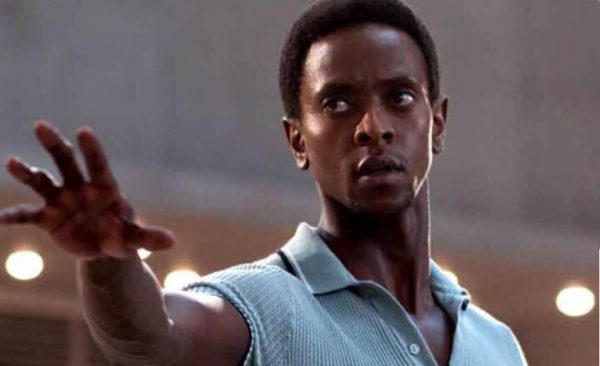
Jesse Williams lends his voice and likeness to Detroit: Become Human as Markus
It is also worth noting that of all the black people that could’ve — and should’ve — been featured in Detroit: Become Human, Cage chose Williams, who is very light-skinned with blue eyes. I want to tread carefully here, because I am in no way suggesting that Williams is any “less black” for these reasons, and he certainly solidifies how and with whom he identifies through his activism. But there is a clear trend in Hollywood, the gaming industry, advertising, and other media to give preference to lighter skinned, more ethnically ambiguous black people, where we’re included at all.
It was an interesting decision to center Williams’s character, who in the context of the game does not have the actual man’s background, identity, politics, or platform. To a player unfamiliar with Williams, as I imagine many will be, the character’s blackness can be plausibly denied. Either implicitly — giving his race conscious consideration, or explicitly in arguing against his blackness as so many gamers do when it comes to ethnically ambiguous characters.
The recent accusations against Cage do not exist in a vacuum, or without precedent. Cage wants to be judged by his work, and indeed if one looks critically at his games, a theme emerges. People of color are reduced to caricatures, invoke harmful stereotypes, and should remain at the margins, if they appear at all. Even if that means literally erasing them from settings where they predominate. This is not the cross-burning of the past or the anger-marching racism so en vogue these days, but the more deeply entrenched racism underlying all of our media institutions.
Cage might be forgiven for simply being ignorant, if only I were able to believe that no one, ever, has brought these issues to his attention. But as he seems to be the kind of man who reads every review and critique of his work, tied as it must be to his self-worth, I think he has simply chosen to ignore them. Worse yet, when the issues drag him out into the spotlight, forcing him to come to terms, he deflects all accountability and uses what amounts to the “black friend” defense, or the…”I’ve worked with an actual woman” defense. Is that even a thing?
What’s sad is that David Cage is a talented developer, and I have, in spite of everything, enjoyed Quantic Dream’s games. But for someone so ambitious as to attempt social commentary, examine the human condition, and speculate on humanity’s future in video games, his massive blind spot about race and racism — or his willful ignorance — is a persisting blight that keeps him well-short of accomplishing any of these objectives.
“Diversity” and “Inclusion“. Buzzwords for the 21st Century, especially in “post-racial” America. But for all the mumbling and fumbling, the empty rhetoric and symbolic gestures, white media creators (and others from non-black majority countries) seem catastrophically inept at understanding what these words mean, or how to put them into meaningful action, especially as they apply to Black people.
What I am about to say is nothing new, nothing original, nothing that hasn’t been said — probably better by countless others — but I felt inspired to join the chorus of voices holding media creators accountable for how they represent me and mine: on paper, on screen, and in every other medium.
So here are my ten tips for white media creators seeking to be “include” Black people. It is by no means an exhaustive list.
1. Blackness is not metaphorical.
The X-Men have long been a stand-in for black people and black struggle.
The Black experience involves real people and real struggles, not to be “sanitized” or reduced to symbolic representation, as in the “Civil Rights” struggle of the X-Men or slavery in Dragon Age. If you’re going to “borrow” (read: appropriate) our struggle, then at least include our likenesses from time to time.
2. Blackness is not skin deep.
Commander Shepard from Mass Effect can be customized to look black, but nothing about the Black experience informs her character.
Merely palette-swapping racially or culturally “neutral” (read: vacuous) characters from #F6DACD to #7E3617 does not count as “inclusion”. Blackness involves a vast, diverse, historically grounded, continuously lived experience all but inexorable from skin tone. Do some research, or better yet, hire some black creators.
3. Blackness is not monolithic.
Dear White People is the rare example of a show that demonstrates that Black people have a wide variety of perspectives, ideologies, conflicts, experiences.
This may seem obvious, but…ALL BLACK PEOPLE ARE NOT THE SAME. See the above point about “vast and diverse”. We come in many skin tones, have thousands of different ethnicities, and countless different experiences along multiple axes of gender, class, sexuality, ability, religion, and…just being different people because that’s how people work. Even an egregious stereotype might be excusable if it doesn’t exist in isolation. Still probably better to avoid those.
TLDR: Feature different kinds of black people.
4. Blackness is not expendable.
Darwin from X-Men: First Class fell victim to the “Black Dude Dies First” trope
It is inconceivable to me, outside the context of pure malice, that I even need to bring up such an established trope. If you’re going to include black characters, maybe don’t kill them off first, or even second, unless you’ve heeded Point #3, and have plenty more to spare. Even then, maybe just don’t, at least not until they’ve had time to develop? Or, you know, unless your the majority of your cast is black. Including your hero.
5. Blackness is not a punchline.
Jules from Pulp Fiction was a “bad mother fucker”, and a bottomless well of meme-ification and white laughter
The “Sassy Black Woman”. The “Mammy”. The “Smooth Pimp”. The “Bad Mother Fucker”. These and others have all been deployed at different times for the amusement of white audiences. There is nothing inherently wrong with these archetypes, provided that they are given some breadth, depth, and nuance. See Point #3 about blackness not being monolithic. Just as all black people aren’t the same, no black person is only one thing. Can we be funny? Absolutely. Humor for black people has been essential to our survival. Exploring why that is and has been might help with your character development.
Black people have struggled. Continue to struggle. We also endure. Our endurance is one of the foundations of our pride. But we also laugh (see Point #5), learn, love, contemplate, question, explore, create, eat, sleep, shit, and fuck just like everyone else. Which is to say, we contain multitudes. Also, our struggle and our endurance don’t exist in a vacuum. Rather they are informed and shaped by the prevailing context of white supremacy. I know those are two words you probably hate seeing adjacent to one another, but the shit is real. Choose to address it head on, because at least you have that choice.
7. Blackness is not violence.
Though black people’s lives and experiences have historically and continue to be beset with violence, it is not inherent to our condition. See Points #2, #3, and #5. And despite the narrative of “black on black” violence, the simple truth is that violence most often occurs between members of the same group — any group — if only because there is a larger set of interactions of any kind between members of the same group. We do not present some unique and ever-present danger. We are no more prone to perpetrating violence than any other group. Which, frankly, is kind of amazing, given that we have been and remain the disproportionate victims of violence, by the state and its proxies.
8. Blackness is not scarce.
Black Joy!
There are over a billion black people in the world — one-sixth of the world’s population. And that’s just by “official” counts, which may exclude any number of people who do or don’t identify as such. Which in itself speaks to Point #3, about how blackness is not monolithic, even in how it is defined. Black people make up anywhere from 11-13 percent of the United States, and yet you’ll hardly ever see either of these proportions (11-13 percent or one-sixth) reflected in the populations of most media properties.
In spite of the huge set of everyday dangers that pretty much ensure these percentages seldom increase, black people are not in short supply. There is, nor has there ever been, any paucity of black resources to draw upon when building that imaginary world which looks suspiciously a lot like this world. For the record (and yes, there are records), we’ve always been around. In spite of white/European historians’ relentless attempts to erase us, or decouple us from our own history. Dwayne McDuffie’s Rule of Threecan actually be broken with a shift in consciousness.
9. Blackness is not a commodity.
It’s only “dreadlocks” when white people do it.
Black music. Black art of any and every kind. Black language. Black aesthetic. Black culture more broadly. The Black Experience (See Point #1). Each and all of these things have been and continue to be stolen, appropriated, decontextualized, remixed, and whitewashed for mainstream consumption. Which is to say they are stripped of their most fundamental element — black people ourselves — for the sake of white palatability. Or perceived white palatability. To be clear, brown skin fixed to a black aesthetic — clothing, voice, music, etc. — does not a black person make. See Points #2 and #3.
More importantly, if the blackness in your properties, however it may manifest, does not promote, uplift, or enhance the lives of black people in some way – and positive representation has a greater impact than you might realize — then your property is not inclusive. It is appropriative for the sake of drawing in black dollars (or maybe white liberal dollars) or creating some sort of “feel good” image for the company — currency that can also be traded for…yes, dollars. This is the very definition of commodification.
Taken literally, this is obvious. But perhaps what isn’t so obvious is that all the shades and nuances of the Black Experience are not accessible to you. No matter how many books you read, albums you listen to, films you watch, plays you attend, black friends you make (though by all means, yes, tap that resource if you have it, without demand or expectation), there are things about being black that you simply cannot comprehend—physically, intellectually, emotionally, or spiritually.
This leaves you with one—also obvious—recourse. Recruit black people to work beside you. By which I mean hire them, because that work-for-free shit is over. Or, if you’re feeling particularly “magnanimous”, hand black people the reins and see where they lead you. I hear some guy named Ta-nehisi Coates is killing it on that Black Panther comic. And every other thing he touches, for that matter. Incidentally, he is not the only smart black person in the world. See Point #8.
Conclusion: Black People are Human Beings
In closing, it needs to be said that including diverse representations of black people in media has nothing to do with “political correctness”. It has little to do with fairness, either. This is not a zero-sum game by which black gain equals white loss.
What it concerns, most significantly, is the acceptance of this proposal that Black Lives Matter. That Black People Matter. Black representations are a matter of survival. Of casting us as fully-realized human beings with thoughts, feelings, dreams, aspirations, complexity, agency — against a backdrop that explicitly shows and tells us (everyone) that the opposite is true.
If we don’t matter, if we are seldom seen or heard, reduced to caricatures, or otherwise rendered less than fully human, it creates a void. Not just of our bodies or our voices, but of empathy and compassion toward us.
The cost of this void, engraved in history and playing out in real time, is our very lives.
*UPDATE* Sushee Games responded to my letter within a few hours, and I have already replied again as well. I will continue to update the post below with any future correspondence.
Fear Effect is coming back. Have you heard? After the heartbreak of Inferno’s cancellation, and a 15 year wait with no new game in sight, French indie studio Sushee Games is creating Fear Effect: Sedna. To say that I “literally screamed”, might actually be literal. I mean, look. There has been a 15 year vacuum that no other game has been able to fill. For fans of Fear Effect, this is huge news, so I can only hope that Sushee is successful, and that they are able to be true to the spirit of the franchise.
As I followed the campaign, being who I am, I couldn’t help but notice some things. 15 years ago, when Retro Helix was released, I had no awareness of cultural appropriation, and probably even a knee-jerk resistance to any discussion of the matter. Now, with the game industry’s slow realization that representation matters, reflecting an even longer-time-in-coming realization by mass media in general, creators are being held accountable for how they “borrow” — let’s go ahead and say appropriate — cultures not their own.
What I noticed with Fear Effect: Sedna, was their proposed use of Inuit culture and a native character. Alarm bells went off in my head, first about my impression that the character, Iluak, pretty much looks like a white man as currently designed.
Concept Art for Iluak from Fear Effect: Sedna
So I tweeted to Sushee Games about it.
Iluak has very European features. In jeans/t-shirt he’d be white. Please tell me he’s not the “more relatable” “half-Native”. @FearEffect
I was delighted that Sushee bothered to respond, as this is something they could’ve easily shrugged off, with me being a nobody on Twitter, and representing a small and easily recoverable amount towards their Kickstarter goal.
@KermitO He has changed yet from the concept till the artwork, especially for this reason. We keep an eye on this, and for others too!
As I continued thinking about cultural appropriation, I decided to contact Sushee Games again, with more in-depth concerns about how they would handle the use of Inuit aesthetic, cultural stories and history. I sent them a message through Kickstarter, which I’m publishing here as an open letter, so that as the game’s production moves forward, it can be known that at least one person brought this issue to their attention.
This is part of the reason I love Kickstarter, as a platform, and as a new standard for interactions between creators and consumers. Will my message make a difference? Maybe. Which is more than I could say for my impact on the production of a mainstream title produced by a major company. I will continue to update the post if and as Sushee Games responds to my letter.
Hello,
I recently tweeted my concern about Iluak’s “European” look and was pleased that your team responded. I just wanted to follow up a little and share some thoughts on the troubled waters Sushee is wandering into. I hope you’ll take the time to consider it.
The big issue at stake here, featuring the likenesses, history, and or lore of Inuit people is cultural appropriation. By the way, you do know that “Inuit” is a broad term encompassing several culturally distinct groups? The appropriation issue is especially contentious when dealing with culture of indigenous or other historically oppressed people.
This is not a matter of “political correctness” but has very serious implications (possibly legal) and consequences for indigenous people. When cultures are in danger of disappearing, appropriated representations can accelerate that erasure by displacing native sources. Outsiders should never be the primary source for any culture.
I think it is really worth your team’s time to read these articles (and the works cited in them) as you proceed:
With respect to Nisi Shawl’s article, you should look at the game “Never Alone” (Kisima Inŋitchuŋa) as an example of how creators can be “Guests”. They work with an indigenous population that I believe fit under the Inuit umbrella.
Be aware that this issue rightfully keeps emerging as creators recklessly use others’ culture, a recent backlash involving JK Rowling and Native Americans. Read about that here, and please Google “JK Rowling Cultural Appropriation” for more:
Also please be aware that different cultures have different rules about when and where and by whom their culture can be used. It is vital that you consult with an authority of the culture you’re borrowing.
This has come up for me personally in writing an Indigenous Australian character for my novel, and in doing my research I came across these resources. Although they deal with Indigenous Australians, I think similar considerations apply to borrowing culture in general:
FE: Sedna is not a film, but again, it’s a place to start.
I write all this to you not to tell you how to make your game, but because I love the Fear Effect franchise and at the same time care deeply about this issue. I don’t want to see the campaign mired in controversy, and I also really want to see indigenous culture and people represented in a way that honors them and preserves their dignity and culture.
One more note, and I’ll leave you alone. It also occurs to me that Iluak is a secondary (non-playable) character. Fear Effect as a franchise already over-represents white/European people, as all of the main characters are white (yes, I know Hana is “half-Asian, but aesthetically, culturally, and even given her voice actor, she might as well be white).
It’s been 15 years since the last Fear Effect game, and a lot has changed in the gaming and media climate in general. It seems to me a lost opportunity not to upgrade the franchise in a way that reflect’s the game industry’s (and consumer base’s) dawning recognition that the vast majority of the world’s people are not white.
Is there any reason why Iluak can’t be a playable character? And also, France has a multitude of different ethnicities (in spite of the government’s ridiculous official policy that race doesn’t exist), so is there anything about Axel that necessitates that he be a white Frenchman?
These are the thoughts of one measly backer, but I feel like Kickstarter as a platform allows for a new level of communication and collaboration between creators and their audience. So I hope you’ll consider my words here as you move forward.
Thank you,
Kermit O
Hi Kermit O
We actually saw your open letter before this message ^^
It’s quite a long (and interesting) question/post, so we’ll take some time to answer it the best as we can. One thing you should know before we start: we are at a very early stage of the development, and the script isn’t finished at all. It’s actually time to think about these questions.
First of all, we are well aware of cultural appropriation. It is a complicated matter, and our first intention was to bring some spotlight to a less known culture that we discovered late ourselves, and which is incredibly rich; and not to use it for dramatic purpose. What is done today with egyptian mythology in some Hollywood movies for example, where all the protagonists have been westernized and the myths just used for the sake of exotic mystery, doesn’t please us at all – we really want to avoid that kind of cheap usage of the Inuit myths and legends. But we don’t want to avoid speaking about a particular country in the world just because no one in the team originates from it (or everything would have happened in Brittany – which is a very nice place, but not really the kind you come across in a dark cyberpunk horror story).
Iluak, in our story (without saying too much) is part of Glas’ past. He originates from Nuuk, but lived in the USA for more than 20 years. As we said earlier on Twitter, his design evolved from the early concepts to the current 3D model. We are happy with his design for now: his aura, his noble and proud stature serve the story perfectly, and he does look like some of the Greenland inhabitants we came across during our research. In a cel-shaded way, of course.
Also, we never said he would not be playable. In fact, he is really central to the story, and not at all a secondary character.
One last thing about Inuits: for now we are doing a lot of research on their story, to begin with; their lifestyle, their art, their music, their ceremonies and celebrations, and the way they live their spirituality. This is all very good, but we all know that academic knowledge alone won’t do justice to their culture. So we are now searching for consultants and advisors who could guide us on the right way. Obviously, we’re now focused on the Kickstarter campaign, so we didn’t dig too much here, but yes for sure, this is our plan.
As for Axel, he is exactly the cute-looking over-confident young white man we wanted him to be – and that will serve the story as well!
There are no good nor villains in Fear Effect (I mean, look at Deke!). So in case you were afraid of that: Iluak won’t be a bad guy. He will do bad things for good reasons, as well as good things for bad reasons, because this is all what Fear Effect is about. To quote John Zuur Platten (writer of Fear Effect 1): “morally ambiguous people ending up doing heroic things”.
We hope this will answer your concerns, and we will keep working hard to create the best experience and story we can provide.
Please don’t hesitate to share you thoughts & ask any question you want, we will be happy to discuss with you!
Friendly yours, Sushee.
Thank you for responding, and promptly at that.
I am glad that you are familiar with the cultural appropriation and have already considered steps to handle the matter carefully. That does a lot to ease my mind.
Still, as there is always more we can learn about any issue, I encourage you still check out the resources I mentioned in my earlier message. You may find they address the issue in ways that you haven’t considered.
Also, please note that I was very intentional about not using the words “myths” or “legends”. The reason for that is that some cultures, especially indigenous cultures, can be reduced simply to their “myths and legends”, when in fact these cultures regard these particular elements of their culture as neither. See the issue of Rowling and her use of “skin walkers” as an example.
Native cultures are often mysticized, treated as something ancient or obscure, in some space “other” than the reality the rest of us inhabit, rather than living and breathing and existing in a continuity with the present. This, too, is a kind of erasure. So another question I would ask would be whether or not the game deals with the realities, including the struggles, of *Inuit people (again, recognizing that term as too broad) TODAY, in the time and place in which it is set? Or do ancient “myths and legends” extend from some dark and mystical past to impact the present? This would be the sort of “dramatic purpose” you mentioned in your response as one to avoid.
As I am not in any way culturally connected to Inuit people, nor have I been nominated by anyone to speak on their behalf, I don’t feel I am the one to continue this discussion. I am glad your team has given it some thought, and I hope you’ll share your thinking and how it factors into your production process publicly and transparently as you move forward (like in your project updates). I think this could encourage those who are impacted by your use of their culture to share their own concerns and help shape the final product.
Thank you again for your response, and I look forward to hearing more as development continues.
Kermit
First of all, let’s be clear : Fear Effect being what it is, mythical creatures and old traditional magic is part of what makes the game unique, along with the fact that it often collides with a futuristic/technologic reality. So we will of course be inspired by Inuit myths to build our world.
From what we read about J.K Rowling’s debate over Skin Crawlers (we hadn’t heard about it before), the fact that she didn’t link the myths to actual people is the problematic part. Also, it seems that she pictured them the wrong way. This will not happen in our game.
When you write a story, you have to fictionalize a lot of things (otherwise you would be creating a documentary). This is where we will have to be careful – but depicting legends in a dramatic way is part of the process, especially with a game like Fear Effect. Building a whole legendary/mystical realm coming out of nowhere is not our intention though. Even if we are not from Greenland ourselves, the myths we talk about will be brought and told by local inhabitants. The mix between a realistic (though futuristic) setting and the legends is one of Fear Effect’s core ingredients.
There are examples of games that made very clever choices while choosing to talk about foreign cultures. In The Secret World, for example, the depiction of Transylvania could have been what we all imagine in the first place: huge pine forests and gothic castles with bats under the moonlight. But they remembered that Transylvania is actually part of Romania, and they chose to show the rural part of that country, in a way that makes you feel they have actually been there to see how they lived and how they would tell their own stories. Same goes for Egypt and the native americans, in the same game.
Of course it’s not perfect, you can still come across the eternal “old fortune teller in her colorful caravan” cliché, but at least it shows a lot of respect for the people. This is what we’re aiming at (minus the cliché, that is).
I know it’s all but words, but we too think these matters are important.
Thanks again for your interest in the game we’re making!
Sometimes it’s tucked away, hidden just beneath the tongue, or in that sly twist of the mouth…
Anti-blackness is so pervasive, and so deeply entrenched in the global collective consciousness, that I think media creators aren’t even aware of how they present and perform it on a regular basis. That’s me giving them the benefit of the doubt, in spite of all the evidence that suggests it’s intentional.
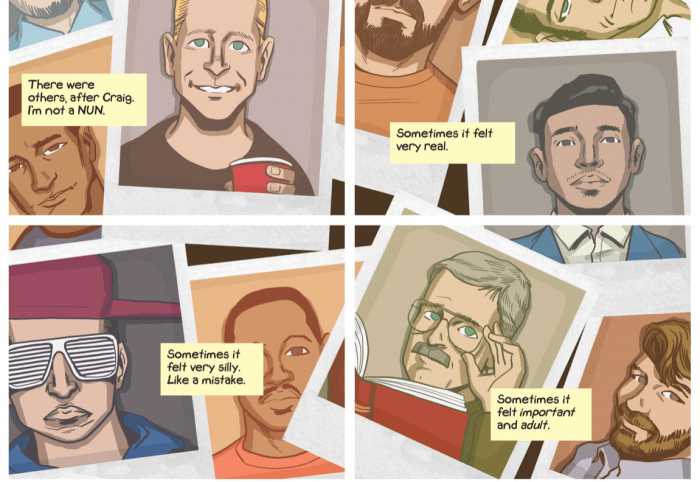
The image below is a cropped page from Image Comics’ SEX CRIMINALS, by Matt Fraction and Chip Zdarsky. You can look up the premise of the book at the link above, but for this post, all you need to know is that the main character—a white woman named Suzie—is reflecting on her sexual history.
Take note of the ethnicities of the men she slept with, and the commentary that goes along with it. When it comes to the black man, and what is presumably a white man appropriating a black cultural aesthetic (red cap, Kanye shades), she says:
“It felt very silly. Like a mistake.”
Really now.
Even if it were just the white dude in the Kanye shades, the image would’ve still evoked anti-blackness, because what makes such a guy “silly” or a “mistake”, is undoubtedly his proximity to blackness. White people came up with the term “wigger” to describe such a person. Wiggers aren’t reviled because they’re cultural appropriators, borrowing from black culture as a fad, while not respecting black people or their experience. White disdain for the “wigger” does not stem from some sense of justice. White people dislike “wiggers” because of all the racial groups to mimic, they’re choosing what to them is the most reprehensible: black people. Because I mean, like dude, seriously, have some self-respect!
You will not see the same revulsion expressed towards the white geek steeped in Japanese culture—because isn’t that so interesting, and isn’t he such a citizen of the world? Nevermind that his entry point was the desperate need to consume more anime and import video games, or in hopes of fulfilling some Asian bride fetish. Or how about the white girl who takes her Spanish classes seriously, deciding to study abroad in Spain, or Argentina—she was always so bright, wasn’t she? But the only proof you really need that white disdain for the wigger is anti-black, can be found in the word itself.
Wigger. Portmanteau of white nigger.
If it were just the white dude in the red hat, maybe it could be said I’m making a logical leap. That perhaps I’m being hypersensitive. But I don’t even have to make that leap, because Fraction and Zdarsky bothered to group the black dude and the wannabe under the same caption. And if you think it was mere coincidence that particular caption was superimposed upon those particular characters, just look at the neighboring caption:
“Sometimes it felt important and adult.”
Placed as it is over the images of two older white men, one holding a book as if to suggest an academic or someone equally “important”. There’s an inside joke in this panel, a subtle nod and an awkward chuckle, as we — some of us, anyway — acknowledge that the only way this white woman would’ve been romantically, or even just sexually involved with a black man, or a man who positions himself in cultural proximity to blackness, is through some flight of fancy.
Because no one takes wiggers seriously. Certainly not any self-respecting white woman. Don’t be silly. And having sex with black dudes? Yeah, right. Not even to make daddy angry. Especially in Suzie’s case, since her father died when she was in high school. No, no, the only way that could’ve happened is by mistake.
Believe me when I say that of all the ways black people could be represented in SEX CRIMINALS, the one place it wasn’t needed was amongst the Suzie’s sexual partners. In spite of all the rumors, mass advertising, the pining of black boys in the suburbs with no other choice, and the fears of white racists—enough to see whole towns burned to the ground—white pussy is not our holy grail.
Still, Fraction and Zdarsky did spare a whole thought for including a black man on this page, and as anyone familiar with comics will tell you, every panel, every image, every line, every caption, every letter, is meticulously considered. So while I want to give these fellows the benefit of the doubt, I can’t help but imagine them laying out the storyboard for this page, and sharing a chuckle. Because jokes about black people—subtle, overt, spoken, illustrated, or told by a glance and a mutual nod—are just oh so hilarious.
Now that we’re all in on the joke, let’s laugh together, shall we?
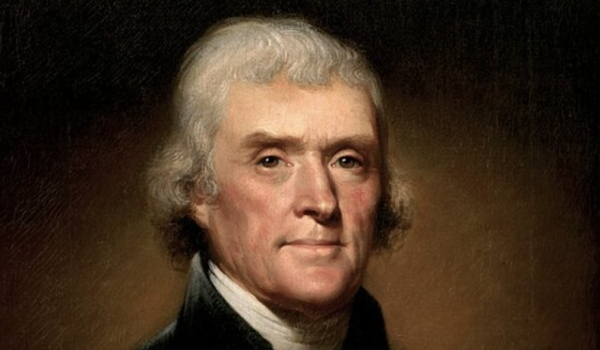
Thomas Jefferson: Founding Father, White Supremacist
When you hear the name Thomas Jefferson, it is likely followed by “founding father”, “hero”, “patriot”, and other such reverent terms. Amongst the mildly critical—or anyone not in complete denial—you’ll hear it acknowledged that he was also a slaver, and that there were some inherent contradictions between this and the idea that “All men are created equal”. The more critical still may point out that he was also a rapist, in that his relationship with Sally Hemmings was a matter of obligation for her, as she was his “property”. Those truly willing to look at the man, that is the reality versus the myth, will point out that Jefferson was not even exceptional amongst his peers, for his time, or for what he purportedly accomplished. The Zinn Education Project, for example, points out how the Declaration of Independence was not some landmark achievement by Jefferson, but a sort of amalgam of pre-existing statements being made throughout the colonies. And not just a few. Historian Ray Raphael notes:
In 1997, Pauline Maier published American Scripture, where she uncovered 90 state and local “declarations of independence” that preceded the U.S. Declaration of Independence. The consequence of this historical tidbit is profound: Jefferson was not a lonely genius conjuring his notions from the ether; he was part of a nationwide political upheaval. Again, textbook writers have watered down the legend while missing the main point. Many now state that Jefferson was part of a five-man congressional committee, but they include no word of those 90 documents produced in less-famous chambers.
However, something few critics seem to note is how Thomas Jefferson should also be considered one of the Founding Fathers of white supremacy. Obviously he was a white supremacist in that he claimed enslaved Africans as property, but it goes beyond that. White supremacy is a multifaceted ideology that pervades every sector of Western culture and society – in the US, Europe, and the present and former colonies of both. It encompasses many ideas, all to do with the explicit or implicit claim that white people are superior to others in all domains, from beauty to intelligence to reasoning to creativity, and that this superiority is inherent, biological, immutable. And, all of these ideas, insofar as they have been put into print, may find their origins in a book published by Thomas Jefferson in 1785, called Notes on the State of Virginia.
While we’re discussing Jefferson’s singular achievements, we should take note that Notes was the only full-length book that Jefferson ever published in his lifetime. The book discusses a number of topics, but of interest here is Query XIV: Laws, wherein Jefferson discusses slavery, and in particular, the inferior nature of black people. I will excerpt the chapter in chunks and comment on each one, in part just to translate his antiquated English into a more modern vernacular.
I also aim to demonstrate that nearly every white supremacist idea, claim, or rationale, can be found in this one chapter, in this one book, again the only book that Jefferson ever published. While the things that Jefferson wrote are extremely—I mean truly, mind-blowingly—offensive, I find Notes almost humorous in how explicit, thorough, and in his mind “scientific”, he is in his reasoning. For what it illuminates about US history, and what it suggests about the ideological foundations of the country, I think Notes might be one of the most important books ever written.
It will probably be asked, Why not retain and incorporate the blacks into the state, and thus save the expence of supplying, by importation of white settlers, the vacancies they will leave? Deep rooted prejudices entertained by the whites; ten thousand recollections, by the blacks, of the injuries they have sustained; new provocations; the real distinctions which nature has made; and many other circumstances, will divide us into parties, and produce convulsions which will probably never end but in the extermination of the one or the other race. (p. 264)
Here Jefferson is considering the consequences of emancipation, and the argument to make black people citizens of the US afterwards, to continue the work they were already doing while enslaved. As the argument goes, the country would otherwise need to bring in more white settlers to fulfill the duties vacated by freed slaves. Jefferson argues that this is not a viable solution, because upon the emancipation of black people, the country would erupt into race war, one that would not end until either black people or white people were completely wiped out.
This fear, that black liberation somehow spells doom for white people, is one of the most powerful tenets of white supremacy, and perhaps its most justifying pretext, the one that convinces people who are otherwise sensible and moral to advocate for injustice. This fear did not go away in 1865 with the Emancipation Proclamation, at which time black people did not suddenly start vengefully murdering white people. It did not end in 1964 or 1968 with the passing of the Civil Rights Acts. It did not fade, and may have even undergone a resurgence, with the election of Barack Obama in 2008, which corresponded to a dramatic uptick in white supremacist activity.
To these objections, which are political, may be added others, which are physical and moral. The first difference which strikes us is that of colour. Whether the black of the negro resides in the reticular membrane between the skin and scarf-skin, or in the scarf-skin itself; whether it proceeds from the colour of the blood, the colour of the bile, or from that of some other secretion, the difference is fixed in nature, and is as real as if its seat and cause were better known to us. (pp. 264-265)
Beyond the tender concern for his country that white and black people would tear each other apart, Jefferson is suggesting that there are physical and moral reasons why black people should not be emancipated and cannot become citizens in any case. You see, because black people are so fundamentally different from white people, on a biological level. He ponders the source of these fundamental differences, waxing pseudo-scientific, about how the difference in color might be caused by differences in blood and other bodily fluids. And I mean, seriously, what in the hell is “scarf-skin”? Jefferson admits he has no idea about the reason for the color differences, but goes on to make arguments for white superiority because of it.
And is this difference of no importance? Is it not the foundation of a greater or less share of beauty in the two races? Are not the fine mixtures of red and white, the expressions of every passion by greater or less suffusions of colour in the one, preferable to that eternal monotony, which reigns in the countenances, that immoveable veil of black which covers all the emotions of the other race?
Add to these, flowing hair, a more elegant symmetry of form, their own judgment in favour of the whites, declared by their preference of them, as uniformly as is the preference of the [orangutan] for the black women over those of his own species. The circumstance of superior beauty, is thought worthy attention in the propagation of our horses, dogs, and other domestic animals; why not in that of man? Besides those of colour, figure, and hair, there are other physical distinctions proving a difference of race. (pp. 264-265)
One facet of white supremacy is that white people are inherently more beautiful than people of color, especially black people. This manifests in the systemic and institutionalized white beauty standards that we see in Hollywood, advertising, the hair and cosmetics industries, modeling, music, and popular culture. That is, that white/European features are the norm, the standard by which all other features are judged, and ultimately found lacking.
In this part of Notes Jefferson is actually saying that white skin is superior because it is better able to express emotion. Beyond the bit about beauty standards, this also evokes the idea that black people are difficult to understand or relate to, that their thoughts and emotions are inaccessible. This is not a small thing, because the ability to relate to other people is central to having compassion for them. Oh, and yes, Jefferson did indeed compare black people to orangutans. This comparison, between black people and apes, is one that echoes loudly into the present, from King Kong to Planet of the Apes.
Another important idea Jefferson advances is that of black people “preferring” white people, that is, finding them more beautiful. This evokes the widespread and deeply entrenched white fear of black men, specifically, having a particular desire for white women. It actually goes well beyond fear into a sort of mass hysteria, manifest countless times in US history, and often resulting in the killing of black men or the destruction of whole neighborhoods. The Atlanta Race Riot of 1906, The East St. Louis Massacre in 1917, the D.C. Race Riots of 1919, the burning of Greenwood in 1921, The Rosewood Massacre of 1923, the unjust imprisonment of the Scottsboro Boys in 1931, and the murder of Emmett Till in 1955 were all predicated upon some alleged trespass by black men against white women, most often false accusations of rape. Though in the case of East St. Louis, the anger stemmed from rumors of black men and white women merely socializing at labor meetings. Far from ending in the 1950s, there have been countless other cases well into the present day.
Lebron James and Giselle Bundchen
The April 2008 cover of Vogue magazine (shown above), featuring Lebron James and Giselle Bundchen, plays with this historical context for the sake of sensationalism. Although the main fuss was about the not-so-implicit and dehumanizing comparison between Lebron and King Kong, there is the additional subtext evoking black men in some way violating white women. These two things are hardly unrelated, as 1933 King Kong film has been widely analyzed as a metaphor for a black man stealing away a white woman. It is illuminating to trace this irrational fear at least as far back as the 1700s, and to see how it has persisted for hundreds of years.
Jefferson continues:
They have less hair on the face and body. They secrete less by the kidnies, and more by the glands of the skin, which gives them a very strong and disagreeable odour. This greater degree of transpiration renders them more tolerant of heat, and less so of cold, than the whites. Perhaps too a difference of structure in the pulmonary apparatus, which a late ingenious experimentalist has discovered to be the principal regulator of animal heat, may have disabled them from extricating, in the act of inspiration, so much of that fluid from the outer air, or obliged them in expiration, to part with more of it. (p. 265)
So…Jefferson thought that black people—inherently, universally, as a people—smelled bad. Just sit with that for a minute. He goes on to give a “scientific” explanation for why this is the case, even though he has absolutely no background or knowledge of human biology. Related is the “fact” that black people also, apparently, sweat a lot more than white people, because of some physical difference in their lungs. Even the KKK couldn’t make this stuff up.
They seem to require less sleep. A black, after hard labour through the day, will be induced by the slightest amusements to sit up till midnight, or later, though knowing he must be out with the first dawn of the morning. They are at least as brave, and more adventuresome. But this may perhaps proceed from a want of forethought, which prevents their seeing a danger till it be present. When present, they do not go through it with more coolness or steadiness than the whites. (p. 265)
According to Jefferson, black people require less sleep. Good thing, I suppose, since it predisposes them to working long hours in the fields. He goes on to talk about how black people stay up all night, amused by stupid, trivial things, even though they know they need to be up in the morning to work. These are other currents that run through white supremacy today, that on the one hand black people’s amusements (part of our culture) are trivial, and that we are irresponsible when it comes to professional responsibilities.
Jefferson then says that black people are as brave as white people, which might seem like a compliment at first, until he goes on to suggest that the reason for our bravery is a lack of forethought. So we’re not really brave, not the way conscious and reasoning white people are, but reckless and stupid. We don’t see danger until it’s immediate, and because of our lack of forethought, we don’t handle the danger rationally. You know, this must be why so many young black men are killed by police! We just can’t see danger until it’s too late!
They are more ardent after their female: but love seems with them to be more an eager desire, than a tender delicate mixture of sentiment and sensation. (p. 265)
Oh, I love this one. According to Jefferson, black men pursue black women with more passion than white men do white women. Because they’re just out of their mind with animal lust, unlike white people, who experience love as a combination of physical and emotional forces. Implicit here is the idea that black people are more like animals when it comes to relationships.
Their griefs are transient. Those numberless afflictions, which render it doubtful whether heaven has given life to us in mercy or in wrath, are less felt, and sooner forgotten with them. In general, their existence appears to participate more of sensation than reflection. (p. 265)
Apparently, when black people feel grief, it isn’t for very long. All the problems we face, we just don’t feel their effects as keenly as white people, and eventually forget about them. And isn’t that great? Because again, it predisposes black people to slavery, in that we don’t feel the indignity and dehumanization as deeply, or for very long. Far from being a character strength, though, the reason grief is so temporary is that black people do not take the time, and presumably lack the ability, to reflect on their situation.
To this must be ascribed their disposition to sleep when abstracted from their diversions, and unemployed in labour. An animal whose body is at rest, and who does not reflect, must be disposed to sleep of course. (pp. 265-266)
Another gem. When black people aren’t working, or participating in some foolishness, they’re sleeping. Why? Well, because they’re animals, of course. Because they lack that capacity for reflection that would otherwise keep the mind awake. Of course, says Jefferson. Of course. Meanwhile, white people are busy contemplating the wonders of the universe. Or secretions of the “scarf-skin”. Or something equally profound.
Comparing them by their faculties of memory, reason, and imagination, it appears to me, that in memory they are equal to the whites; in reason much inferior, as I think one could scarcely be found capable of tracing and comprehending the investigations of Euclid; and that in imagination they are dull, tasteless, and anomalous. (p. 266)
Would you look at that? Jefferson says black people have just as much memory as white people. But didn’t he just say that our grief is transient, and that we have no capacity for reflection? Nevermind. We’ve already established that contradictions are sort of Jefferson’s “thing”, so let’s move on. He says that black people are not as capable of reasoning as white people, and certainly we can’t understand math. This is an idea that continues into the present, via the self-fulfilling prophecy that black kids will do poorly in math, affirmed by the “achievement gap” on standardized tests.
In Jefferson’s time, I am sure it had nothing to do with the fact that enslaved Africans were not taught, nor allowed to learn math (or reading or any subject for that matter). Just like today I’m sure that black kids lower performance (in aggregate) in math has nothing to do with a lower quality of education, stereotype threat, or any of the other factors that actual scientists point to as the reason for the disparity. The sort of ideas at work in the minds of many educators—most of whom are white—come instead from books like The Bell Curve, in which the authors, much like Jefferson, suggest a biological reason for these differences in “achievement”. Notes was written in 1785. The Bell Curve was written in 1994. A lot can change in 200 years, huh?
It would be unfair to follow them to Africa for this investigation. We will consider them here, on the same stage with the whites, and where the facts are not apocryphal on which a judgment is to be formed. It will be right to make great allowances for the difference of condition, of education, of conversation, of the sphere in which they move. Many millions of them have been brought to, and born in America. Most of them indeed have been confined to tillage, to their own homes, and their own society: yet many have been so situated, that they might have availed themselves of the conversation of their masters; many have been brought up to the handicraft arts, and from that circumstance have always been associated with the whites. Some have been liberally educated, and all have lived in countries where the arts and sciences are cultivated to a considerable degree, and have had before their eyes samples of the best works from abroad. (p. 266)
Here Jefferson is saying that his assessment of black and white intellectual differences has to be done in the US, not in Africa, and by US standards. He is oblivious to, or perhaps just disregards, how these apparent differences could be informed by oppression. On the contrary, he argues that black people in the US, for their proximity to white people and society—by way of enslavement—had opportunity to listen to the conversations of white people, to learn to do arts and crafts (no one in Africa produced art, of course)—and some were even formally educated!. For all these reasons, enslaved black people had a great advantage over their counterparts in Africa, and so if he’s going to assess intellectual ability, he has to consider these advantages, and how in spite of them, black people are still inferior.
The Indians, with no advantages of this kind, will often carve figures on their pipes not destitute of design and merit. They will crayon out an animal, a plant, or a country, so as to prove the existence of a germ in their minds which only wants cultivation. They astonish you with strokes of the most sublime oratory; such as prove their reason and sentiment strong, their imagination glowing and elevated. But never yet could I find that a black had uttered a thought above the level of plain narration; never see even an elementary trait of painting or sculpture. (p. 266)
Jefferson talks about how Native Americans are quite capable of producing works of art, and of “astonishing” him with their linguistic abilities, and their capacity for reason. How their minds are just so ripe and eager for “cultivation”, presumably by white people. I dare say that Jefferson thought rather highly of Native Americans, in spite of contributing to their genocide. But perhaps what’s most important here is not his opinion of Native American ability, but him measuring it against that of black people, and again determining that black people are inferior.
This sort of juxtaposition is common. We see it in The Bell Curve, in which the authors sing the praises of Asian people and their abilities, to further emphasize black inferiority. This ties into the “model minority” stereotype, which is not only harmful to Asian people, especially marginalized groups (mostly from Southeast Asia), but builds on a widespread anti-black consensus. Since there were very few Asian folks in the US when Jefferson wrote Notes in 1785, his “model minority” was the Native Americans.
In music they are more generally gifted than the whites with accurate ears for tune and time, and they have been found capable of imagining a small catch. Whether they will be equal to the composition of a more extensive run of melody, or of complicated harmony, is yet to be proved. (p. 266)
Black people are musically talented? Now where have I heard that before? Oh, right, it is easily one of the most widespread and well-known stereotypes of black people anywhere. While it would seem to be a positive characterization, Jefferson reveals the white supremacist undertone. While black people can “imagine a small catch”—today we might phrase that as “having rhythm”—he doubts we are capable of producing anything sophisticated. This racist idea manifests in the white establishment’s persistent criticism of black music in every era (Jazz, Blues, Hip-Hop), up to the point where they co-opt black music for profit. Even then it does not necessarily become sophisticated or equivalent to white music.
Misery is often the parent of the most affecting touches in poetry. Among the blacks is misery enough, God knows, but no poetry. Love is the peculiar oestrum of the poet. Their love is ardent, but it kindles the senses only, not the imagination. (pp. 266-267)
According to Jefferson, misery has inspired some of the greatest poetry. But even though black people have experienced a great deal of misery—how magnanimous he is to acknowledge it—they are not capable of producing poetry of any merit. Love is another source of inspiration for poets, but if you recall, black people only know animal lust, not love, and so they also lack the imagination to produce poetry. It is a running theme in white supremacy, to question and challenge and ultimately disregard the value of black art, in literature as in music.
Religion indeed has produced a Phyllis [Wheatley]; but it could not produce a poet. The compositions published under her name are below the dignity of criticism. The heroes of the Dunciad are to her, as Hercules to the author of that poem. (p. 267)
As his example of black people’s inability to produce real literature, Jefferson uses Phyllis Wheatley, most famous today for being the first black woman in the US to be published, when she wrote Poems on Various Subjects, Religious and Moral in 1773. Jefferson gives her no credit for this, saying that her work is not even worth his time to critique, and indeed dismisses the idea that she is even a poet at all. He takes it a step further to say that in comparison, Alexander Pope’s Dunciad is as far superior to Wheatley’s work as Hercules is superior, presumably in strength, to Pope.
Also implicit in the statement “the compositions published under her name” is Jefferson’s question of whether or not Wheatley wrote her own poems at all. This was a common doubt at the time Wheatley wrote her book, and in fact, she had to be interviewed by eighteen prominent white men—including the Governor of Massachusetts, and the famous John Hancock—in order to verify that she was indeed smart enough to have written the poems herself. Even then, on the cover of Poems, the work was attributed to Wheatley as “Negro Servant of John Wheatley”. Her proximity to her white “master”, of course, explains how she might have been able to put two words together at all.
Jefferson goes on to apply the same sort of racist critique to another black artist, Ignatius Sancho, a composer, writer, and actor from England.
Ignatius Sancho has approached nearer to merit in composition; yet his letters do more honour to the heart than the head. They breathe the purest effusions of friendship and general philanthropy, and shew how great a degree of the latter may be compounded with strong religious zeal. He is often happy in the turn of his compliments, and his stile is easy and familiar, except when he affects a Shandean fabrication of words. But his imagination is wild and extravagant, escapes incessantly from every restraint of reason and taste, and, in the course of its vagaries, leaves a tract of thought as incoherent and eccentric, as is the course of a meteor through the sky. (p. 267)
In short, Sancho’s work comes from his emotions not any ability to think deeply on the subjects he writes about. He has some ability, unlike Wheatley, but at times he is laughable, like Tristram Shandy, a character in a humor novel. Incidentally, the author of that novel, Laurence Sterne, corresponded with Sancho by letter, and those letters became a prominent part of British abolitionist literature.
His subjects should often have led him to a process of sober reasoning: yet we find him always substituting sentiment for demonstration. Upon the whole, though we admit him to the first place among those of his own colour who have presented themselves to the public judgment, yet when we compare him with the writers of the race among whom he lived, and particularly with the epistolary class, in which he has taken his own stand, we are compelled to enroll him at the bottom of the column. This criticism supposes the letters published under his name to be genuine, and to have received amendment from no other hand; points which would not be of easy investigation. (p. 267)
And, of course, while Sancho stands tall amongst other black writers, when compared to white writers, he is at the very bottom. This evokes the white supremacist tradition of separating black art, or anything black people produce, from the broader category in which it belongs. Whether music, literature, or even science what we produce might be good, by inferior black standards, but not when compared to that of our white counterparts. It is the reason why black works are persistently outside the “mainstream”, which is of course, white.
What little praise Jefferson affords Sancho’s work comes with doubt as to whether or not he even wrote it at all. This sort of thing is not limited to the arts, either, as it was also the motive behind a 1991 “investigation” into Martin Luther King’s doctoral dissertation, claiming that he had plagiarized other people’s work. What other purpose could there be to attempt to discredit his scholarship over twenty years after his death? There is a cruel irony in the fact that Jefferson continuously questioned whether or not Wheatley and Sancho even wrote the works credited to them, while his authorship of the Declaration of Independence is taken as a given, even though historians have shown that none of the ideas expressed in that document were uniquely his own.
The improvement of the blacks in body and mind, in the first instance of their mixture with the whites, has been observed by every one, and proves that their inferiority is not the effect merely of their condition of life. (p. 267)
To reinforce the idea that black inferiority is a matter of biology, of inheritance, Jefferson says here that “everyone” has seen how those of mixed race—black and white—are physically (presumably he is referring to beauty here) and mentally superior to people who are only black. This, to Jefferson proves black inferiority has nothing to do with things like slavery, oppression, inequality, educational disparities, all together “their condition of life”, but rather it is a matter of biology. This is also the ideological undercurrent of colorism, even within communities of color, placing black people in an unofficial hierarchy wherein superiority scales with lightness of skin. While colorism is prominent amongst black people, it is actually a global phenomenon.
We know that among the Romans, about the Augustan age especially, the condition of their slaves was much more deplorable than that of the blacks on the continent of America. (p. 267)
Perhaps no other sentence in all of Notes on the State of Virginia better demonstrates Jefferson’s state of denial and his delusions about the conditions of slavery in the US, today pretty much unanimously recognized as the worst instance of slavery in human history. This denial is analogous to that of white people today, who much as Jefferson compares US slavery to Roman slavery, compare modern systemic racism to that of the Jim Crow era, or even to slavery. Yet another current that persists throughout the centuries long reign of white supremacy.
In this country the slaves multiply as fast as the free inhabitants. Their situation and manners place the commerce between the two sexes almost without restraint. (p. 268)
Jefferson reminds us here, again, that black people are consumed by animal lust. They have no restraint, and for that, they have a lot of children. The modern analogue is the false idea that emerges now and again that black women are having a bunch of kids to take advantage of the welfare system. Except that the black population in the US has hovered between 7% and 13% since the founding of the country, so clearly we aren’t having more children—or even as many children—as any other group. Regarding how the percentage of black people in the US never exceeds 13%, much of that also to do with higher infant mortality rates due to a plethora of socioeconomic factors, the disproportionate number of black people who are murdered, or die because of the institutional failure of the US healthcare system. But I digress…
[Roman] slaves were often their rarest artists. They excelled too in science, insomuch as to be usually employed as tutors to their master’s children. Epictetus, Terence, and Phaedrus, were slaves. But they were of the race of whites. It is not their condition then, but nature, which has produced the distinction. (p. 268)
Here Jefferson reminds us that slavery itself need not be an obstacle to people achieving greatness. No, the real obstacle for black people, is our blackness. Probably something to do with those secretions in the scarf-skin again. Or because we’re too busy lusting and reproducing. Or because we just don’t feel love, or understand reason. After all, these white slaves went on to do such great things in spite of their conditions. Which, according to Jefferson, were far worse than slavery here in the US.
Whether further observation will or will not verify the conjecture, that nature has been less bountiful to them in the endowments of the head, I believe that in those of the heart she will be found to have done them justice. That disposition to theft with which they have been branded, must be ascribed to their situation, and not to any depravity of the moral sense. The man, in whose favour no laws of property exist, probably feels himself less bound to respect those made in favour of others. (p. 269)
In his characteristically verbose way, Jefferson is saying that Mother Nature was not generous to black people when it came to providing intelligence or capacity for reason, but that she gave them their fair share of emotion. Then he writes, matter-of-factly, about how black people are predisposed to stealing! Another racist idea that has managed to carry into the present, with shop owners following black people around stores, or presuming that we stole something even after we’ve bought it, or doubting that we even have the money to buy anything at all. Here, at least, Jefferson suggests that it is not inherent, or a moral flaw, but a result of social conditions. He says that because black people didn’t own property, they didn’t respect the laws of private ownership. This is a reasonable conclusion, except that it depends upon his racist presumption that black people have some inherent intellectual or rational deficiency, for which they can’t grasp the concept of private property in the abstract.
When arguing for ourselves, we lay it down as a fundamental, that laws, to be just, must give a reciprocation of right: that, without this, they are mere arbitrary rules of conduct, founded in force, and not in conscience: and it is a problem which give to the master to solve, whether the religious precepts against the violation of property were not framed for him as well as his slave? (p. 269)
Jefferson writes that white people understand private property as a natural (inalienable, no doubt) right, affirmed by law. Without understanding it as a right, the laws become arbitrary and are upheld by force, rather than by the moral conscience of people and society. He goes on to suggest that this problem—of black people being thieves—falls to the slave master, who failed to teach them not to violate other people’s property. After all, black people cannot be expected to understand this principle on their own.
But the slaves of which Homer speaks were whites. Notwithstanding these considerations which must weaken their respect for the laws of property, we find among them numerous instances of the most rigid integrity, and as many as among their better instructed masters, of benevolence, gratitude, and unshaken fidelity. (p. 269)
Just when we think that Jefferson is considering a social/environmental explanation for his racist assessment of black people being inclined to theft, he returns to the biological argument, saying here that white slaves showed great moral character in spite of their circumstances, which black people do not.
The opinion, that they are inferior in the faculties of reason and imagination, must be hazarded with great diffidence. To justify a general conclusion, requires many observations, even where the subject may be submitted to the Anatomical knife, to Optical glasses, to analysis by fire, or by solvents. How much more then where it is a faculty, not a substance, we are examining; where it eludes the research of all the senses; where the conditions of its existence are various and variously combined; where the effects of those which are present or absent bid defiance to calculation; let me add too, as a circumstance of great tenderness, where our conclusion would degrade a whole race of men from the rank in the scale of beings which their Creator may perhaps have given them. (pp. 269-270)
More verbosity from the Father of Verbiage. Jefferson acknowledges that his ideas about black inferiority are his opinion (even though he throws around the word “proof” elsewhere), and that the only way to justify such an opinion would be to cut the subject (black people) open, closely examine them, burn them, or to use some sort of chemicals on them. Difficult as that might be in determining a physical inferiority, it would be even harder to prove a mental deficiency. Jefferson then says, with “great tenderness”, that the conclusion of such an examination might place black people at an even lower rank than God may have intended. So, no proof then? Right. But nothing so trivial as a lack of proof will stop Jefferson from believing that black people are inferior.
To our reproach it must be said, that though for a century and a half we have had under our eyes the races of black and of red men, they have never yet been viewed by us as subjects of natural history. Advance it therefore as a suspicion only, that the blacks, whether originally a distinct race, or made distinct by time and circumstances, are inferior to the whites in the endowments both of body and mind. (p. 270)
Jefferson’s “suspicions” here are echoed by James Watson, nobel laureate in biology, who is perhaps most famous for his deduction of the structure of DNA with Francis Crick, though they came to this conclusion based on the data collected by another scientist: Rosalind Franklin. Watson has also become a rather outspoken proponent of scientific racism, saying during an interview in 2007 that he was “gloomy about the prospect of Africa”, because “all our social policies are based on the fact that their intelligence is the same as ours – whereas all the testing says not really.”
James Watson: Nobel Laureate, Credit Thief, White Supremacist
Watson also said:
“There is no firm reason to anticipate that the intellectual capacities of peoples geographically separated in their evolution should prove to have evolved identically. Our wanting to reserve equal powers of reason as some universal heritage of humanity will not be enough to make it so.”
He would go on to be embroiled in other controversies around race and intelligence, also misogyny, which puts him in good company with good ol’ Thomas Jefferson. To cut Watson some slack, at least he, as far as we know, is neither a rapist, nor has he ever owned slaves. And most exonerating of all, he said “I have never thought of myself as a racist. I don’t see myself as a racist.” We should totally take him at his word, rather than ascribing his two completely incongruous streams of thought to white denial.
But getting back to Jefferson:
It is not against experience to suppose, that different species of the same genus, or varieties of the same species, may possess different qualifications. Will not a lover of natural history then, one who views the gradations in all the races of animals with the eye of philosophy, excuse an effort to keep those in the department of man as distinct as nature has formed them? This unfortunate difference of colour, and perhaps of faculty, is a powerful obstacle to the emancipation of these people. (p. 270)
Running with the idea that black and white people are different species, he asks that we allow him to recognize the distinctions that nature has imposed. It is unfortunate, he says, that black people are black, and stupid, because those things prevent any serious consideration of emancipating them.
Many of their advocates, while they wish to vindicate the liberty of human nature, are anxious also to preserve its dignity and beauty. Some of these, embarrassed by the question `What further is to be done with them?’ join themselves in opposition with those who are actuated by sordid avarice only. Among the Romans emancipation required but one effort. The slave, when made free, might mix with, without staining the blood of his master. But with us a second is necessary, unknown to history. When freed, he is to be removed beyond the reach of mixture. (p. 270)
According to Jefferson, the same people who support emancipation in theory, don’t support it in practice, because of anxiety that black liberation would taint the dignity and beauty of the human race—and here he means white people. Why exactly does Jefferson think that the emancipation of black people would degrade humanity? Well, miscegenation of course!
The Romans could free their slaves and have no concerns about mixing between the slave class and the ruling class, because everyone concerned was white. But in the US, says Jefferson, emancipating black people would require the additional step of relocating them somewhere that they could not mix with white people, if “dignity and beauty” are to be preserved. Jefferson is suggesting that the advocates of emancipation are hypocrites because unlike him, they claim to support emancipation, but will not commit to it, for the very same reasons he opposes it.
This reminds me—and probably suggests one origin—of the divide in racial opinions between white liberals and white conservatives. One group is all about black equality and liberation…in theory, and so long as they need not bear any consequences for it, while the other has been overtly against it, out of fear of those same consequences. How these “consequences” are defined have changed throughout the years, from concerns in the past about “racial purity” to concerns today perhaps about “social purity”. But the underlying ideology — white supremacy — has remained in tact.
Interestingly enough, it was only a few years later that TJ raped and impregnated Sally Hemmings, who bore several of his “illegitimate” children. If anyone takes issue with me calling Jefferson a rapist, consider that Jefferson was in his mid-forties at the time, and Hemmings was a teenager. That makes it at least statutory rape, but regarding consent there’s also the matter of Sally being his “property”, which means that she definitely had no choice in the matter. And hey, according to Jefferson, black people lack the capacity for reason or reflection, so…yeah. Rape.
To recap, in Notes on the State of Virginia, Thomas Jefferson claims, and purports to back his claims with “scientific” evidence that black people:
Upon liberation, would spark a race war, only ending with the annihilation of one side
Are uglier than white people
Cannot be understood or related to, because their dark skin hides their emotions
Desire white people more than other black people
Are comparable to apes
Smell bad
Are reckless and stupid, to the point of not recognizing danger
Are more lustful than white people, and do not understand real love
Don’t feel grief for long, because they lack the ability to reflect
Sleep when they’re not working or fooling around
Are inferior in reasoning and imagination
Are incapable of understanding math
Are intellectually inferior, inherently, regardless of social context
Are musically inclined, but lack the ability to produce anything sophisticated
Are incapable of producing poetry or prose with any literary merit
Might not even have written the few things credited to them
Are smarter and more beautiful whenever they’re mixed race (black and white)
Didn’t really have it that bad, all things considered
Reproduce quickly, because they lack restraint
Can’t blame slavery for their failings, because some white slaves did awesome things
Are naturally deficient in intellect, but have plenty of emotion
Are predisposed to being thieves, because they don’t get the concept of private property
Might just be a different species than white people
Shouldn’t be emancipated because they’re black, and stupid
If liberated, must also be moved far from white people, in order to preserve white racial purity
Wow. This—all of this—from one of the so-called Founding Fathers of the United States. Do you suppose it is even remotely possible that a man who played such a pivotal role in shaping law and public policy, didn’t transfer any of these ideas into the effort? Do you think it is possible that Jefferson conceived all these ideas in a vacuum, that he neither influenced his contemporaries, nor was influenced by them? The latter would somewhat vindicate Jefferson, in that much like the Declaration of Independence, his white supremacist ideas were not unique to him. Alas, he was the one who put these ideas to paper, in the only book he ever published in his life. Which probably means they were integral to his thinking at the time.
If Jefferson was black, maybe we could excuse his reprehensible ideas as those of an inferior mind, one incapable of reflection or reason, driven only by sensation. But this was a white man! Predisposed to great literary achievement, to hear him tell it. And no doubt he “reflected” and “reasoned” quite a bit, because it took him at least five years before he published Notes in 1785.
Anonymously. In Paris.
My purpose in writing this is two-fold. First is to completely disregard the idea that Thomas Jefferson was any sort of noble person, rare intellectual, or least of all, a hero. Unless we’re in the habit of lionizing white supremacist rapists. Actually, looking at the full spectrum of US history, we probably do that a lot, and need to stop immediately. And go back and revoke a number of hero badges while we’re at it.
The second is to make clear connections between Jefferson as one of the foundational ideologues of the United States, and the pervasive and enduring ideology of white supremacy. Whether we’re looking at the crackpot racist ideas of the Ku Klux Klan, the “scientific” racism of biologists and social scientists, or the more covert, unexamined, hidden prejudices towards black people interwoven into the cultural and historical fabric of the country, manifest in everything from media representations and the black hair industry, to white flight and police brutality, we can find an ideological seed in Notes on the State of Virginia. And that makes the book, perhaps more than anything else Jefferson wrote or contributed to —including the Declarationof Independence — one of the real founding documents of the United States.
If the most well-known of the “Founding Fathers” was a white supremacist—documented by his own hand—and that the ideas advanced in Notes have become thematic in how black people have been perceived throughout history and continue to be perceived in the present, is it really so difficult to understand claims that the United States is a white supremacist nation?
12 Years A Slave, for those who have somehow missed all the buzz, is a film about Solomon Northrup, a free black man in the mid 1800s who was kidnapped in New York, taken away from his wife and kids, and enslaved in New Orleans for more than a decade. The film is based upon Northrup’s real-life account. Now, I have a general policy of not watching films about slavery, not because I’d rather turn a blind eye to history, but because I find them plain traumatic to watch. I went against this policy for 12 Years because of all of its critical acclaim, because it was adapted for screen by a black man (John Ridley), directed by another black man (Steve McQueen) and because it featured actors I have come to admire for their craft (Chiwetel Ejiofor, Adepero Oduye, Quvenzhané Wallis). Less than halfway through the film, I realized it was a mistake.
12 Years A Slave is a film for white people. More specifically, white liberals. When I say that, I also mean that I firmly believe that no black person has any business watching the film. For the very reason I don’t watch films about slavery: it is traumatic. Of course many black folks have watched the film, and maybe they came out no worse for wear, or think they did, but I am more inclined to think that this sort of psychological trauma, rooted in the Diaspora’s beleaguered history in the United States, doesn’t always surface on the level of consciousness. Beyond that, the film doesn’t tell us anything that we didn’t already know. That the institution of slavery was brutal, inhuman, and one of few things in this world that can be considered unequivocally, objectively, and absolutely evil.
12 Years A Slave is a film for white people.
What does any black person stand to gain from sitting in a dark movie theater—more than likely surrounded by white people—and being psychologically assaulted for two hours? Will we then turn to those white audience members, or get together in groups with them later, and discuss how horrible it all was, how many tears they shed, and eventually breathe a collective sigh of relief that all that was in the past, and thank God that we’ve come so far? Yeah. No thanks. Fortunately for me, I was able to obtain a DVD screener copy, and watch it in the privacy and security of my own home, with my partner, a safe space where I could distill all the damage this film was heaping upon me.
Solomon runs an errand while two men are lynched behind him
What makes it worse, of course, is that this all more or less really happened—and worse things still—not just to Northrup, but to countless black people throughout the institution of slavery, for the better part of 400 years. I maintain that it simply isn’t possible, as a black person with any knowledge or sense of ownership of history, to watch these sorts of things and come away undamaged. My fellow Diasporans, if you must watch this film, for whatever reason, then I highly encourage you to wait until it is released on home video.
What does any black person stand to gain from sitting in a dark movie theater—more than likely surrounded by white people—and being psychologically assaulted for two hours?
Now, let me go back to what I said earlier, that 12 Years A Slave is a film for white people. What do I mean? Well, white America loves movies about slavery, whether its Amistad or Django. They’ll say they love it because it’s important to take an unflinching look at our history. That much is true. They’ll say they love it because of the “stellar performances” of Actor X, or the amazing cinematography. They’ll say they love it because it’s a story of triumph over adversity, or because of how those people survived in spite of all odds, and they must have had such courage and resilience “as a people” to have “overcome” such horror. Sure we did, but you know what? I really don’t need a white person to tell me that.
The other reason white folks in general, and white liberals in particular, love movies about slavery is because they reinforce a certain narrative wherein black folks have overcome so much, and white society has changed so much, and we as a country (talking about the US here) have come so far. White people like to juxtapose the sheer brutality of slavery against the less visible, less conscious, more subversive systems of inequality today, thereby giving themselves license to downplay or dismiss the latter. After all, we’ve come so far, what is there really to complain about?
This is not a new phenomenon. You could’ve heard some variation of the same conversation between the Emancipation and the institution of the Black Codes. Between the replacement of the Black Codes with Jim Crow laws. During the Civil Rights Movement when white liberals thought Martin Luther King was “asking for too much”. And now, when we speak of the persistence of institutionalized racism and systemic inequality, of white supremacy which is, in fact, the enduring legacy of slavery, we are dismissed as “angry” or “too radical” or in denial of, again, how far we’ve come.
White people like to juxtapose the sheer brutality of slavery against the less visible, less conscious, more subversive systems of equality today, thereby giving themselves license to downplay or dismiss the latter. After all, we’ve come so far, what is there really to complain about?
Addressing these things require white people to look inwards, to accept responsibility for their part in upholding a legacy, and that conflicts with their insistence that the worst is behind us, that even though they’re really very sorry it happened, they weren’t the ones who enslaved us, and for that matter we weren’t even the ones who were enslaved. Films about slavery allow modern white folks to cast slavers—long dead and no longer accountable—as the villains, as the epitome of evil, and more importantly, as the very thing that they are not, thereby absolving themselves of any responsibility. Perhaps they’ll feel guilt, because they should as a “good person”, but if you press them on the facts of slavery’s legacy, that guilt will quickly turn to resentment.
This is especially true of white liberals in the North, and other “free” territories, who can cite the fact that at least their ancestors were on the right side of the thing, or maybe that they never owned slaves at all, or that abolitionism was an ideological current that ran through their family from the beginning. Regardless, 12 Years a Slave, and all films about slavery produced in Hollywood, only serve to empower white people to deny any sort of accountability for a system set up by their ancestors and from which they historically have benefited, and continue to benefit from today.
Films about slavery allow modern white folks to cast slavers—long dead and no longer accountable—as the villains, as the epitome of evil, and more importantly, as the very thing that they are not, thereby absolving them of any responsibility.
For more insight about how “black films”—that is, written/directed by black people, featuring mostly black actors, endorsed by black elites, and are ostensibly geared towards black audiences—are actually made, or perhaps later edited, for white consumption, I highly recommend Ishmael Reed’s op-ed, Fade to White, which discusses the film, Precious, and the hoops it had to jump through before it could be brought to the screen. While 12 Years doesn’t quite reach the same level of #BlackMiseryPorn as Precious, because it at least has the distinction of being based on a true story, many of Mr. Reed’s points apply here as well.
So far I’ve spoken generally about slavery films and the role they play in white USAmerican society, and in the white collective consciousness. But I would like to discuss some of the particulars of 12 Years, and why I think that it—while deserving of some acclaim from a craft perspective—is not a film worth watching. A film that may even be harmful to watch, especially for black people in the United States.
Pretty much everyone who goes to see the film already knows the premise. And the director wastes no time getting right to it. Northrup is kidnapped within the first 15 minutes or so, and the horrors of slavery begin in earnest. We learn a few things right away: that white folks, even in the north, were generally not to be trusted; that white folks in the south were mostly slurry-mouth brutes, and that slavery was a virtually impenetrable institution. The enslaved black folks, by and large, accept their roles as property, as servants, as complacent rape victims who, if they’re raped good enough, might even—in places like New Orleans, where 12 Years takes place—earn placée status. That is, a sort of concubine. Any thought, let alone any act, of dissent was met with a swift and vicious reprisal in all cases.
Solomon is brutally beaten with a wooden paddle.
Early in the film, three captured black men, including Northrup, are conferring about their predicament. Robert, played by Michael K. Williams, suggests that they fight. Abram, played by Dwight Henry, does not think that fighting is a viable option because most of the other slaves on the ships are just lowly niggers who have succumbed to their fate. An interesting dichotomy is presented here, between “free black man” and “nigger”, a sort of class differential that separates black people from each other, and in the eyes of some free black folks, excises the latter from the very humanity that they share with white folks. Solomon, at least, is relieved of this delusion very quickly.
The enslaved black folks, by and large, accept their roles as property, as servants, as complacent rape victims who, if they’re raped good enough, might even—in places like New Orleans, where 12 Years takes place—earn placée status.
By the end of the ship’s journey, Robert is dead—stabbed by a white man as he tried to defend a black woman from being raped, and then thrown overboard—while Abram runs eagerly to his master, who has come to reclaim him. He walks off-screen, leaving Solomon calling after him, and is not seen again for the rest of the film. I am placing a special emphasis on this scene, because I would like to revisit it later. But the message at this point in the film is clear: dissent leads to death, and submission is the only chance an enslaved person has to mitigate some of the cruelty.
Abrams gratefully embraces his master for “freeing” him.
Northrup wouldn’t make for a compelling protagonist, nor would the film be very interesting, if in spite of these lessons he didn’t at least try to rise above his circumstances. So there are a few times throughout the film—two, really—where he attempts to change his fate, first when he literally whips one of the overseers for trying to unfairly punish him, and second when he tries to get a letter to his family.
After the first case, the “aggrieved” white man attempts to lynch Northrup, but is stopped and chased away by the head overseer. But the head overseer’s intervention is clearly to protect his boss’s investment, not a kindness or an act of nobility. Northrup is left hanging by his neck for hours, his feet barely touching the ground, as life on the plantation continues without interruption. To the film’s credit, it stretches this scene to an excruciating length, to the point where you start to wonder why you, as the viewer, should be forced to endure it anymore.
Solomon hangs from a tree while life on the plantation continues like normal.
Only when the plantation owner—William Ford—returns, is Solomon finally cut down from the tree. Ford then keeps vigil over him, rifle in hand, knowing that the “aggrieved” white man will eventually return to have his vengeance. Ford ultimately sells Northrup to another plantation owner named Edwin Epps, ostensibly to protect him, but also to settle his own debt to the man. This is the first instance, but not the last, where we see that the best hope for any black person to survive the circumstances is through the kindness of white people, even if those white people are responsible for their circumstances in the first place.
In the second case, Northrup confides in a white indentured servant, a former overseer who drowned his guilt in alcohol and amassed a high debt. He offers to pay this man, with earnings made from playing fiddle at a nearby plantation party, to deliver a letter to his family. In predictable fashion, the white man—I mean, come on, he was an overseer!—betrays Solomon’s trust, and reveals the plan to Master Epps. Thinking on his feet, Northrup is able to talk his way out of the situation, thankfully not yet having given over the letter to be used as evidence against him. As he watches the letter burn, it seems all hope of escape turn to smoke and ash as well. Again we are reminded, along with Solomon, that white people are not to be trusted.
Solomon burns the letter to his family.
A side story in all of this, is that of Patsey, an enslaved woman who has earned the favor of Mr. Epps, by being twice as productive in the cotton fields as all of the men, and because Epps has taken to raping her on a regular basis. For this, she comes to Solomon one night, begging him to kill and bury her, because she lacks the will to commit suicide. Solomon refuses. Patsey is further punished for her own rape through regular abuse from Mrs. Epps, who can’t do much of anything to punish her husband for his infidelity. Mrs. Epps at one point throws a heavy liquor bottle, striking Patsey in the head.
Another time she slices Patsey’s face with her fingernails. And later she starts denying Patsey soap to bathe, as a punishment, but also conceivably to make her less desirable to Mr. Epps. Unable to stand her own smell, Patsey sneaks off one day to get some soap from a nearby plantation, only to be accused of some other offense, and get whipped into unconsciousness. At first Mr. Epps leaves the whipping to Solomon, but because Solomon does so with a lighter hand, Epps takes over himself, spending the full of his drunken, jealous rage in lashing Patsey’s flesh to pulp.
Patsey, after being whipped mercilessly by Edwin Epps.
About three-quarters through the film, we are introduced to Samuel Bass, a carpenter from Canada, who speaks against slavery to Edwin Epps. By the end, this earns him enough trust for Solomon to confide in him, to tell him the truth of his origins, and to ask him to write a letter to friends in the North who might secure Solomon’s freedom. Shortly thereafter, the Northerners come to the rescue, and whisk Solomon away from the plantation, leaving Epps swearing that he will see justice for this wrong.
During this sequence, Solomon runs into the arms of his friend Mr. Parker, a shopkeeper. It is a moving scene, if only because it signals an end to nearly two hours of psychological assault. But it’s also interesting in how it parallels the scene from the beginning of the film, where Abram runs and embraces the slave master. In the earlier scene, Solomon is left behind, calling after Abram. In the later scene, Patsey calls after Solomon. He remains long enough to embrace her, but ultimately has to leave her behind.
Because of the intentional nature of film as a medium, it must be assumed that these scenes were designed to mirror each other. What does it mean, then, that where Solomon corresponds to Abram, the southern plantation owner corresponds to the northern shopkeeper? In both cases a black man runs into the arms of a white man, who is perceived to represent his salvation. Yet another instance of black people needing to rely upon the kindness of white people to improve their circumstances.
Solomon gratefully embraces Mr. Parker for coming to free him.
The “white savior” is a common trope, and one with a long history, from the lionization of Lincoln, to Atticus Finch in To Kill a Mockingbird, to white NGO activists in Africa, “saving” black folks from hunger, disease, or evil warlords. It is a trope, and by that I mean a fiction, created for white audiences, wherein they get to identify themselves with the “heroes”, as a counterbalance to guilt, to reaffirm their goodness, and to give them permission to distance themselves from the evils of their predecessors. In the process, it also denies black people any agency or any role in their own liberation. The official description of 12 Years A Slave, written by distributor Fox Searchlight, further illustrates that the film is meant for white audiences. It reads as follows (emphasis added):
TWELVE YEARS A SLAVE is based on an incredible true story of one man’s fight for survival and freedom. In the pre-Civil War United States, Solomon Northrup (Chiwetel Ejiofor), a free black man from upstate New York, is abducted and sold into slavery. Facing cruelty (personified by a malevolent slave owner, portrayed by Michael Fassbender), as well as unexpected kindnesses, Solomon struggles not only to stay alive, but to retain his dignity. In the twelfth year of his unforgettable odyssey, Solomon’s chance meeting with a Canadian abolitionist (Brad Pitt) will forever alter his life.
First, in a movie about slavery, any kindness should be unexpected, so including that bit in the description is redundant. And any “kindness”, as such, short of complete liberation, is hardly worth mentioning, which also makes the description misleading. Where exactly do we see kindness in this film? Is it when William Ford gives Solomon a fiddle as a gift, to provide him “some joy over the years”? Is it when Ford cuts him down from the tree, or stands over him to prevent him from being murdered? Excuse me, but I should remind you, again, that none of this would’ve happened, and all could’ve been avoided, had Ford shown the only true kindness and bought Northrup’s freedom.
The description of Northrup’s meeting with a “Canadian abolitionist” that “forever altered his life”, is perhaps the most misleading text of all. While Samuel Bass, the character played by Brad Pitt, is indeed a Canadian, he is not an abolitionist. That is, if we take “abolitionist” to mean a person who actively worked to undermine or dismantle the institution of slavery. Bass is a carpenter who was outspoken in his opposition to slavery, and who—let us praise him for his graciousness—actually saw black people as human beings.
Here I would like to take a moment to show you a couple of the promotional posters for the film that were on display in Italy. Even though the film is about Solomon Northrup, about enslaved black people, and Chiwetel Ejiofor is the primary actor, these posters market the film to Italian audiences under the assumption that white actors like Fassbender and Pitt will draw a larger audience.
Italian Promotional Posters for 12 Years a Slave
I would like to juxtapose this marketing tactic with the official description of the film, which suggests that Samuel Bass “changes Northrup’s life forever”. Indeed, because Bass manages to contact Solomon’s friends in the North, which eventually leads to him being freed, his life is changed. But it needs to be mentioned here that Pitt is on screen for all of ten minutes total, in a film with a duration over two hours. And that really, it was the further intervention by Solomon’s associates in New York that led to his freedom.
Solomon confides in Samuel Bass.
Yet, to read the official description, and to look at the posters above, one might be led to believe that the role of Samuel Bass was greater than it was, maybe even that Pitt’s character formed a deep and meaningful relationship with Solomon Northrup. This, of course, is not an accident. Everything—every image used or cut, every word written—in filmmaking and marketing is meticulously intentional. The Fox Searchlight description, much like the film itself, was created in such a way as to appeal to white audiences, who need these examples of kindness to assuage the grief and guilt they necessarily feel from watching films about slavery. Acts of kindness like those of William Ford, or kind actors like Samuel Bass, remind white audiences that although slavery was such a terrible, terrible thing, there were some good white people, much like they are themselves. Without these things, the film would be plain unwatchable. For them.
Finally, there is all the institutional praise: nominated for and winning multiple Golden Globe and BAFTA Awards, and waiting to find out which of its whopping nine Oscar nominations it will bring home. These awards, and the predominantly white organizations that distribute them, have often come under fire for excluding works created by and/or starring people of color. Even those relatively rare instances where awards were given to people of color, the choices have sometimes been contentious. As in the case of Denzel Washington, who became the second black man to win an Oscar, for his role in Training Day, a film which cast him as the villain, and ended with him being unceremoniously shot to death. There was also Halle Berry, who that very same year, became the first black woman to win the Oscar for best actress, for her role in Monster’s Ball, a film that saw her sexually ravaged by a racist white man.
There are plenty of articles on these subjects, so I won’t go into depth, and merely say that in both films black people occupied roles that were palatable and indeed comfortable for white audiences. There is practically a requirement for black people in the US to be subservient or in some way deferential, to not be considered “angry”, or a threat. What better way to show a black woman’s deference to a white man on screen than to literally place her beneath him, and for him to dominate her sexually? What better way to deal with a black male threat than to gun him down like a dog in the street? These are the roles that the Academy decided were suitable to finally award black actors their prestigious awards. I say all of this, not at all intending to take anything away from the performances of black actors, directors, writers, etc. who by any metric would be considered excellent.
What better way to show a black woman’s deference to a white man on screen than to literally place her beneath him, and for him to dominate her sexually? What better way to deal with a black male threat than to gun him down like a dog in the street?
That brings us back to 12 Years A Slave, which is the answer to both questions raised above, even though they were mostly rhetorical. The single best way to portray black people’s deference to white people, the ultimate example of subservience in history is, of course, slavery. Now, the enslavement of black people was a real thing. It happened. Merely depicting it on screen is not really the issue. Unless you’re a voyeur like Quentin Tarantino, peering through the windows of history and culture, masturbating furiously, and then celebrating the outcome. No, the issue is which instances of slavery Hollywood chooses to put on screen, and afterwards shower with praise and awards nominations.
12 Years A Slave is a safe film, because although the black man triumphs in the end, it isn’t before every attempt at dissent or to play a role in his own liberation is crushed beneath some white man’s heel. And, as I mentioned earlier, his liberation comes due to the kindness of “good white folks”, with whom white audiences can identify. In the case of Solomon Northrup, even in being liberated he remains deferential to the white heroes of the film.
These are the sorts of roles that black people can fill to institutional acclaim, like Tom Robinson was deferential to “white justice” in Mockingbird, and eclipsed in significance by Atticus Finch and Boo Radley. On the other hand, you are not likely see books or films about figures like Nat Turner or Toussaint L’Ouverture or Malcolm X—who scared the hell out of white people—receive the same institutional acclaim. Oh, they went ahead and nominated Denzel for his portrayal of Malcolm, but of course he did not win it. In spite of being shot to death at the end of that film, too.
Institutional acclaim, of course, comes from predominantly white institutions like the Academy of Motion Picture Arts and Sciences, which gives out the Oscars, the British Academy of Film and Television Arts (BAFTA), and the Hollywood Foreign Press Association, which gives out the Golden Globes. For this reason, a great amount of recognition from these organizations necessarily equates to a film being suitable—indeed highly favored—by white audiences.
So to wrap things up, I would like to reiterate my main point: that 12 Years A Slave is a film for white people. And white people only. Now while I realize that it is a completely unrealistic expectation that black people won’t watch the film, given all of the recognition, the genuinely solid performances, and that the film is well-crafted, I hope to at least provide fair warning that this film was not made for us. That there is little for black folks to gain from watching it, unless there is some incentive for widespread rage and sorrow.
While I can think of a few sociopolitical applications for rage and sorrow, I can say with certainty that they did not factor into any decision to write, direct, or distribute 12 Years A Slave. To those ends, a film about Nat Turner or the Haitian Revolution would have been a far better choice. Alas, because such films would not appeal to white audiences without significant historical revisionism, it may be awhile before we see them on-screen. Just ask Danny Glover how production on Toussaint is coming along.
UPDATE (March 3rd, 2014): So, 12 Years A Slave won the Oscar for best picture. That in itself doesn’t necessarily validate my claims, but what I found interesting was the awards that the film was nominated for, and which ones it actually brought home. It won Best Picture, which goes to the production crew, that is the financiers of the film, including Steve McQueen, Brad Pitt, Dede Gardner, Jeremy Kleiner, and Anthony Katagaswas. Most fascinating was how the first person to the podium was Brad Pitt. A movie about enslaved black people, based on a book by a black author, adapted to screen by a black man, directed by another black man, principally starring black actors…and the first person to speak on its behalf is a white man. But I’m sure that was just a coincidence, simply a matter of seating order, and who happened to reach the stage first.
Lupita Nyong’o also won the best supporting actress award for her portrayal of Patsey. Well-deserved with respect to her acting talent, but I would like to refer back to my earlier point about how these awards tend to be given to black folks only when they play roles that fit neatly within white people’s comfort zones for where black people belong in the social and historical hierarchy. Again, intending to take nothing away from Nyong’o, she won the award for a role in which she was brutalized and raped by a white man. Something I’m sure doesn’t correspond at all to Halle Berry winning the award for Monster’s Ball. Right?
Then there was John Ridley, who won the award for Best Adapted Screenplay. I honestly had no idea who Ridley was before his name was attached to this film, but it turns out that he’s a pretty well-known public figure, a contributor for news outlets such as MSNBC and the Huffington Post. Then it came to my attention that in 2006, Ridley wrote an article for Esquire entitled The Manifesto of Ascendancy for the Modern American Nigger, in which he proceeds to offer up choice bits of internalized anti-black racism, presumably for white consumption, since no one with any love for black people could possibly write something so hateful.
Ridley’s commentary is the sort that white pundits solicit when they need TheBlackOpinion™—that is, the alternative view called upon whenever black people present any kind of physical or ideological threat to white supremacy. Now, I would ask if you think it’s even remotely possible that Ridley’s views of Black Americans did not factor into his decision to adapt Northrup’s novel to the screen, and how he chose to adapt it? Or that his views were strictly confined to his own mind throughout the production of 12 Years A Slave, and were altogether unknown to everyone else in the production crew?
Amongst the awards that 12 Years was nominated for, but did not win, were Best Actor (Chiwetel Ejiofor) and Best Director (Steve McQueen). Ejiofor, as Northrup, played the one role in the film where a black person attempted to rise above their circumstances. And ultimately triumphed. Perhaps because Northrup was not humbled into oblivion or killed at the end, his character exists in a space that white audiences find discomforting—even in spite of being fodder for white salvation—thereby disqualifying Ejiofor for the award. As for McQueen not winning Best Director, I think we need look no further than the title of the award itself. Director. That is, s/he who leads, presides over, controls, facilitates—verily a position of power with respect to a film’s production.
But maybe I’m grasping at straws here, and the dynamics of race and power have absolutely nothing to do with the fact that McQueen is only the third black person in eighty-six years to be nominated for the award, and to not win it. To be clear, I’m saying that no black person has ever won the Oscar for Best Director. In case you’re wondering, though, the other two black nominees were John Singleton for Boyz in the Hood and Lee Daniels for Precious, two films that fit neatly within the white establishment’s comfort zone for how black people should be represented on the big screen: as violent criminals and beleaguered victims.
That Daniels was also the director of The Butler, a film about a black man who spent a lifetime serving white people, and a producer on Monster’s Ball, probably isn’t a coincidence. That all three nominees were men invites further discussion about how gender intersects with race and power, especially given how the Academy has chosen thus far to recognize black women: as rape victims, sexual conquests, servants, magical negroes, “angry black bitches”, and victims awaiting white salvation.
But maybe I’m grasping at straws here, and the dynamics of race and power have absolutely nothing to do with the fact that McQueen is only the third black person in eighty-six years to be nominated for the award, and to not win it.
If in light of all of this, if you remain unconvinced that 12 Years a Slave is a film for white people, or more broadly that all film narratives featuring black people in Hollywood are measured against some standard for white palatability, then I concede the point. Because clearly the film was made for you, too, regardless of whatever race or ethnicity you claim.
Amongst the many rich and complex topics tackled by legendary science-fiction author Octavia E. Butler, few are more perennial than sexuality and the inherent moral questions it raises. Butler herself appears to take no moral position, simply presenting behaviors and situations that might be considered objectionable by some, and leaving it for them – be they readers or her characters – to discuss the implications.
This essay will present an examination of how Butler challenges sexual norms, from the incest taboo in the Patternist series, to interspecies sex in the Lilith’s Brood trilogy, to pedophilia and rape in Fledgling, and arguably all three of these in her short story Bloodchild. These stories show us how norms, particularly sexual ones, are flexible between worlds, cultures, and especially individuals. Her challenge to human moral hegemony is implicit, but there is also an acute self-awareness throughout her work that suggests she wanted to inspire discussion.
Interspecies Sex, Heteronormativity, and Ménage à trois
The Xenogenesis trilogy presents a world in which humanity has destroyed the Earth in an unnamed conflict, the means unknown except that they are absolute. However, due to the efforts of a benevolent alien species known as the Oankali, the remnants of humankind are salvaged, and the planet is entered into a slow restorative process.
The Oankali’s benevolence, however, is not without conditions. In order to rein in what they consider to be the cause of humanity’s destruction – that is, a biological predisposition towards hierarchical behavior – they use their biotechnology to sterilize us. As it turns out, the purpose of sterilization is not to prevent procreation, but to see it continue along the paths set by the Oankali, which involves their direct participation. In 1987’s Dawn, the first book of the series, Butler broaches the subject of interspecies sexual relations and crossbreeding.
The Oankali are masters of DNA manipulation, to the point that they can retain a complete memory of a being’s entire genetic makeup for use in duplicating them. The Oankali nature as well as their culture – including gender and sex roles – all revolve around assimilating the genetic traits of other species in order to strengthen their own gene pool. For the Oankali this is more practical than moral – a matter of evolution, even survival, for their species.
The Oankali have three sexes: male, female, and ooloi, this third being neither more male nor female, and in fact completely different from both. The ooloi are essential to Oankali reproduction, which involves all three sexes, and is otherwise impossible. The ooloi role is to extract gametes from both male and female and to induce fertilization within its own body before replacing the new zygote into the female and chemically stimulating the womb for bringing the new life to term.
In her essay Eugenicism: The Construction of Queer Space in the Works of Octavia Butler and Samuel Delany, Freda Fair discusses how Butler uses Oankali social constructions to flex rigid sexual and gender norms.
[Gender roles] are constructed in order to extend along a prescribed sociological trajectory that rests on the existence of a biologically attainable end. Thus, whether it is about pregnancy, menstrual cycles, and erections all have a locale inside of the normative sociological gender-sex trajectory of male and female… [Fair p. 78]
Fair acknowledges the disruption of the gender binary for the mere existence of a third, but also points out that how and where Oankali and humans enter “male” and “female” spaces is dictated by the ooloi. After all, it is the ooloi who receive sperm from the male, which is traditionally a female role, but perhaps with greater agency in that the sperm is actually withdrawn rather than deposited. The ooloi also withdraws the egg from the female, a process for which there is no analog in human sexuality, and renders male and female identical with respect to their “passive” role in the reproductive process.
Because sharing genes between species is endemic to Oankali evolution, the ooloi are capable of facilitating interspecies reproduction as well. The challenge to sexual norms is first introduced in Dawn, when main character Lilith Iyapo participates in sexual intercourse with Joseph, a human man, and Nikanj, an Oankali ooloi.
Nikanj freed one sensory arm from Joseph’s waist and extended it toward her. She stayed where she was for a moment longer, proving to herself that she was still in control of her behavior. Then she tore off her jacket and seized the ugly, ugly elephant’s trunk of an organ, letting it coil around her as she climbed onto the bed. She sandwiched Nikanj’s body between her own and Joseph’s, placing it for the first time in the ooloi position between two humans. For an instant, this frightened her. This was the way she might someday be made pregnant with an other-than-human child. [Dawn, p. 161]
The above circumstance clashes with our social norms on three distinct levels, each with a different degree of severity. The mildest conflict is the matter of sexual relations between three people. Threesomes, or ménage-a-trois if taken to the degree of full companionship, has found acceptance at various times up to the modern era, though usually in an “unofficial” capacity.
In other words, what people do in their private lives may differ greatly from their own account of their activities in the public sphere. Either way, three-way sexual relationships at the very least have often existed in opposition to the “romantic ideal” of sex as an expression of love between two people. It especially conflicts with institutional marriage, which has often throughout history and across cultural boundaries been a social imperative.
Within the context of science fiction, perhaps only the most conservative of readers would take issue with three-way sex in Dawn, were it between two men and a woman, or two women and a man. Three men or three women might be viewed with greater disdain for it then also being gay sex. Which brings us to the second clash with normativity.
If gay sex is so objectionable, even more so than a threesome, how are we to accept Butler’s concept of a third sex? Not male, not female, but…well, it would seem our rigid adherence to binaries leaves us without a term to apply to the situation. This is demonstrated through Lilith’s interaction with Jdhaya, the first Oankali she meets:
Lilith glanced at the humanoid body, wondering how humanlike it really was. “I don’t mean any offense,” she said, “but are you male or female?”
“It’s wrong to assume I must be a sex you’re familiar with,” it said, “but as it happens, I’m male.”
Good. “It” could become “he” again. Less awkward. [Dawn, p. 13]
Humans are most often viewed with respect to a sex and gender binary: males and masculinity versus females and femininity. Yet there are countless individuals of varying circumstance who find this polarity to be restrictive – socially, psychically, and even physically. Many people have, as a result of rational reflection, or intimate feeling, concluded that gender is fluid, and as such they may be plotted anywhere along the continuum between male and female. A person may be biologically female, but identify as male, or more commonly as a gender that exists between the two poles.
Those who fall under the umbrella term transgendered experience a distinct disparity between their own sense of their gender and their biological, i.e. sexual, manifestations. That is to say, those who are born biologically male or female strongly identify – physically and psychologically – as the other, or as neither, again existing somewhere along the continuum between the two. To be clear, this is not some mere schism between the biological and the psychological, but the very reality of the transgendered individual, one that happens to exist apart from those hedged in by the binary.
As with all things that conflict with social norms, the struggle of these individuals to be recognized for the sex and/or gender with which they personally identify, often makes them the target of reprehensible discrimination and abuse. Although recent years have seen more publicity and sincere dialogue around issues of sex and gender, these circumstances and how those they affect have been treated is hardly new. For that we can assume that even were the circumstances of Dawn to have come about in the 1800s, or were they to occur tomorrow, our reaction as a society would probably be much the same.
That being the case, it is no wonder at all that the humans of Dawn have a sort of knee-jerk rejection of the Oankali, and especially the ooloi, for their conceptually foreign gender roles and truly “alien” third sex. Were we as a society able to even accept those amongst our own species who do not fit within rigid sexual and gender “norms”, we might be more amenable to the ways of the Oankali. Alas, there is one more major point of contention between humans and Oankali in matters of sex and sexuality.
The interspecies sex taboo in human society gets smacked with the label “bestiality”, which contains all manner of assumptions about the differences between “man” and “beast”, and the presumed eminence of humankind above all other creatures. It is, by this pretext, beneath us to engage in sexual activity with other animals.
However, if we examine it objectively, separating out the socially conditioned revulsion attached to it, the real moral quandary inherent to sex with animals is that it may amount to rape. The real separation between humans and animals is a communication barrier. We cannot know their minds, and as such we cannot presume or even ascertain consent. Were this communication barrier to be removed, and with it perhaps the idea of human superiority, I imagine that the stigma towards bestiality would have to be reexamined.
The issue of interspecies sex as a matter of superiority also evokes a terrible historical precedent: the morality and legality of so-called miscegenation, a thoroughly racist concept defined as marriage, sex, or procreation between different racial groups. The imperative against interracial relations was perhaps most pronounced amongst Europeans, and indeed the term miscegenation most often applied specifically to relations between Europeans and other groups, not so much between two non-European races, or between two European ethnicities.
The reasons for this are clear. The social and pseudo-scientific consensus in Europe and its colonies around the world was that races demarcated the boundaries between species, or perhaps “sub-species”, there being three: Negroid (African), Mongoloid (Asian), and Caucasoid (European).
In some cases, miscegenation was not merely a social taboo, but seen as the equivalent to bestiality for the fact that other races – especially peoples of Africa – were regarded as less than human. It was not enough for non-Europeans to be seen as “other”, but implicit in that otherness was inferiority. Indeed, it was for their less-than-humanity that the enslavement of African people could even be justified. It was within that institution that human beings could be treated exactly like animals: used for labor, selectively bred for favorable outcomes, traded and sold as nothing more than property. So of course it would be prohibited for a “real” human being – i.e. a European – to lay with a mere animal.
Yet, for all the stigmas against miscegenation, slave-owners mating with the enslaved – often rape – was a common practice. There is an unconscionable paradox in how slavers could have sex with enslaved peoples in spite of their being viewed as animals, while actual bestiality remained forbidden.
This is not a defense of the practice of having sex with animals, but rather a challenge to an obvious hypocrisy. If the enslaved were mere animals, then by their own rules, the European slavers should not have taken to having sex with them. Of course the truth is that they were human beings, but social acknowledgment of that fact would cancel out the “less-than-human” justification for slavery.
More relevant to my analysis, however, is the idea of superiority and inferiority between species mentioned earlier. This human tendency towards hierarchical behavior – the Oankali consider it indivisible from human nature – is what lies at the heart of such despicable concepts as miscegenation, and perhaps why, instinctively, the humans in the Xenogenesis trilogy reject sexual integration with the Oankali.
It must create even more confusion for the humans who reject the Oankali “other” in being forced to acknowledge the latter’s superiority, demonstrated through their absolute control over the human population. In this way, if interspecies sex is to be viewed as bestiality, then the Oankali become analogous to the human, while the humans, whose ability to mate is strictly controlled by the Oankali, and procreation only possible through the ooloi due to sterilization, have been relegated to the role of beast.
Dawn presents a plurality of views and levels of acceptance of the Oankali and their integration of humans into their way of life. In a way the ooloi and the sexual conundrum they present for humanity serve as an open question – about normativity, about propriety, and even morality. There is an implicit challenge to human society, to examine and re-examine our understanding of sexuality, that we might find it more flexible than our social norms dictate.
Incest, Inbreeding, and Eugenics
The incest taboo is examined in the Patternist series, in which a god-like body-swapping telepath by the name of Doro aims to produce a superior race through thousands of years of eugenics. This necessarily involves a lot of inbreeding, with Doro himself often mating with his own children. The obvious stigma towards parent-child breeding becomes a bit muddier when we consider Doro is never in the physical body of the parent when mating with one of his children. In Mind of My Mind, main character Mary – a daughter of Doro – reflects on her feelings towards him:
I remember once when I was about six years old I was sitting on his lap frowning up into his latest face.
“Shouldn’t I call you ‘Daddy’?” I asked.
Until then, I had called him Doro, like everybody else did.
“I wouldn’t if I were you,” he said. And he smiled. “Later you won’t like it.” [Mind of My Mind, p. 17]
As Doro anticipated, he and Mary do engage in a regular sexual relationship, one that is only possible where Mary does not regard him as her father. Indeed he is only ever “Doro”, not “daddy”, and any thoughts to the contrary are lost along with the biological body Doro inhabited in order to conceive her. Still this raises the question of whether or not parentage is merely a biological reality, a social construct, or a combination of the two. More importantly, is the problem implied by the incest taboo a physical one or a moral one?
The incest taboo seems to exist in one form or another in cultures throughout the world, and therefore its origins are near impossible to determine. Whereas many taboos originate from practical concerns – for example the taboo of eating pork stemming from pigs carrying disease – the incest taboo cannot be so easily pinned down. Practical concerns about incest, to do with genetic disorders flourishing within small or isolated populations, were certainly not on the minds of people in the time of Sophocles, whose Oedipus Rex may be viewed as a critique of incest to the point of suggesting that it ultimately brings one’s doom:
Blind, who once had seeing eyes, Beggared, who once had riches, in strange guise, His staff groping before him, he shall crawl O’er unknown earth, and voices round him call: “Behold the brother-father of his own Children, the seed, the sower and the sown, Shame to his mother’s blood, and to his sire Son, murderer, incest-worker.” [Oedipus Rex, vv. 456-478]
In the case of Oedipus, there were no physical consequences to his having sexual relations with his mother, and there was no moral quandary so long as neither knew the other’s true identity. Sophocles, however, transmitting the norms of Greek culture at the time, made Oedipus’s incest a teleological problem, one that aside from any social or physical consequences invokes punishment from fate.
The situation between Mary and Doro in Mind of My Mind is a sort of gender reversal of the Oedipus story, what has sometimes been called an Electra complex. Generally, this complex is used to describe daughters with an affinity to men who resemble their fathers. But for Mary, perhaps because of the different socialization she receives as a part of Doro’s collective, it seems perfectly natural for her to have sexual relations with him. Even so she still must separate his identity as “Doro” from his identity as “daddy”.
The fact that he has different bodies is interesting because it makes us examine the multiple dimensions of sex: physical and emotional. On the one hand, the man she sleeps with does not have the same physical body as the one that gave birth to her, but he does have the same mind.
The practical concerns of incest around inheritable diseases or conditions are a non-issue given that procreation is not the purpose in this case. The moral concerns, once removed from the practical, become completely subjective and vary between individuals, groups and societies. They do not apply at all within Doro’s breeding collective.
On the contrary, the idea of inbreeding for the sake of preserving racial or sanguineous “purity” has been common for centuries, such as the “cousin marriages” of European royal families. Even the degree to which inbreeding or intermarriage is considered acceptable varies from place to place and culture to culture. In ancient China, for instance, patrilineal intermarriage was expressly forbidden, while matrilineal was permitted. Neither would be acceptable in ancient Rome or contemporary Western society, such as the United States where incest is legally prohibited.
Apart from social stigmas, looking to incest as a vehicle for the propagation of genetic disorders retains some practical legitimacy for human beings. The opposite is true for Doro and his brood, as he mates relatives in order to transmit favorable traits into future generations. While he is no geneticist, his immortality grants him the luxury of an eternity of trial and error.
The implicit question Butler raises here is whether or not incest could be acceptable once removed from any practical concerns, such as the propagation of negative genetic traits. And if we are to look at sex strictly as a means of procreation, then where inbreeding allows for the evolution of the species, would it not only be acceptable, but perhaps favorable?
Pedophilia, Rape, and the Age of Consent
Fledgling, Octavia Butler’s final novel, addresses the issue of pedophilia, or at least perceptions of it and the moral questions it raises. The story revolves around the relationship between humanity and the Ina, a humanoid species that evolved in parallel, and which forms the basis for the many vampire legends. Like vampires, the Ina have a master-slave relationship with humankind. They all live together in communes, with the humans providing food (by way of their blood), sex, and companionship. The arrangement is ostensibly mutual, except that the humans are enthralled to the Ina by way of some chemical influence exerted through the exchange of bodily fluids.
Main character Shori is a fifty-three year old Ina, who in spite of her age, retains the appearance of a prepubescent girl. One of her thralls a man in his twenties named Wright Hamlin, who is torn between his supernatural attraction to Shori and the sense that he is having sexual relations with a child.
I looked at him and saw that he was looking intently at me.
“It doesn’t hurt anymore,” he said. “It feels good. Which is weird. How do you do that?”
“I don’t know,” I told him. “You taste good.”
“Do I?” He lifted me, squeezed past the division between the seats to my side of the car, and put me on his lap.
“Let me bite you again,” I whispered.
He smiled. “If I do, what will you let me do?” [Fledgling, p. 11]
At this point in the novel, Wright has yet to become aware of Shori’s true age, but there is a subtle sense of awareness in how he lifts her and places her on his lap, as he might handle the child she appears to be. Yet only moments later he is asking sexually suggestive questions. If his awareness was in doubt, it becomes unambiguous a few paragraphs later:
“You’re way too young. Jailbait. Super jailbait.”[p. 12]
The truth, of course, is that Shori is much older than Wright, and that under normal circumstances their relationship might be looked upon with disdain of a different sort, though ultimately with no real moral or legal implications.
Sexual relationships between adults and children are stigmatized for the assumption that children are not emotionally mature enough to consent. The age of consent is a tricky one, however, as emotional maturity varies by individuals more than by age. And indeed, the legal age of consent also varies from country to country – as low as twelve and as high as eighteen.
However, the argument can be and has been made that maturity is a consequence of biology, and that it corresponds to a certain level of brain development. Recent studies show that the brain does not stop “maturing”, and with that a person doesn’t make truly “adult” decisions, until reaching their mid-20s:
Previous research has shown that most teens’ gray-matter structures – including those involved in decision-making – are less advanced than those of adults, as you would expect, until now no one had studied teens’ white matter, which works along with gray matter to produce decisions. The key part of white matter is called myelin, a fatty substance that coats the individual neural strands, or axons, that make up white matter. Myelination of axons begins during childhood and is completed at the end of adolescence, around the mid-20s. [Cloud 2009]
For this reason, if we tie the age of consent to biological development, it might be increased significantly. I anticipate that such a change in the law would not be well received anywhere in the world.
If the issue is consent, and if sex without consent is rape, then we must also examine the relationship between Shori and Wright in a different way. Shori’s supernatural nature has a seductive effect on Wright, and if we assume he has some revulsion to having sex with a child under normal circumstances, it can even be said that he is being compelled by Shori to act against his will. The question of consent, then, has less to do with adults and children, than with Ina dominion over humans. Is the sexual influence Shori exerts over Wright, then, tantamount to rape?
The Ina exert influence over their human companions – called symbionts – through biochemical exchange. As Shori’s father explains to her:
We addict them to a substance in our saliva – in our venom – that floods our mouths when we feed. I’ve heard it called a powerful hypnotic drug. It makes them highly suggestible and deeply attached to the source of the substance. They come to need it. [Fledgling, p. 79]
This exchange not only enthralls the human symbionts to the Ina, but makes them physically dependent. Ordinarily Ina outlive humans by centuries, but where one perishes prematurely, their symbionts must quickly be bonded with another, or risk dying themselves soon afterwards, from withdrawal.
While this relationship between Ina and human sounds rather one-way and predatory, the word “symbiont” suggests what it really is – a mutualistic symbiosis in which both gain considerable benefits. The Ina are able to feed, and their venom nearly doubles their companions’ life expectancy. Still, in spite of the mutual benefits, due to the catalyst to the symbiosis being an imposed biological imperative, the question of consent still remains. Where a human comes to accept their role as symbiont, is it really a choice, or are they essentially drugged into compliance?
When the story begins, Shori has lost most of her memory, and the first few chapters are spent with her relearning the ins and outs of human-Ina relations by way of her own connection to Wright Hamlin. As she recalls the true nature of the relationship, however, she offers Wright the choice of leaving her. She informs him that he does have the ability to do so at such an early stage, but that soon afterwards their separation would be impossible – and for Wright, fatal.
We come to understand that this is how most if not all Ina-human symbioses play out, that in spite of the biochemical tether, there must be some initial consent on the part of the human before the bond can be realized. So as to the question of whether or not Shori can be said to be raping Wright Hamlin, the answer would appear to be no, for how enthusiastically he agrees to remain as her symbiont.
Still, the ethical lines are blurry, because who is to say at which point a human becomes enthralled, and whether or not that initial consent is given without any influence from the Ina. Indeed Wright had already been subjected to Shori’s venom when he made his choice to stay with her.
Furthermore, these “consensual” symbioses do not preclude situations where Ina simply prey upon humans for their blood without forming a permanent bond with them, usually so as not to exhaust their own symbionts. It also does not stop Ina from using their influence to manipulate humans into serving their other interests, from keeping their existence a secret to protecting their communes.
Where the taking of blood, and with it a transmission of Ina venom, also includes sexual relations, but does not lead into a new symbiosis, it does seem to be a case of rape. The human victims, however, for what they receive in exchange – pleasure beyond anything they’ve ever experienced – is likely to disagree. This is trademark Butler, because here we find the moral conundrum, or rather the flexibility in our sexual norms explored between human and Ina. Again, Butler merely asks a question, but does not give any definitive answer, leaving the matter open to discussion.
Intersections and Gender Fluctuations
Bringing it all together is Bloodchild, which although only a short story, seems to exist at the intersection of sexual themes explored in Butler’s other works. It features the interspecies sex of Dawn, the issue of consent from Fledgling, and arguably from a social standpoint, the incest of Mind of My Mind. In addition, it introduces the concept of male pregnancy, automatically at odds with normative notions of human sexuality and gender roles.
The premise is that humans, having long fled hostile circumstances on Earth, settled on the world of the Tlic, a sentient race of caterpillar-like creatures. During the initial encounters, humans fought against the Tlic and were eventually subjugated and corralled in the way of farm animals. They were heavily drugged to dampen their will, which allowed the Tlic to use them as living incubators for their own young. Over time this relationship changed, however, with Tlic and humans entering into a consensual family dynamic, one son from each human family appointed to be the host – known as N’Tlic – for the single fertile female from each Tlic family.
Gan, the point of view character of the story, is the appointed host, chosen by T’Gatoi, a Tlic politician who oversees the Preserve, a closed human colony. T’Gatoi was a long time member of Gan’s shared family, having been hosted by Gan’s own father, and growing up with his mother. With respect to a traditional human family structure, T’Gatoi is the equivalent of Gan’s sister, and yet she chooses him to bear her young. She chooses him at a young age, and many of his formative years were spent preparing him for the task of becoming an N’Tlic.
However, once Gan witnesses a rather traumatic Tlic birth, he has second thoughts about his role, and even considers suicide as an alternative. In the end, however, he chooses to go forward with the pregnancy, for the fact that he loves and trusts T’Gatoi, but also to spare his sister, who would’ve been chosen in his absence.
Gan lays with T’Gatoi in a ritual that can only be regarded as sexual for the fact that it will eventually lead to T’lic reproduction, but also in Butler’s choice of imagery.
I undressed and laid down beside her. I knew what to do, what to expect. I had been told all my life. I felt the familiar sting, narcotic, mildly pleasant. Then the blind probing of the ovipositor. The puncture was painless, easy. So easy going in. She undulated slowly against me, her muscles forcing the egg from her body into mine. [Bloodchild, p. 53]
This scene clearly disrupts the traditional gendering of sexual intercourse, both in terms of the male and female roles and the expected outcome.
In the essay Would You Really Rather Die than Bear My Young? – the title being a question T’Gatoi asks Gan – author Elyce Rae Helford discusses how many attempts to challenge traditional gender roles fall flat, because they attempt to deny gender altogether, while still using the binary encoding of certain actions and activities as “masculine” and “feminine”. Critical theorist Alice Jardin calls this encoding process gynesis.
The undulating body of T’Gatoi, forcing the egg into Gan’s body, recalls human intercourse from both female and male positions: T’Gatoi’s action embodies both possession of the female egg and male penetration and ejaculation. [Helford, p. 264]
The sex scene from Bloodchild is an example of gynesis, but Helford suggests that a deeper reading presents a legitimate challenge to the encoding process, perhaps even destabilizing the binary altogether rather than merely reversing roles.
Her argument rests on the fact that there is little focus on the genders of Gan or T’Gatoi, or upon the role of the male Tlic, whose function, much like human males, is to fertilize the eggs. Tlic males, however, are short-lived and serve no additional role in the raising or protection of the child as is common amongst the males of other species, including humans. So here we have a complication instead of just a re-encoding, with different aspects of the traditional roles split between males and females and across species.
Beyond this, I would argue that Butler’s imagery also adds a symbolic dimension to the sexual dynamic between male and female, human and Tlic. Consider, for instance, that the very body of T’Gatoi is phallic, which corresponds to her occupying the traditionally “male” role of being the penetrator and impregnator. Yet one might also look at the very name of T’Gatoi’s race – Tlic – and see that it is an anagram for clit, which in spite of being a female organ, is still phallic, and is in fact the female equivalent to the penis. Was this intentional on Butler’s part, or perhaps something that surfaces on a more unconscious level?
Either way, Butler has created a sort of concentric juxtaposition of gender roles, wherein a female entity in the vague shape of a male organ invokes the name of its female counterpart only to fulfill a traditionally male role in sexual intercourse. All of this and perhaps Butler’s only true goal was a mind fuck.
Conclusion
The science fiction of Octavia E. Butler is known for its ability to, as Elyce Rae Helford puts it, “bridge the gap between ‘high’ and popular culture”. As readers we are never merely exploring a foreign galaxy or settling on an alien world. Earth is not merely being invaded by hostile alien forces, nor are our bodies simply host to malignant parasites. These are the tropes of popular science fiction. Butler grazes them to create a familiar framework, but always plumbs to new depths, using science fiction as a tool through which to ask implicit questions challenging our notions of normativity or propriety.
We often regard gender and sex and sexuality as rigid constructs, or perhaps we don’t view them as constructs at all, but rather an inseparable part of reality itself. There are always limits to which people are even willing to think about such charged issues. It is as if even thinking outside the norms, let alone issuing any sort of open challenge, is to participate in social deviancy.
People often fail to consider the subjectivity of norms, that under different circumstances – social or biological – that the behaviors we take for granted might be regarded as aberrant. Or more importantly that this is not merely a hypothetical or a thought experiment, but that people actually do live under different circumstances, and those behaviors we regard as aberrant are simply different, and only stray from the “norm” for the fact that they are in the demographic minority. Going even further, we fail to consider that differences are not so black and white – or straight and gay, or masculine and feminine – but exist within a spectrum, separated by degrees.
Even where there is “tolerance”, the implication is that there is still something wrong and only by one’s graciousness can there be any civility around it.
“I have no problem with gay people,” someone might say, “I just don’t agree with their lifestyle.” They do not realize, nor even consider, that sexuality is not a choice, but an inexorable aspect of being human.
Human. Perhaps therein lies the limitation. The Oankali in Lilith’s Brood attributed hierarchical behavior to our very natures and claimed that it was responsible for the “mass suicide” that destroyed most life on Earth. Given our enthusiastic willingness to destroy each other for our differences, this prospect sometimes seems more science than fiction.
I would argue, however, that these shortcomings of humanity are not genetic – such as could be weeded out by several generations of Oankali engineering – but memetic, meaning that they are rooted in the propagation of cultural rather than biological data. Those who study memetics say that our bigger human brains developed to accommodate memes, to better enable us to transmit them, and that in fact they, rather than genes, are the selfish driving force behind our unique sociobiological trajectory.
If that is true, then we do not need cosmic intervention from the Oankali, manipulation by the Ina, the eugenics of Doro, or to be corralled by the Tlic. We need to instead take a hint from the Oankali, only assimilating new memes instead of genes, in order to assure our preservation as a species. Namely we need to better cultivate an awareness of the fact that differences can co-exist, and in fact, must co-exist peacefully. We also need to more aggressively propagate very old memes such as compassion and humility, not just as abstract ideas, but as concrete practices.
Where do we begin if not with open and candid dialogue that acknowledges these degrees of difference between us, that recognizes the subjectivity of who or what is “other”, and how anyone should be treated because of it?
Freda Fair and Elyce Rae Helford might disagree with me that Ms. Butler did not have any agenda – political, social, or otherwise – in the crafting of her stories. I contend that these commentaries, these implicit challenges to the construction of social orders, naturally emerged out of the kind of person that Butler was – one who simply dared to think beyond what manifests as the “norm”. Butler, in the afterword to Bloodchild published in a 2005 collection, said:
Other people have done all the print interpretations of my work: “Butler seems to be saying…” “Obviously, Butler believes…” “Butler makes it clear that she feels…” Actually, I feel that what people bring to my work is at least as important to them as what I put into it.
Regardless of our different interpretations, I think that all readers of Butler come into alignment in our acknowledgement of what she brings to the discussion of sex and sexuality. We should be thankful that she decided to put her thoughts down on paper, that we might discuss them amongst ourselves and add some diversity to the meme pool. Thinking “differently” about issues of sexuality – flexing sexual norms – is not only purposive in the ongoing struggle to achieve sexual justice, but creates a pretext for our continued examination of what it even means to be human.
References
Butler, Octavia E. Mind of My Mind. New York: Grand Central Publishing, 1977. Print
Butler, Octavia E. Dawn. New York: Grand Central Publishing, 1987. Print
Butler, Octavia E. Fledgling. New York: Grand Central Publishing, 2007. Print
Butler, Octavia E. “Bloodchild.” Isaac Asimov’s Science Fiction Magazine June 1984: 34-54. Print.
Sophocles. Oedipus Rex. 429 B.C.
Fair, Freda. “Eugenicism – The Construction of Queer Space in the Works of Octavia Butler and Samuel Delany” Digital Commons at Macalester College, 2006. Print.
Helford, Elyce R. “Would You Really Rather Die than Bear My Young?: The Construction of Gender, Race, and Species in Octavia E. Butler’s Bloodchild” African American Review 28.2 (1994): 259-71. Web. 17 May 2011.
Cloud, John. “The Teen Brain: The More Mature, the More Reckless” Time.com. 02 Sept. 2009. Web. 07 Mar. 2011.
As a huge fan of Avatar: The Last Airbender, I had high expectations for The Legend of Korra. And for the most part, the show delivered – certainly by virtue of its animation and in crafting a likeable (not to mention non-normative) protagonist in Korra.
However, taken as a whole, the first season of Korra failed, because of what the creators seemed to be setting in motion – call it a promise of great things to come, even – and how they did not deliver on that promise by the season finale. I seem to be amongst a minority of fans who were dissatisfied with the ending, as some amongst the fandom claim to have “cried” at the resolution.
Hm.
Below I’ve broken down five plot points of the first season of Korra into “the setup” for those things suggested, hinted at, foreshadowed by the story – the unspoken promise, if you will, and “the delivery”, those things that were actually realized by the season finale. Mind you, with respect to the setup, it could simply be a case of me projecting “depth” or “meaning” upon the show that was never intended. But I choose to think that DiMartino and Konietzko do not graze these sort of things by chance.
The Bender Supremacy
The Setup
There is a conflict between benders and non-benders, specifically around the power that benders wield, and often against non-benders, as in the case of the Triple Threat Triads. This was a great setup and it evoked themes of privilege and power that frequent the political landscape in the real world. This wasn’t just about a few bad benders misusing their powers, but practically about bending as an institution, one in which benders always have all the power.
Triple Threat Triads extorting a non-bending shop owner
It wasn’t just the Triple Threat Triads, but the entire United Republic Council, and all 4 nations, are led by benders. Hell, even the delineation of nations – the Avatar world equivalent of ethnicity – was determined by bending, which is a bit strange given that so many people in each nation do not have any bending ability at all. And then, of course, there is the Avatar, the most powerful being on the planet, a real god-figure, by virtue of being the ultimate bender.
The Delivery
Throughout the first season, Korra fights against the Equalists in order to…well, what, exactly? Maintain the power and privilege of the benders? When she first arrived in the city, she gave some Triad bullies a real ass-kicking, showing her interest in defending the weak. Yet she spends the entire rest of the season fighting against the non-benders’ (ostensibly “the weak” in the Avatar universe) one movement to garner some agency for themselves.
To deny people the opportunity to fight and defend themselves against oppression under the pretext that they should rely upon you as their savior is oppressive in itself. It suggests that these people can’t do anything on their own. Or that the efforts that they have put in place are useless, or worse, a threat. And this seemed to be the point that the show was making in the first episode, through the tongue-in-cheek moment between Korra and the Equalist announcer.
Korra called out on being an oppressor
Granted, Amon was the Avatar-world equivalent of a “terrorist”, and his methods were debatably cruel. Though, when I consider the fact that he could’ve killed benders instead of merely taking their abilities away, I have reservations about applying that label to him. There is also a sort of hypocrisy in benders wielding their power and influence against non-benders at every turn, while being critical and aggressive towards the one example where the reverse is true – or at least where it seemed to be. More on that later.
Furthermore, while Korra and her bending allies were presented as the “right side” of the conflict, it was purely by virtue of her opposition to Amon’s extremism, not because she represented any peaceful alternative to solving the conflict. For that matter, there was no voice of reason speaking on behalf of the non-benders at all. Not one person, say, who saw fit to approach the all-bender council, or Korra, or call a meeting on their own, and offer a solution. Not for a lack of candidates, though.
Amon’s Lieutenant, a legitimate representative of non-benders
By the end of the first season, all that happened was that the Equalist revolution was crushed, and with it, any discussion of equality between benders and non-benders, which you’ll recall from the setup was the main conflict of the show. There was never any discussion of Amon’s ends, rather only his means, thereby leaving the main arc of the show unresolved.
The Meaning of “Balance”
The Setup
Korra is a bender, but her foremost role is to maintain “balance” in the world. And as one non-bending citizen pointed out to her, she’s “their avatar, too”. Korra scoffed at the idea that bending itself was oppressive, until she saw it being used overtly to oppress non-benders during the episode “When Extremes Meet”. The setup here was that Korra was coming to the realization that in spite of her opposition to Amon, non-benders really had legitimate grounds for complaint.
“You’re our Avatar too!”
The Delivery
Korra, in spite of being the quintessential representative of the institution of bending, had a strong sense of right and wrong, and did on at least two occasions stand against benders on behalf of non-benders. However, she only acted in the most extreme cases, and failed to address the systemic power discrepancy inherent to the relationship between benders and non-benders.
There is a parallel here with the tendency of real world people of privilege to only address the extreme “isms” (of race, gender, etc) without looking at the structures that give rise to those extremes in the first place. And so long as people of privilege aren’t carrying out extreme acts, they delude themselves into thinking they are free of responsibility for any power disparities. The extremists become for them the “proof” that they are not a part of the problem.
For Korra, so long as she is not using her bending to hurt non-benders, she is in the clear. Or so she seems to think. And except where she blatantly uses her power to oppress non-benders, as she does when she silences and bullies the Equalist announcer. By the end of the first season, Korra has done nothing to address her own complicity within the oppression of non-benders, or the problem at large.
On top of that, there is an implicit statement that underprivileged people shouldn’t have a hand in their own liberation, but instead wait for those in power to decide to act on their behalf.
Korra manhandles the Equalist announcer
Amon: The Answer to the Avatar
The Setup
Amon was the one person in the world seemingly with the power to put Korra and all benders in check, to “equalize” the playing field between benders and non-benders.
Amon had so much potential. He had a righteous cause, but questionable methods, the hallmark of any great anti-hero. A non-bender with the power to challenge benders, up to the most powerful of them all, the Avatar. He had the means and the drive to resolve the conflict that the Avatar could or would not. He had the potential to be both Korra’s greatest adversary and a powerful ally, like Zuko was for Aang.
His hidden identity created all sorts of opportunities, from connecting this series to Airbender, to him being a controversial character of some sort. He did end up being controversial, but in a rather dull way.
Back when speculations ran wild over Amon’s identity, the more sober voices amongst the fandom urged us to accept the possibility that Amon was a new character, rather than one whose identity was an important plot point. That actually would have been fine, because Amon’s motives and abilities and extremism were all enough to make him a compelling character without riding the coattails of Airbender, or tying him to any other character in the show.
But the creators not only decided instead to tie him to another character, but to one of the least interesting ones, and one in whom the audience was the least invested. Or was that just me? Tarrlok was at best a worthy side plot, but even then one that relied upon a past context that the show had to take the time to establish.
If Yakone had been some character we had really gotten to know or care about, Tarrlok would’ve been more interesting by proxy. Tying Amon to Tarrlok and Yakone, neither of which were that interesting or well developed, seemed like a contrivance. I didn’t understand why, if there was going to be any tie to the past, and to Aang, it wouldn’t have been to a more familiar character. I mean, really, who the hell was Yakone? He could’ve been anyone for all he really mattered within the continuum of the Avatar universe.
The mere fact that Amon’s entire backstory had to be laid out in the second-to-last episode indicates that there had been little foundation laid for him throughout the season. It was just poor and last minute character development.
Young Amon. Once known as…Noa-who now?
Ultimately, Amon had little connection to the larger arc of the story, to Korra, to the Avatar in general, and as we find out, to his own cause. The fact that he was a bender again suggests that non-benders can’t have either power or agency of their own and must rely upon benders to “save” them. This is a real failure in plotting, character development, and in theme.
The Trouble With Airbending
The Setup
Korra easily masters Water, Earth, and Fire, but struggles with Air, because it is the element most opposed to her personality.
Korra fails to Airbend
We saw the same thing with Aang and his struggle to master Earth. It would be particularly interesting to see hot-headed Korra learn the sort of patience and “go with the flow” mentality required to learn airbending.
The Delivery
Korra’s inability to master air was, at best, a tertiary side plot. While it could’ve – and should’ve – been a running theme throughout the season, we only ever caught glimpses of her failure or progress, such as the comic Air trial that Tenzin put her through early on, or when she randomly started executing Airbender moves during the Pro-bending match. There was no indication that her inability to master Air was connected to the larger arc of the show, which is especially bad given that there was such ample opportunity to do so. For example, as mentioned above, Korra’s approach to stopping the Equalist movement was to meet force with force, to overlook all the nuance of the conflict and just crush the rebellion. Certainly Amon’s extremism pushed her hand, but there was never even an inclination on her part to search for a more peaceable solution.
Aang side-by-side with Zuko, his former adversary
Aang, foremost an Airbender, and Korra’s diametric opposite, would’ve immediately looked for that solution. He would’ve tried to evade the Equalists’ aggression and counter with kindness and diplomacy. While I did not expect Korra to suddenly invoke Aang (funny that she ends up literally doing that, though), I had hoped that she would’ve drawn from the personality required for Airbending to help her resolve the conflict. There would’ve been an easy parallel between both lessons: how to resolve a conflict without force, and how to Airbend, a technique that cannot be forced.
Korra airbends for the first time
And how does Korra ultimately manage to Airbend? Out of desperation, and having no other power to draw upon, she spontaneously just…does it. Nothing in the lore around Airbending connects it to feelings of desperation. The Avatar State, yes, so I could’ve seen her drawing upon that power as she feared for Mako’s life, but Airbending? No. It really didn’t make any sense. There was no connection between all of her struggles and progress with the art, and her ultimately being able to unleash the power. She practically “forced” the air out, which doesn’t match up with the show’s themes at all.
Physical vs. Spiritual
The Setup
Korra is a powerful physical bender, but unlike Aang, has no connection to the spiritual side. Again, being the Avatar is all about “balance” and so Korra learning to tap into her spiritual side was of critical importance to the show and to her characterization.
Through her flashbacks of Aang, we see glimmers of a budding connection to the spirit world, but the question lingered of how it would be fully realized.
Korra meditates on her past life
The Delivery
Finally, Korra had no connection to the spiritual side, being a purely physical bender. Like her trouble with Airbending, this dilemma could’ve been resolved by weaving it into the larger story arc. It also struck me as odd that one of Korra’s primary weaknesses was also an ability that her main protagonist claimed to have. As I mentioned in my theory about Amon’s identity, the opportunity was ripe for a plot tie-in to the spirit world. But it never happened. Not only didn’t it happen, but the potential in Amon’s connection to the spirit world was squandered as it turned out he was plain lying about it.
And how does Korra finally connect to the spirit world? By running off in a bout of existential angst, crying alone, and somehow spontaneously summoning the spirit of Aang. What? All that build-up around the flashbacks, her learning the value of meditation, and none of that even comes into play? By “being emotional” – and I’m not even going to touch how that’s problematic around expectations for female characters – she suddenly develops an ability that had been completely closed off to her before?
Korra tear-bends
First of all, that doesn’t even make sense. Aang never made contact with the spirit world through “being emotional”. He meditated. Intense emotion did on the other hand invoke the Avatar State, but that’s not how it played out for Korra – even though there was an opportunity for it in the showdown against Amon as I mentioned earlier. Second, it wasn’t the first time Korra got emotional. She had numerous emotional outbursts, and at least one other distinct moment of feeling helpless and afraid – when she learned about Amon’s ability to take away bending. Why was it in this particular “emotional” moment that Aang came to her? It was pretty arbitrary, except for the fact that it was in the last 3 minutes of the season, and the conflict still needed a resolution.
Korra makes contact with her past lives
And speaking of resolutions. Really, the entire crisis of benders having their powers taken away, not to mention the flipside of it – what that meant for the power dynamic between them and non-benders – was resolved in the final minute? Korra goes from being a zero on the spiritual scale to being able to evoke the Avatar State at will, and know enough about operating within that state to unlock everyone’s sealed bending abilities?
Korra enters the Avatar state
She accomplished in one emotional moment what it took Aang – who, mind you, was already spiritually inclined – nearly three entire seasons to learn. Ridiculous. Utterly ridiculous. And I’m sorry, but I do not buy that Korra is a shorter and more concise show, and therefore had to fit more story into a smaller space. Because Pro-bending? The Korra-Mako-Asami love triangle fiasco? All unnecessary sidetracks from the main arc, and little more than filler. I am not opposed to either plot element, but I do take issue with the main arc being crumpled like an accordion in order to make room for something that was mostly irrelevant.
Conclusion
If it isn’t clear by now, I was extremely disappointed in the first season of The Legend of Korra – or at least in its resolution. While I recognize that I had high expectations, those expectations are the result of Avatar: The Last Airbender being a stroke – many strokes – of sheer creative genius. What I wanted from Korra was nothing that Konietzko and DiMartino hadn’t already proved to me that they were capable of providing. And I honestly don’t think that my expectations were unreasonable.
Even if one disagrees on one or multiple particular points, even the most out-of-their-mind-fanatical supporters of Korra have to recognize that something was missing. Maybe some of this will be addressed in the second season, but if the first was any indication, and the near-unanimous acclaim by fans suggests to the creators that they were, in fact, on the right track, then my new expectations are very low.
The Legend of Korra hasn’t lost me yet, but unless it makes a dramatic turnaround from first season’s shortcomings, it will register as little more than a blip — albeit a gorgeously animated and musically scored blip — on the radar of good television.
I often think about the issues of inclusion and exclusion in fiction, particularly as it applies to the socially marginalized, along ethnic or sexual lines or some intersection thereof. Growing up, exclusion was the norm, so much so that I didn’t even notice that there were so few characters that carried my likeness, or those of people I knew.
The hegemony of the “mainstream” – here I mean white, heterosexual, and most often male – was so powerful that I even found myself arguing with people that the inclusion of people of color was inconsequential. Now inclusion and/or exclusion, and how the marginalized are treated within a given story are enough to shape my opinion of the entire work, and the author.
That is to say that exclusion or stereotypical characters are enough to ruin a story for me, and inclusion and sensitive portrayals are enough to make an otherwise dull story more interesting.
Tithe: A Modern Faerie Tale, by Holly Black, presents an interesting case. The first description of Kaye Fierch comes early as she brushes back her “ragged, blonde hair”, sealing the expectation that the character will be white. But then, shortly afterwards, we learn something new:
“What flavor of Asian are you?” Marcus asked.
“I’m half Japanese.” Kaye touched her hair, blonde as her mother’s. It was the hair that baffled people. [p. 12]
Indeed the hair does baffle, because never in my life have I seen a naturally blonde Asian person, and for good reason, as blonde hair is itself a recessive trait, and doubly unlikely to manifest in a person who is only half-European. I wondered at this point why there was even a need to make Kaye blonde at all. For all intents and purposes – and by that I mean how Kaye speaks, behaves, for what she knows about her Japanese heritage, and for the non-role her Japanese father plays in her life and in the story – she is mostly still a white character.
This cursory acknowledgement of her ethnicity seems only an excuse to point it out, rather than any real examination of the Asian-American experience. But if her Asian-ness is not really a factor, then why include it at all? Just for the sake of doing so? Ordinarily I wouldn’t have a problem with this, because as I’ve said, the dearth of protagonists of color is something that hampers my reading of speculative fiction, and I revel in their relatively rare appearances.
However, it seemed that, all things considered, Kaye’s “Asian-ness” was a mere concession against the hegemony of whiteness across the rest of the characters, human and fairy alike. Marcus, the only other person of color in the story, is at best a tertiary character. It isn’t lost on me, either, that the black man would be the only one to care about Kaye’s background, because race and ethnicity only matter to people who aren’t white, right?
Honestly, though, because of my expectations that characters of color will be left out of mainstream fiction, I have learned to adapt, to try to read beyond the exclusion. Tithe, however, would not let me forget it, because just as it held up Kaye as a rare protagonist of color, it snatched that minor concession away soon afterwards, when it is revealed that Kaye is not in fact half-Japanese, but a fairy.
There had been a half-Japanese girl named Kaye Fierch, but she had been stolen away years earlier, and replaced with a fairy made to think that that girl’s life was her own. The real Kaye Fierch does not factor into the story really at all, save a brief appearance about three-quarters of the way through the book.
So again I was left wondering, what exactly was the point of introducing a “half-Japanese” character, only to strip her of everything Japanese, make her improbably blonde of all things, and then decide that she’s not even human at all. Was this an attempt at what those on the right would hideously call “political correctness”? I take issue with the very idea that it need be some sort of marketing or political strategy, some sort of acquiescence to irrational demands that someone represent or treat people of color with sensitivity and respect.
Yet in the case of Tithe, I am left wondering if that was not exactly the point. As if it is just “enough” to include the likenesses of people of color, without incorporating their unique experiences, perspectives, or to even truly write them into the story.
I do not think Holly Black meant any malice, but therein lies the rub: white privilege – in this case, the privilege of always having your likeness represented in mainstream fiction – is benign in its tyranny, all about blissful – and sometimes willful – ignorance and indifference. Regardless of Black’s intentions – and let us be reminded of what paves the road to Hell – this strange rhetorical inclusiveness is actually a different form of exclusion.
High concept, as best I understand it, refers to a story in which the ideas underlying the plot take precedence, perhaps even to the detriment of character development. Star Wars is sometimes cited as an example, as with its epic space-battles, Empire vs. Resistance theme, and surplus of action and adventure, there was little room – especially given the time limitations of the film medium – for character development. Yet Star Wars was successful for its concept, one that spawned many a spin-off, from comic books to video games, not to mention the six films.
Certainly high concept and character development need not be mutually exclusive, as evidenced by Nnedi Okorafor’s Who Fears Death. I anticipate that many will argue my classification of the book as high concept at all. Who Fears Death is a speculative fiction novel set in post-apocalyptic Sudan. The apocalypse is so “post” in fact, that we never learn, nor does it even matter, what circumstances brought about the end of the world we know, replacing it with a seemingly endless expanse of desert and a peppering of ruined technology.
The focus, instead, is on the future. The narrator, Onyesonwu, is about to be stoned to death, and she is recounting the tale of how she came to be in that situation. As the readers, we are permanently invested in how the story’s present will lead to those circumstances, and as such are pulled along towards an inevitable conclusion.
This made for an interesting narrative strategy, because while on the one hand it created a sense of urgency and anxiety, there was also a loss of suspense, because regardless of what dangerous circumstances found her, we could disregard anything that did not lead Onyesonwu to the execution chamber. There was the prevailing sense that like in the Great Book heralded by the people of the story, everything that was to happen was already written. Of course, literally, every story we read is already written, or there would be no book, but that sense is not necessarily present in the reading. This kind of thing is often subverted when the narrator’s own expectations are defied for how things will ultimately play out. But in Who Fears Death, there was the sense of an inescapable fate. One perhaps, preordained by an almighty force.
Coming back to the idea of “high concept”, Who Fears Death, for its fatalistic structure, could have easily fallen into the trap of giving the overall plot precedence over the characters. Yet, on the contrary, the vast majority of the book was spent developing the characters as they traveled – no, were pulled along – towards their fate.
We come to regard Onyesonwu as a woman of indomitable will and purpose, yet in spite of that, the sense prevails that for all her strength, there is nothing at all that she can do to avoid her fate. The story – the concept – is in fact, stronger, and no matter how she struggles, she is to be merely whipped about in the figurative sandstorm. The prospect of Onyesonwu’s death hangs heavily over the entire story, reinforced by the characters’ own awareness of their fate by way of prophetic visions. It becomes almost oppressive in its inevitability.
Yet Who Fears Death is a study in contrasts, because while the characters are ruled by their circumstances, they are developed into fully-realized, living, breathing, believable people. It may be for this reason that the tension created by the sense of unavoidable fate is so strong, because most of us do not subscribe to such fatalistic notions, and so therefore neither should those characters with which we identify.
There is also a contrast that comes as the plot itself is turned on its head by the actions of the characters. Before she is executed, Onyesonwu manages to “rewrite” the Great Book – and again, how this happens seems to be completely beyond her control – in the process altering the fate of the world and its characters in subtle ways. Ways that left room for the changes to be perceived by those who were attuned to such things – as were other sorcerers like Onyesonwu herself.
The novel ends with a rewrite of the first chapter, in which Onyesonwu is not stoned to death, but rather destroys her captors and escapes, heading off in search of those she had lost: her lover, her friends, who fate had cruelly wrested from her before taking her life. But could they, who died before the point of revision, still live elsewhere, in a world literally outside of the story told in the Great Book? Perhaps.
This interplay between fate and self-determination, the meta-concept of a novel about a Great Book that once rewritten changes the structure of the novel itself, is an absolute mind-fuck, albeit a good one. And it is for this reason that I would call Who Fears Death a high concept novel. Yet for the precedence of its ideas, it remains a book full of strong characterizations, ones that both determine and are determined by the course of the narrative.