Category: Sustainability & Regeneration

  • Philadelphia Resilience Hubs: A Strategy for Long-Term Thriving

    Philadelphia Resilience Hubs: A Strategy for Long-Term Thriving

    Philadelphia has become known as the “poorest big city” in the nation, a leader in gun violence, a city contending simultaneously with food apartheid [1]Gripper, A. B., Nethery, R., Cowger, T. L., White, M., Kawachi, I., & Adamkiewicz, G. (2022). Community solutions to food apartheid: a spatial analysis of community food-growing spaces and … Continue reading and widespread housing insecurity, at the same time as real estate development is in a pitched battle against the city’s long history of urban agriculture [2]Stanko, H., & Naylor, L. (2018). Facilitating (?) urban agriculture in Philadelphia: sustainability narratives in the inequitable city. Local Environment, 23(4), 468-484 as a means of community self-determination [3]Gripper, A. B. (2023). Practices of Care and Relationship-Building: A Qualitative Analysis of Urban Agriculture’s Impacts on Black People’s Agency and Wellbeing in Philadelphia. International … Continue reading. Above all, Philadelphia is a city straddling massive divides of income inequality and disparate qualities of life, across lines of race, class, and citizenship. 

    As the climate crisis continues to make the city hotter and wetter [4]Malter, S., Rockwell, J., & Maimone, M. (2017). Climate change and precipitation: Applying global climate model projections to local precipitation time series data in Philadelphia. In World … Continue reading[5]Weber, S., Sadoff, N., Zell, E., & de Sherbinin, A. (2015). Policy-relevant indicators for mapping the vulnerability of urban populations to extreme heat events: A case study of Philadelphia. … Continue reading, straining both its aging infrastructure [6]Kessler, R. (2011). Stormwater strategies: cities prepare aging infrastructure for climate change. Environmental Health Perspectives and residents’ bottom line due to increased rent, utility, and maintenance costs [7]Kenner, A., Skula, A., Mankikar, D., Zimmermann, I., Nobles, E., Menzo, J., … & Zerbo, R. (2020). The Climate-Ready Home: Teaching Climate Change in the Context of Asthma Management. … Continue reading, persisting struggles will only be exacerbated. To say Philadelphia is in crisis understates the point, because the very word crisis implies a moment, a turning or tipping point, rather than the long continuity of disinvestment, racist policy and practices that undergird the city’s seemingly intractable woes [8]Hoffman, J. S., Shandas, V., & Pendleton, N. (2020). The effects of historical housing policies on resident exposure to intra-urban heat: a study of 108 US urban areas. Climate, 8(1), 12.; [9]Schinasi, L. H., Kanungo, C., Christman, Z., Barber, S., Tabb, L., & Headen, I. (2022). Associations between historical redlining and present-day heat vulnerability housing and land cover … Continue reading; [10]Jackson, K. L. (2022). Urban Agriculture and Critical Environmental Justice: A Case Study of Gardens and Growers in Philadelphia and Camden (Doctoral dissertation, Rutgers, The State University of … Continue reading. Yet it is also an overstatement, because it is not “Philadelphia” as a whole that suffers — indeed, some quarters are doing quite well — but rather the same neighborhoods time and again which bear the brunt of social, economic, and ecological degradation. There is a clear correlation and continuity between historic disinvestment via redlining and a wide variety of disparities in health and quality of life [11]Wilson, B. (2020). Urban heat management and the legacy of redlining. Journal of the American Planning Association, 86(4), 443-457., from the condition and availability of housing in Eastwick, and the higher risk of flooding [12]Cahn, A. L. (2014). On retiring blight as policy and making Eastwick whole. Harv. CR-CLL Rev., 49, 449., to higher rates of asthma or heat stroke hospitalization in North Philadelphia, to the extremes of the heat island effect (Figure 1), with temperature differentials between neighborhoods as high as 22 degrees [13]Shokry, G. (2021). Competing riskscapes of climate change, gentrification and adaptation in Philadelphia’s Hunting Park neighborhood. In The Green City and Social Injustice (pp. 225-238). … Continue reading.

    All of that is the bad news. The good news is that there are many strategies coursing through the ideosphere which offer Philadelphia a real chance to get its head above water — literally and figuratively speaking. Any serious strategy would have to take a holistic approach, addressing both the immediate social and material needs of overburdened communities, as well as provide a pathway to long term economic and ecological sustainability: building the collective capacity to thrive into the indeterminate future. One such strategy is the Resilience Hub, a singular facility situated at the nexus of climate mitigation, adaptation, and equity to enhance and improve community sustainability [14]Baja, K. (2018). Resilience hubs: Shifting power to communities and increasing community capacity. Urban Sustainability Directors Network, which has the capacity to channel “existing community action and resources towards building resolve and strength in the face of climate injustice” [15]Muir, M., George, A., Oesterle, M., & Pew, J. (2022). Detroit Resilience Hub Framework: Best Practices for the Implementation of Resilience Hubs in Detroit, Michigan.

    Figure 1: Side by Side Comparison of the 1937 Home Ownership Loan Corporation (HOLC) redlining map (left) and an index of heat vulnerability in the city today (right). The red areas on the HOLC map are those the corporation deemed “hazardous” investments, while heat vulnerability increases from light to dark red.

    Resilience Hubs as Philadelphia-Specific Strategy

    Resilience Hubs are trusted and well-used infrastructure, such as community centers, churches, recreation centers, parks, which build and enhance their capacities to meet community needs on a daily basis, and in preparation for significant disruptions and recovery from long-term crises [16]Baja, K., McKinstry-Wu, S., Oxnam, G., & Fitzgerald, G. (2019). Guide to Developing Resilience Hubs. Urban Sustainability Directors Network.. The specific offerings of resilience hubs are contextual, geographically specific, and when done well, designed at the direction of the community itself. Yet there are certain features which are broadly consistent across diverse implementations of the model throughout the country:

    • Programs and Services — providing culture, community, and connection for residents; these are usually in place before the site’s evolution into a hub, and what makes them a trusted resource; optimal hub planning enhances and expands these features.
    • Energy — the ability to provide heating, cooling, electricity year-round, often utilizing a “Hybrid Resilience System (HyRS)”, or solar plus a storage system that can provide energy for at least a few days during grid failures. 
    • Water — On site water collection, sourcing, and storage, from the municipal system, local catchment, and/or advance purchase. 
    • Food — Local production, preparation, distribution, and storage, in the form of community gardens, dry storage, community kitchens, and/or food box pickup and delivery
    • Communications — Free Wi-Fi, telephone service, ham radio, and/or walkie talkies, as a means of receiving and distributing valuable information to and between members of the community, directing them toward resources or sharing safety measures and protocols. 

    Philadelphia’s enduring problems — stressors impacting people’s everyday ability to thrive — only stand to get worse in the face of looming shocks, “major disruptions…that can disrupt a variety of critical systems.”[17]Baja, K. (2018). Resilience hubs: Shifting power to communities and increasing community capacity. Urban Sustainability Directors Network. The COVID-19 pandemic offered Philadelphia a preview of how shocks and stressors can be mutually reinforcing, casting racial and economic disparities in sharp relief, and exposing historical and structural continuities, driven by the primacy of capital accumulation, and the doctrine of “economic growth”. The lackluster and inconsistent government response to the pandemic also revealed a critical inflection point, the approach of a “choose your own adventure” scenario as the burgeoning climate crisis presents a mandate for building resilience. 

    When Philadelphia’s public schools closed to reduce COVID-19 transmission rates, unquestionably saving many lives in the process, it also had a devastating cascading effect, for the fact that schools operate at the nexus of multiple community needs. For Black, Brown, and low-income families, who make up the vast majority of the public school population, school closings meant a loss of free “childcare”, and reasonably safe places for young people to be while parents were working, a loss of access to social services, and potentially the loss of two daily meals, with most schools offering students both breakfast and lunch. 

    Families struggling with unemployment, underemployment, or loss of employment due to the pandemic, for whom the free meals were a necessity, suddenly had to scramble to fill the gaps created by school closures [18]Kinsey, E. W., Hecht, A. A., Dunn, C. G., Levi, R., Read, M. A., Smith, C., … & Hager, E. R. (2020). School closures during COVID-19: opportunities for innovation in meal service. American … Continue reading. Parents who were able to continue working, whether because their jobs were deemed “essential”, or because they were able to transition to working from home, also endured unanticipated financial hardships, both around childcare and daily sustenance. As the city and various nonprofit partners worked to set up meal sites to provide young people with the meals they were no longer able to receive at school, the communications and logistics were haphazard at best, and left many families in the lurch for about two weeks. The social and emotional impacts of these cascading impacts are easy to surmise, and remain the subject of ongoing research [19]Bhamani, S., Makhdoom, A. Z., Bharuchi, V., Ali, N., Kaleem, S., & Ahmed, D. (2020). Home learning in times of COVID: Experiences of parents. Journal of education and educational development, … Continue reading[20]Uzun, H., Karaca, N. H., & Metin, Ş. (2021). Assessment of parent-child relationship in Covid-19 pandemic. Children and Youth Services Review, 120, 105748.

    While the pandemic itself did not discriminate, existing structural inequalities concentrated its impacts in the neighborhoods and communities already overburdened by intersecting and overlapping social, ecological, and health struggles [21]Anaele, B. I., Doran, C., & McIntire, R. (2021). Visualizing COVID-19 mortality rates and African-American populations in the USA and Pennsylvania. Journal of racial and ethnic health … Continue reading[22]Poteat, T., Millett, G. A., Nelson, L. E., & Beyrer, C. (2020). Understanding COVID-19 Risks and Vulnerabilities Among Black Communities in America: The Lethal Force of Syndemics. Annals of … Continue reading. These are communities which need not just relief, but a clear pathway to a thriving future now, in the face of surging violence, displacement, high morbidity for chronic illness, piling trash and epidemic dumping, drug addiction, food and housing insecurity. These are the same communities, by every metric and in every projection, that will be most devastated and resource-starved by the climate crisis. While resilience hubs cannot solve all of these problems in one fell swoop, the model embodies the required logic for building holistic community resilience, rather than relying on isolated one-off solutions.

    Lessons from Detroit

    Case studies in Detroit offer particular insight into the value of resilience hubs for Philadelphia, due to the marked commonalities between the three cities in terms of demographics, topographies, histories of divestment, racist policies, and the projected impacts of climate change. Detroit, like Philadelphia, has already seen more frequent flooding, “major precipitation changes, unseasonal temperature variation, extreme heat, and extreme cold”. It has also seen more days with temperatures above 90 degrees, which intensifies the heat island effect, and can “contribute to heat-related illness and death, exacerbate asthma, and increase the total number of people with asthma and other respiratory illnesses stemming from air quality.”[23]Muir, M., George, A., Oesterle, M., & Pew, J. (2022). Detroit Resilience Hub Framework: Best Practices for the Implementation of Resilience Hubs in Detroit, Michigan

    In yet another similarity, Detroit uses a combined sewer system, which during flood events causes sewage and industrial waste to empty into the river, the same river from which much of the city sources its drinking water, occurrences known as combined sewer overflows (CSO). The recent chemical spill into the Delaware caused widespread alarm [24]​​Sharber, C., & Lamb, A. (2023, March 26). Officials warn of possible advisory Tuesday, encourage residents to begin storing tap water. WHYY., and yet the regular occurrence of waste water entering the river — made more frequent by climate change — barely registers in the public consciousness. This is due in part to the fact that the CSO is a known quantity, with the city confident in its ability to clean the water before it is distributed to homes and businesses, and for that not making a point of sending out emergency alerts and holding press conferences. 

    Then there’s the Jefferson Chalmers neighborhood of Detroit, which “experienced severe flooding in 2014, 2016, and 2021 and 96% of properties in the neighborhood are at an extreme risk of flooding in the future”, which evokes the troubles of the Eastwick neighborhood in Southwest Philadelphia, in which over 70% of homes and business are at major risk of flooding. For the people of Detroit, who also have a high level of distrust in their government, and are therefore uninterested in utilizing existing community shelters in the event of an emergency, resilience hubs have enabled them an alternative resource, one “deliberately designed to overcome this mistrust, [by] placing control in the hands of community leaders.”[25]Muir, M., George, A., Oesterle, M., & Pew, J. (2022). Detroit Resilience Hub Framework: Best Practices for the Implementation of Resilience Hubs in Detroit, Michigan 

    In one example, a church was set up stormwater catchment to support a tree nursery and vegetable garden, as well as solar + battery storage to provide clean energy everyday and boost resilience during power outages. In addition to local resilience, such hubs reduce the strain on city emergency response services, as hubs are ideally designed for “self-governance, agency, and autonomy”[26]Muir, M., George, A., Oesterle, M., & Pew, J. (2022). Detroit Resilience Hub Framework: Best Practices for the Implementation of Resilience Hubs in Detroit, Michigan.

    A Hypothetical Happy Hollow Hub

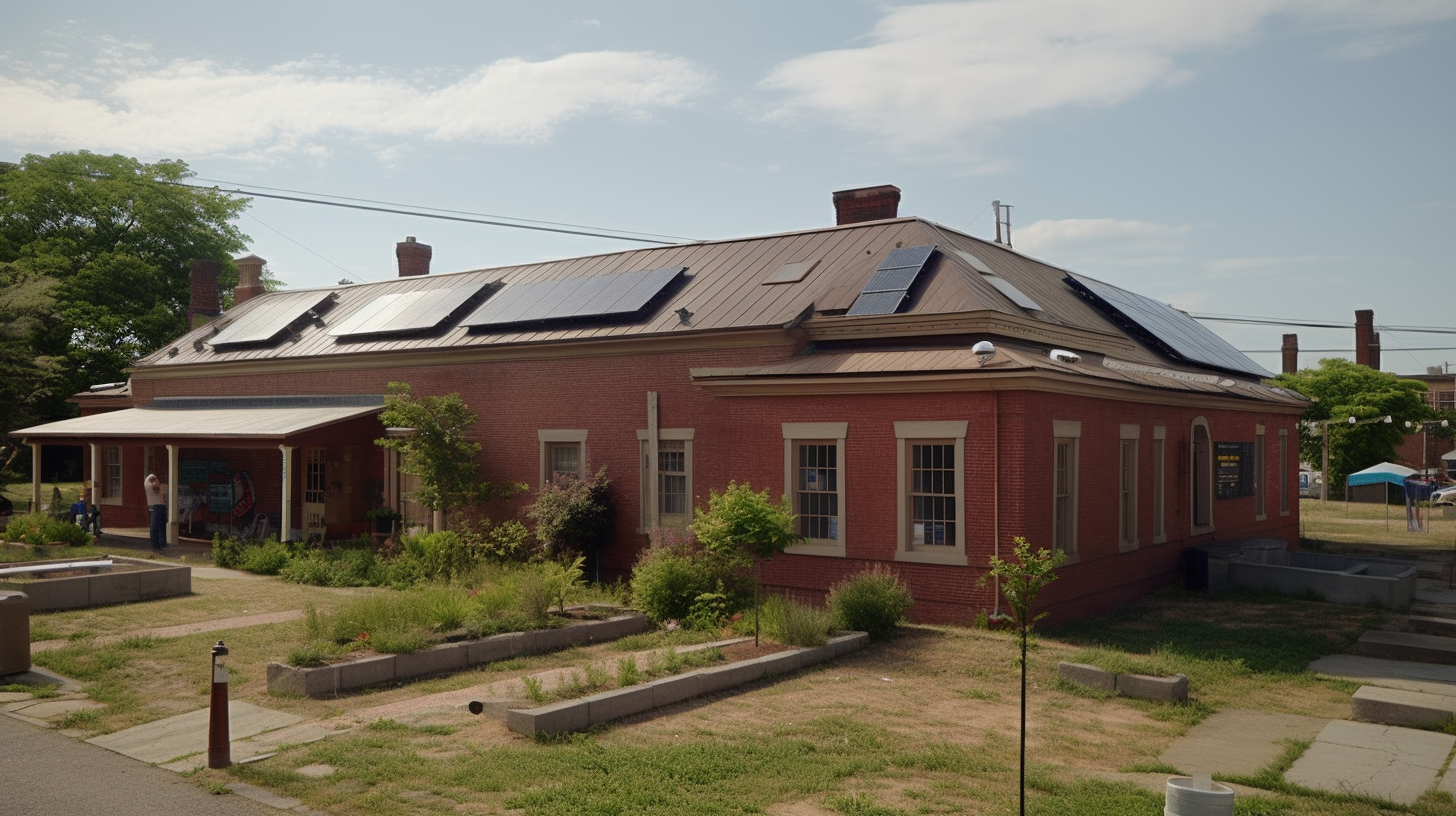
    Happy Hollow Recreation Center in the Germantown section of Philadelphia, is the city’s oldest recreation center, first opened in 1911. It has a playground, two basketball courts, two tennis courts in disrepair, and 2 acres of open land. As a community fixture, Happy Hollow offers a wide variety of community services, including sports, gardening, cooking, and computer classes. It has also gained some repute over the years for producing a series of NBA-caliber basketball players through its coaching programs.[27]Dent, M. (2017, July 7). From Happy Hollow to the NBA: Philly’s oldest rec center is a basketball hotbed. Billy Penn at WHYY. In spite of this history, it has experienced turns of repair and neglect. Most recently it has been slated for renovations as a Parks and Recreation capital project, and was allotted funding through the city’s Rebuild program to finalize those updates. The city website is vague on the details of the renovation, and the project is in the “Pending” phase — a designation which is equally unclear.

    Figure 2: Progress of Rebuild Projects as of July 2022

    As a beloved community center, Happy Hollow is a prime candidate for transformation into a resilience hub. For improving residents’ everyday quality of life, the rooftop real estate is enough to host some solar + storage infrastructure, the installation of which offers both employment and educational opportunities for the community. The surrounding land could be allocated to any number of fundamental community needs, such as an urban farm and/or food forest, complete with beehives and chickens — to provide fresh, local food, and to further enhance existing gardening classes. Programs could be expanded to include training to help residents build resilience, such as counseling on how to access state and federal funding such as the Inflation Reduction Act (IRA) or Whole Home Repairs Act (WHRA) to renovate and retrofit their homes. Taking cues from nearby Mt. Airy Learning Tree, community members could participate in regular skillshares, in those faculties which enhance quality of life today and help people prepare for future stressors and shocks. 

    Stormwater management infrastructure — permeable pavers, rain gardens, etc — in addition to a rain catchment, purification, and storage system, could encourage residents to implement similar solutions in their own homes through the city’s woefully under-utilized Rain Check program. As residents come to understand the value of local air monitoring, additional sensors might proliferate throughout the city, and encourage officials to be more granular in their approach to air quality — addressing disparities in vulnerable neighborhoods. 

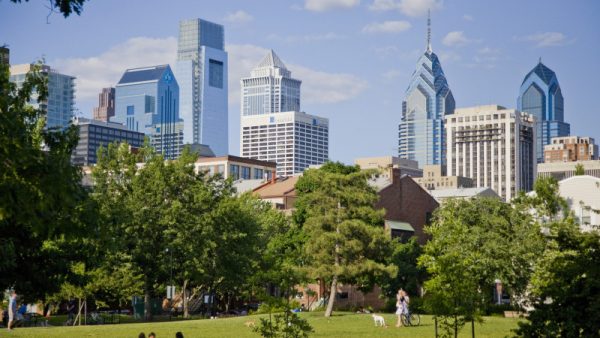
    Figure 3: Happy Hollow Recreation Center in Germantown

    These improvements to residents’ everyday quality of life, building upon the benefits Happy Hollow already offers, would have a wide impact. Increasing young people’s access to recreation is often cited as an antidote to violence, which has become a critical issue in the city. By implementing a resilience hub model, expanding the site’s green space, improving community nutrition, and simply creating more opportunities for neighbors to build relationships with each other, would have a compound effect on reducing violence. 

    In times of disruption, people might come to Happy Hollow for first aid, temporary shelter, or emergency food and water provisioning. Although Germantown is not one of the more vulnerable neighborhoods with respect to the heat island effect, Wayne Avenue, on which the center is located, is a commercial thoroughfare with very little tree canopy, and on a particularly hot day, Happy Hollow might offer cooling stations — of particular value for elders and young children. On poor air quality days, the center could provide some reprieve for residents with asthma or other respiratory challenges. The recent scare around the chemical spill in the Delaware also presents a perfect use-case, as a Happy Hollow resilience hub could’ve provided clean drinking water sourced from rain catchment or purified through relatively low-cost on-site infrastructure such as Lifestraw technology, and forestalled the run on local stores for bottled water. 

    Figure 4: LLM-generated Mockup of Happy Hollow Recreation Center renovated into a Resilience Hub, with solar power and food production capacity on site

    Finally, a Happy Hollow hub, where it regularly provides programs, services, and resources that improve quality of life and help residents build resilience, would also be well-positioned during recovery from a devastating or enduring shock. An on-site tool library could help residents repair damaged homes, with help from a Citizen Repair Corps, trained in carpentry or electrical at Happy Hollow through the community skillshare. And because Happy Hollow is a trusted community location, it would be well-suited to coordinate disaster response with other agencies, and to provide a gathering space during recovery planning.

    Funding

    Happy Hollow has been named as a site to receive renovations through the city’s Rebuild program. Instead of merely restoring the existing facilities, additional funding from Rebuild, coupled with additional resources from the federal government, such as the IRA, could go a long way toward reimagining the recreation center as a resilience hub. More funding still might be secured from the William Penn Foundation, which has placed sustainability initiatives at the top of its list of targeted projects [28]William Penn Foundation (2023). What We Fund., or from long overdue PILOTs — payments in lieu of taxes [29]Leland, P. (2005). Payments-in-lieu-of-taxes: A revenue-generating strategy for central cities. Revitalizing the city, 201-225. — extracted from universities and corporations.

    Community Engagement

    Philadelphia has a poor reputation for community engagement, for while the city ostensibly asks for resident feedback in many fora — testimony at City Council, public comment at various commission meetings, and various community design processes — less transparent, or even evident, is how this feedback gets incorporated into the implementation of the city’s plans [30]Hargrave, L. (2022, August 29). The process of Washington Avenue’s redesign falls short of democracy and fairness. Grid Magazine.. One of the seven stages of development in the Rebuild program is “Public Engagement and Design”, aligning with the process of creating a resilience hub, which must be driven by community input in order for it to be effective.[31]Baja, K. (2018). Resilience hubs: Shifting power to communities and increasing community capacity. Urban Sustainability Directors Network. People don’t use services they don’t need or want, and so it would be crucial to “rebuild” Happy Hollow at the community’s direction. 

    There is even precedent in the city for a participatory budgeting process [32]Murphy, D. (2020, December 3). How would you spend $1M in city cash? Philly wants residents to shape next budget. WHYY., which allowed residents to weigh in on how to allocate funding for community facilities and public infrastructure. Missing from this process, however, were regular cycles of feedback and reflection and a clear articulation of how community input translated into how money was ultimately spent. 

    A truly participatory process would recognize that valuable knowledge can be actively produced by the community. This recognition would need to be made explicit at every stage of the process, from the collection of data, to the analysis and application. A more authentic and robust engagement process could increase the existing social capital of Happy Hollow, and strengthen its stature within the community as a trusted resource. 

    Conclusion and Additional Policy Implications

    The creation of resilience hubs in Philadelphia would not only do a great deal in meeting the city’s sustainability targets, it would foster short and long-term quality of life enhancements for local residents, and prepare us for inevitable stressors and shocks during the long march through the climate crisis. 

    A hub at Happy Hollow could act as a pilot for implementing the model citywide, which, aside from its many clear benefits to community and environmental health and well-being, could also kickstart broader policy conversations. For example, where a hub makes the advantages of solar energy more widely understood, it may cultivate enough political will at the local and state level to push for the legalization of community solar in Pennsylvania [33]Glabicki, Q. (2022, September 20). PA needs new solar energy laws. Here are where the bills stand. PublicSource., itself a strategy for building resilience through lower energy costs [34]Corby, E., & O, K. (2023, April 19). Community solar can propel Pa. Toward an equitable clean energy future. Pennsylvania Capital-Star.[35]Chan, G., Evans, I., Grimley, M., Ihde, B., & Mazumder, P. (2017). Design choices and equity implications of community shared solar. The Electricity Journal, 30(9), 37-41. and creating infrastructure redundancies in case of grid failure.[36]Deng, S., Hansen, A. V., Hiltbrand, G., Maddex, S., & Sinclair Lecaros, S. (2019). Evaluating Viability of Community Solar Microgrids for Resilience in Puerto Rico.[37]French, C., Van Kirk, J., & Messick, A. (2022). Solar Microgrid Implementation in Prince George’s County, Maryland. Partnership for Action Learning in Sustainability (PALS)

    Finally, through the resilience hub co-development process, the city could set a new standard for community engagement, and where the process translates into direct, material, quality of life enhancements for residents, it could do much to reverse long histories of justified distrust toward city officials [38]Atherton, T. L. (2017). Mitigating distrust: Trauma and redevelopment in Eastwick, Philadelphia. University of Delaware..
    Notes & References[+]
  • North Philly Peace Park and the Continuum of Black Struggle

    North Philly Peace Park and the Continuum of Black Struggle

    A shorter version of this article was published by WHYY.

    It was in April of 2020 that I first heard about the North Philly Peace Park. The name came and went in a snatch of text conversation, but a convergence of life-changing circumstances would steer me back. The first was that the COVID-19 pandemic was starting to rage in Philly, calling into question mine and everyone’s relationship to work. The second was that over the previous few months, I had started dipping my toes into the Philly sustainability scene, feeling a calling to the work on a local level. And finally, the many inklings over the years that I wasn’t “cut out” to be a school teacher were starting to coalesce into a new identity as a school abolitionist. 

    For context, before I left the classroom for good in 2020, I had been teaching for eight years, and involved in other forms of education for the better part of a decade before that. In spite of the intractable problems of schools, and their hardy resilience against half-baked neoliberal reforms, I genuinely believed for most of my career that there was something we — or even I — could do as a teacher to improve the lived realities of my students. In my first semester of graduate school, I pondered the role of the teacher in an “education for liberation”. 

    In December 2019, I was in the midst of facilitating a Participatory Action Research (PAR) project with high school students, to investigate the local impacts of climate change, particularly with respect to community health. Looking into how it connected to the higher asthma rates for Black and Brown communities in Philadelphia, we learned about the urban heat island effect, and how historic disparities in health were drawn in red lines.

    We would later apply for a grant to transform our school courtyard into a community green space, as a means of mitigating the disparities in heat, air quality, and access to healthy food. A combination of the pandemic and the inevitable bureaucratic quagmire brought the project to a standstill — though perhaps only temporarily as conversations have recently started to pick up again.

    This was the start of my transition from school teacher to community educator and organizer, a journey that has allowed me to connect with so many incredible people and organizations throughout Philadelphia, in the orbit of land, food, and climate justice. Most significant of them all has been North Philly Peace Park. 

    If you aren’t familiar with the Peace Park, the gist is this: community members in the Sharswood neighborhood of North Philadelphia came together to clean up and restore health to a parcel of land, and convert it to a sustainable space for growing food and building community. They did not ask for “permission” from the owners — the Philadelphia Housing Authority — because no one should need permission to thrive. This early work set in motion a nine year struggle between the Park and PHA, for the very right to self-determination.

    It is a struggle that has always been rooted in control of the land, from Indigenous dispossession, through the displacement of Black farmers in the South, into the present where many battles are being waged over the question of land sovereignty. As explained by mixed media artist and scholar Li Sumpter, a member of the Peace Park design and education teams, “this idea of reclaiming space and reclaiming land, of ownership and agency have always been a part of the Peace Park strategy of community building”. 

    In August 2020, I was able to connect with Tommy Joshua, the founder and executive director of the Peace Park. We had a wide-ranging conversation about education, land, food, and Black self-determination. He invited me to join a newly forming education team, which would be working to formalize the more organic, ad hoc educational programming that the Peace Park had been conducting with local children for years. 

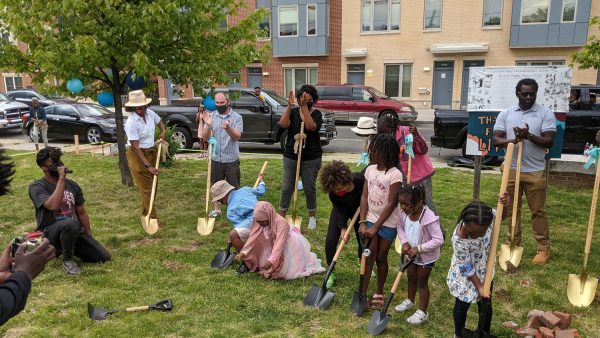
    On Saturday, May 15th, I joined North Philly Peace Park staff, volunteers, and Sharswood community members —  generations of Black people, from infants to elders — for the groundbreaking of the Sala Keturah STEM Pavilion: a stunning fusion of Afrofuturist aesthetic and sustainable design, which will serve as the centerpiece for a full-block ecocampus. 

    Design mockup for the Sala Keturah STEM Pavilion

    The pavilion is part of a larger project to model Black self-determination in Philadelphia through agriculture, design, education, wellness, and cooperative economics. Maya Thomas, lead planner in the building of the pavilion, sees the Peace Park as a case study, providing a pathway for Black communities like Sharswood to push back against gentrification. She says that where people feel helpless in the face of relentless redevelopment, the Peace Park offers a “competing ideal”, an alternative that genuinely meets the needs of the community.

    From the electric enthusiasm of the young people as they drilled their shovels into the earth, to Thomas’s tears of joy, it was clear that the event also represented the breaking of a tide, the crossing of a threshold from dreams to realization. The event was filled with joy and camaraderie, the Park vibrating with the creative energy and the will to see the dream fulfilled. 

    The theme of the groundbreaking ceremony was tracing the continuity of Black struggle, resistance, and resilience. Community elder Mama Gail guided the attendees in calling Black ancestors into the space, while also inviting us to dream the future into being. In the words of lead architect Nyasha Felder, the pavilion will “function as a time capsule, by retaining the cultural significance of place making through the lens of Black radical space.”

    Groundbreaking of the Sala Keturah Pavilion at North Philly Peace Park

    Fifty years ago, community activist, educator, and scholar John Elliott Churchville started the Freedom School on Ridge Avenue, a mere three blocks from North Philly Peace Park. His mission, from 1964 to 1978, was Black self-determination, which he recognized as incompatible with education provided by the State. Churchville honed his vision through the lens of revolutionary nationalism, an ideological current that finds one of its most coherent manifestations today in North Philly Peace Park. 

    Philly school teacher and Peace Park education team member Nzinga Hill wants to cultivate  “intellectually sound, spiritually grounded, culturally knowledgeable liberators”, that these young people need to be “uncompromising”, steeped in Black thought, Black struggle, and Black scholarship. It is a vision I share, having struggled myself with navigating predominantly white spaces, trying to glean some hint of what Black liberation might look like. Faced with an utter void in Western and white scholarship, I turned to the wisdom inherent in years of Black resistance, Indigenous struggle, each grounded in a care and respect for the Earth — working to synthesize what I’m calling a Red, Black, and Green ecology of learning. The Civil Rights and Black Power movements are always discussed in the past tense, but they should rather be understood as part of a continuum. Emblematic of that continuity, Dr. John Churchville himself was among the guests for the groundbreaking of the Sala Keturah Pavilion.

    Philly is a “city of neighborhoods”, really a city of blocks, such that we often aren’t aware of the greatness taking place right under our noses. There have been a few times out at the Park when I’ve been approached by local residents asking me what it’s all about. It was striking to me that even people who lived within walking distance were unaware of this vital space where they were free to harvest food directly from the land, or from the numerous food giveaways. This resourceful space where Black people were creating natural balms and tinctures, art, crafts, and other products, during monthly Green Wall Street gatherings. This magical space, where Black people were coming together for conversations about strategies, logistics, and the very contours of self-determination. This space which has become a convergence point for the ingenuity and creativity of so many people, from educators and activists to artists and architects, to beautiful Black children seeking a place to be their essential selves, wild and free. 

    Also. Y’all. Did I mention that there’s bee hives and a solar smart cube? 

    All the things that North Philly Peace Park is, and will become, are part of a continuum of collective dreaming, striving, and will toward self-determination: the heart of all Black struggle. The life of Black people in this country has always been defined by the tension between our demand for sovereignty, and the violent refusal by the State at every juncture to entertain the mere idea. From the murder of Octavius Catto, situated at the center of a relentless campaign of anti-Black violence against our attempts to vote, to the institutionalized violence of the police, carceral system and the courts, any whiff of Black mobility or agency is met with full-throttled resistance by the State and its proxies. 

    Reemerging into the public consciousness, due to revelations of the egregious violence toward Black people even after death, is the history of the MOVE organization, and the military-style campaign launched against them on May 13, 1985. It is the only example in U.S. history of a city government dropping a bomb on its own citizens. It is a story of police intervening against the fire department to facilitate the destruction of an entire city block, and shooting at people who tried to escape the flames. It is a story of grotesque violence, profane cruelty, and an utter contempt for Black life. 

    Pertinent here is what the MOVE organization was before this redefining incident, and what they have continued to be in the aftermath: a collective of Black people who chose to divest from white supremacist, patriarchal, ecologically devastating, capitalist system. Black people who chose to educate and care for their own children, rather than remanding them to state control. Black people who chose to eat and sustain themselves through their own labor, rather than the mediated exchange of the money economy. Black people who embodied self-determination. 

    And how did the state respond? With a bomb, and ten thousand bullets. Because the viability of our political and economic system depends on Black subordination. 

    North Philly Peace Park occupies the same continuum as MOVE, in the ongoing struggle for Black self-determination. The Park was also the victim of state violence, when the police raided the buildings they were renovating, under the false pretext of drug activity. While what happened at the Park was incommensurate in scale, historical impact, and the deep, reverberating trauma experienced by MOVE, it was a reminder of how any attempts by Black people to be self-determined will be met with fierce resistance by the state. 

    It was the strength and support of the Sharswood community which saw the Peace Park emerge on the other side in an even better position. The Park has since been given control over the land and buildings at the site, and the necessary permissions to move ahead with the construction of the pavilion — itself a representation of continuity, being inspired by the Oshun temples of Nigeria and the shotgun houses of the Black South.

    Felder says that even though there is much to learn from the past, “when it comes to responding to our current needs, we have to innovate, we have to create something for the now, and for the future.” The pavilion, adds Sumpter, will create a space for Black people “to design, to dream, as we see fit for our futures.”

    As I reflect on my own tumultuous journey from teacher to organizer, I realize it could’ve easily been derailed, and sent crashing into any number of dead ends, had it not passed through North Philly Peace Park. What I’m hoping to contribute to an already brilliant and dynamic project of Black self-determination is a framework emerging from my graduate research into the history of education, enclosure, and Black, Brown, and Indigenous resistance to state violence. In line with the values of the Park, which ground our work in land sovereignty, I imagine young people, elders, and everyone in between, learning, growing, and building together. 

    North Philly Peace Park represents a radical vision for Black self-determination, one that we hope can be replicated throughout the city.  In line with the very meaning of the word “radical”, our work starts at the roots — both literal and historical — tracing the continuity of Black struggle and Black resilience, to branch out toward countless possibilities for peaceful, thriving, self-determined Black futures. 

  • ADHD, Organizing, and the Tensions of Hunter’s Mind

    ADHD, Organizing, and the Tensions of Hunter’s Mind

    You will find very little about ADHD on my blog, and this is for two reasons. The first is that I was diagnosed only two years ago, so while it has exerted psychic pressure on everything, it was an unknown quantity for most of my life. The second reason is that in spite of its penetrating influence, I’m not interested in having ADHD define my public persona. I do not want to be another ADHD blogger or podcaster, because frankly, I have “bigger” things to talk about. I do not say this to malign others who have chosen that path, or to minimize the impact of ADHD. I just have different priorities, and mostly regard neurodivergence as my own private struggle. However, I do need to talk about ADHD in this post, as I’m coming to understand how it reverberates through all of my work, and my relationships to people, especially in movement spaces.

    First, a disclaimer. While I have done a good deal of research on ADHD, my story here is based mostly on my lived experience. It is specific to me, my own context and positionality, and I don’t claim to speak for anyone else. For that, I am also going to take out the “H” for this discussion, because I am not the hyperactive subtype.

    Attention Overload

    There are four key “symptoms” — or perhaps “features” — of ADD that are pertinent. Let me start by saying that “ADD” itself is a misnomer. The first “D”, for deficit, is just plain wrong on its face. I do not lack any ability to pay attention or to sustain it. On the contrary, my ADD functions like an antenna, picking up on every little bit of sensory and semantic data from my surroundings, or bubbling up from my unconscious at any given moment. Most human beings naturally filter out all of this “excess” information, in order to focus on a particular task, and so as not to be overwhelmed. ADD makes this filtering difficult for me, and in fact, I pay too much attention.

    This explains why, as a teacher, in spite of my vehement moral and ideological opposition to standardized testing, those days were always the most peaceful for me. Under the pretext of “talking means an automatic zero”, I was able to occupy the classroom without all of the usual “static” — the whispering, chattering, screaming, tapping pencils, knees hitting the undersides of desks, stomping — all the natural sounds of youthful humanity pushing back against enclosure.

    Attention Overload Disorder (AOD) might be a more accurate name, except that I also reject the premise that there is anything wrong with me. Attention Overload Syndrome (AOS)? Better, but it is still missing something. A former therapist, in passing, shared with me some of the thinking about ADD, through the more equitable lens of “neurodiversity”. She said something about ADD being an evolutionary adaptation, that it would’ve been an asset for earlier humans, particularly the hunters among us.

    The hyper-attunement to her surroundings would’ve made the hunter great at tracking, due to the ability to notice and make meaning of small signs in the environment, to recognize and respond quickly to danger.

    So, maybe instead of “ADD” or “AOS”, we could call it “Hunter’s Mind”. From this perspective, what I described earlier as the “intense psychic pressure” ADD exerts, is not quite right, either. What I experience is better understood as a tension between the “Hunter’s Mind” and life in an industrial capitalist society. The shift from hunting and gathering to agriculture to the industrial mode privileged those who were better at filtering. Furthermore, the cascading lattice of enclosure that structures capitalism forces and reinforces the need to “focus” and specialize for the benefit of production, and in the name of “efficiency”.

    Memory Leakage and Revelation

    The second important feature of ADD/Hunter’s Mind is “porous memory”, meaning that things often come and go from consciousness quite rapidly, presenting all manner of challenges with respect to organizing my life and priorities. But the things that enter my memory, even briefly, are not so much lost as temporarily inaccessible. With the right stimulus, whatever snatch of dialogue, forgotten obligation, or very important task, comes rushing back.

    This “inaccessible” information also tends to influence my thinking in more subtle ways. Without fully permeating the conscious/unconscious boundary, it takes on an almost a priori quality. There is a synthesis that takes place just beneath the threshold of consciousness, such that complex thoughts seem to irrupt whole from the ether. It calls to mind the story of Athena emerging fully-formed from the forehead of Zeus. If you’ll forgive the hubris of that comparison, you might imagine how the antenna and porous memory work in concert to spectacular — if often bewildering — effect. I sometimes find myself privy to knowledge or understanding, of things in which I have no expertise or even background. I think the antenna is picking up on bits of information, or I am actually learning from the dizzying array of things I consume on any given day, only to “forget” them shortly thereafter. Through the synthesis process, which remains somewhat opaque, I am able to make meaningful connections.

    The hunter would’ve needed to synthesize and make meaning of many different clues in the environment in order to track down his prey. This almost preternatural intuition — itself a function of memory — allowed him to just “know things”.

    There was a time before I was diagnosed, when I attributed my inexplicable knowledge or understanding of things I couldn’t remember learning or experiencing to something mystical. It strikes me as mystical still, in spite of having a more scientific explanation.

    Hyperfocus and Tuning Out

    The third significant feature of Hunter’s Mind is hyperfocus, the tendency to take an intense and concentrated interest in a particular thing, often for a extended time. Once my mind flags something as important, as mediated by my interests and values, the only way I can fully interact or engage with it is to turn off the “antenna”. Unlike a “neurotypical” person, who I imagine can focus, shift focus, or unfocus at will, turning off the antenna for me is the difference between a spotlight at night, and a laser in absolute darkness. Pretty much everything except for the object of my focus — including my own body — might as well no longer exist.

    For the hunter, it may take long periods of intense focus to track their prey through the forest to the cavern, and more time still laying in wait for the right moment to strike.

    I love to watch films in the theater, but there is always a bit of disorientation after the credits roll, and a heaviness as I am wrenched from the immaterial mind-media interface back down into my body. What I experience in hyperfocus is comparable to Csikszentmihalyi’s concept of “flow”, except that it creates all sorts of challenges with respect to my other priorities and obligations (not to mention vital needs). It also creates tension between me and others in my life, especially when they “break the laser beam” in soliciting my attention. The sudden reactivation of the antenna feels so disruptive and intrusive that it often inspires anger — perhaps like the “hunter” reacting to a perceived threat.

    Laser meets lightning (Image Credit: M. Kornmesser)

    Impulsivity, Impatience, and Intensity

    The final relevant feature of Hunter’s Mind is actually made up of two inexorable characteristics: impulsivity and impatience. And even these words don’t capture the essence of it. My sense is that it relates to porous memory. Not only is memory the literal (physical/chemical) content of identity, it determines how we respond to the world around us. Past information necessarily informs predictions of future outcomes, even if only on a subconscious level. And so where memory is not immediately accessible, a person with Hunter’s Mind — say, me — might find themselves continuously doing things that they should’ve “known better” not to do. Like pushing for institutional change in one beleaguered school after the next, in spite of repeated retribution from hostile leadership. The layered mnemonic accumulation of stimulus-responses that we call “learning from our mistakes”, and which can also inspire a sense of fatalism, is more or less thrown out the window in favor of the endless pursuit of novelty.

    The “caution” or “pragmatism” which anchors us to the status quo is bolstered by all the evidence (stored in memory) that at least the “way things are” allows us to survive. Due to the fragility and precariousness of life under capitalism, embedded in our collective memory, many people fear change, even so much as plucking the thread to which we cling. On the other hand, without a cohesive narrative of all the things that could go wrong, I am quick to embrace radical change. I can, on a whim, make significant life changes, and I am eager to try all the things that offer another possibility. Not tomorrow, or in six months, but now. Others tend to read this as “impatience” or “impulsivity”, but for me it feels obvious, and I have difficulty understanding why they can’t “see what I see”.

    When the moment came for the hunter to make her move, hesitation was the difference between securing food for the band, or returning home empty-handed.

    When my antenna picks up positive frequencies: theories, practices, strategies, stories, methodologies, people, events, opportunities for creating a better world, I feel an intense urgency to act on them, before they disappear. Perhaps because of the way things enter, leave, get displaced or buried within my memory, these opportunities seem ephemeral, difficult to pin down like the position or momentum of particles. But even things that flit in and out of awareness tend to root themselves somewhere in my memory. Complex ideas are synthesized, even as their practical structures elude me. And where these ideas are of particular interest or importance, I concentrate a lot of energy into exploring further or acting on them, which can come across as “intensity”.

    Organizing Principles of a Hunter’s Mind

    Perhaps with all this context, it will be easier for me to explain the frustrations and challenges I encounter on a regular basis. Since leaving the classroom, most of my work has been in the orbit of land, food, and climate justice. I have been extensively networking (by which I mean forming meaningful partnerships) with people from many different organizations — in Philadelphia and beyond — whose work is either in those three areas, or adjacent.

    Many of these organizations operate within silos, not only with respect to how their particular work area overlaps with others, but also within a given area. Which is to say that there are many organizations doing similar, if not the same work, sometimes even in the same part of the city, and yet somehow without knowing about each other. Part of this is specific to Philadelphia, being a “city of neighborhoods”, hyper-segregated with enormous disparities in wealth, health, and quality of life, geographic concentrations of deprivation, poverty, and violence. This matrix of domination breeds distrust, animus, and fear, and with that, a firm commitment by many to the status quo, in spite of all the reasons to demand something better.

    Hunter’s Mind allows me to glimpse both the underlying systems that reinforce domination, and the ley lines along which alternative lifeways might be built. The utter soup that is my mind under capitalism requires serious organizational structure in order to even function. And so my thoughts naturally gravitate toward and coalesce around any possibilities for breaking down silos, traversing boundaries of animus and distrust, fostering communication, and synthesizing many different kinds of work into a more cohesive vision. Which is what I would call “organizing”.

    Network (Image Credit: TheDigitalArtist)

    In my work with the Food Policy Advisory Council, I’ve been thinking about the food system as a series of nodes which either facilitate or obstruct the movement of plants and animals from land or sea. At each node, more energy is required (transportation, processing, storage), which means more emissions and more waste. Both of these contribute to a warming climate, or the degradation of the surrounding environment. I am also aware of how the underlying logics of capitalism, white supremacy, and patriarchy create and reinforce the barriers between people and their fundamental needs.

    In planning an intervention to help mitigate the urban heat island effect, I thought about how green spaces could do double duty by feeding people in the community. When I think about development in Philadelphia, I’m concerned not only about how gentrification exacerbates the housing crisis, but the fact that buildings are the primary contributor to greenhouse gas emissions, and how some of the land might be better used to produce food and localize the supply chain.

    I am not writing any of this to exalt myself as some special or unique thinker, and certainly not as a particularly effective organizer, but to explain how I tend to enter movement spaces. What to others seems like impulsivity, intensity, and moonshot ambition, is how my brain attempts to reconcile the gravity and scale of the problems we face with an internal imperative toward justice. Hunter’s Mind tunes me into many possible solutions, constantly attempts to synthesize, seeks to combine all of the resources and bring in all the necessary people — immediately — and work with relentless focus until we’ve at least made significant progress. And then do it again the next day.

    Where things feel too slow or intermittent, or not comprehensive enough, the energy of Hunter’s Mind accumulates in the form of restlessness and frustration.

    The hunter’s reputation or very identity may have depended upon his ability to bring home food to the band, after all.

    While I do my best not to project these feelings, the pent up energy inevitably finds release in other ways, such as in the way I speak: rapidly, forcefully, and with liberal use of hyperbole. For people who don’t know me very well, and know even less about all the underlying processes at work, I can sometimes be “a bit much”.

    Hunter’s Mind — or ADD, if you must — can be a challenge, but given grace, empathy, and space, I believe it can be an asset in movement work. While I am writing this essay, in part, as an appeal for understanding to all of the people with whom I have worked or will work in the future, I have no illusions or expectations around how many will actually read it. But I have also found it cathartic to articulate and express what I’ve felt or understood intuitively for years, as the tension within myself, and between me and others. As I continue my work, I strive to reconcile these tensions through personal transparency, mutual struggle, and a shared sense of responsibility for people and planet.

  • The Cynical Manipulations of the Gatekeeper

    The Cynical Manipulations of the Gatekeeper

    The biggest problem with conspiracy theories is that they divert attention away from the actual conspiracies playing out in plain sight, albeit obscured by the labyrinthine mechanisms of capital. While people are worrying about pedophilic sex cults, tracking chips hidden in vaccines, or musicians using human sacrifice to accumulate fame, there are less arcane and far worse things taking place.

    There is also an interesting dynamic wherein certain figures are situated at one of two extreme poles in popular discourse: as maniacal supervillains or selfless philanthropists. Usually, neither is an accurate characterization, and the truth lies somewhere along the spectrum, though seldom in the “middle”. This polarization also overlooks the ways in which these figures might sit at both poles simultaneously, to accumulate both capital and power. It is probably obvious by now, if the title didn’t already give it away, that I am talking about Bill Gates.

    Bill Gates at the Munich Security Conference in 2017

    What I want to propose is that the actual Gates agenda, far from facilitating the rise of the lizardmen, depopulating the world, or tracking everyone with microchips, is more…basic. Pretty much everything he does can be be viewed through the lens of accumulating profit and control, and his primary means is by situating himself as a gatekeeper.

    It is easy to get carried away, finding connections between things that aren’t really correlated, all to support a narrative you already believe. So in the spirit of transparency, and to open my analysis to critique, I will admit that I have an intense animosity toward Bill Gates, and that this animosity informs the context of my interpretations. I almost reflexively assume the worst of him, and “the worst” almost always bears out, in spite of paltry evidence to the contrary. My hostility toward Gates is founded upon his status as an ultra-wealthy person, because I understand that such wealth is always based on the exploitation of people and the natural world. There is literally no wealthy person on Earth who earned their wealth through a strict conversion of their own intellectual or physical labor into material assets. At multiple (countless) junctures along the trajectory of their ascension, both temporally and spatially, someone was exploited, or something was extracted, under threat or actualization of violence.

    From that foundation, I also take issue with Gates frequently injecting himself into spaces where he does not belong and where he is not welcome, both because he has no real knowledge or expertise in these areas, and because there is always some ulterior motive, again toward profit or control. Such is the case with his relentless attempts to influence education reform or alleviate poverty in Africa.

    More than his generosity, what Gates’s “philanthropy” reveals is his cynicism and his arrogance. These traits are mutually reinforcing, because on the one hand, Gates does not trust in the capabilities of other people, and on the other he thinks himself to be uniquely capable. In my hometown of Philadelphia, Gates is best known — besides his status as one of the world’s wealthiest men — as a driving force behind education “reform”, physically manifest in the “School of the Future”, a public high school which was supposed to model Gates’s theory that technology could solve all problems.

    School of the Future in Philadelphia, PA

    Like most schools, Future is both a product and a reproducer of the broader society. The experiment, to outfit a school with enough technology to meet the vaunted goal of 1:1, hoping that would somehow reconcile deep historical and systemic inequities for the mostly-Black student population, was an epic failure. Today, the school is the same many others in Philly, doing next to nothing to change the material conditions of young people, nor much at all to alter their prospects. This in spite of the noble efforts of individual teachers, who in their relative isolation can only hope to reduce harm. “School of the Future”, in retrospect, was a rather ironic name, because rather than some gleaming exemplar of “reform”, it represents another reproduction of the relations of domination within the city and country at large.

    Gates’s cynicism and arrogance, blended in equal parts with white liberal racism, create a cocktail of paternalism by which he sees himself as the savior of the “darker nations”, be they Black children in Philadelphia, Africans dying from malaria, or farmers in the two-thirds world dispossessed by a changing climate.

    He is the physical embodiment and ideological convergence — an avatar — of white supremacist patriarchy. Yet due to his vast sphere of influence, namely his accomplices in mass media, he has been able to style himself as a philanthropist icon. Under the pretext of generosity he is able to deflect critique, and valid lines of inquiry get drowned out in the cacophony of conspiracy theory.

    So, in case it wasn’t clear, I don’t like Bill Gates, and I am skeptical of everything he does. In spite of all that, I think the case I want to make here — inklings of a specific and rather grotesque agenda — will stand on the merits.

    Earlier this year, Gates published a book about how to avoid climate disaster, the culmination of many public comments he’s made on the subject over the years. That a man who is not a scientist, environmental or otherwise, nor working in any of the sectors actively problem-solving around climate change, would publish a book claiming to know the “solutions” is sheer hubris. The arguments he makes are generic, easily cherry-picked from any number of articles published on the subject for the past ten years. Yet none of his solutions point toward what every climate scientist and activist knows is necessary: pumping the brakes on the runaway extractivism of capitalist production. By framing the discussion in terms of surface level actions, rather than root causes, Gates is able to maintain his guise as a concerned citizen and caring philanthropist. But the sleight of hand is revealed when we investigate what he gets up to when he thinks no one is looking.

    Recently, it was discovered that Gates has been secretly — through proxies — buying up acres upon acres of farmland. To what end? It’s a question that many have been asking.

    The principal danger of private farmland owners like Bill Gates is not their professed support of sustainable agriculture often found in philanthropic work – it’s the monopolistic role they play in determining our food systems and land use patterns.

    In his new book, Gates talks about how smallholder farmers stand to bear the brunt of the devastation caused by climate change, while being those who contribute the least. We have already seen these consequences play out, driving civil conflict and desperate migrations. It was one of the lesser known variables contributing to the war in Syria, and one of the underlying reasons why Central American migrants made the perilous march north. In all his tender concern for smallholders, Gates writes:

    And we need new seeds and other innovations to help the world’s poorest people— many of whom are smallholder farmers—adapt to a warmer climate.

    In the mind of Gates and other technocrats, it will be innovation that saves us from all manner of crises. These “innovations”, invariably, will be developed behind proprietary firewalls, where for-profit corporations decide how and where they will be deployed based on market logic — that is, who has the means to pay. What Gates does not talk about in his book is how he has positioned himself as a gatekeeper between the smallholder farmers and the “innovations” that might protect their livelihoods, and also between people and their ability to produce food at all in a “post-climate” world.

    Gates has successfully accelerated the transfer of research and seeds from scientific research institutions to commodity-based corporations, centralizing and facilitating the pirating of intellectual property and seed monopolies through intellectual property laws and seed regulations.

    Monopoly capitalism is kind of Gates’s “thing”. There is a clear through-line of monopoly control extending from his war against open source to his behind-the-scenes battle to keep the COVID-19 vaccine distribution under the command of corporations.

    Gates has been tacitly and explicitly defending the legitimacy of knowledge monopolies since his first Gerald Ford–era missives against open-source software hobbyists. He was on the side of these monopolies during the miserable depths of the 1990s African AIDS crisis. He’s still there today, defending the status quo and running effective interference for those profiting by the billions from their control of Covid-19 vaccines.

    The depredations of Gates described so far are merely the facts. The conspiracy comes when we consider these three things — control of farmland, seeds, and vaccine distribution — altogether against the backdrop of looming climate catastrophe, pandemics, and world hunger. All three exist in a close relationship with one another, and stem from the same rotten core of capitalism and white supremacy.

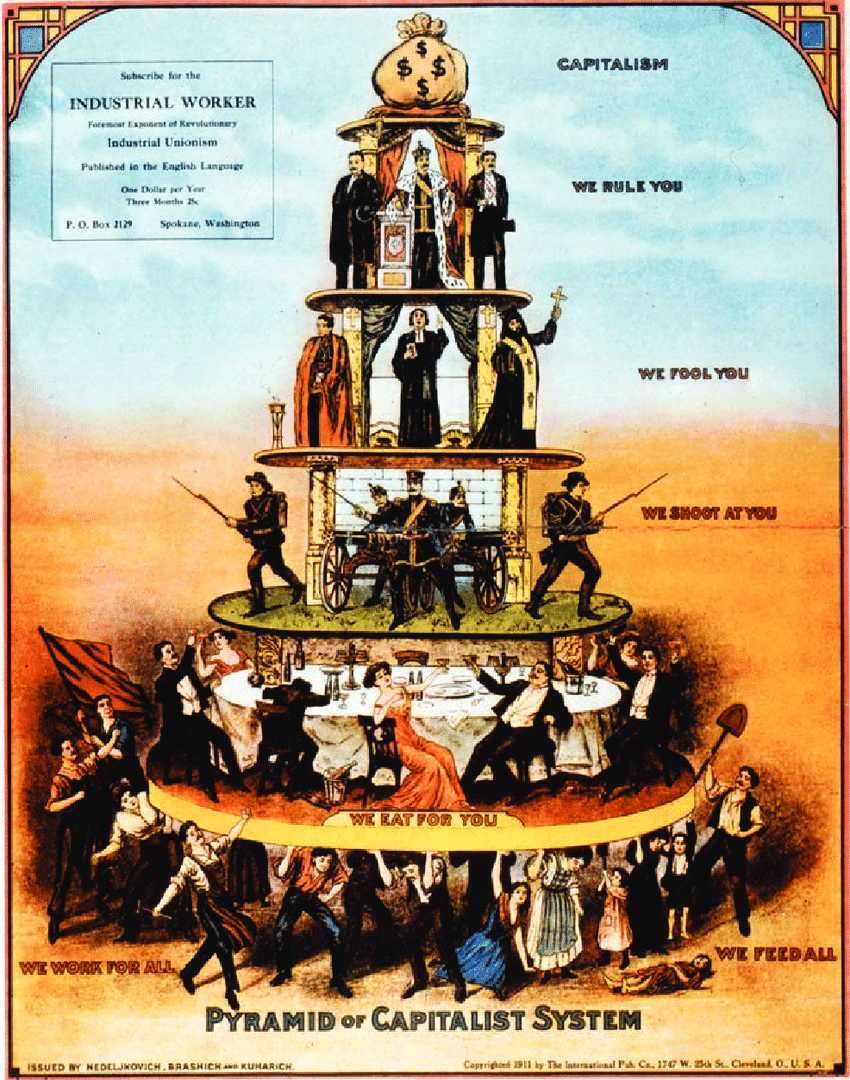
    The Pyramid of Capitalism System by “Nedeljkovich, Brashich, & Kuharich” (1911)

    Climate change drives ecosystems change and the displacement of various animal species, which in turn increases potential contacts between these animals and humans, and the opportunity for zoonotic transfer. The destruction of the natural world through extraction, including arable farmland, and the increasing trend of privatization contributes both to global warming and hunger. People driven off of their farms — by climate change, by land theft, by “market forces” and “trade agreements” which privilege the movement of capital — migrate to survive, and end up being used as fodder in the culture wars. There are more connections still.

    Gates’s public persona, the one that publishes condescending books about how to stop climate change, and wastes no opportunity to discuss his plans to “give away” his money, hides a bad actor whose cynicism and arrogance informs any number of nefarious activities. Why would Bill Gates hide the fact that he is buying up wide swaths of farmland? What follows is conjecture, but I believe it proceeds from a rational observation of the facts at hand.

    Gates understands that his “wealth” is fictional, a wager placed by our economic system that he can and will continue to generate value. It consists of numbers on a network of computers, and only a relatively small percentage translates to anything material. Through this lens, his magnanimous decision to “give away” his wealth appears rather vacuous.

    Given that he has been speaking publicly about climate change for years, Gates clearly understands the threat it presents, not just to people and the planet, but to the fragile economic conditions that sustain the illusion of his wealth. In a world beset by extreme weather, mass migrations, famine, war, and pandemics — all leading to widespread death in a real four-horseman scenario, the bets placed on Gates, Bezos, Musk and their ilk, will amount to scratch. What might be the sources of wealth — real, material wealth — in an apocalyptic world? Seeds to grow food. Arable farmland in which to plant them. And control over the technology to stave off rampaging viruses.

    Four Horsemen of the Apocalypse by Viktor Vasnetsov

    That Gates is positioning himself and others in his class to maintain monopoly control over these vital resources would appear to be a genuine full-blown conspiracy. Even as he writes books laying out the “solutions we have and the breakthroughs we need”, his cynicism prevents him from actually believing any of it. Not only does he have no faith in people to muster the collective will to prevent climate catastrophe, he has neither faith in corporations to abandon their centuries-long commitment to extraction and exploitation, nor in his own ability to “innovate” a way out. In light of this, he would seem to be preparing for inevitable disaster, and in his arrogance, would situate himself as an arbiter of life and death.

    Unlike the delusional plutocrats who believe they can wait out the catastrophe in underground bunkers with finite supplies of food, or the whimsical ones who dream of viable colonies on Mars, Gates is a shrewd pragmatist. It is my sense that while he is not the smartest man, he is smart enough to know his own limitations. And like most wealthy men, he has learned how to capitalize on the talents and labor of others. It is likely the council of these others that gives structure to his conspiracy. And it is these others who have also helped construct around him an illusion of ingenuity, coated in a patina of good will. The entire project is a rather fragile deception, which crumbles beneath any serious scrutiny.

    And that is the end to which I write this post. To throw another stone from outside the glass house. To get a few more people to peer behind the curtain and see the wizard for what he truly is: a self-righteous fraud who pantomimes nobility while actively restraining our collective ability to find a way through crisis, or to build collective resilience in the dangerous new world he helped create.

    *UPDATE 4/28/2021* Shortly after I wrote this piece, calling for more attention to Gates’ machinations, he gave an interview to Sky News in which he doubled-down on his monopolistic position toward COVID vaccine distribution. That interview, in turn, solicited a ton of negative media coverage. It feels almost serendipitous. While I hope this inspires more scrutiny and a few more cracks in his facade, memories are short, the news cycle turns at light speed, and there is no shortage of mainstream media outlets willing to sacrifice their integrity to fend off any enemies at the Gates.

  • From COVID to Climate Change: Herd Immunity vs. Institutional Distrust

    From COVID to Climate Change: Herd Immunity vs. Institutional Distrust

    There is no shortage of comparisons between the dual crises of COVID-19 and climate change. Many people see COVID, and the patchwork and highly inconsistent global response to it as analogous to and also predictive of how we might handle the climate crisis. Some trace their analysis, rightly, to the origin of both crises: the ravages of capitalism — the 500 year problem — which has caused systematic and persistent destruction for both people and planet. While I do not have much to contribute to the conversation by way of expertise or sophisticated analysis, recent experiences have brought to mind an interesting analogy, which may at least offer perspective on mustering the mass mobilization we know is necessary to stall, if not prevent climate catastrophe.

    As the COVID-19 vaccines are being distributed at an increasing rate, there remains a significant portion of the population who are agnostic, or worse, completely refuse to be vaccinated. Putting aside the absurdity of vaccination being a political wedge issue, much like the challenge of getting people to wear masks, there is a fundamental misunderstanding among many people about the role they play in public health — that is to say, the health of other people. If you — anyone — choose not to wear a mask or to get a vaccine, because you do not feel you are at risk for COVID, you miss the point that you may in turn be a carrier for the virus and pass it onto someone who is higher risk, maybe even someone in your own family. We’ll never know how many of the 500+ thousand people who died were infected by those closest to them, but for anyone who has lost someone to the disease, it should inspire some reflection about how our own actions or inaction render us complicit in the spread.

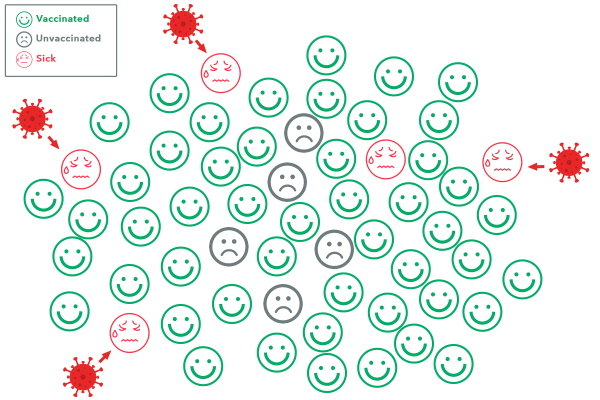
    The hope now seems to be that if we can vaccinate a significant portion of the population, that everyone will be protected through “herd immunity“, the idea being that all the vaccinated people effectively form a barrier that prevents the virus from spreading so wildly. This only works, however, if a high percentage of the population is vaccinated. The threshold varies by pathogen, and we do not have enough data on COVID yet, but it stands to reason that the vast majority of people will need to be vaccinated.

    Diagram of Herd Immunity

    Diagram of “herd immunity” shows how high percentage of vaccinated people insulate unvaccinated people against the virus

    Even in that situation, people will still catch it, and some of these will die, but the global crisis will become manageable. There is a question of how much of a loss of life is considered within the parameters of a “managed” crisis, but that’s a topic for another day.

    Just as vaccination has a society wide impact on health, so will the systems-change work we need to do in order to address climate change. And just like there are people who “do not believe” in COVID, or who refuse to be vaccinated, there are and will continue to be people who deny the realities of climate, and who refuse to make any changes to our social and economic systems in order to prevent its worst impacts. Even as evidence points to the climate crisis already being underway, as with the uncharacteristic snowstorms across the country, urban heat islands in cities, or the tornadoes that somehow got lost in Georgia on their way to Oklahoma.

    The vaccine refusers and climate deniers — and by these I mean the regular citizens, not the ultrawealthy with a financial stake in denial — have one crucial thing in common. While both may be susceptible to conspiracy theory, or lack adequate education on either subject, or have been encapsulated by filter bubbles generated by Youtube or Facebook algorithms, none of these are the most important. The critical commonality instead is a deep — and justifiable — distrust of institutions.

    Just as there are people unable or unwilling to get vaccinated, they may also be skeptical of systems change efforts around climate, or have some other barrier to engagement. This resistance is particularly powerful for people whose immediate needs are so urgent that adopting a systems lens, or looking ahead five or ten years is outside their capacity, or beyond the vanishing point.

    It is important to note here that while some people in the United States are choosing not to get the COVID vaccine when it’s available, there are many countries around the world which simply do not have access to it. This, of course, is analogous to the reality of the U.S being as the second highest volume carbon emitter, at the same time as too many of its citizens choose to ignore the global impact, which will fall disproportionately on countries contributing much less to the problem.

    Also important is the fact that the overwhelming bulk of the responsibility for carbon emissions and other forms of environmental degradation lies with industry. In spite of their attempts — echoing conservative talking points for the past half a century — to convince the general public that it’s an issue of “personal responsibility”. That the environmental costs of production — particularly waste and pollution — are externalized to vulnerable communities within the United States, is a microcosm for how the United States, in turn, exports that same waste to the two-thirds world.

    So I am not writing this to join the chorus of people excoriating the vaccine avoiders and climate deniers. Because, in truth, I feel the blame lies with the institutions — governments and corporations mostly — which have betrayed the public trust, and grievously failed in any stated commitment to public health or well-being. Instead I want to make the case that as we attempt the greatest mobilization in human history to address the climate crisis, we — the big, global we — need to protect everyone, even the deniers, and more importantly, those who for whatever reason remain skeptical of our efforts, or lack the means or capacity to participate.

    Whatever technologies, models, and organizational structures we develop, to orient ourselves toward social and economic justice, we must also make space for the unwilling and the unable to be independent, self-determined, and safe. This means insulating them against the violent death throes of our system of capitalism, white supremacy, and imperialism, as we replace it with something better. Many things better. Institutions and new relationships at the local, regional, national, and global levels that cultivate enough trust and build enough capacity for everyone to participate equitably. This could function much like “herd immunity”, while we do the more difficult work of education and rebuilding trust.

    Maybe eventually we can get to a point where we are all willing — and able — to do our part, for each other, for all life, and for the planet we share.

  • Net-Zero to Net-Positive: Toward a Real Education for Sustainability

    Net-Zero to Net-Positive: Toward a Real Education for Sustainability

    The following are my prepared remarks for the launch of the PHENND Sustainability network, on February 25th, 2021.

    A question I’ve always disliked when meeting people in professional or even casual spaces is: “What do you do?” Because where should I start? Like all of us, I wear many hats: I’m a graduate student, an orchard intern, an aspiring community educator, a writer, a life partner, a brother, son, and uncle, among other things. But the subtext of that question, of course, is “What do you do that has use or exchange value within our capitalist economy?”

    My answer to that is: “Who cares? And why do you even wanna know?” To me, and probably to many of us, that answer is far less important to our everyday lives. Why should my economic value be separate from my value to family or community?

    As a school teacher, I eventually came to the realization that what I was doing in the classroom was fundamentally disconnected from the material concerns of my students. Like many, I bought into the mythology of schooling as an investment into some undefined future, where all these “standards” and “competencies” would eventually “pay dividends”. The perennial question, “Mister, why we gotta learn this?” led to any number of contrived answers on my part, until eventually it became: “You don’t. It actually doesn’t matter at all.” This became especially clear at my last school, where students were forced to choose between coming to class or doing things that were more essential, like raising their own kids, caring for family, or working to survive.

    We attempted a participatory action research (PAR) project around the local impacts of climate change, and I was very intentional about helping students make connections to their lives here and now, rather than polar bears standing on shrinking ice caps hundreds of miles away, ten years from now. We made connections between redlining and urban heat islands, between disinvestment and environmental racism, between higher temperatures and increased asthma rates. Yet still, on a good day, I saw maybe 20% of my students. Not because they didn’t care, but because the system demanded they spend their time elsewhere, for more immediate returns on their labor.

    Sustainability can’t simply mean a “green” continuation of the current system — cleaner, more efficient ways to squeeze out just a bit more: labor, energy, resources, blood. It’s not enough to “reduce our carbon footprint” or get to “net zero”, some neutral zone where harm and repair cancel each other out. Our work needs to be net-positive: to be about healing, regeneration, reparations — of centuries of harm done to people, communities, and the planet — and replacing systems of oppression and extraction with collective lifeways that uplift and liberate all of us.

    This has to start with those who have borne the largest share of the burden: Indigenous, Black, Brown, and immigrant communities — dispossessed of land, exploited for labor, and forcefully situated at the nexus of environmental racism, state violence, and carceral control. And let’s not forget the poor white folx: ground up by the mechanisms of production and spit back out with chronic illnesses like black lung, or endemic hatred, for the very same people with whom they should find common cause.

    The moment demands a mass mobilization of people and collective will. Which means bridging gaps: in knowledge, resources, understanding, and empathy. In our conversations, and in our work around sustainability, we have to integrate those things which support and affirm our rights to healthy, dignified lives, so we even have the capacity to take on something so grandiose as “saving the planet”.

    As one concrete example, consider urban agriculture. Converting hardscape to food-bearing green spaces, as we see through the work of North Philly Peace Park, the Philadelphia Orchard Project, Urban Tree Connection, and others, tackles several problems at once: 1) mitigating the heat island effect, 2) absorbing excess groundwater and cleansing watersheds, 3) improving air quality, 4) capturing carbon, and saving the most obvious for last: 5) feeding hungry people — here in the “poorest big city in America”.

    Last count, Philly has around 40,000 vacant lots. How much additional acreage controlled by universities — ever more gobbled up through gentrification and the false promise of “opportunity zones” — could be committed to projects that restore people and planet? Imagine the opportunities for real, life-affirming education, jobs, and food, at a time where access to all three have been severely crippled by the COVID-19 pandemic.

    I don’t want a student to ever again ask me “Why we gotta learn this?” Because I am determined that any work we do, and whatever we’re learning together, be firmly intertwined with the experience of prosperous living. Not just for ourselves, but for our communities and the environments in which we’re all situated. Not just in the moment, or in the short term, but forever.

    This, to me, is real “education for sustainability”.