Category: Video Games

  • Blindspots or Negligence?: David Cage and Racism in Video Games

    Blindspots or Negligence?: David Cage and Racism in Video Games

    Quantic Dream founder David Cage got in some trouble recently, with accusations of racism, misogyny, and homophobia being lofted at him by employees who accuse him of creating a toxic workplace. Cage, of course, denied these charges, and where there is documented proof of racist or sexist incidents involving his staff, he claims not to know about it. This is a bit difficult to believe, given that Cage actually has a pretty well-established history of racism, particularly anti-black racism, in his games.

    Quantic Dream Founder David Cage

    Terrence Wiggins over at Paste Magazine, already called Cage out on on some of these issues, and others I forgot or blocked out, well over a year ago. That this recent controversy has emerged as a “new” problem suggests that neither Cage, nor the gaming media at large, has been paying attention.

    Fahrenheit

    With Fahrenheit (also known as Indigo Prophecy), released in 2005, Cage started off light, though about as subtle as a brick through a window. All of the controllable (read: important) characters in the game were white, except for Sergeant Tyler Miles, a black police officer who the player controls for a brief period. While all of the other characters have reasonable character development, Tyler is more or less a black caricature, and an accessory to main character Carla Valenti. In scenes where you are not controlling him, it seems to be the player’s objective to prove Tyler’s incompetence, like when Lucas hides from him, under a table in plain sight. Or when Carla beats his ass at the gym. From Tyler’s dialogue to the way he walks, everything hints at the possibility that Cage had never actually met a black American, and had only ever seen them in racist Hollywood movies or blaxploitation films.

    Unique to Tyler, too, is the fact that on two distinct occasions when the player gets to control Tyler, he is in the midst of, or just finished having sex with his girlfriend. At first glance, you might wonder how this constitutes racism, but it has to be considered within the long historical context of how black people are represented in film: in this case, black men as insatiable nymphomaniacs. There is a reason “BBC” is a common search term on pornography websites; it taps into a deeply ingrained stereotype — and well-documented white hysteria — about black men as sexual predators.

    Heavy Rain

    Quantic Dream’s next release, in 2010, was Heavy Rain, another quick-time-event police procedural game with a decidedly somber atmosphere. Cage seems to be a fan of melodrama. This time around there are no playable black characters, or really any black characters of note at all. This in itself is not racist, or uncommon, as there is no shortage of posts about the absence or misrepresentation of black characters in video games. On this very site, no less. What’s interesting about Heavy Rain is that its setting was inspired by Philadelphia — my beloved hometown — a city which demographically is about 50% Black.

    Heavy Rain’s faithful portrayal of Philadelphia’s iconic row homes and murals

    And yet, there is scarcely a brown face to be found anywhere in the city Cage created for Heavy Rain. He copied much of Philly aesthetic with fidelity, but at some point must’ve decided to reimagine the demographics such that black people barely exist, replaced with a majority white population with vaguely French accents.

    Heavy Rain’s portrayal of a shopping area in Philly. Where are all the black people?

    If you think this was merely some oversight, or just a limitation of graphics engine, or some other weak excuse, consider the lens through which Cage even visited Philadelphia in the first place.

    From an interview at Fast Company:

    So we took a plane to Philadelphia, hired this movie scout that worked on the movie Philadelphia. We asked him, “Could you take us to some poor houses and meet poor people?” The movie scout was surprised by the request.

    What kind of weird, condescending, voyeuristic pretext is this? Who even says things like this in real life? I imagine Cage thinks that this request was “surprising” because who would “want” to see poor people, right? Zey are, how do you say in America? Gross? Oui!

    And later, he describes his experience in detail. I have trimmed the excerpt for length, but it really is worthwhile to read the whole thing:

    We saw despair. We saw violence. We saw fear. We saw poverty, in a way that no one in Europe could imagine takes place in the U.S. […] I remember one specific time where we went to this family, and the movie scout had arranged it a month before. But when we arrived, their ten-year-old daughter had died the day before in an accident. The family was there crying in the kitchen and we immediately said, “We’re going to go. Sorry.” And they said, “No. You came from France to take pictures of the house, please come in.” We didn’t want to say no, we couldn’t say no. And we were taking pictures of their house while they were crying about their daughter. This is something that stayed in my mind for all the years I spent writing, this moment of intense sadness, and depression, and death. I hope a little of this is in the final story.

    There are several interesting things about Cage’s commentary here. He talks about “violence”, “fear”, and “poverty” as these novel things that he has barely heard of, and certainly never seen or experienced before. Indeed, “no one in Europe could imagine” the horrible state of things he witnessed in Philadelphia. I suppose Cage has never been to, read an article, or even seen a news report about the some of the banlieues in Paris (he’s from France), or economically depressed and socially marginalized communities anywhere else in the whole continent of Europe.

    As is the case across the United States, Philadelphia’s low-income population is disproportionately black. There is no doubt in my mind that the people Cage met and photographed were also black. The “sadness, depression, and death” Cage claims to have seen — all the while missing the vibrancy, resilience, flourishing culture, art scene, and night life — certainly touches black Philadelphia in unequal proportions, too. The story of the family that lost a daughter “stayed in Cage’s mind” for years, and he hoped a little of it transferred into Heavy Rain. And yet, not even their likeness, or that of people like them, made the final cut.

    Beyond: Two Souls

    In 2013, Quantic Dream released Beyond: Two Souls, featuring the likeness of actors Willem Dafoe and Elliot Page. Worth mentioning is the fact that Cage used Page’s activist reputation to defend himself against accusations of homophobia, because surely Page wouldn’t agree to work with him if they were true? While Page did work on B:TS, he was also furious to discover that Cage and the development team had decided to leave a nude model of him within the assets of the game, in spite of the fact that his character doesn’t actually appear nude at any point. Even in his interactive shower scene. Why even was there an interactive shower scene?

    Seriously, the player has to move the controller back and forth to make Jodie towel dry. It’s weird. I mention this here not to further damage Cage’s credibility, but because it relates to his overall deflection of his former employees’ accusations. I will come back to this point later.

    In Beyond: Two Souls, main character Jodie Holmes (voiced by and designed in the likeness of Page) possesses a variety of psychic powers which enable her to perform any number of superhuman feats. Although she has her own personal conflict to deal with, she continuously finds herself inserted into other people’s and other nation’s affairs, mostly through her work as a US government agent. In a demonstration of the white savior complex rivaled by James Cameron’s Avatar or the KONY 2012 campaign, Jodie goes to Somalia to save the country from a ruthless warlord, only to be manipulated by her handlers into killing the country’s democratically elected president. This was actually a rare case in which a game pointed a finger US imperialism, and the CIA’s very real history of assassination and regime change. For that much, the developers deserve some credit. Still, it surely wouldn’t be a proper depiction of Africa without a child soldier for the white hero to rescue along the way.

    Jodie comforts child soldier Salim in Beyond: Two Souls

    In another segment, oddly titled “Navajo”, Jodie comes upon — you guessed it — a Navajo family living on a remote ranch. A common trope in entertainment media not written or overseen by indigenous people, is to relegate them to some frozen past, playing up the “mystical” aspects of their culture, while rarely taking on the long-term systemic issues that Native folks have had to deal with into the present. They are treated as human relics, only relevant to the present insofar as they can provide some peculiar insight or ancient wisdom.

    In his critique of Beyond: Two Souls for Forbes, Erik Kain writes:

    The Navajo family members are the silliest sort of “noble savages” dressed up in a thin veneer of modernity. The Navajo culture is almost entirely ignored. At one point, Cage gives us a flashback of tepees burning, despite the fact that the Navajo never lived in tepees.

    […]

    There’s even a moment where the boys take Jodie to a place “no white man’s ever been before” which, honestly, is just the worst sort of nonsense. As if the American government hasn’t been all over indigenous lands. No, in Cage’s bizarre vision of the American Indian, it’s all mysticism and horses and Jodie the white savior.

    Jodie stays with a Navajo family in Beyond: Two Souls

    Invited to stay for a few days and help out around the farm in exchange for room and board, it isn’t long before she dons the mantle of the white savior once more. The family has apparently been under siege by an evil entity known as Yé’iitsoh, a character lifted arbitrarily from Navajo creation mythology and then bastardized.

    This entity has attacked the Navajo family every night, for generations. Five spirits protect the family from “Yé’iitsoh”, but none of the flesh and blood Navajo can figure out a way to stop it. Once again, all of indigenous America’s power and agency must be an artifact of another time, with B:TS consigning modern Native folk to incompetence, ignorance of their own history and culture, and ultimately, irrelevance. Because it is Jodie who figures out how to use some ancient talismans in some ancient ritual to save the family from Yé’iitsoh once and for all — though not without sacrificing the grandmother in the process. It is patently absurd, and indicative of the kind of “subtle racism” that runs throughout all of Cage’s games.

    Detroit: Become Human

    This brings us to the present, with Quantic Dream’s latest release, Detroit: Become Human. I need to disclaim from the start that I have not played — and likely will not — simply because I refuse to give any more money to this developer. If I borrow a copy from someone, perhaps I’ll have more to add here in an update.

    Detroit: Become Human is, of course, set in Detroit. The reason Cage gives for choosing the setting is that given its history as a manufacturing city, its current decline might be reversed by the establishment of a new industry such as artificially intelligent androids. It’s a solid premise.

    But can you guess the substance of my critique?

    Detroit is — wait for it — over 80% black. Yet in the future the game imagines, black people are once again relegated to minor roles and are relatively absent with respect to the city’s actual demographics. What’s interesting, too, is that the proportion of black people in Detroit has only increased over the years.

    Since 1910, the black population of Detroit has increased

    Much like he did with Philadelphia in Heavy Rain, Cage seems to have made it a point to “unblacken” Detroit as much as possible. At least he has a more reasonable explanation in this case, because it is almost certain that any burgeoning industry in future-Detroit would displace the mostly black population, those who have remained in spite of the city’s decline, either out of necessity, or love for their city. But even if this was the case, why not make that gentrification and displacement part of the narrative? Because Androids? That’s a lazy excuse, and suggests an inability to write with complexity or nuance.

    In an interview with Gamespot at E3 2016, Cage says that Detroit is “great, for its cultural background”, and then goes on to mention music and Motown, a decidedly black institution. Later he rambles on about the people he met, apparently having honed his lens to notice some of the positive things about Detroit, though he doesn’t say much of any substance.

    “We met the people, and we were very surprised by the energy there, and the fact that there are people there who want to build something new here.”

    What did they expect, then? More fear, violence, and despair, like they found in Philadelphia? It’s a strange interview, made all the more difficult to watch due to the interviewers’ boot-licking and complete failure to ask any deep questions.

    Watch the entire interview, if you are so inclined. The quoted segment takes place at about 4:40.

    Earlier, I mentioned Elliot Page’s ordeal with Quantic Dream. If you recall, in Cage’s mind, the mere fact that Page agreed to work on Beyond: Two Souls somehow vindicates him of any wrongdoing with respect to creating a toxic workplace, or charges of misogyny or homophobia. He called the accusations — not the alleged behavior, mind you — “ridiculous, absurd, and grotesque”.

    He also said:

    “You want to talk about homophobia?” he said. “I work with [Elliot] Page, who fights for LGBT rights. You want to talk about racism? I work with Jesse Williams, who fights for civil rights in the USA… Judge me by my work.”

    Well, that’s exactly the purpose of this essay, Mr. Cage. Your work speaks volumes, and not in your defense.

    Like with Page, he seems to think that merely working with Jesse Williams — who, yes, isn’t just any black man, but one who uses his platform to speak out against racism — means that Cage, by association, cannot be racist.

    This is, of course, utter nonsense, because one’s mere proximity to a member of a marginalized group does not magically clear their mind of prejudice toward that group. Especially that of the implicit variety, as I think is mostly at work in Cage’s games. Proximity certainly helps, and working relationships more so, and if Cage actually recruited more people of color for his development team, he would grow as a developer, and be a lot less likely to commit these kinds of offenses.

    I’m not sure what kind of compartmentalization took place in the development process, that is, how much of the world design Williams was privy to, but I wonder what he thought, or would’ve thought, of a visibly not-black Detroit. According to an interview with Waypoint, Williams lent his voice to the project “very early on”, before he even emerged as an activist.
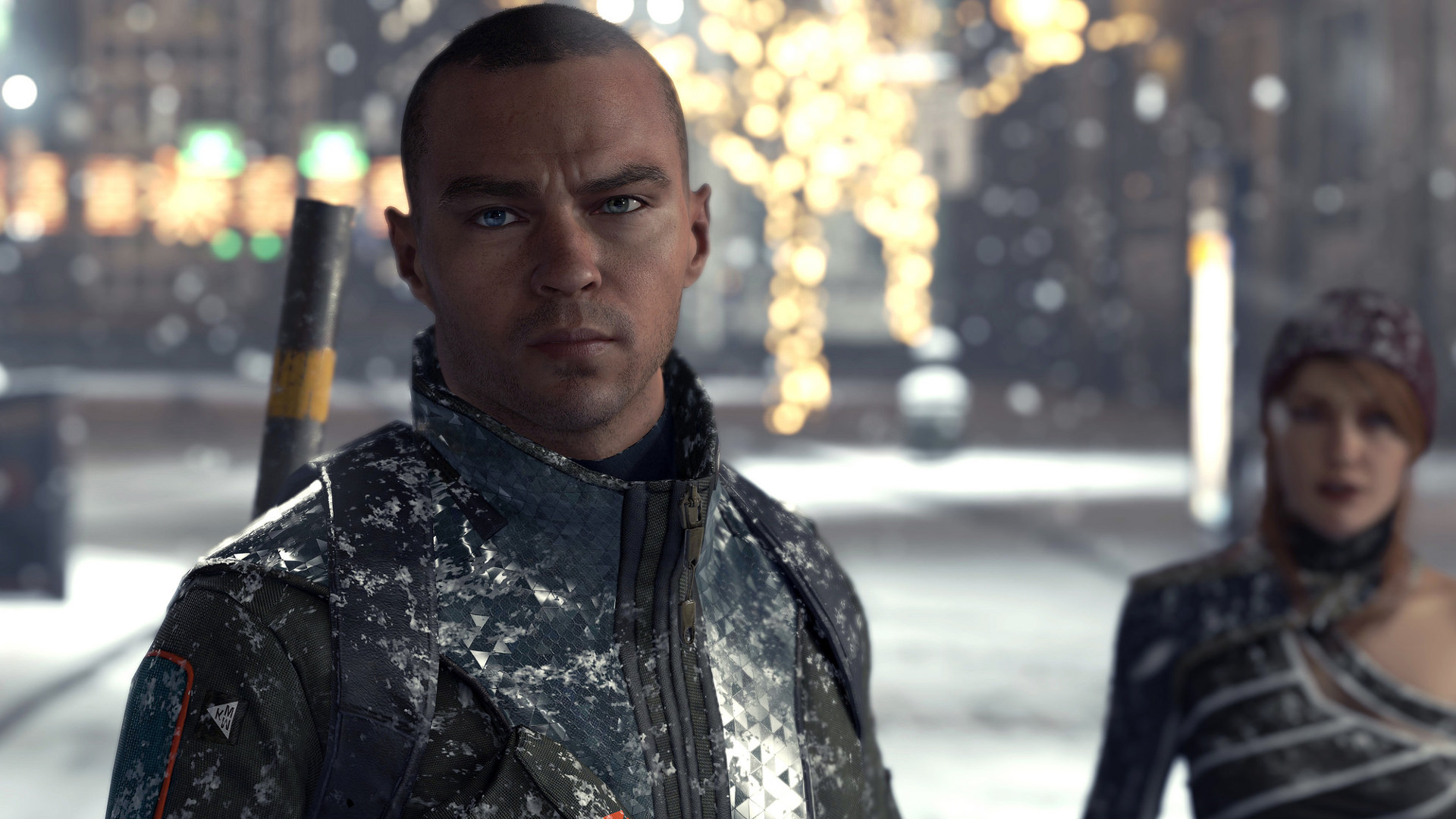
    Jesse Williams lends his voice and likeness to Detroit: Become Human as Markus

    It is also worth noting that of all the black people that could’ve — and should’ve — been featured in Detroit: Become Human, Cage chose Williams, who is very light-skinned with blue eyes. I want to tread carefully here, because I am in no way suggesting that Williams is any “less black” for these reasons, and he certainly solidifies how and with whom he identifies through his activism. But there is a clear trend in Hollywood, the gaming industry, advertising, and other media to give preference to lighter skinned, more ethnically ambiguous black people, where we’re included at all.

    It was an interesting decision to center Williams’s character, who in the context of the game does not have the actual man’s background, identity, politics, or platform. To a player unfamiliar with Williams, as I imagine many will be, the character’s blackness can be plausibly denied. Either implicitly — giving his race conscious consideration, or explicitly in arguing against his blackness as so many gamers do when it comes to ethnically ambiguous characters.

    The recent accusations against Cage do not exist in a vacuum, or without precedent. Cage wants to be judged by his work, and indeed if one looks critically at his games, a theme emerges. People of color are reduced to caricatures, invoke harmful stereotypes, and should remain at the margins, if they appear at all. Even if that means literally erasing them from settings where they predominate. This is not the cross-burning of the past or the anger-marching racism so en vogue these days, but the more deeply entrenched racism underlying all of our media institutions.

    Cage might be forgiven for simply being ignorant, if only I were able to believe that no one, ever, has brought these issues to his attention. But as he seems to be the kind of man who reads every review and critique of his work, tied as it must be to his self-worth, I think he has simply chosen to ignore them. Worse yet, when the issues drag him out into the spotlight, forcing him to come to terms, he deflects all accountability and uses what amounts to the “black friend” defense, or the…”I’ve worked with an actual woman” defense. Is that even a thing?

    What’s sad is that David Cage is a talented developer, and I have, in spite of everything, enjoyed Quantic Dream’s games. But for someone so ambitious as to attempt social commentary, examine the human condition, and speculate on humanity’s future in video games, his massive blind spot about race and racism — or his willful ignorance — is a persisting blight that keeps him well-short of accomplishing any of these objectives.
  • 10 Tips on How to Include Black People in Media

    10 Tips on How to Include Black People in Media

    Diversity” and “Inclusion“. Buzzwords for the 21st Century, especially in “post-racial” America. But for all the mumbling and fumbling, the empty rhetoric and symbolic gestures, white media creators (and others from non-black majority countries) seem catastrophically inept at understanding what these words mean, or how to put them into meaningful action, especially as they apply to Black people.

    What I am about to say is nothing new, nothing original, nothing that hasn’t been said — probably better by countless others — but I felt inspired to join the chorus of voices holding media creators accountable for how they represent me and mine: on paper, on screen, and in every other medium.

    So here are my ten tips for white media creators seeking to be “include” Black people. It is by no means an exhaustive list.

    1. Blackness is not metaphorical.

    The X-Men have long been a stand-in for black people and black struggle.

    The Black experience involves real people and real struggles, not to be “sanitized” or reduced to symbolic representation, as in the “Civil Rights” struggle of the X-Men or slavery in Dragon Age. If you’re going to “borrow” (read: appropriate) our struggle, then at least include our likenesses from time to time.

    2. Blackness is not skin deep.

    Commander Shepard from Mass Effect can be customized to look black, but nothing about the Black experience informs her character.

    Merely palette-swapping racially or culturally “neutral” (read: vacuous) characters from  #F6DACD  to  #7E3617  does not count as “inclusion”. Blackness involves a vast, diverse, historically grounded, continuously lived experience all but inexorable from skin tone. Do some research, or better yet, hire some black creators.

    3. Blackness is not monolithic.

    Dear White People is the rare example of a show that demonstrates that Black people have a wide variety of perspectives, ideologies, conflicts, experiences.

    This may seem obvious, but…ALL BLACK PEOPLE ARE NOT THE SAME. See the above point about “vast and diverse”. We come in many skin tones, have thousands of different ethnicities, and countless different experiences along multiple axes of gender, class, sexuality, ability, religion, and…just being different people because that’s how people work. Even an egregious stereotype might be excusable if it doesn’t exist in isolation. Still probably better to avoid those.

    TLDR: Feature different kinds of black people.

    4. Blackness is not expendable.

    Darwin from X-Men: First Class fell victim to the “Black Dude Dies First” trope

    It is inconceivable to me, outside the context of pure malice, that I even need to bring up such an established trope. If you’re going to include black characters, maybe don’t kill them off first, or even second, unless you’ve heeded Point #3, and have plenty more to spare. Even then, maybe just don’t, at least not until they’ve had time to develop? Or, you know, unless your the majority of your cast is black. Including your hero.

    5. Blackness is not a punchline.

    Jules from Pulp Fiction was a “bad mother fucker”, and a bottomless well of meme-ification and white laughter

    The “Sassy Black Woman”. The “Mammy”. The “Smooth Pimp”. The “Bad Mother Fucker”. These and others have all been deployed at different times for the amusement of white audiences. There is nothing inherently wrong with these archetypes, provided that they are given some breadth, depth, and nuance. See Point #3 about blackness not being monolithic. Just as all black people aren’t the same, no black person is only one thing. Can we be funny? Absolutely. Humor for black people has been essential to our survival. Exploring why that is and has been might help with your character development.

    6. Blackness is not misery.

    12 Years a Slave is a prime example of Black suffering for white consumption.

    Black people have struggled. Continue to struggle. We also endure. Our endurance is one of the foundations of our pride. But we also laugh (see Point #5), learn, love, contemplate, question, explore, create, eat, sleep, shit, and fuck just like everyone else. Which is to say, we contain multitudes. Also, our struggle and our endurance don’t exist in a vacuum. Rather they are informed and shaped by the prevailing context of white supremacy. I know those are two words you probably hate seeing adjacent to one another, but the shit is real. Choose to address it head on, because at least you have that choice.

    7. Blackness is not violence.

    Though black people’s lives and experiences have historically and continue to be beset with violence, it is not inherent to our condition. See Points #2, #3, and #5. And despite the narrative of “black on black” violence, the simple truth is that violence most often occurs between members of the same group — any group — if only because there is a larger set of interactions of any kind between members of the same group. We do not present some unique and ever-present danger. We are no more prone to perpetrating violence than any other group. Which, frankly, is kind of amazing, given that we have been and remain the disproportionate victims of violence, by the state and its proxies.

    8. Blackness is not scarce.

    Black Joy!

    There are over a billion black people in the world — one-sixth of the world’s population. And that’s just by “official” counts, which may exclude any number of people who do or don’t identify as such. Which in itself speaks to Point #3, about how blackness is not monolithic, even in how it is defined. Black people make up anywhere from 11-13 percent of the United States, and yet you’ll hardly ever see either of these proportions (11-13 percent or one-sixth) reflected in the populations of most media properties.

    In spite of the huge set of everyday dangers that pretty much ensure these percentages seldom increase, black people are not in short supply. There is, nor has there ever been, any paucity of black resources to draw upon when building that imaginary world which looks suspiciously a lot like this world. For the record (and yes, there are records), we’ve always been around. In spite of white/European historians’ relentless attempts to erase us, or decouple us from our own history. Dwayne McDuffie’s Rule of Three can actually be broken with a shift in consciousness.

    9. Blackness is not a commodity.

    It’s only “dreadlocks” when white people do it.

    Black music. Black art of any and every kind. Black language. Black aesthetic. Black culture more broadly. The Black Experience (See Point #1). Each and all of these things have been and continue to be stolen, appropriated, decontextualized, remixed, and whitewashed for mainstream consumption. Which is to say they are stripped of their most fundamental element — black people ourselves — for the sake of white palatability. Or perceived white palatability. To be clear, brown skin fixed to a black aesthetic — clothing, voice, music, etc. — does not a black person make. See Points #2 and #3.

    More importantly, if the blackness in your properties, however it may manifest, does not promote, uplift, or enhance the lives of black people in some way – and positive representation has a greater impact than you might realize — then your property is not inclusive. It is appropriative for the sake of drawing in black dollars (or maybe white liberal dollars) or creating some sort of “feel good” image for the company — currency that can also be traded for…yes, dollars. This is the very definition of commodification.

    10. Blackness is not transparent.

    What’s beneath the “immoveable veil of black” is not available for your commodification.

    Taken literally, this is obvious. But perhaps what isn’t so obvious is that all the shades and nuances of the Black Experience are not accessible to you. No matter how many books you read, albums you listen to, films you watch, plays you attend, black friends you make (though by all means, yes, tap that resource if you have it, without demand or expectation), there are things about being black that you simply cannot comprehend—physically, intellectually, emotionally, or spiritually.

    This leaves you with one—also obvious—recourse. Recruit black people to work beside you. By which I mean hire them, because that work-for-free shit is over. Or, if you’re feeling particularly “magnanimous”, hand black people the reins and see where they lead you. I hear some guy named Ta-nehisi Coates is killing it on that Black Panther comic. And every other thing he touches, for that matter. Incidentally, he is not the only smart black person in the world. See Point #8.

    Conclusion: Black People are Human Beings

    In closing, it needs to be said that including diverse representations of black people in media has nothing to do with “political correctness”. It has little to do with fairness, either. This is not a zero-sum game by which black gain equals white loss.

    What it concerns, most significantly, is the acceptance of this proposal that Black Lives Matter. That Black People Matter. Black representations are a matter of survival. Of casting us as fully-realized human beings with thoughts, feelings, dreams, aspirations, complexity, agency — against a backdrop that explicitly shows and tells us (everyone) that the opposite is true.

    If we don’t matter, if we are seldom seen or heard, reduced to caricatures, or otherwise rendered less than fully human, it creates a void. Not just of our bodies or our voices, but of empathy and compassion toward us.

    The cost of this void, engraved in history and playing out in real time, is our very lives.

  • The Return of Fear Effect and Fears About Its Effect

    The Return of Fear Effect and Fears About Its Effect

    *UPDATE* Sushee Games responded to my letter within a few hours, and I have already replied again as well. I will continue to update the post below with any future correspondence.

    Fear Effect is coming back. Have you heard? After the heartbreak of Inferno’s cancellation, and a 15 year wait with no new game in sight, French indie studio Sushee Games is creating Fear Effect: Sedna. To say that I “literally screamed”, might actually be literal.  I mean, look. There has been a 15 year vacuum that no other game has been able to fill. For fans of Fear Effect, this is huge news, so I can only hope that Sushee is successful, and that they are able to be true to the spirit of the franchise.

    Check out the video below, and support their Kickstarter campaign here.

    As I followed the campaign, being who I am, I couldn’t help but notice some things. 15 years ago, when Retro Helix was released, I had no awareness of cultural appropriation, and probably even a knee-jerk resistance to any discussion of the matter. Now, with the game industry’s slow realization that representation matters, reflecting an even longer-time-in-coming realization by mass media in general, creators are being held accountable for how they “borrow” — let’s go ahead and say appropriate — cultures not their own.

    What I noticed with Fear Effect: Sedna, was their proposed use of Inuit culture and a native character. Alarm bells went off in my head, first about my impression that the character, Iluak, pretty much looks like a white man as currently designed.

    Concept Art for Iluak from Fear Effect: Sedna

    So I tweeted to Sushee Games about it.

    I was delighted that Sushee bothered to respond, as this is something they could’ve easily shrugged off, with me being a nobody on Twitter, and representing a small and easily recoverable amount towards their Kickstarter goal.

    As I continued thinking about cultural appropriation, I decided to contact Sushee Games again, with more in-depth concerns about how they would handle the use of Inuit aesthetic, cultural stories and history. I sent them a message through Kickstarter, which I’m publishing here as an open letter, so that as the game’s production moves forward, it can be known that at least one person brought this issue to their attention.

    This is part of the reason I love Kickstarter, as a platform, and as a new standard for interactions between creators and consumers. Will my message make a difference? Maybe. Which is more than I could say for my impact on the production of a mainstream title produced by a major company. I will continue to update the post if and as Sushee Games responds to my letter.

    Hello,

    I recently tweeted my concern about Iluak’s “European” look and was pleased that your team responded. I just wanted to follow up a little and share some thoughts on the troubled waters Sushee is wandering into. I hope you’ll take the time to consider it.

    The big issue at stake here, featuring the likenesses, history, and or lore of Inuit people is cultural appropriation. By the way, you do know that “Inuit” is a broad term encompassing several culturally distinct groups? The appropriation issue is especially contentious when dealing with culture of indigenous or other historically oppressed people.

    This is not a matter of “political correctness” but has very serious implications (possibly legal) and consequences for indigenous people. When cultures are in danger of disappearing, appropriated representations can accelerate that erasure by displacing native sources. Outsiders should never be the primary source for any culture.

    I think it is really worth your team’s time to read these articles (and the works cited in them) as you proceed:

    Appropriate Cultural Appropriation
    http://irosf.com/q/zine/article/10087

    Primer on Cultural Appropriation
    http://jezebel.com/5959698/a-much-needed-primer-on-cultural-appropriation

    With respect to Nisi Shawl’s article, you should look at the game “Never Alone” (Kisima Inŋitchuŋa) as an example of how creators can be “Guests”. They work with an indigenous population that I believe fit under the Inuit umbrella.

    http://neveralonegame.com/

    Be aware that this issue rightfully keeps emerging as creators recklessly use others’ culture, a recent backlash involving JK Rowling and Native Americans. Read about that here, and please Google “JK Rowling Cultural Appropriation” for more:

    “Magic in North America”: The Harry Potter franchise veers too close to home
    http://nativeappropriations.com/2016/03/magic-in-north-america-the-harry-potter-franchise-veers-too-close-to-home.html

    Also please be aware that different cultures have different rules about when and where and by whom their culture can be used. It is vital that you consult with an authority of the culture you’re borrowing.

    This has come up for me personally in writing an Indigenous Australian character for my novel, and in doing my research I came across these resources. Although they deal with Indigenous Australians, I think similar considerations apply to borrowing culture in general:

    More than Words: Writing, Indigenous Culture & Copyright in Australia
    http://www.terrijanke.com.au/#!more-than-words/j3yth

    Pathways and Protocols: A Filmmaker’s Guide
    http://www.terrijanke.com.au/#!pathyways-protocols/ig3b6

    FE: Sedna is not a film, but again, it’s a place to start.

    I write all this to you not to tell you how to make your game, but because I love the Fear Effect franchise and at the same time care deeply about this issue. I don’t want to see the campaign mired in controversy, and I also really want to see indigenous culture and people represented in a way that honors them and preserves their dignity and culture.

    One more note, and I’ll leave you alone. It also occurs to me that Iluak is a secondary (non-playable) character. Fear Effect as a franchise already over-represents white/European people, as all of the main characters are white (yes, I know Hana is “half-Asian, but aesthetically, culturally, and even given her voice actor, she might as well be white).

    It’s been 15 years since the last Fear Effect game, and a lot has changed in the gaming and media climate in general. It seems to me a lost opportunity not to upgrade the franchise in a way that reflect’s the game industry’s (and consumer base’s) dawning recognition that the vast majority of the world’s people are not white.

    Is there any reason why Iluak can’t be a playable character? And also, France has a multitude of different ethnicities (in spite of the government’s ridiculous official policy that race doesn’t exist), so is there anything about Axel that necessitates that he be a white Frenchman?

    These are the thoughts of one measly backer, but I feel like Kickstarter as a platform allows for a new level of communication and collaboration between creators and their audience. So I hope you’ll consider my words here as you move forward.

    Thank you,

    Kermit O

    Hi Kermit O


    We actually saw your open letter before this message ^^

    It’s quite a long (and interesting) question/post, so we’ll take some time to answer it the best as we can. One thing you should know before we start: we are at a very early stage of the development, and the script isn’t finished at all. It’s actually time to think about these questions.

    First of all, we are well aware of cultural appropriation. It is a complicated matter, and our first intention was to bring some spotlight to a less known culture that we discovered late ourselves, and which is incredibly rich; and not to use it for dramatic purpose. What is done today with egyptian mythology in some Hollywood movies for example, where all the protagonists have been westernized and the myths just used for the sake of exotic mystery, doesn’t please us at all – we really want to avoid that kind of cheap usage of the Inuit myths and legends. But we don’t want to avoid speaking about a particular country in the world just because no one in the team originates from it (or everything would have happened in Brittany – which is a very nice place, but not really the kind you come across in a dark cyberpunk horror story).

    Iluak, in our story (without saying too much) is part of Glas’ past. He originates from Nuuk, but lived in the USA for more than 20 years. As we said earlier on Twitter, his design evolved from the early concepts to the current 3D model. We are happy with his design for now: his aura, his noble and proud stature serve the story perfectly, and he does look like some of the Greenland inhabitants we came across during our research. In a cel-shaded way, of course.

    Also, we never said he would not be playable. In fact, he is really central to the story, and not at all a secondary character.

    One last thing about Inuits: for now we are doing a lot of research on their story, to begin with; their lifestyle, their art, their music, their ceremonies and celebrations, and the way they live their spirituality. This is all very good, but we all know that academic knowledge alone won’t do justice to their culture. So we are now searching for consultants and advisors who could guide us on the right way.
    Obviously, we’re now focused on the Kickstarter campaign, so we didn’t dig too much here, but yes for sure, this is our plan.

    As for Axel, he is exactly the cute-looking over-confident young white man we wanted him to be – and that will serve the story as well!

    There are no good nor villains in Fear Effect (I mean, look at Deke!). So in case you were afraid of that: Iluak won’t be a bad guy. He will do bad things for good reasons, as well as good things for bad reasons, because this is all what Fear Effect is about. To quote John Zuur Platten (writer of Fear Effect 1): “morally ambiguous people ending up doing heroic things”.

    We hope this will answer your concerns, and we will keep working hard to create the best experience and story we can provide.

    Please don’t hesitate to share you thoughts & ask any question you want, we will be happy to discuss with you!

    Friendly yours,
    Sushee.

    Thank you for responding, and promptly at that.

    I am glad that you are familiar with the cultural appropriation and have already considered steps to handle the matter carefully. That does a lot to ease my mind.

    Still, as there is always more we can learn about any issue, I encourage you still check out the resources I mentioned in my earlier message. You may find they address the issue in ways that you haven’t considered.

    Also, please note that I was very intentional about not using the words “myths” or “legends”. The reason for that is that some cultures, especially indigenous cultures, can be reduced simply to their “myths and legends”, when in fact these cultures regard these particular elements of their culture as neither. See the issue of Rowling and her use of “skin walkers” as an example.

    Native cultures are often mysticized, treated as something ancient or obscure, in some space “other” than the reality the rest of us inhabit, rather than living and breathing and existing in a continuity with the present. This, too, is a kind of erasure. So another question I would ask would be whether or not the game deals with the realities, including the struggles, of *Inuit people (again, recognizing that term as too broad) TODAY, in the time and place in which it is set? Or do ancient “myths and legends” extend from some dark and mystical past to impact the present? This would be the sort of “dramatic purpose” you mentioned in your response as one to avoid.

    As I am not in any way culturally connected to Inuit people, nor have I been nominated by anyone to speak on their behalf, I don’t feel I am the one to continue this discussion. I am glad your team has given it some thought, and I hope you’ll share your thinking and how it factors into your production process publicly and transparently as you move forward (like in your project updates). I think this could encourage those who are impacted by your use of their culture to share their own concerns and help shape the final product.

    Thank you again for your response, and I look forward to hearing more as development continues.

    Kermit

    First of all, let’s be clear : Fear Effect being what it is, mythical creatures and old traditional magic is part of what makes the game unique, along with the fact that it often collides with a futuristic/technologic reality. So we will of course be inspired by Inuit myths to build our world.

    From what we read about J.K Rowling’s debate over Skin Crawlers (we hadn’t heard about it before), the fact that she didn’t link the myths to actual people is the problematic part. Also, it seems that she pictured them the wrong way. This will not happen in our game.

    When you write a story, you have to fictionalize a lot of things (otherwise you would be creating a documentary). This is where we will have to be careful – but depicting legends in a dramatic way is part of the process, especially with a game like Fear Effect. Building a whole legendary/mystical realm coming out of nowhere is not our intention though. Even if we are not from Greenland ourselves, the myths we talk about will be brought and told by local inhabitants. The mix between a realistic (though futuristic) setting and the legends is one of Fear Effect’s core ingredients.

    There are examples of games that made very clever choices while choosing to talk about foreign cultures. In The Secret World, for example, the depiction of Transylvania could have been what we all imagine in the first place: huge pine forests and gothic castles with bats under the moonlight. But they remembered that Transylvania is actually part of Romania, and they chose to show the rural part of that country, in a way that makes you feel they have actually been there to see how they lived and how they would tell their own stories. Same goes for Egypt and the native americans, in the same game.

    Of course it’s not perfect, you can still come across the eternal “old fortune teller in her colorful caravan” cliché, but at least it shows a lot of respect for the people. This is what we’re aiming at (minus the cliché, that is).

    I know it’s all but words, but we too think these matters are important.

    Thanks again for your interest in the game we’re making!

    Thibaut & the Sushee team

  • Video Games Can Never Be Art: The Myopia of Roger Ebert

    This was a statement made by famed movie critic Roger Ebert.

    And it affirms something to which I’ve long attested, that the film critic’s pathetic lot is to forever claw and scratch for recognition by other film critics, since no one else – namely those other film students who went on to actually make films – gives a damn.

    journey-game-screenshot-1-b

    What is art?

    This question is one that has been debated perhaps since the beginning of human history – indeed I would venture a guess that even the cave painters Ebert mentions in his post argued the validity of those works, unaware as to how they would inform historians of the social context in which they were created.  It is only at the modern heights of arrogance that could one claim to be able to answer this age-old question with any certainty.  And it is hardly possible to be any more arrogant than making a universal truth claim, let alone one expected to hold for eternity. The whole thing is laughable.

    I have argued in the past that video games are the ultimate form of expression, and what is art if not expression?  Indeed video games are a convergence of art from just about every medium – audio, visual, literary – and their social impact is ever-increasing.  Ebert makes his statement by observing video footage of a few games offered up as art, already prepared to deny the possibility.  Aside from the sheer fallacy of denying art as a form of expression, there is also the matter of his evaluation not being made from the proper standpoint.  As I’ve argued in the past, what sets video games apart from film, television, music, books, and other mediums is their interactivity.

    That one thing [that sets video games apart from other media] is interactivity. You can rip a page out of a book in frustration as a story takes an unfavorable turn, or you can yell your lungs out at movie screen as the stupid teenage girl wanders down the dark hallway alone towards the lurking killer, but chances are that you’re not going to change anything. In a video game, however, a person is given a measure of control over the characters and environment presented.

    To evaluate any video game without playing it is as dubious as evaluating a piece of music by only reading the lyrics or reading the sheet music, or evaluating the merits of a film based on – insert laughter here – a critic’s review.

    If the art is expression argument alone doesn’t validate video games’ status as an art form, then allow me to speak from a more personal place, because is not the meaning of art in any context entirely subjective?  I can attribute to two single moments in the games Chrono Cross (Playstation) and Lunar: Eternal Blue (Sega CD), the abstracts that would expand to become the cornerstone of my personal philosophy.  The former, in that one moment, had me question how color could correspond to sound, and the latter had me considering the relationship between creation and destruction, which I would later come to understand more abstractly as two forms of change.  In that art has often sparked philosophical inquiry and introspection – for the creator and the audience – video games clearly fit the bill.

    Furthermore, my ethics – manifest in my sense of justice – if not founded in, was certainly bolstered by the lofty ideals of good vs. evil I found in video games as a child.  The evolution of video game conflicts from black and white conceptualizations of good and evil in the “old school” to the shades of gray now explored through the tough moral choices players have to make in the “new school” not only showcases video games’ increasing complexity, but also their increasing relevance to the real world.  Art, as a medium, is nothing without its flexibility, and its ability to evolve as a reflection of the surrounding social atmosphere.

    My inspiration to write came from video games as well, at first little more than an emulation or reworking of video game plots, but soon thereafter the expression of a burgeoning imagination, forged in outlandish worlds and impossible situations.  Video games spoke to me in ways that other mediums simply did not, and if we are measuring art in terms of social or personal impact, then Ebert’s claim is not only false for me, but a personal slight to me and others like me, for whom games have been either a subtle or direct influence.  His claim invalidates me, personally – dismissing the countless hours in which I was visually, aurally, physically, and emotionally invested and engaged – as frivolous, or a waste of time.

    This is saying nothing of how it invalidates the creators of video games – themselves musicians, painters, 3D modelers, programmers, writers, choreographers, actors, and more – each of which, outside the context of the video game itself, Ebert could hardly argue were not artists.

    So, on what sort of project, exactly, could established artists from many different fields come together, only to miraculously create something that is not art?

    To propose that such a project could even exist is to stand at the very apex of stupidity.

    For someone who is without a doubt – no matter how one chooses to define art – not an artist himself, and one who has never been touched by the myriad forms of expression contained within a video game, Ebert only proves himself incapable of making such a judgment.  He also proves, for his increasing detachment from an evolving media culture, his sheer cultural irrelevance.

  • Once You See it: Uncharted and the Burden of Awareness

    This post could also be entitled: “Uncharted 2 and Why I Can’t Enjoy Anything Anymore.

    Let me preface this rant by saying that Uncharted 2 is a remarkable game, on both technical and aesthetic levels.  It is in fact the PS3’s “killer app” and is well-deserving of all of the accolades it has received thus far.  I have been playing it for the past two weeks and I am still discovering little details that demonstrate both the level of skill and love for the craft that can go into a triple-A title.  But perhaps it is for all those accolades and that demonstration of skill that I must call the game out on a several fronts.

    I’ve had discussions with various people – particularly African-Americans – about video games where they expressed to me their problem with the prevalence of white protagonists.  They felt a disconnect from the characters they were playing for this reason, felt they couldn’t “relate” to them.  For a long time, whenever I had this conversation, I thought it was silly.

    Afterall, there were plenty of ways/reasons to identify with a character outside of race/ethnicity.  Most of these games were taking place on other worlds, where our racial categories did not exist.  Even where themes of discrimination were visited, as in Chrono Cross, it was a problem between humans and some actual other race – like Elves or Metahumans.  What did it matter that the heroes in these worlds happened to be blue-eyed blonde-haired ubermensch?  I’m looking at you, Cloud Strife.

    (more…)
  • Black, White, and Jade: Race in Video Games

    In an earlier post, I discussed the need for designers to incorporate a wider range of ethnicities in video games.  As to why they haven’t done so up to this point, and why the few non-white characters tend towards stereotypes, I offered up one possible explanation.

    Part of the reason for this is that a large number of games come out of Japan, which being nearly homogeneous in terms of ethnicity, and insulated – both physically and culturally – may lack a strong frame of reference for depicting a diverse cast of characters.  Where the games are made in the Europe or the United States, where ethnic variety is more common, stereotypes may instead emerge as a consequence of one-dimensional writing.  Perhaps a developer cannot be bothered to do the research into all of the nuance and idiosyncrasies that rise from a character’s ethnic experiences.

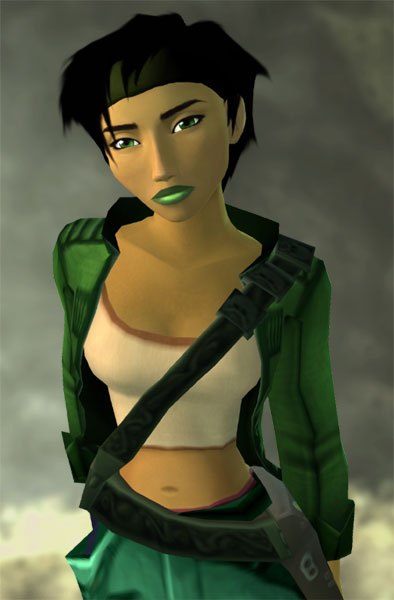
    Jade from Beyond Good & Evil
    Jade from Beyond Good & Evil

    While those developers who have at least made the attempt to be more inclusive should be acknowledged, it is more important to point out where more work needs to be done.  I am almost six years late in discussing the case of Jade from Beyond Good & Evil, but an interesting post by Jason over at Microscopiq brought the issue to my attention.  The post discusses the “first 11 black video game stars”, specifically those characters of visible African descent who were not only featured in games, but were the main character.  Jade was amongst those mentioned. 

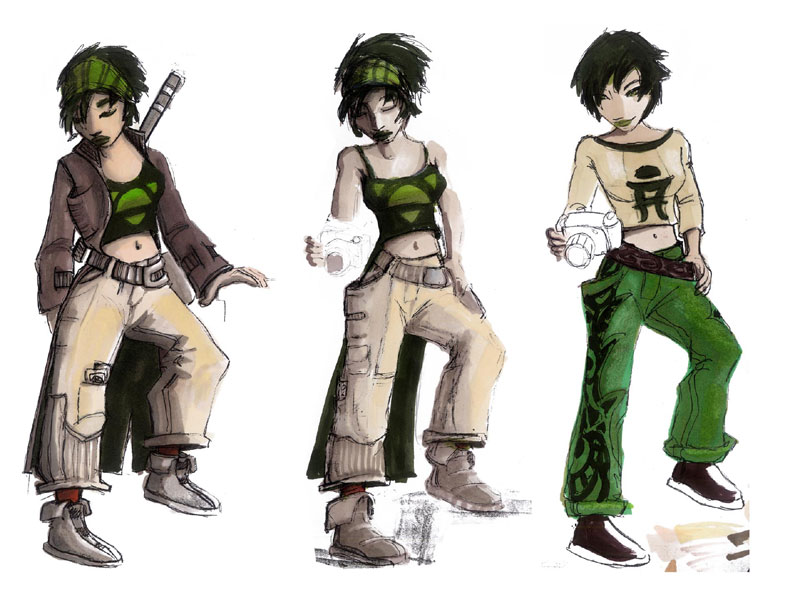
    At a glance, some – if not most – people would question whether or not Jade qualifies as “black” in any sense.  Arguments could be made for virtually any ethnicity as her appearance is quite ambiguous.  The only solid support for Jade being a “black” heroine is in looking at the original concept art, which featured some earlier renditions of Jade with either locks or braids in her hair, and features more commonly associated with certain peoples of Africa.

    Jade Concept Art

    From the concept stage to the final version, much was changed, and we have a character who could pass for virtually anything.

    There are many possible reasons for the change, such as wider market appeal, as an ethnically ambiguous character alienates no one.  It is also a truism that the mainstream beauty standard – set mostly by Americans and Europeans – is not inclusive of distinctively “non-white” features, particularly Africanesque features.  For marketing’s sake – and this literally could’ve been a decision made by marketing against the wishes of the original designer – Jade could have been altered to resonate more with the mainstream.  Looking at the final version, is it enough to say that Jade was intended to be “black” by the designer, or even that she is so in his/her mind, in order to claim her as such?  I would say that it isn’t.

    Jade’s ethnic ambiguity alone, however, is not enough to dismiss her from the ranks of black heroines.  After all, blackness is subjective, varying from place to place and culture to culture.  If we take it to be synonymous with “African”, then the ethnic diversity of that continent means that Jade could look like anything.  But here’s where we get to another important point.

    Jade is most certainly not African.  Because she is not even from this planet.  Beyond Good & Evil takes place on the fictional world of Hillys, where people like Jade are classified as “homo sapiens”, distinguished from other humanoid races such as “Capra Sapiens” (goat people), “Sus Sapiens” (pig people), and “Felis Sapiens” (cat people).  The concept of race that divides human populations on Earth simply does not exist on Hillys.  For that matter, there are no social divisions between any of the “Sapiens” – they are subclassified solely for the sake of compiling a photographic catalogue of all of the planet’s species.  That is to say, these distinctions are biological, and do not manifest at all in the culture of Hillys.

    This is an important point, because the meaning of “blackness” on planet Earth is defined mostly in a social context.  There are some vague overlaps into a biological context – some valid, particularly with regards to medicine, and some not – where genetics is cited incorrectly to support a social or political argument.  Without getting too much into the meaning of blackness, there is the experience of so-called “black people” to be considered, which historically, and with few exceptions, tends to be one of hardship, oppression, social inequality, prejudice, and even dehumanization.  This is particularly true of those peoples of Africa who were sold into slavery, and who even in the aftermath, have been forced to face social and economic oppression.

    Coming back to video games, what would be required for a character to be considered “black”?  Appearance could be one qualifier, but as we see in the case of Jade, this can become dubious due to the wide variety of physical characteristics that can be classified as “black”, a reflection of the extreme diversity to be found within such a vague and subjective category.

    The “black experience” could be another qualifier, as in a situation where a character is forced to face certain indignities, in spite of her ethnic ambiguity.  There are undoubtedly women who resemble Jade and who have been forced to endure such conditions.  In the United States, by way of the one-drop rule, it is common for a woman of fair skin to be deemed a “black” woman by virtue of her other features, and therefore share in the black experience.  Jade as she appears in Beyond Good and Evil, however, fails to meet either of these qualifiers.

    Cree Summer
    Cree Summer

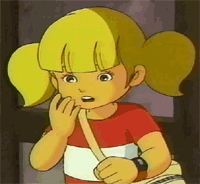
    The only remaining qualifier brings us back to the designer’s intent.  Without speaking to Michel Ancel or his art team, we cannot know which ethnicities inspired Jade’s appearance from original concept to final incarnation.  Perhaps then, we could derive clues from the voice actors chosen to play Jade.  We have to take this with a grain of salt, however, because the ethnicity of voice actors do not necessarily match those of their characters.  Cree Summer, who is African-American, is one of the most prolific voice actors in the field, and because her voice does not invoke any particular ethnicity, she has been tapped to play a wide range of characters – most of which are not African-American or “black” in any sense.  She got her start playing Penny from Inspector Gadget.

    Penny
    Penny from Inspector Gadget

    What this suggests about the willingness of game producers to cast black actors for their voices versus their willingness to craft black roles may be another subject worth exploring.  As for Jade, since the game was released in different languages, she was played by several different voice actors.  But with respect to how Jade’s voice corresponds to her ethnicity in the mind of the developer, we should take a look at the actor closest to the developers  – Ubisoft Montreal – which would be the one cast for Jade’s French voice.  Her name is Emma de Caunes, and thanks to the artist John Karp, we can see her picture below modified to resemble Jade.

    Emma de Caunes as Jade

    Even had Jade’s voice actress been of any French-African ethnicity, it would’ve been a stretch to therefore consider the character as being of any African ethnicity.  The example of Cree Summer demonstrates the distance between the identities of voice actors and their characters.  In any case, Emma de Caunes is not of any visible African descent, and therefore we cannot use her ethnicity as a case for Jade’s “blackness”.

    This brings me to my final point about Jade, which is that in spite of the developer’s original intent, any ethnic inspiration for the character, how Jade is perceived by her audience may be even more important.  By looking at a few random samples of fan-created art for Jade, we can gain some insight into how others perceive her ethnicity. An extensive spread of Jade fan art can be seen at the deviantART Beyond Good & Evil Fan Club, where not one rendition depicts Jade with Africanesque features.

    Because an artist’s work will necessarily be based in part on their personal experiences, and probably in some way reflect the artist him or herself, it stands to reason that the artist’s own ethnicity may factor into how they depict a character. What we see is that in spite of the varied ethnicities of the artists, not one of them depicted Jade with features any more distinctively Africanesque than what we see in the official Ubisoft rendition. Had these artists had even an inkling that the developer intended Jade to be “black”, then it may have been more likely that we would have seen that understanding reflected in their work.

    While we cannot discount the possibility that Jade’s features would’ve been “de-ethnicized” even had she been more clearly Africanesque – as is common amongst fan artists of Storm from Marvel Comics – we can at least say that nothing about Jade seems to encourage fans to depict her as “black”.

    So in the end, based on overwhelming evidence, we are forced to conclude that Jade from Beyond Good & Evil is not “black” in any sense of the word.  For the reasons discussed above about how races are defined, and how they do not correspond to any human categorization on the planet Hillys, she cannot accurately be considered “white”, “Asian” or any other race/ethnicity from Earth.  She can only barely be classified as human, being a “homo sapien”, but those who have played the game also know that she is a little something more.  I’d like to count Jade amongst “black” female protagonists in video games, due to the fact that there are otherwise none, but doing so actually sets a weak precedent.

    It is not enough to be inspired by Africanesque features, only to see that inspiration disappear for the sake of market appeal.  And it is regressive, if not plain insulting, to create a character of color – in terms of background and appearance – only to completely undo it in a future incarnation, as in the deplorable example of Vanessa Lewis from Virtua Fighter.  Note the lighter skin, thinner lips, altered facial structure, and reduced hips from the Virtua Fighter 4 version (background) to the Virtua Fighter 5 version (foreground).

    (Vanessa Lewis | Background: VF4 Foreground: VF5)

    As technology improves, and as the content of games expands in terms of breadth and depth, opportunities only increase for representing diversity.  In the future, it will not be enough for a character to have darker skin, thicker lips, or a different eye shape.  We will have to see different cultures and experiences represented as well.  This wouldn’t have to be a limitation with regards to restricting the game setting to Earth.

    After all, there is always interstellar or cross-dimensional travel.  There is also alternative history.  And already, plenty of creators have told stories of other worlds, only to draw inspiration from the experiences of the peoples of Earth, because doing so adds a certain richness and credibility.

    As I discussed in Ethnic Depictions in Video Games, there has been a want for protagonists of color with which gamers of color can identify.  If gamers cannot identify on a superficial level – i.e. by appearance, if they cannot identify on the basis of a common social experience, and if they cannot identify by way of voice, then there is little remaining to connect them to the character.  For most gamers this probably will not taint their experience with a game, as the lack of inclusive ethnic representation has become the norm.

    But there is certainly a call, albeit muted and scattered amongst the more thoughtful pockets of the gamer population, for game developers to be more inclusive in their thinking.

  • Pearl-Clutching, Stereotypes, and Ethnic Representation in Video Games

    The Escapist – an online publication best known for analyzing and discussing video games as a cultural phenomenon, rather than a mere form of entertainment, is currently discussing racial [in]sensitivity in games. The article Gangbangers, Victims, and Whores by Christina González, which discusses how Latinas are depicted in games, is a particularly insightful read.

    The timing for this week’s Escapist happens to coincide with a bill proposal in the New York State Assembly also taking aim at racial insensitivity in video games. Sponsored by Assemblyman Keith L.T. Wright, the bill seeks to:

    Prohibit the sale to minors of certain rated video games containing a rating that reflects content of various degrees of profanity, racist stereotypes or derogatory language, and/or actions toward a specific group of persons.

    While this bill may just be the latest in what seems to be an endless crusade on the part of the state of New York against the gaming industry, the concerns raised by Wright are legitimate. Race and ethnicity, and how they are depicted in video games, has been a point of contention ever since games started receiving serious consideration as media. One point that is often made – and that I have made myself – is that video games are severely lacking in hoisting non-white characters to the status of main protagonist.

    Those of us who are not white, but hope to identify with the characters we play in games the same as anyone, find the industry to be deficient.  At best we have had to settle for ethnically ambiguous characters, often in non-Earth settings, which while fulfilling an aesthetic need still leave players wanting for a more substantial connection.  When characters of non-European ethnicities are depicted in video games, it is true that they are often stereotypes.

    Barrett
    Barrett from Final Fantasy VII

    Part of the reason for this is that a large number of games come out of Japan, which being nearly homogeneous in terms of ethnicity, and insulated – both physically and culturally – may lack a strong frame of reference for depicting a diverse cast of characters.  Where the games are made in the Europe or the United States, where ethnic variety is more common, stereotypes may instead emerge as a consequence of one-dimensional writing.  Perhaps a developer cannot be bothered to do the research into all of the nuance and idiosyncrasies that rise from a character’s ethnic experiences.

    So Wright is valid in his concerns about racial stereotypes in that they not only leave players without a character with which to identify, but with a caricature that debases them or their culture.  Where I think Wright is wrong, however, is in thinking that the solution to the problem lies in more restrictive legislation.  Most games with racial stereotypes are also mature-rated games, and laws are already in place to protect minors from playing them.  The efficacy of these laws is questionable, and so simply imposing a second and redundant law is not likely to fix the situation.

    In my opinion, it’s necessary for lawmakers to start recognizing games themselves as an extension of culture, to place them within the general category of “the arts”.  Viewed that way, games may be held to a higher standard, as are film and literature.  Rather than restrict the sale of a game with objectionable material, perhaps it would be better to encourage developers to release material that is less objectionable, or that at least places it in its proper context.  For example, were game developers to be provided an incentive, such as an arts grant or tax subsidy, they may be more inclined to develop culturally relevant and accurate games.  Recognizing games as art could inspire more developers to create games as art, rather than simply to turn a profit.

    The restriction on mature-themed games, up to and including the blacklisting of anything receiving the “Adults Only” rating, has done nothing to stop younger players from experiencing them.  Even where parents are educated as to what’s out there and mindful of what their children are playing at home, they cannot monitor what their children are playing when they aren’t watching, or what they learn by proxy from peers who have played games with objectionable content.

    It would be more more effective to reward developers who perform admirably, who raise the bar in creating games as art, rather than punishing those who produce fluff.  The fluff will continue to exist, of course, because sometimes those games are just plain fun.  But they could be balanced by an increase in the alternative – games with real substance.

    Game developers could then take the time to craft characters and settings that are three-dimensional – in how they’re written as well as how they’re rendered.  Three-dimensions allow for dynamic characterization and provide room for development beyond stereotypes and caricatures.