Philadelphia, the sixth largest city in the United States by population, is also the “poorest big city” in the nation. It is a city contending simultaneously with widespread housing insecurity and epidemic gun violence. The structural dimensions of food apartheid[1]Gripper, A. B., Nethery, R., Cowger, T. L., White, M., Kawachi, I., & Adamkiewicz, G. (2022). Community solutions to food apartheid: A spatial analysis of community food-growing spaces and … Continue reading are reinforced by the tensions between real estate development and a robust culture of urban agriculture, which has a long history in Philly[2]Stanko, H., & Naylor, L. (2018). Facilitating (?) urban agriculture in Philadelphia: sustainability narratives in the inequitable city. Local Environment, 23(4), 468-484. as a means of community self-determination. Above all, Philadelphia is a city straddling massive divides of income inequality and disparities in health and quality of life across lines of race, class, and citizenship.[3]Wilson, B. (2020). Urban heat management and the legacy of redlining. Journal of the American Planning Association, 86(4), 443-457. There is a clear correlation and continuity between historic disinvestment via redlining a wide variety of structural challenges, from the poor condition and low availability of housing in Eastwick in the southwest, particularly in the face of high flood risk[4]Cahn, A. L. (2014). On retiring blight as policy and making Eastwick whole. Harv. CR-CLL Rev., 49, 449., to higher rates of asthma or heat stroke hospitalization in the north, due to the extremes of the heat island effect.[5]Shokry, G. (2021). Competing Riskscapes of Climate Change, Gentrification And Adaptation In Philadelphia’s Hunting Park Neighborhood. In The Green City And Social Injustice (Pp. 225-238). … Continue reading
Foreshadowing the disproportionate impact of the climate crisis, COVID-19 cast racial and economic disparities in sharp relief, historical and structural continuities driven by the primacy of capital accumulation and its reinforcement by state power. As climate change makes the city hotter and wetter, [6]Malter, S., Rockwell, J., & Maimone, M. (2017). Climate change and precipitation: Applying global climate model projections to local precipitation time series data in Philadelphia. In World … Continue reading[7]Weber, S., Sadoff, N., Zell, E., & de Sherbinin, A. (2015). Policy-relevant indicators for mapping the vulnerability of urban populations to extreme heat events: A case study of Philadelphia. … Continue reading straining both its aging infrastructure[8]Kessler, R. (2011). Stormwater strategies: cities prepare aging infrastructure for climate change. and residents’ bottom line due to increased rent, utility, and maintenance costs[9]Kenner, A., Skula, A., Mankikar, D., Zimmermann, I., Nobles, E., Menzo, J., … & Zerbo, R. (2020). The Climate-Ready Home: Teaching Climate Change in the Context of Asthma Management. … Continue reading, persisting struggles will only be exacerbated. To say Philadelphia is in crisis understates the point, because the very word crisis implies a moment, a turning or tipping point, rather than the long continuity of disinvestment, racist policy and practices (e.g. redlining) that undergird the city’s seemingly intractable woes.[10]Hoffman, J. S., Shandas, V., & Pendleton, N. (2020). The effects of historical housing policies on resident exposure to intra-urban heat: a study of 108 US urban areas. Climate, 8(1), 12.[11]Jackson, K. L. (2022). Urban Agriculture and Critical Environmental Justice: A Case Study of Gardens and Growers in Philadelphia and Camden (Doctoral dissertation, Rutgers, The State University of … Continue reading Yet it is also an overstatement, because it is not “Philadelphia” as a whole that suffers — indeed, some quarters are doing quite well — but rather the same neighborhoods, concentrated in the north and southwest regions of the city, which time and again bear the brunt of social, economic, and ecological degradation.[12]Barron, L., Ruggieri, D., & Branas, C. (2018). Assessing vulnerability to heat: a geospatial analysis for the City of Philadelphia. Urban Science, 2(2), 38.[13]Conway, M. (2020). Mapping Social Vulnerability to Air Pollution in Philadelphia, PA. Veritas, 2.[14]Sicotte, D. (2016). From workshop to waste magnet: Environmental inequality in the Philadelphia region. Rutgers University Press.[15]Vitiello, D. (2024). Urban Agriculture as a Public Good: Valuing Farming and Gardening in Philadelphia and Chicago. In Planning for Equitable Urban Agriculture in the United States (pp. 67-87). … Continue reading
Defining Resilience: Stressors and Shocks
Within the continuous relations of domination inherent to capitalism consistently the burden tends to fall disproportionately on people of subalternated identities, along lines of race, gender, class, and ability. These conditions — of extraction, exploitation, environmental degradation — are chronic and unabating stressors: long-term structural dynamics that increase vulnerability to social, economic, and environmental impacts, while at the same time reducing the potential of affected populations to live a thriving life. At any given time, there may be sudden high impact disturbances to an existing system / set of relations — economic, climatic, political — which we can call shocks. Resilience, then, is the ability of a system, or individuals and groups within that system, to endure and adapt to both stressors and shocks.[16]Baja, K. (2018). Resilience hubs: Shifting power to communities and increasing community capacity. Urban Sustainability Directors Network.[17]Hertel, T. W., Elouafi, I., Ewert, F., & Tanticharoen, M. (2021). Building Resilience to Vulnerabilities, Shocks and Stresses.[18]Muir, M., George, A., Oesterle, M., & Pew, J. (2022). Detroit Resilience Hub Framework: Best Practices for the Implementation of Resilience Hubs in Detroit, Michigan.
For my purposes, resilience is not defined merely as the ability to survive and adapt to these chronic or acute impacts, but to thrive under existing and changing conditions. To thrive, for me, means the ability to move and remain beyond precarity, to move beyond the economic logic of scarcity to the material possibilities of cultivating abundance. It means regular access to and control of key resources such as food, water, energy, and housing, and the ability to sustain the social and material infrastructure needed to endure persisting stressors.
Research Questions and Hypothesis

The overarching question my research seeks to answer is how might alternative social and economic relations, based on conviviality and reciprocity, mitigate persisting stressors, and build resilience against inevitable shocks? Nested within this inquiry are three additional questions: 1) How can participatory methods be deployed toward the co-production of space?; 2) How might returning to a logic of the commons, particularly with respect to the governance of local productive assets, enhance everyday social relations between neighbors?; and 3) How might concentrating the work at the food-water-energy nexus enable a more holistic approach to solving systemic and deeply interlinked problems?
Gentrification, redlining, toxic land uses, and from these an increased vulnerability to economic and climatic shocks, all stem from state negligence, if not policy and practice that is blatantly indifferent to or contemptuous of the people in affected communities. They are each also part of the imperial continuum, the afterlives of slavery and settler colonialism manifesting in persisting discrimination, displacement, and state violence, while communities are restricted access to healthy food, clean air and water, and affordable housing and energy[19]Bruno, T. (2023). Ecological memory in the biophysical afterlife of slavery. Annals of the American Association of Geographers, 113(7), 1543-1553.[20]Whyte, K. (2018). Settler colonialism, ecology, and environmental injustice. Environment and Society, 9(1), 125-144., the timescale stretched from the more immediate violence of European invasion to the “slow violence”[21]Nixon, R. (2011). Slow Violence and the Environmentalism of the Poor. Harvard University Press. inherent to precarity.
Precarity is, fundamentally, an entrenched condition of subjection to stressors and increased vulnerability to shocks. The etymology of the word, from the Latin precarius “depending on favor, pertaining to entreaty, obtained by asking or praying,” or “dependent on the will of another”[22]Merriam-Webster (n.d.). Precarious is not “before carious.” https://www.merriam-webster.com/grammar/precarious-word-history-and-definition directly corresponds to the relationship between people and the state. Therefore it is my contention that the solution to precarity requires a shift in relations where people are no longer “asking” or “entreating”, but deciding and producing on their own terms, particularly Black, Brown, and Indigenous people, who “must contend with specific regimes of power that define their position in society”[23]Bledsoe, A., McCreary, T., & Wright, W. (2022). Theorizing diverse economies in the context of racial capitalism. Geoforum, 132, 281-290. within the context of settler colonial racial capitalism. And governance must be collective, because whosoever is not included (or at least invited) to participate, then automatically becomes “dependent on the will” of those who make the decisions. I hypothesize that community control and decision-making power at the level of self-determination — over land use, labor, resources, across the means and modes of production and exchange — is indispensable in the project of building community resilience.
This is especially true in Philadelphia, where machine politics cement the dominance of the Democratic party, whose officials in turn have unaccountable power from the district level to the mayor’s office, including a near feudal authority over land use,[24]Louthen, Elliot. (2020). Prerogative and legislator vetoes. Northwestern University Law Review, 115(2), 549-598. and a systematic elimination of any real challenge to their incumbency. This gives representatives little incentive to enact policy that brings about real material change, and instead enables a culture of performativity in which gestures to democracy are made without any imperative for follow-through.[25]Brown, B. (2023, April 3). The next mayor will inherit a backlog of half-finished, paused or never-implemented initiatives from the Kenney administration. Grid Magazine. … Continue reading
Philadelphia’s crisis of (mis)representation is two-fold: from officials’ institutionalized absence of accountability, to a deeply entrenched politics of identity, wherein the appointment of Black leaders in particular has not translated to social or material gains for Black people at large. There was no greater exemplification of this disassociation between representation and real power than the 1985 bombing of the MOVE organization[26]Cleaver, K. N. (1993). Philadelphia fire. Peace Review, 5(4), 467-474., in which a Black Democratic mayor presided over the murder of eleven Black residents (including five children), the displacement of 250 more, and the erasure of Black wealth through the destruction of over 60 homes. At the heart of this conflict was the tension between state economic growth and community self-determination[27]O, K. (2021, May 20). Why north philly peace park is building an afrofuturist pavilion. WHYY. https://whyy.org/articles/why-north-philly-peace-park-is-building-an-afrofuturist-pavillion/ [28]Ebram, T. (2020). Black Urban Revolution: A Cultural History of Move and the Radical Everyday in West Philadelphia (Doctoral dissertation, University of Pennsylvania)., an expression of the greater conflict between use and exchange value that has defined city politics for generations.
This is the broader social and political context which leads me to situate my research on the city-block, under the pretext that it is the largest scale within the urban context at which collective decision-making is feasible, and before it gives way to bureaucracy and the aforementioned politics of (mis)representation. Without any representatives to squander the power vested in them, the matter of governance can be attended by the people themselves. This issue of “governance” is implicit in both commoning and participatory development, and shows up as a gap in the FWE literature [29]Tye, M. R., Wilhelmi, O. V., Pierce, A. L., Sharma, S., Nichersu, I., Wróblewski, M., … & Nichersu, I. (2022). The food water energy nexus in an urban context: Connecting theory and … Continue reading, where there are significant differences in priorities between larger scales and smaller scales, reflected in the gulf between policy making and the social and material needs of communities.[30]Wahl, D., Ness, B., & Wamsler, C. (2021). Implementing the urban food–water–energy nexus through urban laboratories: A systematic literature review. Sustainability Science, 16, 663-676. Further, because a large-scale systemic transformation of relations is not imminent, small-scale experimentation[31]Roggema, R., & Yan, W. (2019). Developing a design-led approach for the food-energy-water nexus in cities. Urban planning, 4(1), 123-138., as in block-scale resilience planning is more feasible as a prefigurative strategy.
Historical Vulnerabilities in Germantown
The Germantown neighborhood is one of the oldest in Philadelphia, and like the rest of the city, has seen significant and uneven changes in accordance with patterns of migration, development, and economic shifts throughout the years.[32]Brown, J. (2002). Perpetual Educational Inequality: An Historical Analysis of The Germantown Community In Philadelphia, Pennsylvania (Doctoral Dissertation) The typical race and class gradations from the poor and working class neighborhood of Nicetown to the south, to the more middle class neighborhood of Mount Airy to the north, gets jumbled and confused as it filters through Germantown, with a rather hodgepodge mix of poor, working, and middle class residents even amongst its majority Black population.[33]Smith, S. (2018, July 9). How This Philadelphia Neighborhood is Gentrifying Without Displacement. Next City. … Continue reading
In the 1930s, the neighborhood was classified as middle and upper-middle class by one J.M.Brewer (Figure 1.1), an appraiser for the MetLife Corporation, who would go on to contribute to the redlining maps for Philadelphia created by the Home Ownership Loan Corporation. Within a span of five years, the neighborhood’s “rating” was depreciated from mostly middle and upper class to overwhelmingly “declining” with large swaths of “hazardous” (Figure 1.2), contemporaneous with the arrival of poor Black laborers from the South, fleeing violence from both the state and its proxies and seeking possibilities for self-determination during and in the aftermath of Reconstruction.[34]Seeley, S. (2020). Freedom and the Politics of Migration After the American Revolution. Revolutions and Reconstructions: Black Politics in the Long Nineteenth Century, 84-101. Only to meet with white supremacist violence in the North, where any expression of Black political power, in real or figurative terms, was regarded as subtractive from white economic prospects.[35]Du Bois, W. E. B. (2007|1899). The Philadelphia Negro. Cosimo. Germantown’s history as an abolitionist stronghold, and the location of Philadelphia’s only stop on the Underground Railroad, did not prevent the racism-fueled mass exodus of white residents during the second and definitively lower class great Black migration.[36]Ghuru, A., & Ortiz, M. (2020). Migration and immigration trends in Germantown from 1970–2018. Germantown Crier, 70(2), 45-61.

Bright red areas indicate the majority Black population in Germantown in 1934.[37]Brewer, J.M. (1934). J. M. Brewer’s Map of Philadelphia [Map]. Free Library of Philadelphia. https://libwww.freelibrary.org/digital/item/16714

Germantown 1937. Yellow areas indicate “declining” value while red are considered “hazardous” for investment purposes.[38]Home Ownership Loan Corporation. (1937). New Indexed Guide Map of Philadelphia and Camden, N.J. [Map] C.S. Wertsner & Son.
The neighborhood as a whole has large swaths of high poverty (Figure 1.3). While this value refers specifically to income, it has wider ramifications with respect to people’s ability to secure and sustain the means of their own subsistence, safety, and long-term health. In addition, the federal poverty guidelines are standardized across the country, meaning that they do not take into account the cost of living in a given area, with Philadelphia being in the top 25% of most expensive cities to live in the United States. With respect to food access, Germantown has a relatively low percentage of stores carrying fresh produce in nearly every block group, with the exception of those abutting the wealthier Wissahickon neighborhood (Figure 1.4). What this means, in practice, is that even where food stores are within an accessible distance, they are not likely to carry fresh produce. Juxtaposing poverty and food access, one can start to trace a narrative wherein low-income residents, who are more likely not to have access to their own transportation, either have to settle for lower quality food, or ration against other expenses, by traveling further for fresh produce.[39]Mayer, V. L., Hillier, A., Bachhuber, M. A., & Long, J. A. (2014). Food insecurity, neighborhood food access, and food assistance in Philadelphia. Journal of Urban Health, 91, 1087-1097.


Resilience Hubs as Point of Departure
In our era of increasing social and economic turbulence, and the ever-looming threat of climate disaster, it has become even more important to explore how we might build resilient infrastructure at various scales. One promising model is the resilience hub, which has been implemented in other cities in the U.S., such as Detroit and Baltimore, which are similar to Philadelphia both demographically and through a shared post-industrial history. Resilience hubs are facilities situated at the nexus of climate mitigation, adaptation, and equity to enhance and improve community sustainability [40]Baja, K. (2018). Resilience hubs: Shifting power to communities and increasing community capacity. Urban Sustainability Directors Network., which has the capacity to channel “existing community action and resources towards building resolve and strength in the face of climate injustice”[41]Muir, M., George, A., Oesterle, M., & Pew, J. (2022). Detroit Resilience Hub Framework: Best Practices for the Implementation of Resilience Hubs in Detroit, Michigan..
Resilience Hubs are trusted and well-used infrastructure, such as community centers, churches, recreation centers, parks, with a history of providing everyday services, programs, and/or material support to local community members. Resilience hubs enhance their capacities to meet community needs on a daily basis, and build up their capacity to meet existing and emergent community needs in times of emergency and recovery, in the face of shocks, such as climate change, pandemics, and economic turmoil.[42]Baja, K., McKinstry-Wu, S., Oxnam, G., & Fitzgerald, G. (2019). Guide to Developing Resilience Hubs. USDN. The specific offerings of resilience hubs are contextual, geographically specific, and when done well, designed at the direction of the community itself. Yet there are certain features which are broadly consistent across diverse implementations of the model throughout the country:
- Food — Local production, preparation, distribution, and storage, in the form of community gardens, dry storage, community kitchens, and/or food box pickup and delivery
- Water — On site water collection, sourcing, and storage, from the municipal system, local catchment, and/or advance purchase.
- Energy — the ability to provide heating, cooling, electricity year-round, often utilizing a “Hybrid Resilience System (HyRS)”, or solar plus a storage system that can provide energy for at least a few days during grid failures.
- Programs and Services — providing culture, community, and connection for residents; these are usually in place before the site’s evolution into a hub, and what makes them a trusted resource; optimal hub planning enhances and expands these features.
- Communications — Free Wi-Fi, telephone service, ham radio, and/or walkie talkies, as a means of receiving and distributing valuable information to and between members of the community, directing them toward resources or sharing safety measures and protocols.
However, one of the strengths of the resilience hub — control/ownership of a physical space — is also one of its key limitations in that 1) it relies on the good will of the owner class or the state, both of which are in short supply, and 2) where the facility is compromised (e.g. by state violence or natural disaster), so too goes most of its capacity for resilience. What I hope to discover is how this same capacity can be distributed across wider networks of everyday people, organizations, and facilities, in order to build redundancy and deepen resilience.
Urban Resilience at the Food-Water-Energy Nexus
The Food-Water-Energy (FWE) Nexus is a burgeoning framework currently being situated as a response to the UN Sustainable Development Goals (SDGs), which aims understand and analyze the interactions between the social and environmental, and to “work towards a more coordinated management and use of natural resources across sectors and scales”.[43]Food And Agriculture Organization of The United Nations (FAO). (2014). The Water-Energy-Food Nexus: A New Approach In Support Of Food Security And Sustainable Agriculture. Within the literature, a few major debates emerge, revealing gaps that have significant relevance for and resonance with my research into resilience at the urban block scale. The first big question is around how FWE nexus researchers and practitioners can work horizontally, across disciplinary silos and sectors, and vertically, at different spatial/geographic scales (e.g. local, regional, national, global) [44]Wahl, D., Ness, B., & Wamsler, C. (2021). Implementing the urban food–water–energy nexus through urban laboratories: A systematic literature review. Sustainability Science, 16, 663-676.[45]Tye, M. R., Wilhelmi, O. V., Pierce, A. L., Sharma, S., Nichersu, I., Wróblewski, M., … & Nichersu, I. (2022). The food water energy nexus in an urban context: Connecting theory and … Continue reading — with a pronounced gap where the Nexus manifests in the urban context, a scale at which FWE is under-studied and not commonly implemented.[46]Wahl, D., Ness, B., & Wamsler, C. (2021). Implementing the urban food–water–energy nexus through urban laboratories: A systematic literature review. Sustainability Science, 16, 663-676.[47]Tye, M. R., Wilhelmi, O. V., Pierce, A. L., Sharma, S., Nichersu, I., Wróblewski, M., … & Nichersu, I. (2022). The food water energy nexus in an urban context: Connecting theory and … Continue reading[48]Ma, N., Zhang, Y., Zhang, R., Zhang, W., & Li, X. (2023). Comprehensive review of food-energy-water nexus at the community scale. Journal of Cleaner Production, 138311.[49]Bellezoni, R. A., Meng, F., He, P., & Seto, K. C. (2021). Understanding and conceptualizing how urban green and blue infrastructure affects the food, water, and energy nexus: A synthesis of the … Continue reading[50]Caputo, S., Schoen, V., Specht, K., Grard, B., Blythe, C., Cohen, N., … & Poniży, L. (2021). Applying the food-energy-water nexus approach to urban agriculture: From FEW to FEWP … Continue reading.
At the same time, much of the FWE framing is around “sustainability”, at a global scale and at a mostly technical level (e.g. quantitative data sets and abstract models), rather than concerned with real people’s everyday ability to thrive. The question that emerges is how Research and Policy can better acknowledge and represent the social dimension of the FWE nexus [51]Wahl, D., Ness, B., & Wamsler, C. (2021). Implementing the urban food–water–energy nexus through urban laboratories: A systematic literature review. Sustainability Science, 16, 663-676.[52]Tye, M. R., Wilhelmi, O. V., Pierce, A. L., Sharma, S., Nichersu, I., Wróblewski, M., … & Nichersu, I. (2022). The food water energy nexus in an urban context: Connecting theory and … Continue reading[53]Ma, N., Zhang, Y., Zhang, R., Zhang, W., & Li, X. (2023). Comprehensive review of food-energy-water nexus at the community scale. Journal of Cleaner Production, 138311.[54]Bellezoni, R. A., Meng, F., He, P., & Seto, K. C. (2021). Understanding and conceptualizing how urban green and blue infrastructure affects the food, water, and energy nexus: A synthesis of the … Continue reading[55]Caputo, S., Schoen, V., Specht, K., Grard, B., Blythe, C., Cohen, N., … & Poniży, L. (2021). Applying the food-energy-water nexus approach to urban agriculture: From FEW to FEWP … Continue reading, and its implications and impacts on the everyday lives of people, especially the residents of cities. Discussions, debates, and knowledge production around the FWE nexus are enclosed within a walled garden, mostly inaccessible to the majority of people for whom the implications are the most severe. Local FWE nexus management is obstructed by technical/knowledge barriers on the one hand, and unfamiliarity with democratic governance on the other. [56]Wahl, D., Ness, B., & Wamsler, C. (2021). Implementing the urban food–water–energy nexus through urban laboratories: A systematic literature review. Sustainability Science, 16, 663-676.[57]Tye, M. R., Wilhelmi, O. V., Pierce, A. L., Sharma, S., Nichersu, I., Wróblewski, M., … & Nichersu, I. (2022). The food water energy nexus in an urban context: Connecting theory and … Continue reading This divide is further mediated by power[58]Tye, M. R., Wilhelmi, O. V., Pierce, A. L., Sharma, S., Nichersu, I., Wróblewski, M., … & Nichersu, I. (2022). The food water energy nexus in an urban context: Connecting theory and … Continue reading, as researchers, other “experts”, and policy-makers are in conversation with each other, implementation carried out without significant community engagement. Regular residents have virtually no power within/over the nexus at any scale.
The literature outlines the numerous potential and actual benefits of using participatory methods [59]Wahl, D., Ness, B., & Wamsler, C. (2021). Implementing the urban food–water–energy nexus through urban laboratories: A systematic literature review. Sustainability Science, 16, 663-676.[60]Tye, M. R., Wilhelmi, O. V., Pierce, A. L., Sharma, S., Nichersu, I., Wróblewski, M., … & Nichersu, I. (2022). The food water energy nexus in an urban context: Connecting theory and … Continue reading[61]Ma, N., Zhang, Y., Zhang, R., Zhang, W., & Li, X. (2023). Comprehensive review of food-energy-water nexus at the community scale. Journal of Cleaner Production, 138311.[62]Bellezoni, R. A., Meng, F., He, P., & Seto, K. C. (2021). Understanding and conceptualizing how urban green and blue infrastructure affects the food, water, and energy nexus: A synthesis of the … Continue reading[63]Caputo, S., Schoen, V., Specht, K., Grard, B., Blythe, C., Cohen, N., … & Poniży, L. (2021). Applying the food-energy-water nexus approach to urban agriculture: From FEW to FEWP … Continue reading, not merely for collecting data, but as a means of distributing responsibilities for governance of FWE solutions and the co-production of urban space [64]Wahl, D., Ness, B., & Wamsler, C. (2021). Implementing the urban food–water–energy nexus through urban laboratories: A systematic literature review. Sustainability Science, 16, 663-676.. The absence of participation is implicated in regular people’s lack of awareness of the FWE nexus; knowledge held at a certain level of technical expertise and sectoral power. This manifests as a significant gulf with respect to the priorities across sectors and scales. For example, even though at the local community scale, food is the most critical node in the FWE nexus, is at odds with the heavy focus on water, consistent across sectors and scales[65]Tye, M. R., Wilhelmi, O. V., Pierce, A. L., Sharma, S., Nichersu, I., Wróblewski, M., … & Nichersu, I. (2022). The food water energy nexus in an urban context: Connecting theory and … Continue reading, until we reach the global/geospatial scale, where food is rightfully recognized as the primary consumer of global freshwater (70%) and the largest individual share of energy (30%).
Finally, there is a divide between theory and practice, manifest both in research and in policy as a broad lack of actual implementation.[66]Tye, M. R., Wilhelmi, O. V., Pierce, A. L., Sharma, S., Nichersu, I., Wróblewski, M., … & Nichersu, I. (2022). The food water energy nexus in an urban context: Connecting theory and … Continue reading This raises the question of how FWE researchers and practitioners might attend to more prefigurative strategies, in the form of “urban living labs”[67]Roggema, R., & Yan, W. (2019). Developing a design-led approach for the food-energy-water nexus in cities. Urban planning, 4(1), 123-138. and experimentation in order to operationalize various FWE nexus solutions to sustainability problems. Because these “labs” and “experiments” have very real implications for people’s livelihoods, it is also essential that resident stakeholders drive decision-making through collective governance, and evaluate any development through an iterative reflection process.
The FWE nexus literature indicates a lack of consistency in concepts of governance across sectors and at different scales. At the block scale, the everyday importance of food to people resonates with the resource-intensiveness of production at all (and especially global) scales. The complexity of FWE nexus solutions and infrastructures suggests that governance needs to be distributed across sectors and at different scales. This is not simply a matter of “consulting all relevant stakeholders”, but as a resilience matter, people need to be vested with genuine power in each sector, and at every scale, such that FWE nexus implementations are not dependent only on the knowledge, authority, and resources within any particular silo.
Building Solidarity in a Move Toward the Commons
Solidarity economics (SE) is a term used to describe the social and material conditions in which people work together, sharing space, time, and resources through relations of exchange that “promote social solidarity, mutual aid, reciprocity, and generosity.”[68]Akuno, K. (2017). The Jackson-Kush Plan: The Struggle for Black Self- determination and Economic Democracy. Jackson rising: The struggle for economic democracy and Black self-determination in … Continue reading However, building a solidarity economy also requires a certain political solidarity which may be long in coming, due to long and deeply embedded tensions which bubble up from the country’s foundation as a settler colony and slave state, and Philadelphia’s own history of racial conflict. Philadelphia, it is said, is a “city of neighborhoods”, one in which various enclosures — economic, geographic, affective — are permeable to material and capital flows, but more rigid when it comes to people’s physical and economic mobility. Migration, uneven development, and racist policy, have all resulted in patterns of segregation which are slow to change at the city scale, even as certain neighborhoods see demographic spikes by way of gentrification, predatory tax schemes, and aggressive property development.
Segregation is not merely a physical phenomenon, but rather, as George Lipsitz discusses, a divergence between black and white spatial imaginaries, characterized most prominently by how each prioritizes use vs. exchange values — a thematic distinction reverberating throughout the literature. Whereas the white imaginary is “based on exclusivity and augmented exchange value,” enshrined as cultural hegemony within liberal Western democracy, the counter-spatial black imaginary emphasizes “use value over exchange value, sociality over selfishness, and inclusion over exclusion.”[69]Lipsitz, G. (2007). The racialization of space and the spatialization of race: Theorizing the hidden architecture of landscape. Landscape journal, 26(1), 10-23. These spatial imaginaries are not racially encoded, meaning that even as the black imaginary constitutes land and resources as being shared/distributed for collective well-being, it also runs up against the demands of capital and the impositions of the state, instilling the same preoccupation with exchange value and individual gains.
The aims of the solidarity economy range from simply doing business in more equitable and environmentally sustainable ways, to trying to “organize oppositional institutions”[70]Colon, J.M., Herson-Hord, M., Horvath, K.S., Martindale, D., & Porges, M. (2023). Dual Power and Revolution. In Jackson Rising Redux: Lessons on Building the Future in the Present. PM Press., occupying the spectrum between use and exchange value. Worker-owned cooperatives, time banks, credit unions, community land trusts, and other fixtures of the solidarity economy, often seek to “maximize community benefit, rather than the narrow concept of maximizing profit”[71]Gordon Nembhard, J. (2017). A long and strong history with Southern roots. Jackson rising: The struggle for economic democracy and Black self-determination in Jackson, Mississippi, 171-181., a difference which can also be expressed as that between use and exchange value.
Due to a combination of factors, amongst them no access to land or productive technologies, and arbitrary zoning practices which situate production and reproduction at great distances from each other, black and brown people are often denied access to productive opportunities in which we reap the benefits of our own labor. Many of us, especially the working class, have to commute to far away commercial centers, across that spectrum from use to exchange, across spatial imaginaries, to perform alienated labor toward someone else’s capital accumulation. Also implicated are the schools, which in their bid to reproduce existing relations of production and exchange, through an emphasis on compliance and workforce development, effect a disruption in the continuity of solidarity practices across generations.
In spite of the long history of black cooperative enterprises and mutual aid, most SE enterprises in Philadelphia are led by white people, yet are situated in the liminal zones between the city’s hyper-segregated geographies[72]Borowiak, C., Safri, M., Healy, S., & Pavlovskaya, M. (2018). Navigating the fault lines: Race and class in Philadelphia’s solidarity economy. Antipode, 50(3), 577-603., corresponding to the gradient between black and white spatial imaginaries. Unfortunately, these liminal zones are also ripe for new development, which accompanied by property tax and rent increases, leads to displacement, and greater police surveillance, creating an association between the solidarity economy and gentrification. This leads to low trust, making collaborations across race, class, and geographies “immensely challenging, even with dedicated grassroots leadership.[73]Borowiak, C., Safri, M., Healy, S., & Pavlovskaya, M. (2018). Navigating the fault lines: Race and class in Philadelphia’s solidarity economy. Antipode, 50(3), 577-603.
I would extend Lipsitz’s analysis of spatial imaginaries to the dichotomy between liberal Western democracy — the white imaginary given political form — which extracts from land to generate exchange value, and indigenous politics, which integrates land with life.[74]Garba, T., & Sorentino, S. M. (2020). Slavery Is A Metaphor: A Critical Commentary On Eve Tuck And K. Wayne Yang’s “Decolonization Is Not A Metaphor”. Antipode, 52(3), 764-782. It also corresponds to the difference between private ownership (enclosure) and the commons, best characterized as divergent and incompatible understandings of possession, on the one hand “about what one owns or occupies” and on the other “what one has to offer.”[75]Noterman, E. (2022). Adverse commoning: Tracing contested legal geographies of the urban commons. Environment and Planning D: Society and Space, 40(1), 99-117.
The dual logics of profit and control dictate the movement of bodies and the uses of space toward “higher and better use”, which is defined by the state, through its mutually constitutive relationship to capital as the maximization of market value. While the city at various times lends tacit support to commoning practices, particularly community gardens and urban farms in times of economic downturn, it does not “promote any sort of preservation or long-term land tenure.”[76]Noterman, E. (2021). Taking back vacant property. Urban Geography, 42(8), 1079-1098. Land stewardship is only legible through the prism of (eventual) exchange value; a devaluation both of the inherent use value and the energy embedded through the stewards’ labor.
The idea of “highest and best use” stems from the doctrine of terra nullius (Latin for “empty land”), which in settler colonial states became justification for the dispossession of indigenous people and the appropriation of the lands on which they lived and stewarded for generations. As La Paperson points out, however, there is no such thing as empty land: rather it is “made empty forcibly and ideologically,”[77]Paperson, L. (2017). A ghetto land pedagogy: An antidote for settler environmentalism. In Land Education (pp. 127-142). Routledge. through the determination that particular land uses and particular people are illegible or inferior. Paperson invokes Lipsitz’s concept of pure spaces — that is, inhabited and used by white people — by “[mapping] the ghetto as excess”[78]Paperson, L. (2010). The postcolonial ghetto: Seeing her shape and his hand. Berkeley Review of Education, 1(1). from which “impure populations had to be removed.”[79]Lipsitz, G. (2007). The racialization of space and the spatialization of race: Theorizing the hidden architecture of landscape. Landscape journal, 26(1), 10-23. The Cross-Bronx expressway in New York, the creation of the elevated train line (El) in Philadelphia, amongst other urban renewal projects, are examples of how black space is destroyed and cleared “to make pure space contiguous”[80]Paperson, L. (2010). The postcolonial ghetto: Seeing her shape and his hand. Berkeley Review of Education, 1(1)..
Black and indigenous people, as well as the land uses that affirm our lives and lifeways, become the unwanted excess of labor and production. Where these same bodies and activities are arranged — or worse, organized — in configurations of unrest, dissent, or purposes that run counter to profit maximization, the state invokes its monopoly on violence to have them “bridled, caged, killed” [81]Paperson, L. (2010). The postcolonial ghetto: Seeing her shape and his hand. Berkeley Review of Education, 1(1). or otherwise shunted into “sacrifice zones”[82]Lerner, S. (2012). Sacrifice Zones: The Front Lines Of Toxic Chemical Exposure In The United States. MIT Press., Black and Brown communities which serve as “a reserve of waste land for colonialism’s human and environmental detritus,”[83]McIntyre, M., & Nast, H. J. (2011). Bio (necro) polis: Marx, surplus populations, and the spatial dialectics of reproduction and “race”. Antipode, 43(5), 1465-1488. establishing long continuities of environmental racism.[84]Bullard, R. (2019). Addressing environmental racism. Journal of International Affairs, 73(1), 237-242. The intertwining logics of pure space and excess land expands more broadly to other “surplus populations” such as community gardeners, the unhoused, and various participants in the informal economy, who for their inability to produce exchange value, mostly in the form of tax revenue, must also be displaced.[85]Noterman, E. (2022). Adverse commoning: Tracing contested legal geographies of the urban commons. Environment and Planning D: Society and Space, 40(1), 99-117.
The solidarity economy, where it opens space for political solidarity, seeds emergent possibilities for reciprocal, mutually beneficial exchange across divides of race and class. The realization of this vision requires access to political participation, not mere racial representation, but “the direct participation of citizens rather than the unaccountable authority of elites”[86]Colon, J.M., Herson-Hord, M., Horvath, K.S., Martindale, D., & Porges, M. (2023). Dual Power and Revolution. In Jackson Rising Redux: Lessons on Building the Future in the Present. PM Press. As it stands now, most land use decisions are “fundamentally undemocratic, rendering people unable to make basic decisions about how to improve their own communities”[87]Rameau, Max. “The Jackson-Kush Plan: The Struggle for Land and Housing.” Jackson Rising: The Struggle for Economic Democracy and Black Self-Determination in Jackson, Mississippi (2017): … Continue reading — like what constitutes a “productive” or “highest and best” use of land, such that “the needs, experiences, perspectives and leadership of marginalized populations [are] central to the SE’s overall meaning and day-to-day practice.”[88]Borowiak, C., Safri, M., Healy, S., & Pavlovskaya, M. (2018). Navigating the fault lines: Race and class in Philadelphia’s solidarity economy. Antipode, 50(3), 577-603. I believe the possibilities for solidarity can be explored on the block scale where land use decisions can be made through a process of co-governance.
Participatory Co-Production at the Block Scale
What is meant by “participation” generally refers to three positions: those who stand to be impacted by the decisions made about how space will be transformed and used, those who can offer knowledge to inform the changes, and those who ultimately have the power to decide what changes and how it changes. The term “participatory methods” actually refers to epistemologies or orientations[89]Guishard, M. (2009). The false paths, the endless labors, the turns now this way and now that: Participatory action research, mutual vulnerability, and the politics of inquiry. The Urban Review, 41, … Continue reading, wherein the researcher and the subjects collaborate horizontally, or with the subjects themselves being the researchers. The methods within this broader orientation are many, including but not limited to surveys, mapping, focus groups, story circles, and interviews. The use of these methods alone, however, does not make a process participatory, and in fact, they are often used in ways that reinforce existing power relations. Sherry Arnstein conceptualized this dynamic as a “ladder of participation” (Figure 2.1), wherein the bottom rungs represented various degrees of “nonparticipation” — those impacted by development decisions manipulated by the process.[90]Arnstein, S. R. (1969). A ladder of citizen participation. Journal of the American Institute of planners, 35(4), 216-224. The middle rungs represent “tokenism”, the sourcing of information from those impacted, and telegraphing that feedback as an indication of power-sharing, when it is “really little more than consultation”.[91]Coombes, B., Johnson, J. T., & Howitt, R. (2014). Indigenous geographies III: Methodological innovation and the unsettling of participatory research. Progress in Human Geography, 38(6), 845-854. Finally, the top rungs represent good faith attempts to transfer decision-making authority, or even to shift the locus of power.
Where Arnstein’s ladder of participation is juxtaposed with the continuum between subjectivity and objectification, it reveals a parallel spectrum of power from exploitation to self-determination (Figure 2.2). Where so-called participatory methods only extract information, it serves as both a form of manipulation, and exploitation of the research object (through a disregard of their subjectivity). Where research is done as part of an “impact agenda” [92]Coombes, B., Johnson, J. T., & Howitt, R. (2014). Indigenous geographies III: Methodological innovation and the unsettling of participatory research. Progress in Human Geography, 38(6), 845-854., rather than emerging from the needs of participants, it reeks of paternalism, ostensibly providing information or a “service”, and further cementing a sense of dependency — which only upholds conditions of precarity. Climbing the ladder to the levels of consultation, placation, or even partnership, corresponds to attempts by the state or other institutional powers to confer “enfranchisement” — that is, to enable subalternated communities to participate on “equitable” terms within an existing structure, as opposed to challenging extractive or exploitative economies and societies themselves.


On the contrary, where people “[claim] the rights of self-definition, the right to tell their own histories, recover their own traditional knowledge”[94]Coombes, B., Johnson, J. T., & Howitt, R. (2014). Indigenous geographies III: Methodological innovation and the unsettling of participatory research. Progress in Human Geography, 38(6), 845-854., it is akin to self-determination (citizen control on Arnstein’s ladder), the highest form of subjectivity, or “engagement”. To effect such a monumental shift in power is not a singular action or transaction; rather it is the wholesale transformation of relationships between communities, Capital, and the State.
My research concerns my own block in the Germantown neighborhood of Philadelphia. My intentions in choosing my block are two-fold: first, to situate myself as a participant in a process of co-production, rather than having to navigate the prickly terrain of power relations between researcher and subjects — at least not to the full extent. And second, to strip away the pretense of altruism or “help” or “activism”, by transparently situating the project within my own self-interest, the potential outcomes conferring direct social and material benefit to myself, my family, and my community.
The block consists of 30 parcels, adjacent and facing, along a narrow, low-traffic street. All parcels are zoned for single family residence, although three are currently vacant. Most residents are homeowners and have lived on the block for an average of twenty years. Two of the vacant parcels are adjacent, and have been for over 10 years, after the homes once standing there burned down and had to be fully demolished. The two lots are privately owned but long neglected by different individuals, and maintained by the Pennsylvania Horticultural Society, though this only means kept free of trash, not put to any use value for the community, which likely serves the purpose of allowing them to accrue exchange value. The vacant lot in Philadelphia — of which there are about 40,000 — embodies the social/political boundary between private ownership (enclosure) and the commons, and different conceptions of use vs. exchange value — between neighbors, between residents and city officials, between the academic and experiential.
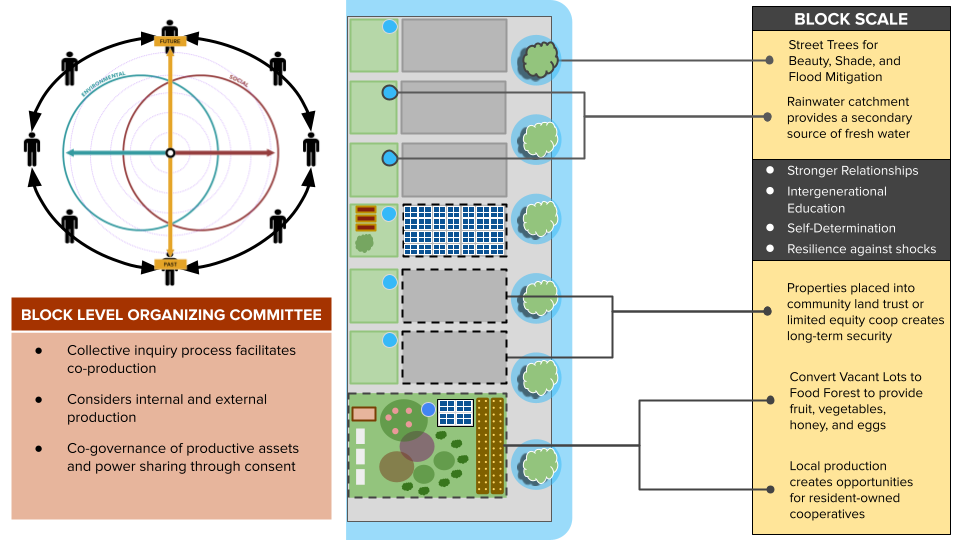
As I have previously emphasized, participatory methods and co-production are the epistemological foundation of sharing knowledge, power, and resources. A process of consent building can be used in the coproduction of physical and social space at the block scale to determine the creation, placement, and use of resilience infrastructure, such as urban agriculture and rainwater catchment, and from this generating possibilities for hyperlocal self-directed enterprises (e.g. produce coop). These assets can be produced, maintained, and used under a logic of commoning, and governed collectively by way of Block Level Organizing Committees (BLOCs), small resident councils.
Taking it further, I believe that elevating a logic of the commons within governance structures/relationships may help facilitate the sort of distributive model of power that’s necessary to realize FWE nexus solutions at various scales. There is a need for prefigurative modeling of solutions, which usually takes place at the smaller scales, like the block — with the intention of scaling up and sharing across sectors. The BLOC model offers the possibility for small scale commons governance, as well as FWE nexus resource management, such as urban agriculture, rainwater catchment, and solar microgrids.
Methodology: The Five-Dimensional Compass
The Five Dimensional (5D) Ecological Compass (Figure 3) is a framework and tool which invites the residents of the block into a participatory process, where they can consider the social and environmental relationships at the scale of the block, the neighborhood, or the city more broadly. The compass is meant to stimulate conversation about the relationships between people to both space (social or physical) and time. Inquiry into the future of the community corresponds to collective dreaming, while a rigorous exploration of the community’s past might encourage intergenerational dialogue between young people and elders to build collective memory. The past condition or composition of the environment — the embedded memory of the land itself — might provide important context (e.g. geomorphology, hydrology, history of land use) for current development considerations, or expose repeating trends that demand intervention. Inquiry into the future of the land is part of a process of worldmaking — which itself may either follow or disrupt a trajectory started in the past. The compass further invites participants to consider three mediating factors: materiality, affect, and power, which shape their ability and to what degree they interact with each other on the block and within the city at large.

These mediating factors cannot be considered in isolation, as they are not only mutually constitutive, but additive. Power + Materiality invokes physical barriers or facilitators within the relationship between subject and a given space-time, while Power + Affect is psychological, with past or existing power dynamics influencing perceptions of what happened and what is possible. Materiality + Affect filters the emotional experience of the physical space. Taken together, explorations of the relationships between subjectivities, space, time, and community, as mediated by power, affect, and materiality, across different scales, creates the scaffolding for rich and ongoing community inquiry.
The compass circumvents the need for formal methodologies such as interview, survey, focus group, because users generate and answer questions organically and collectively. The structure frames conversations with respect to relationality across sociospatial, sociotemporal, and spatiotemporal dimensions, at different scales, as well as making explicit and thematically linking what participants already know and understand with respect to how power, materiality, and affect mediate our relationships to each other and to our environment.
Data Collection and Analysis
Using the compass, participants might consider how space might be co-produced in such a way as to address the problems and enhance the assets revealed through the collective thought process. The framework is not just about asking questions / collecting data (epistemology), but about actively making changes to physical and social worlds (technology) and empowering people to contemplate, reflect upon, and dream/prefigure/change their lived realities (ontology). Some epistemological questions might be: What do we know, what knowledge has been lost, what do we want to know / what knowledge do we want to restore? Technological questions might include: What are we doing / making / producing? What past productive capacities have we ceded to the state or capital? What do we want to build for the future? While the ontological might be concerned with: Who are we / What is this place? Who came before us? / What did this place used to be? Who do we want to become together? What could this place become? What are / have been / might be the material or affective barriers to what we want to create, and what does power have to do with any of it? (See Table 1 for a breakdown of the inquiry cycle).

After questions are generated, they can be sorted and “coded” to identify recurring themes, linkages, and gaps. Questions can be further categorized as ontological, epistemological, and technological. Are we thinking too concretely (about what we want to do/make) without considering the underlying questions that inform that? On the contrary, are we thinking too abstractly and not getting into the nuts and bolts of what we need to actually do to achieve whatever state of being we desire? What (additional) methods we want to use to answer these questions (e.g survey, photovoice) that can give a different perspective on these same questions? Whose perspective are we missing? What social scales?
One problem with the outside researcher creating the questions is that they frame the conversation and possibly preclude / foreclose upon lines of inquiry that are more relevant to the community. Inversely, where community fully drives the process, decides the questions, priorities, etc, it may be limited by pre-existing onto-epistemo-technological frames. In other words, asking questions they already had, or already have answers to, the questions just being a way to express what they already think rather than truly engaging in collective inquiry. For example, the question “What can we do to keep the kids out of trouble?” may already have an answer: “afterschool programs”, which both may be relevant, but the compass might encourage a counter-exploration of the well-being of young people, beyond avoiding trouble, such as questions about nutrition, or self-efficacy and esteem, or about trauma. Participants might even consider whether or not “the kids” are the most salient frame, particularly where conversations are taking place intergenerationally.
A Vision of Block-Scale Resilience
The two vacant lots, which together span about a tenth of an acre, could be repurposed as a food forest using permaculture and agroecological practices to produce large and diverse yields. Some food could be grown for seeds, to be both replanted in the next season, or shared between neighbors for their own personal gardens. Through the PHS Tree Tender program, the block could acquire street trees, offering shade and water retention — which, incorporated into a larger water harvesting plan,[95]Lancaster, B. (2019). Rainwater Harvesting For Drylands And Beyond, Volume 1: Guiding Principles To Welcome Rain Into Your Life And Landscape (Vol. 1). Rainsource Press. would not only mitigate flooding, but provide additional water for farming and consumption.
Food: Benefits of Urban Agriculture
There is an enormous amount of research on the benefits of urban agriculture, from providing fresh, local produce, as an alternative to the unhealthy, more processed food sold in convenience stores and other low produce markets, or in worse cases, coming through emergency food services and pantries. The productive capacity of urban agriculture can yield anywhere from 40 to 50,000 pounds of food per acre[96]Siegner, A., Sowerwine, J., & Acey, C. (2018). Does urban agriculture improve food security? Examining the nexus of food access and distribution of urban produced foods in the United States: A … Continue reading[97]McDougall, R., Kristiansen, P., & Rader, R. (2019). Small-scale urban agriculture results in high yields but requires judicious management of inputs to achieve sustainability. Proceedings of the … Continue reading, meaning that the vacant lot food forest could conceivably produce about 5,000 pounds, enough for the 30 households on block (See Figure 4).

Water: Informal Provision vs. Institutional Distrust
Where rainwater is collected in barrels and/or cisterns, a niche is created for yet another worker-owned enterprise: this one collecting unused rainwater from households, purifying it at a designated local site, and then providing neighbors with fresh drinking water through a low-cost subscription program, or even moneyless exchange, using and reusing glass bottles to eliminate plastic waste and costs (see Figure 5). The need for alternative water systems is not only as a matter of resilience, but becomes an issue of everyday use when we consider the widespread distrust of the municipal water supply, most pronounced among Black, brown, poor, and working class residents.[98]Schmidt, S. (2023, April 16). Philly City Council to investigate the city’s preparedness for drinking water threats. WHYY. While much of this institutional distrust is anecdotal and generational, there is empirical evidence that these concerns are well founded, under normal conditions, or in the face of unexpected shocks, like the recent Delaware river chemical spill.[99]Schmall, E. (2023, March 26). Philadelphia Monitoring Water Supply After Chemical Spill. The New York Times. https://www.nytimes.com/2023/03/26/us/delaware-river-latex-chemical-spill.html

Energy: From the Macro to the Micro
Broadly speaking, the energy needs of a resilient community could be broken down into two categories: internal, which includes workers’ labor, and food calories consumed, or produced through agriculture, and external, which refers to energy coming from outside the community, whether piped in through fossil fuel infrastructure, or absorbed from the sun. Where space allows (including sufficient shared rooftop real estate across rowhomes), a local solar array or microgrid could be owned and maintained by a block-scale energy cooperative, provisioning multiple households, storing surplus in batteries, or selling it to the municipal grid (see Figure 6). Community-owned community solar is one strategy for energy resilience in that it provides lower cost or even free energy now (offsetting stressors) and can act as a backup where infrastructural failures leave people without power. Where the state and utility companies are bad faith actors, community organizing around models of local ownership and control becomes essential.

Conclusion
There are two critical points of intervention for the Building BLOCs project: 1) using the 5D ecological compass as a theoretical and analytical framework for engagement with the FWE nexus at multiple scales and across sectors; and 2) using the block as an “urban living lab” to model potential implementation of FWE nexus activities/solutions as well as governance at the hyperlocal scale. Elevating a logic of the commons within governance structures/relationships can facilitate the sort of distributive model of power that’s necessary to realize FWE nexus solutions at various scales. Prefigurative modeling at the scale of the block can yield possibilities for scaling up and sharing across sectors.

BLOCs can model hyperlocal collective self-determination, both as a means of subsistence, and practice with governance. While these activities aren’t “political” in the sense of engaging with the state, they are political for the fact that they secure community control of the means of production and reproduction. I believe that once people have a taste for decision making power over something of material significance, they’ll be less likely to cede power to representative government. Further, because the work of co-production requires control of land, which may have to be acquired extralegally and contend with legal structures such as zoning, encounters with the state are nearly inevitable. Where these encounters infringe upon the right of self-determination, and threaten control of the means of subsistence, community members will be incentivized to organize in their own defense. In poor and working class Philly communities where engagement with local government is low, the opportunity for people to step into their own power is greater still, as a means of uncoupling their collective well-being from appeals to the “will of another” (i.e. the state), moving from precarity to resilience.