Indian Killer, a novel by Sherman Alexie, is a mystery thriller in which the Seattle area is terrorized by an unknown murderer. Because of the killer’s calling card – scalping the victims – and due to the fact that all of the victims are white men, many people in the area suspect that the killer is Indian. Fears and racial tensions further escalate when a six-year boy is kidnapped right from his family home. Attacks on Indians by white people lead to retaliatory attacks, and before long the situation is out of control.
Matters are further exacerbated by the ramblings of a conservative talk show host from the mold of Rush Limbaugh or Glenn Beck – the one gives the killer the name “Indian Killer”. It is a strange moniker for its ambiguity, able to be interpreted as a killer who is an Indian, or one who kills Indians. And indeed, the situation taken as a whole, beyond just the actions of the killer, encompasses both interpretations.
Alexie writes the story in the tradition of all good mysteries, leaving the reader suspecting just about anyone and everyone as a possible suspect, giving them motive and opportunity. Yet the end gives the reader no conclusive evidence as to the killer’s identity, and it is even suggested, with elements of magical realism, that the killer is something other than human.
Yet the identity of the killer is not even the point. More than a thriller, the book is a social commentary, one pointing at the bubbling racial tensions in ostensibly liberal and harmonious Seattle, such that a single event could unravel the social order.
As Alexie has been known to do in his other work, he points a finger at the self-satisfying ramblings of white liberals, who for all they may understand intellectually, lack any real personal understanding of the Indian condition, or of the fact that there may not even be any such monolithic condition.
One such character, a college professor named Dr. Mather, who has studied Indians in depth, and even lived on a reservation for three months, makes the following assessment about the Indian Killer:
“The Indian Killer,” began Dr. Mather, “is an inevitable creation of capitalism. A capitalistic society will necessarily create an underclass of powerless workers and an overclass of powerful elite. As the economic and social distance between the worker and elite increases, the possibility of an underclass revolution increases proportionally. The Indian Killer is, in fact, a revolutionary construct.” [p. 245]
His assessment draws the ire of student Marie Polatkin, who already takes issue with white men presuming to know so much about Indians for all they’ve read about them in books – books, she points out, mostly written by other white men.
While the professor does well to cite the classic Marxist argument regarding the relationship between a generic and hypothetical proletariat and bourgeoisie, he does not take into consideration the specifics of individual or group experiences.
While such revolutions have occurred, and broadly speaking, for the reasons suggested, there are countless micro-dynamics that unfold within the greater conflict. To look only at the surface, at the seemingly universal aspects of revolution, is to ignore the specific factors leading up to it. In the case of the Indians, it also ignores history, as for the most part, for the unprecedented devastation visited upon them by European colonists, they did not and have not responded in accordance to the Marxist framework.
The professor’s windy exposition also fails to consider one obvious fact: that the killer is an individual, one who could be killing for any reason at all, such as mental illness or revenge. Most importantly, the professor’s assessment – and it resonates with the presumptions of the white population of Seattle at large – is contingent upon the killer being Indian at all.
This presumption is entirely racist, not only for fingering an Indian as the killer without any evidence, but in suggesting that for the mere fact of the killer’s ethnicity that he/she should behave in a certain manner. Furthermore, even if he could otherwise confirm that the killer was Indian, he cannot with any certainty say that he or she would be motivated by forces conceived of within a European social context.
For me this brings back to mind the ambiguity of the book’s title. Are we supposed to be following the story of a killer who is allegedly Indian, or the wider circumstances that continue to “kill” Indians?
Perhaps the real Indian Killer is not the man or woman scalping random white men, but the society that, as the novel’s blurb reads: “colonizes and marginalizes a group of people while failing to value or understand it”.
In the novel Flight, by Sherman Alexie, there is a visible current in which the author establishes the white person aesthetic as “beautiful”, in contrast to the “ugliness” of Indians. As it is common in American (U.S.) society for whiteness and white people to be held aloft as the standard by which all else be judged, this current became clear to me almost immediately.
The main character is a half-Indian, half-white teenager named “Zits” – a nickname he adopts for the fact that he has a severe case of acne. The character defines himself by his worst physical quality, but also his “Indian-ness”, in spite of his blended heritage. That Indian-ness and ugliness should be mutually inclusive, at least in the narrator’s mind, is established early in the story.
I’m ashamed of … being tall. And skinny. And ugly. I’m ashamed that I look like a bag of zits tied to a broomstick. […]I wonder if being Indian causes acne. […] I’ve inherited his [my father’s] ruined complexion and black hair and big Indian nose. (p. 4)
This self-identification with Indian-ness and ugliness is juxtaposed against the other side of his heritage, which he regards as beautiful. We are first exposed to the “white is beautiful” theme as Zits speaks of his mother and mourns the fact that he did not inherit her qualities.
She was a white woman. Irish I guess. I have a photograph of her, too, and she is gorgeous. My eyes are green, like hers, but I’m not pretty. I wish I looked more like her. (p. 5)
Throughout the story, Zits has the unusual opportunity to occupy the bodies and circumstances of other people throughout time. The pretext for this “time-jumping” is that he experience the universality of human brutality, but the equally ubiquitous – if only less common – instances of compassion. But there is a subtext tucked within this main premise wherein the character also has the opportunity to be “beautiful” by inhabiting the bodies of white people. The first is Hank Storm, an FBI agent who serves on the front lines of some sort of shadow war against Native Americans. When Zits first notices his new body, he thinks:
And so they had to take my zitty teenage Indian mug and replace it with a handsome white guy’s face. Yes, I am looking at a very handsome white guy in the mirror. His hair is blond. His eyes are blue. His skin is clear. (p. 40)
Here we notice two things: first, that Hank Storm has blond hair and blue eyes, two qualities that are quintessentially “white”, those regarded as pristinely beautiful for the fact that they belong almost exclusively to white people. Second, the man has clear skin, another way the narrator notices how different – that is, how beautiful – this white man is compared to himself.
Later, while Zits is still occupying Hank’s body, we meet his wife, who again is clearly described as a white woman, and also the most beautiful woman he has ever seen.
I can’t believe this woman is my wife. She is beautiful. Black hair, blue eyes, pale skin. She is maybe the most beautiful woman I have ever seen in person. (p. 58)
For their prevalence, it is my impression that Alexie is drawing intentional parallels between white and beautiful, Indian and ugly. Also for the emphasis he places on features that are unmistakably white versus those that could also belong to people of a different race.
During another time-jump he inhabits a pilot named Jimmy – who also has pale skin, blond hair, and blue eyes. Jimmy has relationships with two women, one of which is his wife, and the other a younger acquaintance. Zits describes the mistress, Helda, as:
Red hair, green eyes. And she’s pretty. Very short and very curvy. Cheerleader curvy. (p. 115)
There is a connection drawn between Helda and Zits’ own mother, who had earlier was identified as white – specifically, Irish. Helda’s features automatically speak to her whiteness even were the connection to the mother not made, as red hair and green eyes are second only to blond and blue in identifying a person as white. Both are described as beautiful. In contrast, Zits describes the wife – Linda – as:
…older, gray-haired, a little bit pretty and a little bit chubby. Her brown eyes are huge. (p. 117)
Linda’s race is left ambiguous, although for Jimmy and Helda’s ultra-whiteness, the reader might assume that she is white as well. I get the sense that the ambiguity is intentional, because Alexie does not miss any other opportunity to identify a character by ethnicity. Linda has features that could belong to any other race or ethnicity, and perhaps for those features she can only qualify as “a little bit pretty”, not for the overwhelming beauty of Helda or the other quintessentially white women in the book.
One of the last instances of tethering beauty to whiteness comes towards the end of the book, as Zits finds himself back in his own body, just seconds before he made the lethal choice that set the book in motion – to shoot and kill random strangers in a bank, and to be shot in the head himself. Visiting this choice a second time, he takes a particular interest in a woman and her son.
He is maybe five years old. He has blue eyes and blond hair. He’s wearing good shoes. A jean jacket. Khaki pants. Blue shirt. He’s beautiful. A beautiful little man. (p. 158)
Again the emphasis on blond hair and blue eyes. Alexie even verges on hyperbole by saying beautiful twice, and by making the child’s clothes blond and blue – Khaki pants, blue shirt – as if to punctuate the statement that white is beautiful. If there is beauty in compassion and ugliness in brutality, then perhaps this child is also the punctuation on Zits’ decision not to carry out mass murder a second time.
Throughout the text, Zits makes it clear that he regards himself as ugly, in contrast to the beauty of the many white people he encounters. When in his final time-jump he occupies the body of an Indian man – and not just any Indian man, but his own father – we are again presented with an unappealing physical image.
Not only do we know him to possess the features that Zits regards as ugly in himself, but Alexie adds an extra veneer, of dirtiness – the man is homeless, drunk, and has vomited on himself – and bloodiness – he is ill, vomiting up blood. He meets a couple of strangers, a couple who are, at least ostensibly, of the white liberal ilk that in spite of the most benign of intentions (they call the homeless man an ambulance and the woman even goes so far as to say he is important to them) try to smother all the nuance of racial and social dynamics beneath a pretext of compassion. Alexie shows us the kind of rage the white liberal attitude can provoke, but instead of recognizing it as justifiable, he paints this man as ugly both inside and out, the point being not merely to cast Indian as ugly and white as beautiful, but to identify this current as one of self-hatred.
Self-hatred is explicitly named on page 137 – “Maybe I can defeat her with my rage and self-hatred”, as an answer to a white woman’s display of compassion towards him – and again on page 156 as Zits’ father affirms his own father’s low opinion of him, repeating “I ain’t worth shit!” over and over again. It is the same self-hatred and rage that underlies Zits’ predisposition at the start of the book, and ultimately his violent actions that set the story in motion.
But in the end, Zits makes the “beautiful” choice and rather than killing the people at the bank, turns himself in to the police. He is in turn offered a chance at redemption, but more importantly a chance to love and find beauty in himself.
This shift in self-image and potential – a word Zits sneers at early in the story – is punctuated by his new foster mother telling him that he is handsome, and showing him how to remove the acne from his face. The story ends with Zits insisting that his foster mother refer to him as Michael, his real name.
Where I am left wondering, however, is in how redemption and self-love are still necessarily facilitated by white people and via whiteness. It is the white cop, his white brother, and white sister-in-law, who foster Zits and who offer him not only to wash away those physical traits that he identifies as ugly, but also to participate in the quintessentially “American” – that is, white – experience, living with them and going to baseball games.
A psychologist early in the book tells Zits that he’s “never learned how to be a fully realized human being”, something she connects to mainstream U.S. (white) culture, things like wearing a tie and having newly shined shoes. Zits, while strongly identifying as Indian, rejects these norms, but at the end of the story seems to embrace them. It is interesting too how he distinguishes between Indian-ness and American-ness, the latter interchangeable with whiteness for all that it seems to be inclusive of people of color in the United States – which is to say, not very inclusive at all.
A baseball game! Jesus, how American. Next thing you know, Dave and the firefighter and I will be playing catch in the backyard. (p. 176)
In Flight, Alexie seems to be asking whether or not self-hatred can be neutralized through assimilation – that is, can Zits’s hatred of his own Indian-ness be dissolved into a claiming of his whiteness? Indeed whiteness itself is a product of assimilation, with Irish, Italian, German, and other European ethnicities blending within the “melting pot” to create a new racial paradigm. Alexie clearly recognizes the construct of whiteness – an institution that transcends individuals – identifying it explicitly when Zits occupies the body of his own father:
Jesus, I wonder if this homeless guy understands the difference between white and whiteness. And then I wonder if I should be so condescending, considering I am this homeless guy. (p. 136)
Yet in spite of this clear acknowledgement of whiteness, at the same time Zits becomes Michael he embraces his white foster family and their “American” cultural norms. It seems Zits is on the verge of the same assimilation. Should, then, his father have accepted the compassion of the white liberals rather than demanding their respect?
Could there be salvation or redemption in assimilation? Just who is redeemed in such a situation – the person of color who by default is excluded from the mainstream American experience only to be invited in by the sheer grace of white people? Or is the redemption for the white people themselves who seek to alleviate the guilt they possess for how their own institutionalized supremacy has caused such exclusion? Alexie may be hinting at this question, if not its answer, on page 177:
[Officer Dave] is trying to save me. And he’s smiling about it. I guess that’s okay. Maybe I can save him, too. (p. 177)
Is Alexie’s message, then, a more saccharine one, that through some sort of joint effort people of pallor and people of color can come together and redeem each other or their collective society? I sincerely doubt it. I think Mr. Alexie, known for his wit and subversiveness, is taking aim and laughing at the idea.
The Alchemyst: The Secrets of the Immortal Nicholas Flamel, a speculative fiction novel by Michael Scott, is a solid example of where the reader’s senses are evoked to great effect. In the excerpt below, Scott manages to appeal directly to three of the five, and implies a fourth. Exposition in fiction would go nowhere without visual descriptions, so it is a given that every author will use them, sometimes even to the point of excess.
Robert Jordan comes to mind with his penchant for describing blades of grass; the Wheel of Time turns slowly indeed. Unlike the more gassy storytellers, however, Scott’s prose is lean and precise, as he manages to stuff plenty of visual details into a small space simply by using the right words.
She was startled when the woman’s bright green eyes snapped wide open and she whirled around to look across the street…just as all the little square windows of the bookshop abruptly developed cracks and two simply exploded into dust. Wisps of green and yellow smoke curled out into the street and the air was filled the stench of rotten eggs. Sophie caught another smell too, the sharper, cleaner smell of peppermint. (p. 17)
Consider the use of snapped in the first sentence – intended to demonstrate the speed and thus the urgency in her expression. Yet snapped is also a sonic word, and while we can assume that the woman’s eyes did not make such a sound, it serves well as a beat, a moment preceding the rise of tension in the story. She then proceeds to whirl around, again a word that creates a visual, but also a sound, and even a feeling – the implied whipping of her coat as she turns, and the gust of air kicked up by the sudden movement.
We can also clearly picture the wisps of smoke, and not just any smoke, but green and yellow, which in the story are the colors of two opposing forces. We know from this description that an unseen battle is taking place behind those windows. So much detail, both explicit and implicit, simply by using the right visual cues.
But it would hardly be enough for an author to use visual descriptions and rely on mere implications of the other senses. It is also interesting to consider that a book heavy on visual language could be translated into Braille for a reader born blind, and for whom such words have much less, if any significance. Yet so many writers rely almost exclusively on visuals, to the expense of the other senses.
Sound is nearly as common, from the more obvious explanations of characters’ tones or inflections, to the more visceral onomatopoeia – bones crunching or innards squishing. Words like explosion are both visual and aural, the latter implied due to it involving windows, which allows us to hear glass shattering with our mind’s ear, even though it is not actually described. Before the explosion, we see the cracks forming, but again, a word like cracks serves a dual purpose. Implied is the straining and popping we associate with glass cracking as we recall similar events from memory. Scott could have easily spent another few sentences describing the sounds, but in this case it is unnecessary for all that is implied through our own experience.
Touch is probably a close third in a writer’s repertoire, as they describe the feeling of the icy winds biting exposed skin, or the sharp penetration of a blade through flesh for the person on either side of the knife. Scott makes ample use of touch throughout the novel though not in the above paragraph.
It seems especially rare, however, that an author will tap into the reader’s sense of smell or taste, except for under the most trite of circumstances like breathing in the wind off of the ocean or sampling the greasy starches and sugars of a doughnut for breakfast. Such things tend to be inconsequential, arbitrary details the author throws in just for the sake of doing so.
But for Scott in The Alchemyst, the sense of smell is evoked for significant reasons. In the above paragraph, he describes the odors of rotten eggs and peppermint. Much like the colors green and yellow, these two smells are also associated with one of the protagonists and one of the antagonists. Each of the two characters is a sort of magician – an alchemist and a necromancer to be specific – and when they invoke their powers, these odors of rotten eggs or peppermint fill the air.
Even if we had not already been told, we might automatically associate yellow – a color of caution or sickness – with the rotten egg smell, and the green – of leaves, and indeed mint – with peppermint. And we’d be correct. It is interesting to think of how a different juxtaposition of the same elements might disrupt a story’s believability. Would it cause a sort of dissonance if, in fact, the yellow smoke carried the peppermint odor? I think so. Or what if the “good guy” was the one who used powers that reeked of rotten eggs? He might make for a rather unlikeable sort, certainly not the person you want on your side in a fight for the sake of the world.
What The Alchemyst in general, and the above paragraph in particular demonstrate, is how the reader’s senses can be tapped not just for the sake of creating a scene, but also infusing it with nuance, with meaning. Within the context of the novel, these details, which might be applied to say, a cooking accident in another book, convey so much more than just how the characters physically experience the world. They express all the tension and urgency of high stakes conflict and even combat, all without mentioning any of those things explicitly. Evoking the senses is one of the most powerful tools that an author can use, one that can give spare prose like Scott’s the same impact as that of a more flowery writer.
This was a statement made by famed movie critic Roger Ebert.
And it affirms something to which I’ve long attested, that the film critic’s pathetic lot is to forever claw and scratch for recognition by other film critics, since no one else – namely those other film students who went on to actually make films – gives a damn.
What is art?
This question is one that has been debated perhaps since the beginning of human history – indeed I would venture a guess that even the cave painters Ebert mentions in his post argued the validity of those works, unaware as to how they would inform historians of the social context in which they were created. It is only at the modern heights of arrogance that could one claim to be able to answer this age-old question with any certainty. And it is hardly possible to be any more arrogant than making a universal truth claim, let alone one expected to hold for eternity. The whole thing is laughable.
I have argued in the past that video games are the ultimate form of expression, and what is art if not expression? Indeed video games are a convergence of art from just about every medium – audio, visual, literary – and their social impact is ever-increasing. Ebert makes his statement by observing video footage of a few games offered up as art, already prepared to deny the possibility. Aside from the sheer fallacy of denying art as a form of expression, there is also the matter of his evaluation not being made from the proper standpoint. As I’ve argued in the past, what sets video games apart from film, television, music, books, and other mediums is their interactivity.
That one thing [that sets video games apart from other media] is interactivity. You can rip a page out of a book in frustration as a story takes an unfavorable turn, or you can yell your lungs out at movie screen as the stupid teenage girl wanders down the dark hallway alone towards the lurking killer, but chances are that you’re not going to change anything. In a video game, however, a person is given a measure of control over the characters and environment presented.
To evaluate any video game without playing it is as dubious as evaluating a piece of music by only reading the lyrics or reading the sheet music, or evaluating the merits of a film based on – insert laughter here – a critic’s review.
If the art is expression argument alone doesn’t validate video games’ status as an art form, then allow me to speak from a more personal place, because is not the meaning of art in any context entirely subjective? I can attribute to two single moments in the games Chrono Cross (Playstation) and Lunar: Eternal Blue (Sega CD), the abstracts that would expand to become the cornerstone of my personal philosophy. The former, in that one moment, had me question how color could correspond to sound, and the latter had me considering the relationship between creation and destruction, which I would later come to understand more abstractly as two forms of change. In that art has often sparked philosophical inquiry and introspection – for the creator and the audience – video games clearly fit the bill.
Furthermore, my ethics – manifest in my sense of justice – if not founded in, was certainly bolstered by the lofty ideals of good vs. evil I found in video games as a child. The evolution of video game conflicts from black and white conceptualizations of good and evil in the “old school” to the shades of gray now explored through the tough moral choices players have to make in the “new school” not only showcases video games’ increasing complexity, but also their increasing relevance to the real world. Art, as a medium, is nothing without its flexibility, and its ability to evolve as a reflection of the surrounding social atmosphere.
My inspiration to write came from video games as well, at first little more than an emulation or reworking of video game plots, but soon thereafter the expression of a burgeoning imagination, forged in outlandish worlds and impossible situations. Video games spoke to me in ways that other mediums simply did not, and if we are measuring art in terms of social or personal impact, then Ebert’s claim is not only false for me, but a personal slight to me and others like me, for whom games have been either a subtle or direct influence. His claim invalidates me, personally – dismissing the countless hours in which I was visually, aurally, physically, and emotionally invested and engaged – as frivolous, or a waste of time.
This is saying nothing of how it invalidates the creators of video games – themselves musicians, painters, 3D modelers, programmers, writers, choreographers, actors, and more – each of which, outside the context of the video game itself, Ebert could hardly argue were not artists.
So, on what sort of project, exactly, could established artists from many different fields come together, only to miraculously create something that is not art?
To propose that such a project could even exist is to stand at the very apex of stupidity.
For someone who is without a doubt – no matter how one chooses to define art – not an artist himself, and one who has never been touched by the myriad forms of expression contained within a video game, Ebert only proves himself incapable of making such a judgment. He also proves, for his increasing detachment from an evolving media culture, his sheer cultural irrelevance.
This post could also be entitled: “Uncharted 2 and Why I Can’t Enjoy Anything Anymore.“
Let me preface this rant by saying that Uncharted 2 is a remarkable game, on both technical and aesthetic levels. It is in fact the PS3’s “killer app” and is well-deserving of all of the accolades it has received thus far. I have been playing it for the past two weeks and I am still discovering little details that demonstrate both the level of skill and love for the craft that can go into a triple-A title. But perhaps it is for all those accolades and that demonstration of skill that I must call the game out on a several fronts.
I’ve had discussions with various people – particularly African-Americans – about video games where they expressed to me their problem with the prevalence of white protagonists. They felt a disconnect from the characters they were playing for this reason, felt they couldn’t “relate” to them. For a long time, whenever I had this conversation, I thought it was silly.
Afterall, there were plenty of ways/reasons to identify with a character outside of race/ethnicity. Most of these games were taking place on other worlds, where our racial categories did not exist. Even where themes of discrimination were visited, as in Chrono Cross, it was a problem between humans and some actual other race – like Elves or Metahumans. What did it matter that the heroes in these worlds happened to be blue-eyed blonde-haired ubermensch? I’m looking at you, Cloud Strife.
In an earlier post, I discussed the need for designers to incorporate a wider range of ethnicities in video games. As to why they haven’t done so up to this point, and why the few non-white characters tend towards stereotypes, I offered up one possible explanation.
Part of the reason for this is that a large number of games come out of Japan, which being nearly homogeneous in terms of ethnicity, and insulated – both physically and culturally – may lack a strong frame of reference for depicting a diverse cast of characters. Where the games are made in the Europe or the United States, where ethnic variety is more common, stereotypes may instead emerge as a consequence of one-dimensional writing. Perhaps a developer cannot be bothered to do the research into all of the nuance and idiosyncrasies that rise from a character’s ethnic experiences.
Jade from Beyond Good & Evil
While those developers who have at least made the attempt to be more inclusive should be acknowledged, it is more important to point out where more work needs to be done. I am almost six years late in discussing the case of Jade from Beyond Good & Evil, but an interesting post by Jason over at Microscopiq brought the issue to my attention. The post discusses the “first 11 black video game stars”, specifically those characters of visible African descent who were not only featured in games, but were the main character. Jade was amongst those mentioned.
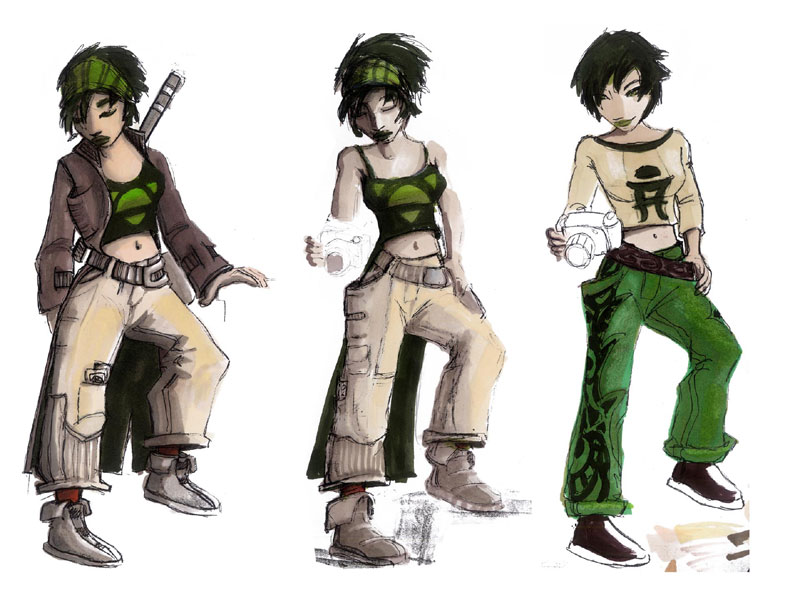
At a glance, some – if not most – people would question whether or not Jade qualifies as “black” in any sense. Arguments could be made for virtually any ethnicity as her appearance is quite ambiguous. The only solid support for Jade being a “black” heroine is in looking at the original concept art, which featured some earlier renditions of Jade with either locks or braids in her hair, and features more commonly associated with certain peoples of Africa.
Jade Concept Art
From the concept stage to the final version, much was changed, and we have a character who could pass for virtually anything.
There are many possible reasons for the change, such as wider market appeal, as an ethnically ambiguous character alienates no one. It is also a truism that the mainstream beauty standard – set mostly by Americans and Europeans – is not inclusive of distinctively “non-white” features, particularly Africanesque features. For marketing’s sake – and this literally could’ve been a decision made by marketing against the wishes of the original designer – Jade could have been altered to resonate more with the mainstream. Looking at the final version, is it enough to say that Jade was intended to be “black” by the designer, or even that she is so in his/her mind, in order to claim her as such? I would say that it isn’t.
Jade’s ethnic ambiguity alone, however, is not enough to dismiss her from the ranks of black heroines. After all, blackness is subjective, varying from place to place and culture to culture. If we take it to be synonymous with “African”, then the ethnic diversity of that continent means that Jade could look like anything. But here’s where we get to another important point.
Jade is most certainly not African. Because she is not even from this planet. Beyond Good & Evil takes place on the fictional world of Hillys, where people like Jade are classified as “homo sapiens”, distinguished from other humanoid races such as “Capra Sapiens” (goat people), “Sus Sapiens” (pig people), and “Felis Sapiens” (cat people). The concept of race that divides human populations on Earth simply does not exist on Hillys. For that matter, there are no social divisions between any of the “Sapiens” – they are subclassified solely for the sake of compiling a photographic catalogue of all of the planet’s species. That is to say, these distinctions are biological, and do not manifest at all in the culture of Hillys.
This is an important point, because the meaning of “blackness” on planet Earth is defined mostly in a social context. There are some vague overlaps into a biological context – some valid, particularly with regards to medicine, and some not – where genetics is cited incorrectly to support a social or political argument. Without getting too much into the meaning of blackness, there is the experience of so-called “black people” to be considered, which historically, and with few exceptions, tends to be one of hardship, oppression, social inequality, prejudice, and even dehumanization. This is particularly true of those peoples of Africa who were sold into slavery, and who even in the aftermath, have been forced to face social and economic oppression.
Coming back to video games, what would be required for a character to be considered “black”? Appearance could be one qualifier, but as we see in the case of Jade, this can become dubious due to the wide variety of physical characteristics that can be classified as “black”, a reflection of the extreme diversity to be found within such a vague and subjective category.
The “black experience” could be another qualifier, as in a situation where a character is forced to face certain indignities, in spite of her ethnic ambiguity. There are undoubtedly women who resemble Jade and who have been forced to endure such conditions. In the United States, by way of the one-drop rule, it is common for a woman of fair skin to be deemed a “black” woman by virtue of her other features, and therefore share in the black experience. Jade as she appears in Beyond Good and Evil, however, fails to meet either of these qualifiers.
Cree Summer
The only remaining qualifier brings us back to the designer’s intent. Without speaking to Michel Ancel or his art team, we cannot know which ethnicities inspired Jade’s appearance from original concept to final incarnation. Perhaps then, we could derive clues from the voice actors chosen to play Jade. We have to take this with a grain of salt, however, because the ethnicity of voice actors do not necessarily match those of their characters. Cree Summer, who is African-American, is one of the most prolific voice actors in the field, and because her voice does not invoke any particular ethnicity, she has been tapped to play a wide range of characters – most of which are not African-American or “black” in any sense. She got her start playing Penny from Inspector Gadget.
Penny from Inspector Gadget
What this suggests about the willingness of game producers to cast black actors for their voices versus their willingness to craft black roles may be another subject worth exploring. As for Jade, since the game was released in different languages, she was played by several different voice actors. But with respect to how Jade’s voice corresponds to her ethnicity in the mind of the developer, we should take a look at the actor closest to the developers – Ubisoft Montreal – which would be the one cast for Jade’s French voice. Her name is Emma de Caunes, and thanks to the artist John Karp, we can see her picture below modified to resemble Jade.
Emma de Caunes as Jade
Even had Jade’s voice actress been of any French-African ethnicity, it would’ve been a stretch to therefore consider the character as being of any African ethnicity. The example of Cree Summer demonstrates the distance between the identities of voice actors and their characters. In any case, Emma de Caunes is not of any visible African descent, and therefore we cannot use her ethnicity as a case for Jade’s “blackness”.
This brings me to my final point about Jade, which is that in spite of the developer’s original intent, any ethnic inspiration for the character, how Jade is perceived by her audience may be even more important. By looking at a few random samples of fan-created art for Jade, we can gain some insight into how others perceive her ethnicity. An extensive spread of Jade fan art can be seen at the deviantART Beyond Good & Evil Fan Club, where not one rendition depicts Jade with Africanesque features.
Because an artist’s work will necessarily be based in part on their personal experiences, and probably in some way reflect the artist him or herself, it stands to reason that the artist’s own ethnicity may factor into how they depict a character. What we see is that in spite of the varied ethnicities of the artists, not one of them depicted Jade with features any more distinctively Africanesque than what we see in the official Ubisoft rendition. Had these artists had even an inkling that the developer intended Jade to be “black”, then it may have been more likely that we would have seen that understanding reflected in their work.
While we cannot discount the possibility that Jade’s features would’ve been “de-ethnicized” even had she been more clearly Africanesque – as is common amongst fan artists of Storm from Marvel Comics – we can at least say that nothing about Jade seems to encourage fans to depict her as “black”.
So in the end, based on overwhelming evidence, we are forced to conclude that Jade from Beyond Good & Evil is not “black” in any sense of the word. For the reasons discussed above about how races are defined, and how they do not correspond to any human categorization on the planet Hillys, she cannot accurately be considered “white”, “Asian” or any other race/ethnicity from Earth. She can only barely be classified as human, being a “homo sapien”, but those who have played the game also know that she is a little something more. I’d like to count Jade amongst “black” female protagonists in video games, due to the fact that there are otherwise none, but doing so actually sets a weak precedent.
It is not enough to be inspired by Africanesque features, only to see that inspiration disappear for the sake of market appeal. And it is regressive, if not plain insulting, to create a character of color – in terms of background and appearance – only to completely undo it in a future incarnation, as in the deplorable example of Vanessa Lewis from Virtua Fighter. Note the lighter skin, thinner lips, altered facial structure, and reduced hips from the Virtua Fighter 4 version (background) to the Virtua Fighter 5 version (foreground).
(Vanessa Lewis | Background: VF4 Foreground: VF5)
As technology improves, and as the content of games expands in terms of breadth and depth, opportunities only increase for representing diversity. In the future, it will not be enough for a character to have darker skin, thicker lips, or a different eye shape. We will have to see different cultures and experiences represented as well. This wouldn’t have to be a limitation with regards to restricting the game setting to Earth.
After all, there is always interstellar or cross-dimensional travel. There is also alternative history. And already, plenty of creators have told stories of other worlds, only to draw inspiration from the experiences of the peoples of Earth, because doing so adds a certain richness and credibility.
As I discussed in Ethnic Depictions in Video Games, there has been a want for protagonists of color with which gamers of color can identify. If gamers cannot identify on a superficial level – i.e. by appearance, if they cannot identify on the basis of a common social experience, and if they cannot identify by way of voice, then there is little remaining to connect them to the character. For most gamers this probably will not taint their experience with a game, as the lack of inclusive ethnic representation has become the norm.
But there is certainly a call, albeit muted and scattered amongst the more thoughtful pockets of the gamer population, for game developers to be more inclusive in their thinking.
My official position on the nation of Israel is that it should have never existed. It is one of the more grotesque products of colonialism and has continued to stand as a blatant offense to nearly every other nation in the region. That said, I do not think it is feasible, or even reasonable, to expect that it will go anywhere, neither by peaceably reverting to the state of Palestine, nor being removed by aggression. It is about as unreasonable as expecting the United States to cede half of its territory back to the Native American tribes from whom the land was stolen. It simply will never happen.
For the sake of peace, Israel will have to maintain its sovereignty as a nation, regardless of the conditions by which that sovereignty was acquired. However, also for the sake of peace, something must change with regards to how Israel maintains that sovereignty. It cannot continue to conduct its military operations and Apartheid-like practices unabated, with no accountability.
I fail to understand what seems to be the infallibility of Israel – how those voices who speak out against the country’s practices are either a quiet minority or a few violent pockets of militancy. How is it that most of the world seems to offer either tacit approval or feign blissful ignorance as Israel has continued throughout its history to perpetrate a plethora of human rights violations and countless other offenses?
I could be wrong, and it may be that I simply cannot hear the voices speaking out against Israel because they are censored – i.e. simply not covered – by the media. Either way, I wonder what exactly Israel would have to do before the mainstream voice becomes one of opposition to Israel rather than one of quiet complicity.
Today the Associated Press reports that the Israeli Defense Forces, in their continuing incursion into Gaza, attacked the United Nations headquarters, destroying large supplies of food intended for the suffering Palestinians. That, along with a hospital, five high-rise apartment buildings and a media outlet, appear to be the latest in a list of targets that have nothing to do with Hamas and the stated purpose of the offensive.
This raises the question of whether or not Israel is simply incompetent – in killing more civilians than soldiers and “accidentally” destroying benign civilian infrastructure – or merely careless and arrogant in its apparent infallibility. Interestingly enough, the associated press article goes on to reiterate the purpose of the Israeli offensive:
[A]n effort to stop militant rocket fire from Gaza that has terrorized hundreds of thousands of Israelis.
In characteristic fashion, in the same virtual breath as it reports an obvious offense on the part of Israel, the press seems to want to justify it by overstating the causes. “Hundreds of thousands” of Israelis are being terrorized by Hamas rockets? Really? The latest reports say that altogether Israel has had thirteen casualties – two of which were civilians killed by the rockets, the others Israeli soldiers who fell during the ground offensive.
No loss of innocent life should be dismissed as insignificant, but there is a matter of proportionality to be discussed here. Hamas, in spite of representing a legitimately aggrieved Palestinian citizenry, was misguided in launching its rockets. However, they also appear to be quite inept, failing to hit any meaningful targets. Israel, who has them out-manned, out-gunned, and seems to have the moral imperative of “infallibility”, has killed as many as 1,100 Palestinians, more than half of which have been civilians – and too many of which have been children. There simply is no argument that can be made to justify Israel’s exaggerated response to the utterly ineffective actions of Hamas.
That Hamas continues to launch rockets – and continues to miss everything that matters – shows not only the kind of illogical reasoning that inspires terrorism, but the clear sense of desperation felt by the Palestinian people. It can be only foolish pride or a sense of having nothing more to lose that an organization would invite upon itself complete annihilation. Either that, or a desperate last ditch appeal to the world community to pay attention to the chronic injustices that continue to plague the people of the Gaza strip.
But that plea continues to be ignored due to the self-victimization of Israel – affirmed by the mainstream press corps – and the infallibility license extended by the rest of the world. If the United States can be maligned by the global community for the ill-motivated war in Iraq, then why can’t that same sense of right and wrong be applied to Israel? What is it about that little country that gives it carte blanche authority to violate every established moral and legal convention of the civilized world? And what is it that makes us – the rest of the world – so complicit?
The Escapist – an online publication best known for analyzing and discussing video games as a cultural phenomenon, rather than a mere form of entertainment, is currently discussing racial [in]sensitivity in games. The article Gangbangers, Victims, and Whores by Christina González, which discusses how Latinas are depicted in games, is a particularly insightful read.
The timing for this week’s Escapist happens to coincide with a bill proposal in the New York State Assembly also taking aim at racial insensitivity in video games. Sponsored by Assemblyman Keith L.T. Wright, the bill seeks to:
Prohibit the sale to minors of certain rated video games containing a rating that reflects content of various degrees of profanity, racist stereotypes or derogatory language, and/or actions toward a specific group of persons.
While this bill may just be the latest in what seems to be an endless crusade on the part of the state of New York against the gaming industry, the concerns raised by Wright are legitimate. Race and ethnicity, and how they are depicted in video games, has been a point of contention ever since games started receiving serious consideration as media. One point that is often made – and that I have made myself – is that video games are severely lacking in hoisting non-white characters to the status of main protagonist.
Those of us who are not white, but hope to identify with the characters we play in games the same as anyone, find the industry to be deficient. At best we have had to settle for ethnically ambiguous characters, often in non-Earth settings, which while fulfilling an aesthetic need still leave players wanting for a more substantial connection. When characters of non-European ethnicities are depicted in video games, it is true that they are often stereotypes.
Barrett from Final Fantasy VII
Part of the reason for this is that a large number of games come out of Japan, which being nearly homogeneous in terms of ethnicity, and insulated – both physically and culturally – may lack a strong frame of reference for depicting a diverse cast of characters. Where the games are made in the Europe or the United States, where ethnic variety is more common, stereotypes may instead emerge as a consequence of one-dimensional writing. Perhaps a developer cannot be bothered to do the research into all of the nuance and idiosyncrasies that rise from a character’s ethnic experiences.
So Wright is valid in his concerns about racial stereotypes in that they not only leave players without a character with which to identify, but with a caricature that debases them or their culture. Where I think Wright is wrong, however, is in thinking that the solution to the problem lies in more restrictive legislation. Most games with racial stereotypes are also mature-rated games, and laws are already in place to protect minors from playing them. The efficacy of these laws is questionable, and so simply imposing a second and redundant law is not likely to fix the situation.
In my opinion, it’s necessary for lawmakers to start recognizing games themselves as an extension of culture, to place them within the general category of “the arts”. Viewed that way, games may be held to a higher standard, as are film and literature. Rather than restrict the sale of a game with objectionable material, perhaps it would be better to encourage developers to release material that is less objectionable, or that at least places it in its proper context. For example, were game developers to be provided an incentive, such as an arts grant or tax subsidy, they may be more inclined to develop culturally relevant and accurate games. Recognizing games as art could inspire more developers to create games as art, rather than simply to turn a profit.
The restriction on mature-themed games, up to and including the blacklisting of anything receiving the “Adults Only” rating, has done nothing to stop younger players from experiencing them. Even where parents are educated as to what’s out there and mindful of what their children are playing at home, they cannot monitor what their children are playing when they aren’t watching, or what they learn by proxy from peers who have played games with objectionable content.
It would be more more effective to reward developers who perform admirably, who raise the bar in creating games as art, rather than punishing those who produce fluff. The fluff will continue to exist, of course, because sometimes those games are just plain fun. But they could be balanced by an increase in the alternative – games with real substance.
Game developers could then take the time to craft characters and settings that are three-dimensional – in how they’re written as well as how they’re rendered. Three-dimensions allow for dynamic characterization and provide room for development beyond stereotypes and caricatures.
The following article is the second part of an independent study intended to examine and deconstruct some of the major biases towards the practices and ideologies within the Islamic tradition. The first part discussed the role of women in Islam, which from a uninformed Western perspective appears to be one of lower status and oppression, but upon closer examination takes on an entirely different character. In similar fashion, this article aims to examine how Islam as a religion gives license – if it does so at all – to the many violent activities that have taken place in its name. This is a question that burned in every Westerner’s mind after the tragic events in the United States on September 11th, 2001, and then became even more urgent in the wake of other terrorist attacks around the world. Muslim apologists all around the world answered the call, and stepped forward to defend their religion against hatred, prejudice, misinformation, as well as against those “within” who would misrepresent it to the world.
Qur’an
In that Islam as a blanket term accounts for the religion, politics, philosophy, moral values, lifestyles, and practices of 1.2 billion people, it would be plain absurd to assume that the actions of a violent few represented the entire global community. If it represented even a tenth, the world would be a far more hostile place.
However, even in accepting the apologists’ arguments, that Islam was essentially a peaceful religion, and it was only through a myopic and agenda-driven misinterpretation of the holy texts that the “Islamist” perspective emerged, there was still a problem. It seemed to me that all around the world, where there were “insurgencies” or other forms of violent conflict, at least one side was Muslim. The separatists in Chechnya, the Abu Sayyaf in the Philippines, the Jemaah Islamiyah in Indonesia, the Moroccan Islamic Combatant Group in Spain, and last but not least, Osama bin Laden and Al Qaeda – active in multiple places.
If Islam is a peaceful religion, I asked myself, then how are so many violent excursions perpetrated by Muslims? A very obvious rebuttal would be that for every such crime not committed by Muslim terrorists, they may have in turn been committed by Christian terrorists, being as though Christians constitute the religious majority worldwide. This possibility suggests many things. One scenario is that due to the sheer number of Muslims worldwide, that these so-called insurgents are Muslim is just a matter of probability. If 1 in 5 people in the world are Muslim, and the insurgents represent far less than even a thousandth of one percent, there is a good chance that they would fall under the umbrella of Islam.
A second possibility is that where these kinds of crimes are perpetrated by Christians, they do not seem to cite their religion as any sort of reason for their actions – at least not in the same way as Muslim terrorists, who would call their actions a military jihad – which in Islam refers to a struggle against those who would persecute, oppress, or destroy the religion. Finally, a third possibility is that if the mass media is guided mostly by Jewish and Christian interests, then the role of Islam in various terrorist or separatist acts may be overplayed. Since virtually no one will accept the idea that Islam’s role in terrorism is a matter of mere probability, I will examine the latter two scenarios in order to come to a satisfactory conclusion.
First we must gain a greater understanding of this term “jihad”, which seems to be at the center of Islamist rhetoric and the rhetoric of an increasingly anti-Islamic Western media. Second we will examine three specific cases of where Islam appears to have played a role in the actions of separatists and terrorists worldwide, and to what extent it was involved as a motivational factor for these actions.
Perhaps we will find that much like with violent antagonists who happen to be Christian, the religion of the so-called Islamists is merely a general fact of their existence, not actually relevant to their actions. And where this is the case, perhaps we will also find that the Western media has completely distorted and misrepresented the facts, in order to play off of a growing enmity towards Islam for the sake of sensationalism or anti-Islamic political agendas.
On the other hand, we may find that for all the image advocacy of Muslim apologists, there is indeed a violent character to the religion, one that most Muslims – fortunately – ignore or re-interpret into a place of lesser prominence. So to begin, what is this thing called jihad? From Arabic to English it is often translated as “striving” or “struggle”.
Jihad and Qur’anic Interpretation
Unlike what the Western media would have us believe, the word Jihad in no way means or even implies a “holy war”. Before we go any further, there is a certain understanding that must be gained with regards to how we look at Islam, or more specifically its most sacred text, the Qur’an. For this we will turn to a beautiful analogy given by David Dakake in Islam, Fundamentalism, and the Betrayal of Tradition (henceforth “Betrayal”):
If we were to use an image to illustrate the Qur’anic revelation, it would be that of an individual standing upon a mountain at night as lightning flashes on him and in a valley below. As this individual looks out upon the landscape shrouded in darkness, he would see…sudden illuminations of different portions of the mountain and the valley, but there would not appear to be any immediate relationship between these different illuminated regions… [A] relationship does exist…but that relationship is not explicit. It is hidden amid the darkness.
The idea here is that unlike the Bible, there is no chronological continuity within the Qur’an. Its different passages appear to have been transcribed in the order that Mohammed received revelations from God, which were specific to the different situations that he and his followers encountered in the early years of the religion. More importantly, this lack of continuity means that to the untrained or willfully ignorant eye, the various passages can be read completely outside of the context within which they were written. This combined with a certain disparity in meaning between the original Arabic and the English translation can be plain disastrous for someone not trained properly in the reading of the holy text. These poorly versed ideologues include both the Islamists and the Western observers who have already made up their mind that Islam is a violent religion, and seek confirmation in the Qur’an, which inevitably becomes a self- fulfilling prophecy.
An example of this is presented in Betrayal where a Qur’anic passage states that Christians and Jews should not be taken as awliya’. The Arabic word here is often translated as “friend”, which is accurate within certain contexts. In this case, such a translation would confer upon the passage a hostile or at least uncivil meaning. Yet even if we accept this meaning, a mandate not to befriend someone is not also automatically a justification for making an enemy out of them. Such an interpretation would negate the whole range of neutral relationships that exist between friends and enemies. Therefore this passage provides no Qur’anic support for terrorism, nor does it give the detractors of Islam their “proof” that it is a violent religion. However, in the specific context of this passage, awliya’ does not mean “friend” at all.
At the time this passage was written, the early Muslims – under Mohammed – were being persecuted by the pagans of Mecca, who regarded them as a threat. Since the Muslim community was small and far weaker militarily than the Meccans, they were inclined to turn to the Christian and Jewish tribes in Medina for protection. As it happens, awliya’ can also mean – and in this passage does mean “guardians”. The intention here, as it is most commonly interpreted by Muslim scholars, was to get the young Muslim community to rely upon its own strength, and faith in God and the Prophet to guide them through these difficult times. To turn to Christians or Jews was to compromise the strength or rightness of Islam, and therefore it was not allowed. Those who turned to Christians or Jews, it was said, were no longer Muslim, but Christians or Jews instead. But as it states nowhere in the Qur’an that Christians or Jews are to be holistically regarded as enemies – and on the contrary there are passages specifically obligating Muslims to protect the “People of the Book” and their institutions – the aforementioned passage becomes even less useful as justification for violence.
Now that we understand a little better how easy it can be to misinterpret the Qur’an, either by improper translation or contextualization, we can turn back to the concept of jihad. The more prominent, more important, and as it is called “greater” jihad in Islam – yet which is never mentioned within popular journalism – refers to an internal struggle. It is the same kind of struggle that the Christians refer to as resisting sin, i.e. fighting temptation, doubt, disbelief, or detraction. The greater jihad is about holding fast against any ideas and practices that run contrary to the Prophet’s revelations and teachings (Qur’an and Hadith) and the examples set by how he lived his life (Sunnah). This concept of jihad has absolutely zero manifestation in the physical world, meaning that it has nothing to do with military action.
However, there is also the “lesser jihad”, which does indeed refer to taking offensive action against certain others. These others, however – unlike Islamic separatists and Western propagandizers would have us believe – are not merely non-Muslims, but those who threaten Muslims physically (e.g. through invasion or conquest), and those who would prevent Muslims from practicing their religion and lifestyles freely or try to lead them away from their faith. Still, even in this lesser jihad, the first counter-offensive is said to be ideological – or the enemy “fought with the tongue”. In other words, lesser jihad, while under certain circumstances giving license for military action, still mandates an attempt at diplomacy. In any case, the offensive must be initiated by the other, and so jihad is then a defensive action.
The only justification for Muslims to attack when they are not themselves directly provoked, is when other Muslims – considered part of the ummah or global community – are threatened. It is for this reason that groups like Al Qaeda are able to recruit and send so-called mujahideen to other locations – under the pretext of fighting for the rights or freedoms of Muslims there. However, for reasons that will be discussed later, these initiatives are far from the proper execution of lesser jihad. So here we have a word – jihad – which is rich with meaning, either as a spiritual battle within the self, or a verbal or physical battle with external forces in order to preserve the integrity of Islam and the security of its adherents. For a word so rich, to make it interchangeable with a blatantly violent term like “holy war” is reckless, irresponsible, and rife with prejudices or hidden agendas. Now let us look beneath the surface of some of these agendas to determine if jihad does indeed apply, and for that matter, what role Islam as a religion plays in the given conflicts.
Chechnya
Chechen Soldier
The first case we shall examine is that of the Chechen separatists in the Northern Caucasus Mountains – a territory officially controlled by the Russian government. During the time of the Soviet Union, that which was recognized as one entity was actually an alliance of several republics with a somewhat shared ideology. For reasons varying from ethnic distributions to quasi-nationalist identity, soft borders were drawn within the collective to distinguish the disparate groups within this collective. But when the Soviet Union collapsed in 1991, these borders became widely accepted as the lines of demarcation between 15 new independently sovereign nation states.
The Chechen Republic, however, was not one of these 15, which led to two wars of independence – one in 1994, and the other in 1999. The first ended in a cease-fire, which led to Chechnya’s establishment as an independent republic – albeit not globally recognized – and in an ironic twist, the second was lost, resulting in it being reincorporated as a subject of Russia. As of today there is still some unrest between the Russians and the Chechens, but upon the establishment of a pro-Moscow regime, most of the insurgency has died down.
Now what role did Islam play in this conflict? At a glance it would seem to have been almost irrelevant. The Chechens desired independence not on the basis of any Muslim identity in opposition to the Russian Orthodox, but on the basis of self-identification as a separate ethnic and linguistic group which manifested as nationalism even where there wasn’t a recognized state. As is the case in many political conflicts, different principles and aspects of a religion are taken to justify the cause of one side or the other.
This does not mean that the religion itself necessarily advocates the cause itself, the struggle, or the methods employed. As Anatol Lieven says in his book Chechnya: Tombstone of Russian Power, Muslim identity for the Chechens was just a fact of life, an integrated aspect of their culture like any other. Its role in the conflict against the Russians was far less significant than the aforementioned spirit of nationalism. Yet at the same time it did become just something else for the Chechens to use to distinguish themselves from the Russians, and for that matter, from all non- Chechens.
Islam is held to as something that makes the Chechens different from the Russians, and – in so far as they are convinced that they are better Muslims than any of the other supposedly Muslim peoples of the Caucasus – superior to their other neighbors. (Lieven 355)
So if Islam is secondary to Chechen nationalism as far as a motivating force behind their rebellion, and their Muslim identity does not exist in any clearly manifest opposition to the Russian Orthodox, why is the fact of their Muslim identity so well-publicized in discussions of the conflict?
The answer seems to be that upon the launch of the global “war on terrorism” – spearheaded by the United States – a media frenzy ensued which sought to characterize the perceived enemies on the basis of some common trait, to categorize them in a way that placed them in some clear opposition to America and its allies. This common trait, due to many – but hardly all – of the perceived enemies claiming it for themselves, became Islam. The problem with categories, though, is that they form the basis for sweeping generalizations, and how individuals and particular groups fit within them is often not examined.
Perhaps for the Russians – who even prior to 9/11 had initiated a propaganda campaign against the Chechen separatists – the Americans’ crusade against “radical Islam” gave them a reason to dump the Chechens into the Islamist classification simply because of their opposition and the mere fact of their identity as Muslims. Whether or not the Chechens subscribed to the ideologies of more insidious extremists – which they appear not to – was hardly the point.
The intention [of branding the Chechen separatists as “Muslim fundamentalists”] has generally been threefold: to appeal to Western audiences with the line that the war has been a sort of Western crusade against a common Islamic enemy; to argue that the Chechens are too ‘primitive’ to have developed a modern nationalism and sense of national identity, and to suggest that as a simple, primitive people, they have been misled by religious propaganda into acting contrary to their own best interests. (Lieven 357)
Yet, in spite of this, it should be noted that the Chechens mere identification as Muslims became just cause for many would-be mujahideen to mobilize in the name of jihad and fight in the Chechen wars. The Chechens of course were not likely to turn down the help, but at the same time, this does not mean that they allied with Islamist terrorists on any other front. After all, their fight was strictly with the Russians, and on the basis of national sovereignty, not any opposition between Islam and the “West” or any other conceivable faction.
The Philippines
The second case to be examined is that of the separatists in the Philippines, namely the Islamist groups the Abu Sayyaf Group (ASG) and the Moro Islamic Liberation Front (MILF). From the start, just in identifying these two groups, we discover a distinct separation with regards to their motives, and methods – and even an ideological opposition between them. This immediately makes any sweeping classification such as “Muslim fundamentalists” subject to examination.
Moro Islamic Liberation Front
Between the two groups, the ASG is better identified as an Islamist group, based on their stated goals and the means by which they seek to achieve them. While their stated objective is the formation of an independent Islamic state in Mindanao – much like the MILF – except with the added intention of making that state exclusivist. Towards that end, their particular spin on Islam involves violent attacks against Filipino Christians in the region. Furthermore, they see their objective as only one part of a global initiative to establish Islam as the world’s dominant religion – something that in their view can only be achieved through armed conflict. As such, they have claimed responsibility for numerous terrorist attacks, quite disproportionate to their rather small membership. Their perspective and excessive aggression actually puts them on the extreme fringe even amongst other militant Islamist groups. If their objectives and methods were not enough to place them in the same camp as Osama bin Laden and other such radicals, there is the fact of a direct connection between the two.
The founder of the ASG, Ustadz Abdurajak Janjalani, met bin Laden in Afghanistan. He was recruited for the purpose of creating a staging point for Al Qaeda in the Philippines, as an alternative to bin Laden’s base of operations in Afghanistan, which was starting to feel pressure from the outside. Still, even this connection does not help in drawing a line between Islam and terrorist activity, because much like with bin Laden’s own relationship to the rest of the “Muslim World”, the views of Abu Sayyaf do not correspond to the majority of people in Mindanao. Furthermore, as evidence has shown, the goals of the ASG are becoming less and less about Islam – if it ever had anything to do with it – and more about the potential gains of the individuals involved.
For the past three years the ASG has been effectively devoid of any unified command structure, essentially operating as a loose collection of bandits and warlords motivated less by ideology and self-defined religious piousness than pure financial gain and greed. (Lumbard, et. al 21)
As stated earlier, the Moro Islamic Liberation Front – another group labeled as radical Islamists – are not allied with the ASG or on the whole aligned with their objectives. The MILF, similar to the ASG, wish to establish an independent Muslim state – but not as part of any agenda to establish Islamic global dominance or to destroy other religious groups. More than anything, the members of MILF wish to succeed on the basis of their identity as Moros – an ethnic group separate from the Filipino majority.
While Islam is certainly a characteristic of that identity, it does not exist in any true opposition to the Christianity of the Filipino majority. For this reason the MILF’s desired state does not necessitate religious exclusivism, nor do the MILF engage in any sort of attacks due to their opponents being Christian. Much like the Chechens, the fact of the Moros being Muslim and that they are involved in armed conflict against the Western- allied Philippines government, merely gives license to them being classified as Islamists. However, at the very least, in their opposition to the terrorist methods of groups like Abu Sayyaf, the Moro Islamic Liberation Front should be given separate consideration. More importantly, their objectives on behalf of their identity as Moros should be separated from their identity as Muslims.
Osama bin Laden and Al-Qaeda
Osama bin Laden
The final case – and of course there can hardly be an essay discussing Islamist terrorism without mentioning him – will examine the motives of Osama bin Laden and the members of his Al-Qaeda network. When bin Laden’s name is mentioned, the most likely terms you will hear associated with him are “terrorist”, “Islamic fundamentalist”, and “anti-Western”. His name was known amongst political commentators and military strategists for his role in the Afghan war against the Soviets, and perhaps there was a slight buzz in the public consciousness after the embassy bombing in Somalia.
However, it was not until he claimed responsibility for the attacks against the United States on September 11th, 2001 that he became a household name all across the globe. Yet, for all of his notoriety, how much do we – the general public – really even know about bin Laden? What are his ultimate objectives? What in his ideology places him at in such vehement opposition to the United States and its allies? And what does Islam have to do with any of it?
According to interviews and video recordings, Osama bin Laden sees himself as an executor of God’s will. Yet this only seems to work in cases where God’s will is as believed by bin Laden himself and his fellow ideologues. At the risk of blatant apostasy, he cannot claim to be receiving any true transmission from Allah, as that would make him a prophet, and central to Islamic belief is that Mohammed was the seal, and that no other prophets would follow him. Therefore, “God’s will” becomes a mere mechanism through which bin Laden appeals to other Muslims, who like he does, have some reason for mobilizing for armed struggle.
What needs to be recognized, however, is that these reasons have less to do with Islam as an ideology and practice – indeed as a religion – than it does with political objectives. So as not to misrepresent the issues here, it should be noted that Islam has and does create a sort of ideological gap between itself and many aspects of so-called Western culture, much as it does between itself and Far Eastern culture, or any other culture removed from its sphere of influence. The separate roles of men and women in society and the relationship between religion and government are just a few examples. This gap, however, does not in any way necessitate violence between Muslims and any other group of people.
As we have seen in the other scenarios, conflicts between Muslims and others are often founded upon situations that have little to do with religion and more to do with nationalism, ethnocentrism, or desires for independence. These isms are not in any way specific to Muslims or really at all related to Islam as a religion. Of course, for Muslims, there is no distinct separation between Islam and culture – the former often the backbone of the latter – and so can appear to be the basis for opposition. Osama bin Laden understands this relationship between Islam and culture, and exploits it to great effect.
The disparate ethnic groups and nationalities from which bin Laden draws his support sometimes have as little in common as their self-identification as Muslims and some grievance against a perceived “Western” enemy. Under different circumstances, some of these groups may even have been in opposition to one another for different reasons. But if bin Laden knows anything, it’s rhetoric, and it is his clever manipulation of words that brings people together under the auspices of a unified cause, regardless of individual reasons for participation.
He (Allah) said “Stand by your brother be he oppressor or oppressed.” When asked how were they to stand by him if he were the oppressor, He answered them, saying “by giving him guidance and counsel.” They should all unite in the fight against polytheism and they should pool all their resources and their energy to fight the Americans and the Zionists and those with them. They should, however, avoid side fronts and rise over the small problems for these are less detrimental. Their fight should be directed against unbelief and unbelievers (bin Laden in 1998 interview)
In the above quote we see an example of how bin Laden shifts to the back burner any ideological splits between Muslims for the purpose of uniting against a perceived common enemy – in this case Jewish people and Americans. He cites decontextualized Qur’anic verses and speaks in broad terms, as being any more specific would better reveal the clear split between mainstream Islamic ideals of peace and bin Laden’s own agenda of violent aggression.
As far as bin Laden’s objectives are concerned, there seems to be no all-encompassing “end game”. He has several different objectives, all of which involve an oppositional relationship with the “West”, but they are as disparate as the people from whom he draws his support. In order to understand these objectives it helps to understand a bit of bin Laden’s background – most significantly the influence of the Muslim Brotherhood and one of its chief ideologues, Sayid Qutb.
Qutb, after a visit to the United States, felt as though American ideals and American values were in direct moral opposition to his understanding of Islam, and thereby, how societies should operate. This opposition became a more pressing issue for Qutb – an Egyptian – as he saw the increasing influence this culture was having on his country by way of its pro-Western and secularist government. The connection between bin Laden and Qutb came by way of the latter’s brother, Mohammed Qutb, another member of the brotherhood who felt the same crisis of consciousness between his world and the West.
Osama bin Laden, by way of the same ideology, appears to want nothing less than the complete elimination of American/Western influence on the Middle East, whether by ideological transmission or physical presence in the region. However, as massive and complex entities as culture and ideology are not so simple to “purify”, bin Laden’s objectives appear to place him in the midst of a battle with no foreseeable conclusion. The conflict between “Islam” – here signifying regions and peoples with a Muslim majority – and the “West”, apart from the ideological dichotomy, is mostly an extension of European colonialism. Although most of the Europeans’ physical presence has been withdrawn, many of their ideals and the systems they put in place remain.
By way of this residual influence, the stain of colonialism has created a lingering resentment in the hearts and minds of Arabs, Persians, and others in the region. This resentment only becomes more pronounced in places and situations where Western powers strong-arm Muslims in their own territories, as in the case in the Israeli-Palestinian conflict and the current U.S.-led war in Iraq. It is not so difficult for bin Laden, then, to use this resentment, and the actuality of a Western offensive against Muslim people, to rally support against this common enemy.
However, in spite of the language of rhetoricians on both sides, none of these conflicts is the eighth crusade, and therefore it is also not a conflict between Islam and Christianity, or Islam and any other belief system. Islam is merely a characteristic of the people involved in a struggle that is quintessentially political.
A Curiously Western Slant
Lastly, in examining how Islam has been misrepresented as a violent religion, we need to be aware of how Western media contributes to this image. We have to be careful of slanted misinformation, espoused to promote an agenda, as in the book Endgame by two former U.S. military generals, Thomas McInerney and Paul Vallely. On the one hand, the book states that the vast majority of Muslims are “peaceable people”, which would appear to align it with the defense of Muslim apologists. Yet in the same chapter, the authors state the following:
Militant Islam has often been at war with the West – from the time of Mohammed, when Islam conquered Christian North Africa, to the end of the seventeenth century… Radical Islam is seeking to breathe new life into the history of Islamic jihad – a history of warfare against all nonbelievers. (McInerney and Vallely 164)
And later:
A pan-Islamic state [the goal of Radical Islam] would…lead to the restoration of a great Islamic empire – creating that time when the Prophet and his successors swept through the world. (ibid 165)
So here we have a sentence – no, a word – that suggests that Islam is a benign religion, while in the same breath the authors attribute “radical Islam” to the Prophet Mohammed himself and broadly to over a thousand years of Islamic history. In this blatant contradiction, where do we see the strongest push? Will readers even remember that the authors said the majority of Muslims are “peaceable”? Or will they remember this completely fallacious assertion that Islam throughout its long history has been inherently violent and intent on the destruction, conversion, or suppression of the “West” and all “infidels”?
The idea of Muslims as peaceable here seems only to be present to deflect the inevitable accusations of anti-Islamic prejudice. It is exactly this kind of literary trickery that allows the biases against Islam to perpetuate. Just as that peaceable Muslim majority is relegated a place of little significance in the authors’ broader perspective, so too are they mostly ignored when the United States wages its “War on Terrorism”. This fictitious war, although it has named many targets, has invariably taken place on the soil of Muslim countries, where most of the people killed have been this peaceable majority.
Conclusion
The role of Islam in violent conflict worldwide is not universal. For some people in some situations it becomes a way of distinguishing them from their enemy. For others it becomes the mantle for a fight against injustice, but no different than the use of Christian or Buddhist or Jewish principles for the same reason. For yet others it becomes a veneer – a façade – for agendas that are political in nature, but that just so happen to involve Muslim people.
In most cases, the fact that people are Muslim is just that – a fact, a characteristic – one that has little to do with their goals or methods. Therefore we can say with certainty that there is no particularly violent character to Islam as a religion, but that like any other broad ideology and practice, it can be used as a tool by which to justify action – violent or non-violent, social or political, religious or secular.
The following article is part of an independent study intended to examine and deconstruct the biases of the author (and undoubtedly many others) towards the practices within “Islam”. The quotations there acknowledge that such an umbrella term was made prominent by Westerners (i.e. non- practitioners) and is often mistakenly used to group many ideologies under one category, to the detriment of acknowledging the many differences between them. I will continue to use the term Islam to highlight the fact that this article may need to be subjected to further scrutiny to acknowledge that the assessments contained within do not apply universally to any group of people or ideologies. Aside from casting a negative light on a religion, my biases present the additional risk of stigmatizing the people who participate in it, and it is for that reason most of all that I am writing this article.
It should be understood in advance that I am writing as someone who is mostly secular in orientation, and a skeptic who feels a need to challenge anything that would be claimed as “truth”. That being the case, I must also put my own orientation to the test, to be willing to abandon my preconceptions about religion – particularly that it is necessarily any more misguided than scientism or any other secular schools of thought. It should also be noted that where I have any grievances towards Islam, it is not due to any exaltation of Western ideals. Instead my biases come out of my own personal ideals – such as a strong sense of justice – which while certainly shaded by Western ideology often fall outside of that context. That is to say, I am not making any qualitative comparisons between “Islam” and “the West”, because I am equally inclined to subject both to indictment.
So it must be said that my bias did not emerge out of some self-fulfilling prophecy that there was anything inherently wrong with Islam, as is often the case where the self must find fault with the “other” to maintain its integrity. Instead it emerged where Islam came into ideological conflict with my own ideals. Therefore Islam can easily be “redeemed” if by further examination I find that my preconceptions on the whole are incorrect. With all of this in mind, one of the few points of contention that I have with Islam is what I have perceived to be a great inequality between genders. I acknowledge right from the start that this preconception is based on the absolute minimum of information about Islam, some of it drawn from sensationalist pop-journalism, the rest from my own conjecture based on what I’ve observed. Focusing on two particular situations that appear to demonstrate gender inequality, I will gather more information, and attempt to either affirm or refute my preconceptions.
The first issue to be discussed is the practice of hijab – the concealment of women to varying degrees behind special types of clothing. My first “understanding” of this practice was that it was to hide women from the eyes of men who were not their husbands or family, to prevent any sort of infidelity. Implicit within the practice seemed to me to be this idea that if women dared to reveal their physical merits they would be advanced upon like meat for the wolves. More importantly, it seemed to imply that women did not have within themselves the fortitude to stave off these unwelcome advances, that due to some inherent absence of morality they would succumb to base desires.
Woman Practicing Hijab
In this way it seemed to me that Muslim men were “protecting” their women – not with regards to their honor or peace of mind – but as property. My preconceptions are strongly rooted in my own culture’s history of gender inequality and the resistance to it that has emerged and become prominent since the 1920s. It is because I have grown up in this climate of resistance, and because of my aforementioned sense of justice, that I have become suspicious of anything that can be perceived as gender-based oppression.
However, based on a few personal accounts from Muslim women that I’ve encountered, and a few articles I’ve read, I learned that there are a few reasons why these women choose hijab of their own free will. The first is that the women want to avoid the ogling of men and to be perceived with regard to their internal merits, as opposed to their physical characteristics. While this sounds practical, it still seemed to me to be somehow rooted in gender suppression. In her essay, Fumbling Towards Ecstasy, Yousra Y. Fazili gives an account of her life as a Muslim woman in America, and her decisions at different times in her life to wear or not wear hijab. In response to the practice of desexualization, she states:
Muslim women must be modest and unalluring so they are not seen as sex objects; This reasoning takes all responsibility away from men and places it on women. Men are not taught to have self-control, but women are repeatedly instructed to dress and behave modestly so as not to arouse a man. 1
If these values – for a woman to obscure her sexuality – have been built into Islam as a cultural mechanism, then it could still have a basis in the men’s imperative to control them. After all, the practice seems to have originated when the Prophet wanted to bar other men from flirting with his wives. Was this idea truly the result of divine revelation from Allah to Muhammad the Prophet, or of Muhammad the man protecting what he saw as belonging exclusively to him? Foremost of all things that make me skeptical towards messiahs or prophets is their humanness, which means that they are – divine purpose notwithstanding – fallible and can have their judgment affected by selfish whims.
This is not to say that Muhammad was not justified in not wanting other men to flirt with his wives, but to place it within the context of divine revelation and thereby make it applicable to women universally is where I’d say he went wrong. If the Qur’an truly was divinely inspired, then Muhammad should have known how to separate his own personal worldly concerns from those things that belonged in the holy text. And if there is even the remote possibility that the Prophet is fallible, then all other Muslim men can certainly be held to account, that is, they can be examined for their true reasons for wanting their women to cover. It sounds all well and good for women in the Islamic tradition to be taught to downplay their sexuality, and make it a matter of personal pride for them, while it also conveniently serves as a covert method of control for men.
The second reason I discovered that women themselves have adopted the practice of hijab is self- identification as a Muslim. With regards to self-identification through hijab, Fazili states:
“…I feel fundamentally Muslim, before I identify myself with a gender, a nationality, or an ethnicity. In fact, the love of Islam…grew to a point where I began to wear hijab – not because my parents forced it upon me, but because I saw it as a means to declare and claim a uniquely Muslim American identity.” 2
I can find no fault at all with this reasoning. In fact, I find it refreshing where people express their own unique cultural identities here in the United States, a place where we are indoctrinated with the delusion of the melting pot, and where so many disavow their heritage for the privileges that come with assimilation. I particularly advocate such actions for Muslims in post-9/11 America, for the added purpose of standing defiant in the face of growing prejudice. However, I should point out here that it never was necessarily the practice of hijab itself that spawned my grievances, but that it was reserved only for women. Muslim identity, as Fazili says, goes beyond gender or ethnicity, and therefore any practice exercising it should be conducted without regard to whether a practitioner is male or female.
For this reason I feel that there is one very simple thing that could be done which would reconcile the apparent gender-segregation of hijab with all of the ideals of humility and self-identification that it claims to represent. Cover the men as well. The argument could be (and has been) made that men – greatly more so than women – place a visual criteria on their choice of mate. By contrast, women are said to be more “emotional” or even “cerebral” in their decision making process, even to the point of ignoring physical chemistry. Personally I think this a complete fallacy, contingent upon the cultural paradigm that women must preserve their sanctity through desexualization or at least sexual reservation.
This paradigm itself stems from male dominance, because implicit within these ideals of chastity are that the woman can – and should – unbridle her sexuality wholeheartedly once she is married. Only once she has a man to officially “give herself” to, then she can finally become a sexual being. What a farce. Women can, should, and do engage their sexuality at any time they please – this freedom still allowing room for reservation and humility within or without the confines of religion. This also means acknowledging and accepting the role that physical chemistry plays in who they choose as a partner.
I understand that this point of view puts me completely at odds with more “traditional” schools of thought – in Islam, in the West, and in many other places. So I will concede for those who do not subscribe to my ideals of liberal sexuality that they may also choose to maintain the sanctification paradigm. For in a situation where all things are equal, there is nothing inherently wrong with sexual reservation. Sexual liberation, after all, does not necessitate wanton sexual activity.
For the case of Islam, the covering of the man would serve a more symbolic than practical purpose. Even if we say that women are not prone to ogling and therefore men do not need to cover, then they should cover just as a statement of gender equity. If hijab were adopted by men it would instantly and completely destroy the possibility of anyone using the practice as a platform from which to attack Islam on the grounds of gender inequality. There is absolutely no argument against male covering that would not be explicitly segregationist.
At this point, I still have yet to reconcile the purported ideals of gender equity in Islam with the real-life practices of the religion. It is here, then, that I must reiterate my earlier assertion that there really is no such thing as “Islam”, and that the many ideals and practices that fall under that umbrella are widely varying. This variation is due to the fact that the Qur’an has been subject to numerous interpretations with regards to many different issues – not the least of which is how it addresses the equality of the sexes.
With regards to hijab, there seems to be no consensus on whether or not it must be practiced at all, and great variation as to what degree it is practiced (i.e. hair covering, face-veiling, full head- to-toe dress). My argument, therefore, is not directed at “Islam” as an all-encompassing ideology and practice, but reserved for those who would enforce the practice of hijab as a religious or cultural mandate. For these people – if they would also argue against the suggestion of male covering – the practice is nothing more than gender suppression, any claims of a moral or spiritual ideal little more than a pretext.
I spent a good amount of time addressing the issue of hijab, not because it is the primary example of gender inequality in Islam, but because it is the most visible. If it were the only point of contention, then the implementation of male covering or the subjectivity of the practice between individual traditions would leave the argument with a very weak foundation. If it turns out that my other arguments are equally challengeable or that other seemingly unequal practices are as amenable to change and variation as hijab, then I will have little choice but to abandon my preconceptions.
The second circumstance in which I perceive gender inequality is the diminished role for women in the sociopolitical sphere. That is, it seems to be true that men are mostly the ones making the decisions that govern the greater society. They are the imams, the jurists, the caliphs, and the members of the ulama who interpret the Qur’an in order to establish Islamic law. If we are to understand Islamic society as indivisible between religion and politics, then it would seem that there is something inherent within Islam that dictates that men occupy the positions of greatest power. However, this interpretation of the facts may be based on a Western understanding of an individual’s relationship to society.
In contemporary Western society – particularly in America – there is a spirit of individualism that has come to supersede any tradition of family or community. This ideal of individualism and independent thought can at least be traced back as far as the very pretexts on which the country (and the colonies before it) was established. There was an emphasis on the right to think freely – i.e. differently from the perceived establishment – that rose necessarily in resistance to religious persecution. This individualism has become so accentuated as to cause a breakdown in social institutions such as ideological communities and even the family. The large families of old have been replaced by “nuclear families” – one or two parents with very few children who are almost completely separated from the greater family by both physical and emotional distance. This individualism also creates a distinct separation between the “self” and the “other”, and makes us highly inclined to find reasons to maintain that separation. It is through this lens that we view the rest of the world – and of particular importance to this article – how we view the so-called Islamic world.
The spirit of individualism in the West also creates a distinction between many socio-cultural phenomena that elsewhere blend into one another more fluidly along a continuum. There is a division in the West between the individual and the family, and an even stronger division between the family and the local community, as many of us don’t even bother to know our immediate neighbors. There is a stronger division still, between each individual and the greater society. Our individualism has left us with this sense that we are accountable only to ourselves, that we do not have to bend to cultural pressures, that we can engage society exclusively at the times and places we wish, while disregarding it otherwise.
This is most likely a consequence of there being so many distinctly different cultures co-existing within a relatively small space – a phenomenon that does not exist on the same scale anywhere else in the world. People do all sorts of different things that others may disapprove of – on an individual level or as a group sharing a certain set of cultural norms – but those others are not likely to take the offending individual to account. They may speak of it with disdainful whispers and contemptuous gazes, but keep their comments mostly to themselves or their groups. And in an atmosphere where we stress “tolerance” – a necessity where we exist in such close proximity to so many very different kinds of people – we are able to associate our many differences with cultural discrepancies. The fact that there are different cultures, and that we must be tolerant, almost become a license for people to do anything carte blanche. In the end we are accountable only to ourselves on one end and the government on the other, should our actions go so far as to present a threat to others.
This kind of cultural unaccountability does not exist in Islamic societies. There is a meshing of the individual with the family, the family with the local society, the local society with the greater society, and finally the greater society with the perceived “global community” or umma. People are accountable for their actions on every level of this system, with the Qur’an and Hadith running through it as the central current.
In many cultures throughout the world, women are relegated to the role of domestic custodian. This phenomenon is not unique to the West, or to the Middle East, or to the Far East. It seems to be true globally. The reasons for this are manifold. There is the obvious fact of patriarchy – that has shaped the dynamic between men and women virtually worldwide. Then there is the pseudo-psychological explanation that women are more “nurturing”, and therefore “better suited” to take care of children and see to the emotional well-being of the family. In actuality, there is nothing physically inherent in women that make them any more nurturing; this paradigm has arisen out of cultural norms.
There is also the biological explanation that since only women can get pregnant, and since pregnancy physically inhibits them from engaging in the more strenuous tasks often associated with men, it is only “natural” that they should remain close to the homestead and tend to the work there. While the vein of feminism running through Western societies would tell us to reject this idea, it is sensible and practical. Yet we must diverge from this way of thinking in our realization that women are not obligated to bear children, and some women are physically incapable of doing so. Therefore any cultural norms – whether practical or “moral” – that have arisen out of the fact of pregnancy cannot be said to be applicable universally to women.
The spirit of individualism that has emerged in Western society, and at the expense of the sense of family or community, does not exist in Middle Eastern societies, or by extension, societies that have taken on those values by way of Islam. The family is the fundamental unit of Islamic society, not the individual. That change in emphasis requires a change in how we perceive the roles of women in society. Where individualism is a dominant current, as it is in the West, we see a focus on the individual strength and independence of the modern woman. She exists for herself, not for the sake of any man, or out of any obligation (biological or cultural) that she produce or maintain a family. If she takes a husband and together they choose to raise a family, then her role as a mother is in some way mutually exclusive from her position as a woman in society. This distinction does not seem to exist at all in Islamic societies.
Where women do not seem to have as much of a voice in the public society, they have a stronger voice at home, as the homestead is their domain. Muslim women do not see this as a burden or an infringement upon their freedom or independence. It is not a role that they have fallen into as an “unfortunate” consequence of being the child-bearing sex, but a role that they have taken on with pride. In Islamic culture, where the family is the first level of accountability – before external social pressures or the political system – and where the demarcation of these “levels” is not so distinct, the woman – as custodian and governor of the household – can be seen as having a great deal of overall power and authority.
In conclusion, by examining the dynamics of Islamic society – and attempting to do so not through the lens of Western sensibilities – we can certainly illuminate the role of women within that society. Understanding that women’s roles in Islamic society are simply much different than they are in the West does not mean that there are not still many instances of inequality. What it does mean is that those things that we perceive to be examples of gender inequality due to our Western understanding of people (i.e. women’s) relationship to society may not be examples of anything of the sort.
Gender inequality, even where it takes on a distinctly “Islamic” character, is not specific to Islam as a religion, or Muslim society. Rather, it is a consequence of patriarchy – a phenomenon that knows no religious or cultural boundaries. How patriarchy manifests in any given society, the ways that people – particularly women – respond to it, are simply different. We must be careful not to presume that these differences are qualitative. Just because women are responding differently, and because they understand their relationship to the greater society differently, does not mean that they are any less active in their stance against inequality.
In the end, whatever women’s roles may be – in Islamic society or elsewhere – if they are truly content within their livelihoods, then who are we to judge their status? It may be that the need for people in the West to argue for Muslim women’s equality is merely a projection of their own need for equality here. The remnants of gender inequality that still exist within Western society are no longer so overtly manifest. Instead, they are of the more deeply rooted and institutionalized variety, the kind that would require a complete deconstruction and ground-zero renovation of our entire social structure to eliminate.
For this reason, I think that perhaps the Western feminism movement has reached a dead end, at least in the sense of affecting any immediate and obvious change to the female-male social dynamic. This may be why the Western woman – and by extension the justice-minded Western male – feels the need to carry on the fight elsewhere, and needs to see that the fight is actually making a difference. That this interventionist drive may stem from American imperialism is yet another possibility, but unfortunately it is a topic that exceeds the scope of this article. Still, it could be said that just as we overstepped our bounds the moment U.S. and British troops moved into Iraq, our Western feminism may have stepped too far outside its ideological boundaries in even thinking that Muslim women need or want its intervention.