Category: Race & Racism

  • Beauty and Self-Hatred: A Reading of Sherman Alexie’s Flight

    In the novel Flight, by Sherman Alexie, there is a visible current in which the author establishes the white person aesthetic as “beautiful”, in contrast to the “ugliness” of Indians.  As it is common in American (U.S.) society for whiteness and white people to be held aloft as the standard by which all else be judged, this current became clear to me almost immediately.

    The main character is a half-Indian, half-white teenager named “Zits” – a nickname he adopts for the fact that he has a severe case of acne.  The character defines himself by his worst physical quality, but also his “Indian-ness”, in spite of his blended heritage.  That Indian-ness and ugliness should be mutually inclusive, at least in the narrator’s mind, is established early in the story.

    I’m ashamed of … being tall.  And skinny.  And ugly.  I’m ashamed that I look like a bag of zits tied to a broomstick.  […]I wonder if being Indian causes acne.  […] I’ve inherited his [my father’s] ruined complexion and black hair and big Indian nose. (p. 4)

    This self-identification with Indian-ness and ugliness is juxtaposed against the other side of his heritage, which he regards as beautiful.  We are first exposed to the “white is beautiful” theme as Zits speaks of his mother and mourns the fact that he did not inherit her qualities.

    She was a white woman.  Irish I guess.  I have a photograph of her, too, and she is gorgeous.  My eyes are green, like hers, but I’m not pretty.  I wish I looked more like her. (p. 5)

    Throughout the story, Zits has the unusual opportunity to occupy the bodies and circumstances of other people throughout time.  The pretext for this “time-jumping” is that he experience the universality of human brutality, but the equally ubiquitous – if only less common – instances of compassion.  But there is a subtext tucked within this main premise wherein the character also has the opportunity to be “beautiful” by inhabiting the bodies of white people.  The first is Hank Storm, an FBI agent who serves on the front lines of some sort of shadow war against Native Americans.  When Zits first notices his new body, he thinks:

    And so they had to take my zitty teenage Indian mug and replace it with a handsome white guy’s face.  Yes, I am looking at a very handsome white guy in the mirror.  His hair is blond.  His eyes are blue.  His skin is clear. (p. 40)

    Here we notice two things: first, that Hank Storm has blond hair and blue eyes, two qualities that are quintessentially “white”, those regarded as pristinely beautiful for the fact that they belong almost exclusively to white people.  Second, the man has clear skin, another way the narrator notices how different – that is, how beautiful – this white man is compared to himself.

    Later, while Zits is still occupying Hank’s body, we meet his wife, who again is clearly described as a white woman, and also the most beautiful woman he has ever seen.

    I can’t believe this woman is my wife.  She is beautiful.  Black hair, blue eyes, pale skin.  She is maybe the most beautiful woman I have ever seen in person. (p. 58)

    For their prevalence, it is my impression that Alexie is drawing intentional parallels between white and beautiful, Indian and ugly.  Also for the emphasis he places on features that are unmistakably white versus those that could also belong to people of a different race.

    During another time-jump he inhabits a pilot named Jimmy – who also has pale skin, blond hair, and blue eyes.  Jimmy has relationships with two women, one of which is his wife, and the other a younger acquaintance.  Zits describes the mistress, Helda, as:

    Red hair, green eyes.  And she’s pretty.  Very short and very curvy.  Cheerleader curvy. (p. 115)

    There is a connection drawn between Helda and Zits’ own mother, who had earlier was identified as white – specifically, Irish.  Helda’s features automatically speak to her whiteness even were the connection to the mother not made, as red hair and green eyes are second only to blond and blue in identifying a person as white.  Both are described as beautiful.  In contrast, Zits describes the wife – Linda – as:

    …older, gray-haired, a little bit pretty and a little bit chubby.  Her brown eyes are huge. (p. 117)

    Linda’s race is left ambiguous, although for Jimmy and Helda’s ultra-whiteness, the reader might assume that she is white as well.  I get the sense that the ambiguity is intentional, because Alexie does not miss any other opportunity to identify a character by ethnicity.  Linda has features that could belong to any other race or ethnicity, and perhaps for those features she can only qualify as “a little bit pretty”, not for the overwhelming beauty of Helda or the other quintessentially white women in the book.

    One of the last instances of tethering beauty to whiteness comes towards the end of the book, as Zits finds himself back in his own body, just seconds before he made the lethal choice that set the book in motion – to shoot and kill random strangers in a bank, and to be shot in the head himself.  Visiting this choice a second time, he takes a particular interest in a woman and her son.

    He is maybe five years old.  He has blue eyes and blond hair.  He’s wearing good shoes. A  jean jacket.  Khaki pants.  Blue shirt.  He’s beautiful.  A beautiful little man. (p. 158)

    Again the emphasis on blond hair and blue eyes.  Alexie even verges on hyperbole by saying beautiful twice, and by making the child’s clothes blond and blue – Khaki pants, blue shirt – as if to punctuate the statement that white is beautiful.  If there is beauty in compassion and ugliness in brutality, then perhaps this child is also the punctuation on Zits’ decision not to carry out mass murder a second time.

    Throughout the text, Zits makes it clear that he regards himself as ugly, in contrast to the beauty of the many white people he encounters.  When in his final time-jump he occupies the body of an Indian man – and not just any Indian man, but his own father – we are again presented with an unappealing physical image.

    Not only do we know him to possess the features that Zits regards as ugly in himself, but Alexie adds an extra veneer, of dirtiness – the man is homeless, drunk, and has vomited on himself – and bloodiness – he is ill, vomiting up blood.  He meets a couple of strangers, a couple who are, at least ostensibly, of the white liberal ilk that in spite of the most benign of intentions (they call the homeless man an ambulance and the woman even goes so far as to say he is important to them) try to smother all the nuance of racial and social dynamics beneath a pretext of compassion.  Alexie shows us the kind of rage the white liberal attitude can provoke, but instead of recognizing it as justifiable, he paints this man as ugly both inside and out, the point being not merely to cast Indian as ugly and white as beautiful, but to identify this current as one of self-hatred.

    Self-hatred is explicitly named on page 137 – “Maybe I can defeat her with my rage and self-hatred”, as an answer to a white woman’s display of compassion towards him – and again on page 156 as Zits’ father affirms his own father’s low opinion of him, repeating “I ain’t worth shit!” over and over again.  It is the same self-hatred and rage that underlies Zits’ predisposition at the start of the book, and ultimately his violent actions that set the story in motion.

    But in the end, Zits makes the “beautiful” choice and rather than killing the people at the bank, turns himself in to the police.  He is in turn offered a chance at redemption, but more importantly a chance to love and find beauty in himself.

    This shift in self-image and potential – a word Zits sneers at early in the story – is punctuated by his new foster mother telling him that he is handsome, and showing him how to remove the acne from his face.  The story ends with Zits insisting that his foster mother refer to him as Michael, his real name.

    Where I am left wondering, however, is in how redemption and self-love are still necessarily facilitated by white people and via whiteness.  It is the white cop, his white brother, and white sister-in-law, who foster Zits and who offer him not only to wash away those physical traits that he identifies as ugly, but also to participate in the quintessentially “American” – that is, white – experience, living with them and going to baseball games.

    A psychologist early in the book tells Zits that he’s “never learned how to be a fully realized human being”, something she connects to mainstream U.S. (white) culture, things like wearing a tie and having newly shined shoes.  Zits, while strongly identifying as Indian, rejects these norms, but at the end of the story seems to embrace them.  It is interesting too how he distinguishes between Indian-ness and American-ness, the latter interchangeable with whiteness for all that it seems to be inclusive of people of color in the United States – which is to say, not very inclusive at all.

    A baseball game!  Jesus, how American.  Next thing you know, Dave and the firefighter and I will be playing catch in the backyard.  (p. 176)

    In Flight, Alexie seems to be asking whether or not self-hatred can be neutralized through assimilation – that is, can Zits’s hatred of his own Indian-ness be dissolved into a claiming of his whiteness?  Indeed whiteness itself is a product of assimilation, with Irish, Italian, German, and other European ethnicities blending within the “melting pot” to create a new racial paradigm.  Alexie clearly recognizes the construct of whiteness – an institution that transcends individuals – identifying it explicitly when Zits occupies the body of his own father:

    Jesus, I wonder if this homeless guy understands the difference between white and whiteness.  And then I wonder if I should be so condescending, considering I am this homeless guy. (p. 136)

    Yet in spite of this clear acknowledgement of whiteness, at the same time Zits becomes Michael he embraces his white foster family and their “American” cultural norms.  It seems Zits is on the verge of the same assimilation.  Should, then, his father have accepted the compassion of the white liberals rather than demanding their respect?

    Could there be salvation or redemption in assimilation?  Just who is redeemed in such a situation – the person of color who by default is excluded from the mainstream American experience only to be invited in by the sheer grace of white people?  Or is the redemption for the white people themselves who seek to alleviate the guilt they possess for how their own institutionalized supremacy has caused such exclusion?  Alexie may be hinting at this question, if not its answer, on page 177:

    [Officer Dave] is trying to save me.  And he’s smiling about it.  I guess that’s okay.  Maybe I can save him, too. (p. 177)

    Is Alexie’s message, then, a more saccharine one, that through some sort of joint effort people of pallor and people of color can come together and redeem each other or their collective society?  I sincerely doubt it. I think Mr. Alexie, known for his wit and subversiveness, is taking aim and laughing at the idea.

  • Once You See it: Uncharted and the Burden of Awareness

    This post could also be entitled: “Uncharted 2 and Why I Can’t Enjoy Anything Anymore.

    Let me preface this rant by saying that Uncharted 2 is a remarkable game, on both technical and aesthetic levels.  It is in fact the PS3’s “killer app” and is well-deserving of all of the accolades it has received thus far.  I have been playing it for the past two weeks and I am still discovering little details that demonstrate both the level of skill and love for the craft that can go into a triple-A title.  But perhaps it is for all those accolades and that demonstration of skill that I must call the game out on a several fronts.

    I’ve had discussions with various people – particularly African-Americans – about video games where they expressed to me their problem with the prevalence of white protagonists.  They felt a disconnect from the characters they were playing for this reason, felt they couldn’t “relate” to them.  For a long time, whenever I had this conversation, I thought it was silly.

    Afterall, there were plenty of ways/reasons to identify with a character outside of race/ethnicity.  Most of these games were taking place on other worlds, where our racial categories did not exist.  Even where themes of discrimination were visited, as in Chrono Cross, it was a problem between humans and some actual other race – like Elves or Metahumans.  What did it matter that the heroes in these worlds happened to be blue-eyed blonde-haired ubermensch?  I’m looking at you, Cloud Strife.

    (more…)
  • Black, White, and Jade: Race in Video Games

    In an earlier post, I discussed the need for designers to incorporate a wider range of ethnicities in video games.  As to why they haven’t done so up to this point, and why the few non-white characters tend towards stereotypes, I offered up one possible explanation.

    Part of the reason for this is that a large number of games come out of Japan, which being nearly homogeneous in terms of ethnicity, and insulated – both physically and culturally – may lack a strong frame of reference for depicting a diverse cast of characters.  Where the games are made in the Europe or the United States, where ethnic variety is more common, stereotypes may instead emerge as a consequence of one-dimensional writing.  Perhaps a developer cannot be bothered to do the research into all of the nuance and idiosyncrasies that rise from a character’s ethnic experiences.

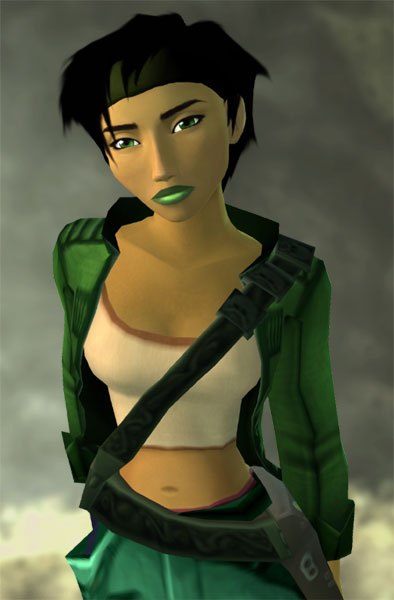
    Jade from Beyond Good & Evil
    Jade from Beyond Good & Evil

    While those developers who have at least made the attempt to be more inclusive should be acknowledged, it is more important to point out where more work needs to be done.  I am almost six years late in discussing the case of Jade from Beyond Good & Evil, but an interesting post by Jason over at Microscopiq brought the issue to my attention.  The post discusses the “first 11 black video game stars”, specifically those characters of visible African descent who were not only featured in games, but were the main character.  Jade was amongst those mentioned. 

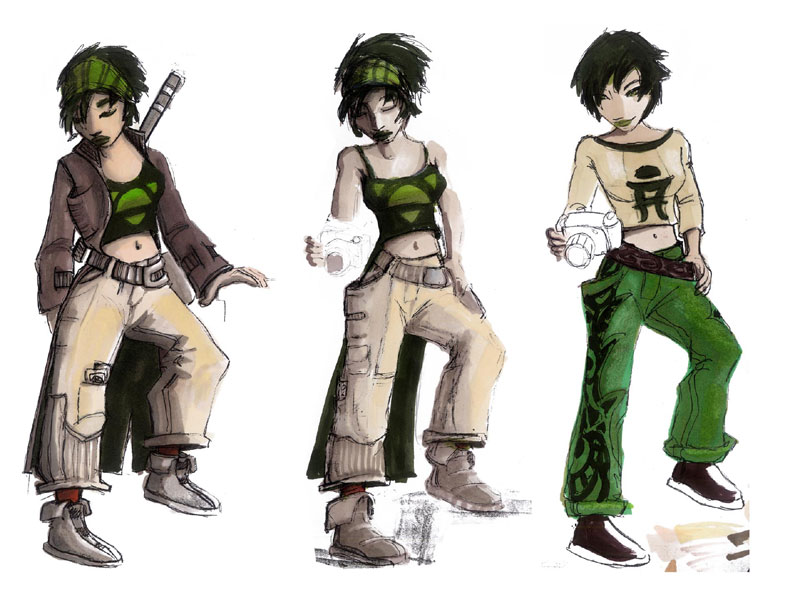
    At a glance, some – if not most – people would question whether or not Jade qualifies as “black” in any sense.  Arguments could be made for virtually any ethnicity as her appearance is quite ambiguous.  The only solid support for Jade being a “black” heroine is in looking at the original concept art, which featured some earlier renditions of Jade with either locks or braids in her hair, and features more commonly associated with certain peoples of Africa.

    Jade Concept Art

    From the concept stage to the final version, much was changed, and we have a character who could pass for virtually anything.

    There are many possible reasons for the change, such as wider market appeal, as an ethnically ambiguous character alienates no one.  It is also a truism that the mainstream beauty standard – set mostly by Americans and Europeans – is not inclusive of distinctively “non-white” features, particularly Africanesque features.  For marketing’s sake – and this literally could’ve been a decision made by marketing against the wishes of the original designer – Jade could have been altered to resonate more with the mainstream.  Looking at the final version, is it enough to say that Jade was intended to be “black” by the designer, or even that she is so in his/her mind, in order to claim her as such?  I would say that it isn’t.

    Jade’s ethnic ambiguity alone, however, is not enough to dismiss her from the ranks of black heroines.  After all, blackness is subjective, varying from place to place and culture to culture.  If we take it to be synonymous with “African”, then the ethnic diversity of that continent means that Jade could look like anything.  But here’s where we get to another important point.

    Jade is most certainly not African.  Because she is not even from this planet.  Beyond Good & Evil takes place on the fictional world of Hillys, where people like Jade are classified as “homo sapiens”, distinguished from other humanoid races such as “Capra Sapiens” (goat people), “Sus Sapiens” (pig people), and “Felis Sapiens” (cat people).  The concept of race that divides human populations on Earth simply does not exist on Hillys.  For that matter, there are no social divisions between any of the “Sapiens” – they are subclassified solely for the sake of compiling a photographic catalogue of all of the planet’s species.  That is to say, these distinctions are biological, and do not manifest at all in the culture of Hillys.

    This is an important point, because the meaning of “blackness” on planet Earth is defined mostly in a social context.  There are some vague overlaps into a biological context – some valid, particularly with regards to medicine, and some not – where genetics is cited incorrectly to support a social or political argument.  Without getting too much into the meaning of blackness, there is the experience of so-called “black people” to be considered, which historically, and with few exceptions, tends to be one of hardship, oppression, social inequality, prejudice, and even dehumanization.  This is particularly true of those peoples of Africa who were sold into slavery, and who even in the aftermath, have been forced to face social and economic oppression.

    Coming back to video games, what would be required for a character to be considered “black”?  Appearance could be one qualifier, but as we see in the case of Jade, this can become dubious due to the wide variety of physical characteristics that can be classified as “black”, a reflection of the extreme diversity to be found within such a vague and subjective category.

    The “black experience” could be another qualifier, as in a situation where a character is forced to face certain indignities, in spite of her ethnic ambiguity.  There are undoubtedly women who resemble Jade and who have been forced to endure such conditions.  In the United States, by way of the one-drop rule, it is common for a woman of fair skin to be deemed a “black” woman by virtue of her other features, and therefore share in the black experience.  Jade as she appears in Beyond Good and Evil, however, fails to meet either of these qualifiers.

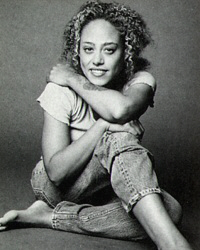
    Cree Summer
    Cree Summer

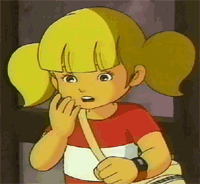
    The only remaining qualifier brings us back to the designer’s intent.  Without speaking to Michel Ancel or his art team, we cannot know which ethnicities inspired Jade’s appearance from original concept to final incarnation.  Perhaps then, we could derive clues from the voice actors chosen to play Jade.  We have to take this with a grain of salt, however, because the ethnicity of voice actors do not necessarily match those of their characters.  Cree Summer, who is African-American, is one of the most prolific voice actors in the field, and because her voice does not invoke any particular ethnicity, she has been tapped to play a wide range of characters – most of which are not African-American or “black” in any sense.  She got her start playing Penny from Inspector Gadget.

    Penny
    Penny from Inspector Gadget

    What this suggests about the willingness of game producers to cast black actors for their voices versus their willingness to craft black roles may be another subject worth exploring.  As for Jade, since the game was released in different languages, she was played by several different voice actors.  But with respect to how Jade’s voice corresponds to her ethnicity in the mind of the developer, we should take a look at the actor closest to the developers  – Ubisoft Montreal – which would be the one cast for Jade’s French voice.  Her name is Emma de Caunes, and thanks to the artist John Karp, we can see her picture below modified to resemble Jade.

    Emma de Caunes as Jade

    Even had Jade’s voice actress been of any French-African ethnicity, it would’ve been a stretch to therefore consider the character as being of any African ethnicity.  The example of Cree Summer demonstrates the distance between the identities of voice actors and their characters.  In any case, Emma de Caunes is not of any visible African descent, and therefore we cannot use her ethnicity as a case for Jade’s “blackness”.

    This brings me to my final point about Jade, which is that in spite of the developer’s original intent, any ethnic inspiration for the character, how Jade is perceived by her audience may be even more important.  By looking at a few random samples of fan-created art for Jade, we can gain some insight into how others perceive her ethnicity. An extensive spread of Jade fan art can be seen at the deviantART Beyond Good & Evil Fan Club, where not one rendition depicts Jade with Africanesque features.

    Because an artist’s work will necessarily be based in part on their personal experiences, and probably in some way reflect the artist him or herself, it stands to reason that the artist’s own ethnicity may factor into how they depict a character. What we see is that in spite of the varied ethnicities of the artists, not one of them depicted Jade with features any more distinctively Africanesque than what we see in the official Ubisoft rendition. Had these artists had even an inkling that the developer intended Jade to be “black”, then it may have been more likely that we would have seen that understanding reflected in their work.

    While we cannot discount the possibility that Jade’s features would’ve been “de-ethnicized” even had she been more clearly Africanesque – as is common amongst fan artists of Storm from Marvel Comics – we can at least say that nothing about Jade seems to encourage fans to depict her as “black”.

    So in the end, based on overwhelming evidence, we are forced to conclude that Jade from Beyond Good & Evil is not “black” in any sense of the word.  For the reasons discussed above about how races are defined, and how they do not correspond to any human categorization on the planet Hillys, she cannot accurately be considered “white”, “Asian” or any other race/ethnicity from Earth.  She can only barely be classified as human, being a “homo sapien”, but those who have played the game also know that she is a little something more.  I’d like to count Jade amongst “black” female protagonists in video games, due to the fact that there are otherwise none, but doing so actually sets a weak precedent.

    It is not enough to be inspired by Africanesque features, only to see that inspiration disappear for the sake of market appeal.  And it is regressive, if not plain insulting, to create a character of color – in terms of background and appearance – only to completely undo it in a future incarnation, as in the deplorable example of Vanessa Lewis from Virtua Fighter.  Note the lighter skin, thinner lips, altered facial structure, and reduced hips from the Virtua Fighter 4 version (background) to the Virtua Fighter 5 version (foreground).

    (Vanessa Lewis | Background: VF4 Foreground: VF5)

    As technology improves, and as the content of games expands in terms of breadth and depth, opportunities only increase for representing diversity.  In the future, it will not be enough for a character to have darker skin, thicker lips, or a different eye shape.  We will have to see different cultures and experiences represented as well.  This wouldn’t have to be a limitation with regards to restricting the game setting to Earth.

    After all, there is always interstellar or cross-dimensional travel.  There is also alternative history.  And already, plenty of creators have told stories of other worlds, only to draw inspiration from the experiences of the peoples of Earth, because doing so adds a certain richness and credibility.

    As I discussed in Ethnic Depictions in Video Games, there has been a want for protagonists of color with which gamers of color can identify.  If gamers cannot identify on a superficial level – i.e. by appearance, if they cannot identify on the basis of a common social experience, and if they cannot identify by way of voice, then there is little remaining to connect them to the character.  For most gamers this probably will not taint their experience with a game, as the lack of inclusive ethnic representation has become the norm.

    But there is certainly a call, albeit muted and scattered amongst the more thoughtful pockets of the gamer population, for game developers to be more inclusive in their thinking.

  • Pearl-Clutching, Stereotypes, and Ethnic Representation in Video Games

    The Escapist – an online publication best known for analyzing and discussing video games as a cultural phenomenon, rather than a mere form of entertainment, is currently discussing racial [in]sensitivity in games. The article Gangbangers, Victims, and Whores by Christina González, which discusses how Latinas are depicted in games, is a particularly insightful read.

    The timing for this week’s Escapist happens to coincide with a bill proposal in the New York State Assembly also taking aim at racial insensitivity in video games. Sponsored by Assemblyman Keith L.T. Wright, the bill seeks to:

    Prohibit the sale to minors of certain rated video games containing a rating that reflects content of various degrees of profanity, racist stereotypes or derogatory language, and/or actions toward a specific group of persons.

    While this bill may just be the latest in what seems to be an endless crusade on the part of the state of New York against the gaming industry, the concerns raised by Wright are legitimate. Race and ethnicity, and how they are depicted in video games, has been a point of contention ever since games started receiving serious consideration as media. One point that is often made – and that I have made myself – is that video games are severely lacking in hoisting non-white characters to the status of main protagonist.

    Those of us who are not white, but hope to identify with the characters we play in games the same as anyone, find the industry to be deficient.  At best we have had to settle for ethnically ambiguous characters, often in non-Earth settings, which while fulfilling an aesthetic need still leave players wanting for a more substantial connection.  When characters of non-European ethnicities are depicted in video games, it is true that they are often stereotypes.

    Barrett
    Barrett from Final Fantasy VII

    Part of the reason for this is that a large number of games come out of Japan, which being nearly homogeneous in terms of ethnicity, and insulated – both physically and culturally – may lack a strong frame of reference for depicting a diverse cast of characters.  Where the games are made in the Europe or the United States, where ethnic variety is more common, stereotypes may instead emerge as a consequence of one-dimensional writing.  Perhaps a developer cannot be bothered to do the research into all of the nuance and idiosyncrasies that rise from a character’s ethnic experiences.

    So Wright is valid in his concerns about racial stereotypes in that they not only leave players without a character with which to identify, but with a caricature that debases them or their culture.  Where I think Wright is wrong, however, is in thinking that the solution to the problem lies in more restrictive legislation.  Most games with racial stereotypes are also mature-rated games, and laws are already in place to protect minors from playing them.  The efficacy of these laws is questionable, and so simply imposing a second and redundant law is not likely to fix the situation.

    In my opinion, it’s necessary for lawmakers to start recognizing games themselves as an extension of culture, to place them within the general category of “the arts”.  Viewed that way, games may be held to a higher standard, as are film and literature.  Rather than restrict the sale of a game with objectionable material, perhaps it would be better to encourage developers to release material that is less objectionable, or that at least places it in its proper context.  For example, were game developers to be provided an incentive, such as an arts grant or tax subsidy, they may be more inclined to develop culturally relevant and accurate games.  Recognizing games as art could inspire more developers to create games as art, rather than simply to turn a profit.

    The restriction on mature-themed games, up to and including the blacklisting of anything receiving the “Adults Only” rating, has done nothing to stop younger players from experiencing them.  Even where parents are educated as to what’s out there and mindful of what their children are playing at home, they cannot monitor what their children are playing when they aren’t watching, or what they learn by proxy from peers who have played games with objectionable content.

    It would be more more effective to reward developers who perform admirably, who raise the bar in creating games as art, rather than punishing those who produce fluff.  The fluff will continue to exist, of course, because sometimes those games are just plain fun.  But they could be balanced by an increase in the alternative – games with real substance.

    Game developers could then take the time to craft characters and settings that are three-dimensional – in how they’re written as well as how they’re rendered.  Three-dimensions allow for dynamic characterization and provide room for development beyond stereotypes and caricatures.